Showing posts with label huffingington post. Show all posts

Thursday, July 29, 2010

The Empire State Building: A Beacon for Energy Efficiency - Op/Ed by Rep. Carolyn Maloney: The Huffington Post

Read original...


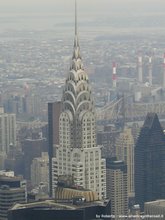
The Empire State Building is a New York City Landmark, a U.S. National Historic Landmark, and has also been named by the American Society of Civil Engineers as one of the Seven Wonders of the Modern World. In the years to come, I wouldn't be surprised if this great structure also became known as the most energy-efficient skyscraper in the world.

Standing at 1472 feet, and with 2.8 million square feet of leasable office space, the Empire State Building currently consumes the energy equivalent of 40,000 single-family homes.

Yesterday, I convened a hearing of the U.S. Congress Joint Economic Committee (JEC) and learned more about the Empire State Building's plans to completely change this -- to substantially reduce their energy consumption and do it in a way where the retrofitting costs would be completely recouped in 3 years. My colleagues -- both Democrats and Republicans -- were impressed.
Considerable attention has been placed on making homes, utility appliances and cars more energy efficient. Making the things we rely on each and every day use less energy is undoubtedly an important initiative that will not only reduce our energy consumption, but also create jobs. In the Recovery Act, for example, $5 billion was included to weatherize homes -- money that is paying contractors and their employees to reduce homeowners' energy bills by making homes more energy efficient.

In total, the Recovery Act included over $90 billion for clean energy, the largest clean energy investment in our nation's history. The law provides a range of clean energy economy investments including innovation and job training.

These federal dollars have been instrumental in driving private sector projects and progress. For example, $46 billion of the Recovery Act's clean-energy investments are leveraged investments, which support an additional $100 billion in private sector clean energy commitments. This money will be used to fund energy technology projects that have the potential to completely reshape how we fuel our day-to-day lives. Or, as President Obama's team explains it, "Ultimately, the investments could help transform the United States into a global clean energy leader."

While these endeavors are important, in major cities across our country, it is commercial buildings that consume the most energy. As Anthony Malkin of the Empire State Building explained in Washington, D.C. yesterday during the JEC hearing, in New York City, "80% of the energy consumed is consumed by buildings. 20% of the buildings consume 80% of that energy." In simple terms, what this means is that big commercial buildings are the City's biggest energy consumers.

The Empire State Building is leading the effort to change this right now. The Empire State Building retrofit will deliver improved windows, high-efficiency light bulbs, and among many other things, renovated heating and cooling systems at a cost of $13 million after netting out other savings. By 2013, this plan will have reduced the Empire State Building's energy usage by 40%. The $4.4 million in annual energy savings will have completely paid for the costs of the retrofit project 3 years after completion.

One of the reasons I convened this hearing was to identify innovative ways to promote a clean energy economy and at the same time help create jobs. Three key points arose from the hearing.

First, energy efficiency does not have to just be a decision to save the planet, it is also makes good business sense. Business owners can save an enormous amount of money in energy costs by retrofitting.

Second, if we want to make real progress in reducing greenhouse gas emissions, we must concentrate on the biggest energy consumers and that is big buildings that exist today.

Third, government has a role to play in shining a spotlight on the economic, environmental and consumer benefits of retrofits, but it is the private and non-profit sectors that will roll up their sleeves, nail down the economics and make these retrofits happen.

Each year, the Empire State Building attracts more than 3.5 million visitors who come to see the New York City sights from the highest point in our city. I am confident that it will attract even more visitors in the near future -- visitors interested in learning how cities and buildings like the Empire State Building can provide a beacon to a more energy-efficient future.

Congresswoman Carolyn B. Maloney represents parts of Queens and Manhattan in the U.S. House of Representatives where she is the Chair of the U.S. Congress Joint Economic Committee.

Saturday, July 24, 2010

What Edward Norton Should Know for the UN's Biodiversity Summit by Marielle Anzelone - The Huffington Post

Read an excellent article from my friend, Marielle Anzelone in The Huffington Post...She's Co-founder and Executive Director of NYC Wildflower Week...

Read original...


Actor Edward Norton is unhappy. He is miffed because although he had starred as The Hulk in an earlier movie, he was not cast as the great green hero in a follow-up film. Cheer up, Ed! You've landed an even greener role: United Nations' Biodiversity Ambassador. As the former botanist for New York City, I know first-hand the importance of biodiversity. In fact, I'll be hosting international diplomats on a tour of New York's nature this fall for the UN's Biodiversity Summit. Since we're going to be colleagues, I'd like to help you prepare for your new role. Here are some things you should know.

Urban nature exists. Most people embrace Kurt Vonnegut's description of the Big Apple as a "Skyscraper National Park". While accurate at 51st Street and 7th Avenue, it obscures the fact that there is bona fide nature in the five boroughs, even in Manhattan. New York City has more open space than Los Angeles and Chicago combined. These 53,000 acres include towering forests, vibrant marshes and grassland meadows. The world looks increasingly like New York, with more people now living in urban settings than rural areas. The city's 8 million residents are drafting a blueprint for biodiversity from which global lessons can be learned.

Clean air isn't free.
Local biodiversity provides us with fresh air to breathe and pure water to drink. Humans benefit from abated floodwaters and the pollination of food crops. Nature provides these ecosystem services for free, but there is clearly a price to be paid for their loss. Purifying contaminated water costs money. Recently a study commissioned by the New Jersey Department of Environmental Protection determined that natural ecosystems provided benefits worth $18 billion per year, equal to the state's construction industry.

Charismatic megafauna are attention-grabbers.
A few years ago, New Yorkers went cuckoo over Pale Male, a red-tailed hawk in Manhattan. His mate Lola had a nest on a tony apartment building across from Central Park. The management of the building found it messy and wanted to take the nest down. The public was having none of this. There was a giant outcry, with plenty of media coverage and dozens of protesters carrying placards. The birds won. This outcome is wonderful for the flashier elements of nature, but what about organisms incapable of garnering any attention for themselves?

Plant blindness is real. People barely notice plants or even realize they are alive! Most see native vegetation as the green backdrop to their outdoor forays. At the same time as the Pale Male controversy, scientists rediscovered Torrey's mountainmint on Staten Island. This globally-rare plant was inconveniently located on land threatened with development. Despite being only one of 20 known populations in the world, there was no public outcry. Bulldozers rolled in and the strip mall was built. Today the mountainmint lives in a sad, garbage-filled strip along a roadside. Its future is precarious. Without a large fan base, our native plants may survive only as photographs.

Extinction is quiet. Dramatic events such as fires, hurricanes and even oil spills have gross negative consequences, but extinction usually is not one of them. Most native plants and animals are lost to quiet, everyday events. The destruction of red maple swamp forests cut down for ball fields and the introduction of invasive garlic mustard seeds from mountain bikes destroy and degrade the places where biodiversity lives. Even parkland is not safe when parking lots, public works, and active recreational pursuits trump preservation of wild spaces.

Nature is good for you. More intangibly but no less important, biodiversity enhances the quality of our lives, providing scenic vistas and shady spots for picnics. Research shows that being in nature lowers stress, boosts immunity, and heightens creativity. The "tonic of wilderness" was well documented before Henry David Thoreau wrote about it. Yet it is difficult for people to understand the benefit of open space conservation - how their individual well-being is fundamentally intertwined with the vast richness of the nature that is around them.

This is why we need you. Most folks think my line of work is interesting, but irrelevant to their everyday lives. People used to know the nature in their backyards, back when basic biology classes were taught regularly in schools. Now more children can identify the McDonald's logo than a white oak leaf.

What nature really needs, then, is your star power to help garner better publicity. Human beings grossly undervalue and ignore the importance of this biodiversity, their life support system. Your voice will amplify the work that we conservation biologists do, and help mitigate our struggles with popular perceptions. I wish you much success but would encourage you to not quit your day job.

Marielle Anzelone is an urban conservation biologist and Co-Founder and Executive Director of NYC Wildflower Week.

Sunday, July 4, 2010