Showing posts with label jack kerouac. Show all posts

Saturday, March 6, 2010

Kerouac Was Queens Recluse by Jason Antos - Queens Gazette

Read original...

Last week the Queens Gazette ran an article about a lecture given by Pat Fenton about author Jack Kerouac’s life in Queens. The article attracted the attention of Larry Myers, a playwright and associate professor of rhetoric and communication at St. John’s University, who has also been studying the prolific author and his movements, not only in Queens, but also around Greater New York and the country. Myers wrote an Off-Broadway play about Kerouac entitled, “Jack Kerouac, Christian.” which opened in 2009. Given a very strict Catholic upbringing, Kerouac would often paint depictions of Christ with a religious orientation.

The author of On the Road lived at 133-01 Cross Bay Blvd. in Ozone Park and 94-21 134th St. in Richmond Hill for a total of 12 years. It was the longest amount of time that Kerouac and his mother, Gabrielle, with whom he lived for a good portion of his life, ever stayed in one place.

“They were constantly on the move,” Myers said. “Jack and his mom would sometimes just pack up and leave because they could not pay the rent.”

The Queens period of Kerouac’s life has always been shrouded in mystery, simply because he never talked about it. However, the reasons for his silence are less significant than others might think.

“Kerouac kept quiet because nothing major ever happened to him while he was living there,” Myers said. “Gabrielle worked all day in a shoe factory in Brooklyn while he sat home and wrote. He was kind of a recluse.”

Although he lived a mainly uneventful existence in Queens, Kerouac had his moments. He was hospitalized not too far from his home in Ozone Park after having an attack of thrombophlebitis (inflammation of a vein caused by a blood clot) while walking with poet and friend Allen Ginsberg across the Brooklyn Bridge. Kerouac would go on to mentor Ginsberg by giving him lessons in his apartment on Cross Bay Boulevard, which was also the former home of actor John Garfield. It was in this home where Town and the City was written. Ginsberg and Kerouac would take many walks together around the city.

One day they stopped at the Atlantic Avenue overpass of the recently built Van Wyck Expressway. “It looks like a bowling alley of cars,” Kerouac observed.

July 17, 1947 was the day that Kerouac left Ozone Park for his trip across the country. This was one of several journeys that would come to shape his On The Road.

By January 1948, Kerouac rarely left Ozone Park for Manhattan or anywhere else. Whenever he was lonely or felt melancholy, he would write letters to Ginsberg. Most of the information about Kerouac in Queens comes from the correspondence between Ginsberg, Neal Cassady and himself.

On July 26, 1950, Kerouac, now living in Richmond Hill, wrote another draft of his book and entitled it Gone On The Road. This version would be one of many to be scrapped.

From 1952 through 1957, Kerouac continued traveling around the country and even made a trip to Mexico, writing poems. Kerouac lived with the Cassadys through the winter and into the spring of 1952. After leaving Queens in 1955, he went back to a succession of addresses.
Kerouac’s writing would become known as “beat” literature. He has been called the creator of the beat generation, an accolade that he detested. Kerouac meant “beat” to mean “beatific”, or the showing of joy and happiness.

The success of On The Road propelled Kerouac to legendary status. Some people compared him to Walt Whitman. Kerouac was also the inspiration for the television series “Route 66”, which aired on CBS from 1960 to 1964.

Despite his fame there was little fortune. Not all of his books were successes. He was also an alcoholic. When Kerouac died in 1969 at age 47 he had only $87 in his bank account.

Many celebrities make more money dead than when they were alive and Kerouac is no exception. The famous scroll of teletype paper on which he wrote On The Road was purchased by Indianapolis Colts owner Jim Irsay for $2.6 million.

“Kerouac’s family makes millions each year off his name.” Myers said. “He is bigger than James Dean.”

Saturday, November 7, 2009

Fenton Traces Kerouac’s Trail by Connor Adams Sheets - YourNabe.com

Read original...

Pat Fenton began to chase the ghost of Jack Kerouac across Queens in 1986.

From Ozone Park to Richmond Hill and the Van Wyck Expressway to Phil Rizzuto Park, he has followed the beloved writer’s footsteps throughout the borough the so-called father of the Beatgeneration inhabited for 12 years.

Fenton, now 68, first discovered Kerouac when he was a 17-year-old growing up in the hardscrabble Windsor Terrace neighborhood of Brooklyn, where he said young boys mostly aspired to careers as policemen or firemen, not writers.

At that young age, he read “On the Road,” the seminal Kerouac masterpiece, and was inspired. On a whim he and a friend followed their idol’s lead and took a short-lived drive from an Irish bar in New York to Chicago with a couple of girls, spurred on by Kerouac’s tales of open highways and wild America.

And Fenton has continued to pursue the essence of the deceased author for several decades through his writings as a part-time freelance journalist and playwright and his advocacy for a greater awareness of the importance of Queens in his life.

He formally started down the path toward becoming a Kerouac expert in 1986 by securing an assignment to freelance a story looking into Kerouac’s past in Queens for New York Newsday’s magazine.

His first dalliance as a bona fide Kerouac sleuth led him to Glen Patrick’s, an Ozone Park bar across from an apartment in which the writer once lived.

It was not a successful jaunt, seemingly confirming Fenton’s Newsday editor’s concern that Fenton would be unable to find enough information for a story about Kerouac in Queens.

“I went into the bar and they didn’t know who he was,” he said. “But I could imagine Jack Kerouac there playing shuffleboard.”

So Fenton kept at it, and his investigation soon led him to Columbia University’s rare document’s collections, where he spent eight hours poring through “a literary supermarket” of documents and correspondence which revealed his local history. “After those eight hours, when I was on my way back downtown, I felt like I saw Jack Kerouac’s life passing before my eyes like in a penny arcade,” he said. “And I felt like I’ve got to follow this and see where it takes me.”


So for more than 20 years he has criss-crossed Queens, drawing from conversations with the author’s relatives and friends, such as poet Allen Ginsberg and composer David Amram, as well as the texts of his writings, to put together a narrative to explain Kerouac’s place in the borough’s history — and its in his.

For years he has led people on free tours of southern Queens sites of prominence in the author’s life, a task he says he would like to pass on to a new guide.

He has petitioned the city to assist with posting plaques at the locations, so a new generation can take the tour once he can no longer lead them. “If he can make someone who’s a year away from 80 and who knew Kerouac feel enlightened and interested, imagine what he can do for a young schoolchild or someone who loves Kerouac and didn’t know he lived in Queens,” Amram said.

Reach reporter Connor Adams Sheets by e-mail at csheets@cnglocal.com or by phone at 718-229-0300, Ext. 138.

Monday, June 1, 2009

Preservationists Push for Ozone Park Site Where Jack Kerouac Planned 'On the Road' to Be Landmark by Nicholas Hirshon - NY Daily News

Read original...


The Queens Historical Society will run a guided trolley trek past seven sites, including Kerouac's Cross Bay Blvd. apartment, on Sunday. Above, the apartment where Kerouac lived for 6 years. Ward for News

Preservationists are capitalizing on a tour of endangered Queens historic sites - inspired by a Daily News series - to push for landmarking of the Ozone Park walkup where Jack Kerouac planned his iconic 1957 novel "On the Road."

The Queens Historical Society will run a guided trolley trek past seven sites, including Kerouac's Cross Bay Blvd. apartment, on Sunday. The tour will be followed by an hour-long talk about the voice of the Beat Generation.

On display at the society's Flushing base at 143-35 37th Ave. - where the tour will depart at 1 p.m. - are rare artifacts and photos relating to Kerouac, alongside parts of The News' "History in Peril" series, which ran last year.

Kerouac scholar Patrick Fenton, who will lecture Sunday about how the author's work was shaped by living in Ozone Park during the 1940s, slammed the city for not landmarking the site.

"They don't really know the history of Jack Kerouac in Queens," said Fenton, 68. "If they knew it, I think they'd run to his house to put a plaque up."

Fenton accused the city of anti-Queens bias by recently landmarking the childhood home of novelist Henry Miller as part of a historic district in Williamsburg, Brooklyn, before designating Kerouac's apartment.

Miller lived in the three-story brick building for less than a decade in the 1890s, leaving years before penning his signature works, "The Tropic of Cancer" and "The Tropic of Capricorn."

Kerouac, meanwhile, planned one of the most famous road trips in literary history at his mom's walkup in Ozone Park - and embarked on it from there in 1947.

Marisa Berman, the historical society's executive director, said the full slate of "History in Peril" tour stops merit landmarking "if a site with such a small connection to [Miller] is eligible."

A spokeswoman for the city Landmarks Preservation Commission - which is reviewing the Kerouac walkup - insisted the 29 rowhouses that compose the Williamsburg district were designated for architectural reasons.

"It most likely would have been included even if Henry Miller hadn't lived there," said spokeswoman Lisi de Bourbon.

Only five city landmarks were recognized solely for cultural significance - the designation that seems most fitting for the Kerouac home.

To get tickets for the tour, call the Queens Historical Society at (718) 939-0647.

nhirshon@nydailynews.com

Saturday, May 9, 2009

Saving Boro's 7 Wonders: Landmark Effort to Preserve News' 'History in Peril' Sites by Nicholas Hirshon - NY Daily News

Read original...

A Flushing museum is unveiling an exhibit and launching a series of tours and lectures on Sunday to push the city to landmark significant Queens sites profiled last year in the Daily News' History in Peril series.

The display at the Queens Historical Society at 143-35 37th Ave. will serve as the starting point for a 1 p.m. bus ride past seven structures from the series, followed by a cautionary tale about two lost icons from the 1939 World's Fair.

None of the seven structures - such as the former homes of writer Jack Kerouac, baseball icon Jackie Robinson and Malcolm X - have been designated landmarks, leaving them at risk of major alterations or even demolition.

"It's bringing to light a lot of places that have either been forgotten or people didn't know existed," said Danielle Hilkin, the society's outreach coordinator.

Lisi de Bourbon, a spokeswoman for the city Landmarks Preservation Commission, promised to alert the panel's 11 members about the exhibit, tours and lectures.

The exhibit, which will run through September. will be accompanied by three tours, held the last Sundays of April, May and June.

The post-tour talk on May 31 will focus on Kerouac, who lived in Ozone Park in the 1940s, while the June 28 edition will highlight Woodhaven Lanes, a shuttered bowling alley in Glendale.

The exhibit features rare memorabilia like a bookshelf from a library where Kerouac planned his "On the Road" trip.

Also on display will be mementos from the 1939 and 1964 World's Fairs, both held in Flushing Meadows-Corona Park.

The 1939 collection includes pins depicting the iconic 610-foot-tall Trylon and 180-foot-wide Perisphere - which were demolished after the fair closed and will be the focus of Sunday's lecture by historian Pierre Montiel.

"People should realize Queens has a history," Montiel said. "If you keep tearing it all down, you won't really have a history."

The most prominent remaining structure from the 1939 fair is the New York City Building - also not landmarked - an early headquarters for the United Nations.

Other tour sites include the Ridgewood Theatre, which opened in 1916 and was the nation's longest continuously operating movie house until it closed in March 2008.

To RSVP for the tours, call the Queens Historical Society at (718) 939-0647, extension 17.

Tuesday, February 3, 2009

Following Kerouac's Road in Queens by Dennis Hamill - NY Daily News

Read original...

For decades, Pat Fenton has tried to put Jack Kerouac back on the road.

And now with an assist from the Queens Historical Society there will be a stop at Kerouac's former Ozone Park home as part of a historic spring trolley tour through Queens with other stops at the wedding site of W.E.B. DuBois in Addisleigh Park, Jackie Robinson's home also in Addisleigh Park, Malcolm X's home in East Elmhurst, the Woodhaven bowling lanes and more. Those tours will roll once a month beginning in March, running through May.

The stop at the former home of Kerouac, arguably the most celebrated writer to ever live and work in Queens, is due in large part to the tenacity of Kerouac aficionado Fenton, a retired Queens court officer, freelance journalist and playwright who meets me on the corner of 133rd St. and Cross Bay Blvd. in front of Glen Patrick's Pub and points to The Little House of Flowers across eight lanes of traffic.

"Kerouac was a soda jerk in that store in the '40s when it was a pharmacy," says Fenton. "His parents moved down from Lowell, Mass., looking for factory work, when he was 21 and just out of the Navy. He moved into their apartment upstairs. Jack used to drink in this bar, when it was called McNulty's, with Neal Cassady, novelist William Burroughs, and Allen Ginsberg, the beat poet who called Kerouac 'The Wizard of Ozone Park.'"

Fenton leads the way across Cross Bay Blvd. to the entrance to Kerouac's first New York home at 94-10 133rd Ave., on the first leg of a personal tour of not just this historic site but Jack Kerouac's Queens.

"Kerouac lived here from 1943 to 1949, and wrote his first book, 'The Town and the City,' here," says Fenton, who penned "Jack's Last Call: Say Goodbye to Kerouac," a terrific play that's been staged in Lowell and Boston, and on Long Island. It has been broadcast as a radio play on more than 50 public radio stations across America.

It begs for an Off-Broadway production.

Fenton points to the ghostly outline of a missing plaque on the wall.

"In 1996 I finally convinced the Historical Landmark Preservation Center to put a plaque on the wall of this building where Kerouac began writing 'On the Road,' the seminal novel of the Beat Generation," says Fenton.

The plaque was stolen last year.

"We're discussing replacing the missing plaque at Kerouac's Ozone Park residence with one of our historical Queensmarks," says Marisa Berman of the Queens Historical Society.

"For years I urged the previous Queens borough president's people to set plaques into the sidewalks outside Kerouac's two Queens homes, the basketball court where he often played, and the library where he researched 'On the Road,'" says Fenton. "Their response was that they didn't want to memorialize a drunk."


Fenton guides me down Cross Bay Blvd., pointing to the A train rumbling out of the Rockaway Blvd. stop. "Kerouac started his journey for 'On the Road' from this subway station," says Fenton. "He took the train toward Manhattan, somehow wound up in Bear Mountain, before returning to Port Authority and catching a bus to Chicago [on his way to Denver] to meet Neal Cassady."

We proceed to 95-16 101st Ave., once a library where "old silver-rimmed" librarians helped Kerouac map out his famous cross-country trek. Today, a Hispanic woman answers the door of Grace Evangelical Ministries. Asked if she knew that Jack Kerouac mined for literary gold inside, she said she never heard of him.

"There should be a plaque in the sidewalk outside," says Fenton. "It's amazing to me that a literary giant helped create a masterpiece here and that people walk by without ever knowing."

Soon, we are strolling across the deserted basketball courts of Phil Rizzuto Park in Richmond Hill. "Cassady and Kerouac used to play pick-up basketball games here all the time when it was still called Smokey Oval Park," says Fenton. "It's sad to me that we recognize a sports legend like Rizzuto but not a literary legend from the neighborhood."

After Kerouac's father died, he and his mother moved from Ozone Park to Richmond Hill. "Kerouac lived, wrote, played and drank in Richmond Hill for five years," says Fenton.

His address was 94-21 134th St., today a two-family house fortified with steel gates. "Kerouac rented this house from 1950 to 1955, and wrote 'Maggie Cassidy,' 'The Subterraneans' and 'Book of Dreams' here," says Fenton.

"Students come around asking about him," says the wary owner, after confronting strangers outside his house. "I guess he was famous but I never read him."

After "On the Road" was published in 1957, Kerouac moved to Northport, L.I., where he lived from 1958-64. "He hated the celebrity," Fenton says. "So he went out to live with the clam-diggers."

Kerouac died in St. Petersburg, Fla., in 1969.

"But his most prolific years as a writer were in Queens," says Fenton. "So I'm glad the Queens Historical Society plans to stop at Kerouac's Ozone Park home on their trolley tour. But I think the city should also embed plaques on a Jack Kerouac Literary Trail in the forgotten footsteps that this literary giant left in Queens."

Great idea.

dhamill@nydailynews.com

Wednesday, April 2, 2008

On the Road to Saving Two Kerouac Sites - By Nicholas Hirshon - NY Daily News

Read original...

View audio slideshow...

Poring over books and maps in his mom's Ozone Park apartment, Jack Kerouac planned the most famous road trip in literary history - and embarked on it in 1947.

But neither the walk-up where Kerouac plotted his cross-country exploits, nor a South Richmond Hill home where he worked on the classic novel "On the Road," are protected with city landmark status.

"Without question, they should be city landmarks. No book has captured the public imagination like 'On the Road,' " said Douglas Brinkley, a CBS News history analyst and Kerouac scholar.

To aid a landmark push, Indianapolis Colts owner Jim Irsay told Queens News he would consider loaning the original 120-foot "On the Road" manuscript - a unique, continuous scroll that he purchased for $2.4 million in 2001 - for display at the borough sites.

"You always consider putting it in a place where it's conceived," Irsay said. "The man has left the building, so to speak, but, at the same time, these places that are preserved, they mean a lot."

It's unknown whether the city Landmarks Preservation Commission has Kerouac's homes on its recent survey of 12,495 Queens structures. The commission has repeatedly declined to provide the survey to Queens News, fearing its release would alert developers to the sites before they can be protected.

Writer Patrick Fenton helped put a plaque outside the apartment in 1996 - just after the Lindenwood Volunteer Ambulance Corps moved in and gutted the space, without realizing its link to Kerouac.

"The organization would have tried to save more of the history if we knew," said Corps Chief Chris DeLuca. Still, the walls and door frames are original. "There's a lot of history up there," Fenton said.

In the early 1950s, Kerouac's mom moved to 94-21 134th St. in South Richmond Hill, where the author lived on and off over five years, and wrote "Maggie Cassidy," Fenton said.

The home's current owner, Lester Holt, arrived in 1984 and oversaw a major renovation. When told landmarking would require him to consult the commission before making more changes, he said, "I ain't interested in all of that."

But the next spot where Kerouac lived - a cottage in Orlando, Fla. - offers inspiration to preservationists. A grassroots effort saved it from destruction.

Kerouac was living there in 1957, when the publication of "On the Road" made him the voice of the Beat Generation. Forty years later, despite the home's history, it appeared destined for demolition.

Enter Florida book dealer Marty Cummins, who helped raise $10,000 for a down payment on the home in 1997. But he was short $100,000 to close the deal - until corporate titan Jeffrey Cole pledged the funds.

Now, the house is provided rent-free to writers for three-month stays. Cummins predicted a similar result in Queens.

"The key is finding an advocate or an angel backer who will step up to the plate," he said.

That could be Cole, the former chairman of Cole National, who promised to look into Kerouac's Queens homes. "It's always a good idea if some of these artists' and writers' places can be saved," Cole said.

[location: 94-10 133 Avenue, Ozone Park, NY 11417]

Sunday, August 26, 2007

Queens Chronicle - Bible Of Beat Generation Born In Queens by Colin Gustafson...

Queens Chronicle - Bible Of Beat Generation Born In Queens

In the five decades since “On the Road” first appeared in print, Jack Kerouac has proven troublingly elusive for any devotee searching for signs of the writer’s ghost in his old Queens haunts.

The novelist, who penned what would become the bible of the Beat Generation, lived for 12 years in Queens — spending six years with his mother and father in Ozone Park, then another six with his mother in Richmond Hill.

There, he not only wrote long portions of his famed travelogue, he also used Ozone Park — fictionalized as Paterson, N.J. — as the real-world departure point for his cross-country travels with counterculture icon Neal Cassidy (aka Dean Moriarty) in “On the Road.”

The borough is teeming with other reminders of his literary genius. Yet, walk into any Kerouac landmark today, and you’re likely to encounter anything from polite dismissals to blank stares upon mentioning his name.

“You want to know about Kerouac?” asked an employee in the flower shop that sits below the writer’s former Ozone Park apartment. “Plaque’s around the corner,” she said, pointing to the front door, which leads to a small wooden memorial hanging inconspicuously on the side of the building.

At the bar across Crossbay Boulevard, where Kerouac and his father used to drink together, one patron simply shrugged at questions about Kerouac. Another scoffed.

“That’s the type of reaction I just don’t understand,” said writer Patrick Fenton, when asked of Kerouac’s posthumous absence from his old stomping grounds. Fenton was responsible for getting the plaque erected in 1996, after spending years studying Keroauc’s connection to Queens.

“This is where he planned an incredible adventure, where he came up with this great American novel. Now, it’s like some people could care less.”

“A plaque,” he added, “isn’t enough.”

The only fitting memorial for the so-called “Wizard of Ozone Park,” he believes, would be an entire literary trail across Queens, replete with dozens of signposts detailing the real-life experiences Kerouac had at each location and fictionalized in his work.

Where would such a trail start?

Possibly at 133-01 Crossbay Blvd. There, Kerouac penned his first novel, “The Town and the City” in the “cursed kitchen” of his mom’s apartment where, just months before, he had witnessed his father succumb to stomach cancer. The home was also where Kerouac, at age 25, set out for San Francisco, Calif., on the first leg of the classic journey that later became the subject of his novel.

Kerouac lived with his mother, Gabrielle (fictionalized as his aunt in the book), on the second floor of what used to be a drugstore from 1943 to 1949.

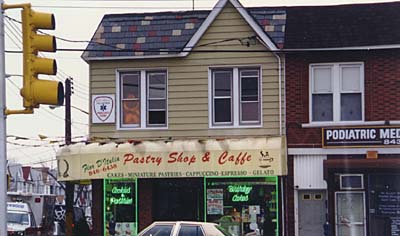
Today, the Ozone Park building is home to a flower shop and the Lindenwood Volunteer Ambulance Corps, which occupies the back rooms and top floors. The kitchen where Kerouac stayed up until dawn for weeks, writing “The Town and the City,” is now the emergency call center. The upper left window was his bedroom, and passers-by could often hear piano melodies pouring forth from the jazz-lover’s room on summer nights, according to Fenton.

“There were a lot of brilliant ideas hatched in that room,” he said.

Now, the only visible evidence of such brilliance is the wooden plaque outside.

Across the street is Glen Patrick’s Pub, formerly McNolte’s Tavern, where Kerouac used to spend evenings playing shuffleboard and drinking beer with his father. Old friends recalled how the family would eat Gabrielle’s French-Canadian stew at night. During dinner, the young writer would often run across the street to McNolte’s to have them fill a tea kettle with beer for her. Over drinks, Kerouac would then start reading from his latest manuscripts, Fenton said.

Today, the bar’s only memorial is also a creation of Fenton’s — a framed 1997 Newsday article he wrote, hung on a wall near the back door.

Shortly after his father’s death, Kerouac moved with his mother to 94-21 134th St. in Richmond Hill, where they lived for another five-or-so years.

With no breadwinner in the family, Gabrielle took work at a Brooklyn shoe factory — leaving Kerouac alone to entertain the “wild” writer friends she so often shunned and barred from her old apartment in Ozone Park.

One was Cassidy, who often came to play basketball in a nearby park. The pair could often be seen running down opposite sides of Atlantic Avenue, tossing a ball back and forth, diving into hedges.

Another regular was beat poet Allen Ginsberg, who used to join Kerouac on walks over to the Van Wyck Expressway, where the pair would stare down at the traffic, while discussing each other’s work.

According to Fenton, the author loathed the Van Wyck and often complained to Ginsberg about how it had ruined the neighborhood.

Perhaps that’s why Kerouac chose such an ugly location to set the final farewell between Moriarty and Sal Paradise (the author’s alter-ego).

Moriarty is incoherent and lost when Paradise abruptly leaves him standing near the corner of Atlantic Avenue and the Van Wyck, marking an abrupt end to their deep friendship. “I waved back,” Kerouac wrote. “Suddenly he bent to his life and walked quickly out of sight.”

No marker commemorates that spot, and Fenton believes no other place deserves it more.

“People need to know more about these places,” he said, as he listed the possible benefits of a literary trail. “For people who grew up here, it would be a point of pride. ... If you bring tourists here, it’s a way to make money.

“If you bring high school students and tell them what happened here in the book — and if that inspires just one kid to become a writer, that’s perfect.”

Thursday, August 9, 2007

TheTorontoStar.com: On the (wrong) road with Jack Kerouac

Read original...

As he set out, albeit unwittingly, to change the literary landscape, Jack Kerouac started off by going the wrong way.

Sixty years ago this month – July 17, 1947, to be exact – Kerouac, then 25, left his mother's house in the Ozone Park district of Queens, New York, on the first of four treks around the United States and into Mexico that would lead to the publication 10 years later of his autobiographical novel On The Road.

September will mark the book's half century. It remains a steady seller. Biographies and critical studies of the father of the Beat Generation appear regularly. Kerouac, who was already developing a drinking problem when he hit the highways, died in 1969, aged 47.

As he tells it in On The Road, he'd been "poring over maps" and thought he'd hitchhike to the West Coast along "one long red line called Route 6 that led from the tip of Cape Cod clear to Ely, Nevada, and there dipped down to Los Angeles... To get to 6, I had to go up to Bear Mountain."

Kerouac took the 7th Ave. subway to the end of the line at 242nd St. and then a trolley to Yonkers. "Five scattered rides" took him to Bear Mountain, where it began to rain "in torrents... I began crying and swearing and socking myself on the head for being such a damn fool... I looked like a maniac, of course, with my hair all wet, my shoes sopping. My shoes, damn fool that I am, were Mexican huaraches, plant-like sieves not fit for the rainly night of America and the raw road night."

He got a lift south with someone who told him, "There's no traffic passes through 6. If you want to go to Chicago you'd be better going across the Holland Tunnel in New York and head for Pittsburgh...

"And I swore I'd be in Chicago tomorrow, and made sure of that, taking a bus to Chicago, spending most of my money, and didn't give a damn, just as long as I'd be in Chicago tomorrow."

It was a rocky start to an odyssey that would resonate through the years and put generations of beatniks, hippies, call them what you will, out there with hope in their hearts and faith in their thumbs.

Legend has it that Kerouac wrote On The Road in 1951, in three Benzedrine-fuelled weeks, with no margins or paragraphs, on a single scroll of paper almost 37 metres long. Certainly, such a scroll exists. It was bought in 2001 by Jim Irsay, owner of the Indianapolis Colts, for $2.4 million (U.S.). It's comprised of pieces of tracing paper taped together and was typed from the notebooks in which Kerouac had written segments of the book as they happened.

The manuscript went through several painful revisions, cuts and rejections before being accepted by Viking Press. To mark its anniversary, the original "scroll" version is being published in book form. Several excised scenes, involving sex and drugs, have been restored.

By the time his book appeared, Kerouac was a sadder, wiser man who never came to terms with what he'd wrought. Or with the teenagers who would show up on his doorstep and wonder why he didn't want to go wandering with them.

They'd have done better seeking out Neal Cassady, the basis for Dean Moriarty in On The Road, and who, until his death in 1968, never really came off it.

Monday, July 16, 2007

Boston Globe & NY Times: Jack Kerouac - Retracing 'On the Road' 50 years Later...

Boston Globe: Retracing 'On the Road' 50 years Later...

Chapter 1 - Lowell, Mass

Chapter 2 - Iowa and Nebraska

Chapter 3 - Wyoming, Utah and Nevada

Chapter 4 - California


NY Times: When ‘On the Road’ Was ‘On the Subway’ by Mitch Keller...

SIXTY years ago this week, Jackie Robinson was playing his historic first season with the Dodgers, the Yankees finally lost after 19 straight victories and Perry Como topped the Billboard charts with “Chi-Baba, Chi-Baba (My Bambino Go to Sleep).” Reports had recently come out of Roswell, N.M., that a rancher had found the wreckage of a flying saucer.
Associated Press - Jack Kerouac in 1962.

That Thursday, July 17, an unknown writer named Jack Kerouac, who loved baseball but preferred Charlie Parker to Perry Como and two-lane blacktops to outer space, left his mother’s apartment in Ozone Park, Queens, and set out on one of the best-known journeys in American literature. Then 25, he was heading west across the country in what became the opening trip in his classic novel of the Beat Generation, “On the Road.”

Kerouac experts like John Sampas, the executor of his estate, and the historian Douglas Brinkley say there is no record of Kerouac’s earliest movements that day. In all probability, though, his journey began at the elevated train station at Liberty Avenue and Rockaway Boulevard in Ozone Park. There, according to Joe Cunningham, a subway historian, he would have boarded a train consisting of six old wooden cars and taken it to Rockaway Avenue in Brooklyn. Then he would have transferred to the A train — which did not, at that time, extend to Ozone Park — and taken it into Manhattan.

By his own account in “On the Road,” Kerouac’s next train was the West Side IRT, which means he would have switched to it at Fulton Street, dropping another nickel into a coin box to activate the ponderous wooden arms of a 1940s-style IRT turnstile. Changing from the IND to the IRT cost an extra nickel in those days. Tokens were not yet in use, and it was still a year before the original nickel fare went up to a dime.

Kerouac’s immediate destination was 242nd Street/Van Cortlandt Park in the Bronx, his ultimate destination San Francisco. In a letter to a friend three months earlier, he had said, “My subject as a writer is of course America, and simply, I must know everything about it.”

Ten years later, when the book finally came out in September 1957 — its 50th anniversary is one of this year’s big literary events — Kerouac became a national celebrity.

To hip young Americans and others who loved the freedom and exuberance they found in his book and his new, loose, often jazzlike way of writing, Kerouac was a liberating hero. To his detractors, including many established reviewers, his book depicted what they saw as the decadence and perversity of the dope-smoking, hard-partying, rat-race-phobic Beat Generation, whose founding members, in addition to Kerouac, included the poet Allen Ginsberg and the writer William S. Burroughs.

At the time of his trip, Kerouac, who had grown up in Lowell, Mass., and dropped out of Columbia University, was working on his first novel, “The Town and the City,” which would be published in 1950. In “On the Road” the character of his mother was changed to an aunt, Ozone Park became Paterson, N.J., and the author gave himself the name Sal Paradise.

On his way to San Francisco, Kerouac planned to stop in Denver to see friends he had made in New York, most prominent among them Neal Cassady, a former juvenile delinquent who would become a counterculture demigod as the character Dean Moriarty in “On the Road.”

Kerouac had met Cassady late the previous year. The highly intelligent but educationally deprived son of a Denver hobo, Cassady had a turbocharged personality, manic energy, big-screen looks and, as a serial car thief and reform-school alumnus, a practiced eye for the main chance. He would exert an enormous influence on Kerouac’s writing.

The IRT subway car that Kerouac boarded that day in July was probably grimy black from the steel-on-steel dust that built up on subway cars in the years before mechanized washing, and was outfitted with yellowish rattan seats, overhead fans and functioning windows. According to Mr. Cunningham, it had probably been in service since before World War I.

KEROUAC’S train emerged from the underground part of its journey at Dyckman Street in Upper Manhattan, 11 stops from 96th Street, and traveled the remaining six stops on elevated tracks, as it does today. The view out the window was one Kerouac knew well: After graduating from Lowell High School in 1939, Kerouac, who came from a working-class family, had spent a year at the elite Horace Mann School for Boys in Riverdale, the Bronx, before enrolling at Columbia, and had made the long commute there each day from the home of his mother’s stepmother in Brooklyn.

Just before it crossed the Harlem River Ship Canal, the train took Kerouac past Columbia’s football stadium at Baker Field, a sight that almost certainly stirred some emotion in him. Kerouac had been an accomplished scholastic football player and had wanted to play for Columbia, but a broken leg his freshman year basically ruined that dream, a development that Ann Charters, one of Kerouac’s biographers, said “remained always a crushing personal defeat.”

In those days, the end of the subway line at 242nd Street and Broadway, adjacent to Van Cortlandt Park, was a busy trolley hub. Descending the stairs from the elevated station, Kerouac boarded a trolley and took it into Yonkers, then changed to another one and took it, in the words of Sal Paradise, “to the city limits on the east bank of the Hudson River.” Then he started hitchhiking up the Hudson.

What’s wrong with this picture?

Kerouac/Paradise wanted to go west, yet he was traveling due north. This was because Kerouac, in studying his maps, had liked the looks of “one long red line called Route 6” — U.S. Route 6, which runs from Provincetown, Mass., 3,000 miles west to California — and had settled on the idea of taking the road all the way to Denver.

Unfortunately, to pick up Route 6 he had to go up to the Bear Mountain Bridge, some 40 miles north of the city. Worse, once he got there he discovered that little traffic passed through that semi-wilderness, and while waiting futilely for a ride, he got drenched in a thunderstorm.

Enraged at himself, humiliated by his “stupid hearthside idea that it would be wonderful to follow one great red line across America,” Kerouac ended up taking a bus back to New York and then another one all the way to Chicago. In “Chi,” after he had rested up and “dug” the city, he took yet a third bus to the suburbs to escape the urban traffic, and finally began hitchhiking to Denver.

That November, Kerouac was back home in Ozone Park, working again on “The Town and the City” but now possessing lots of material for the book that would make his name. He lived 12 more years after “On the Road” appeared, dying in 1969 at age 47 from internal bleeding caused by years of stupendous drinking. His muse, Cassady, gave up his own tortured ghost in 1968 after being found unconscious beside some railroad tracks in Mexico, just shy of his 42nd birthday.

Sunday, July 8, 2007

NY Times: Kerouac Fans Stage Marathon Reading by The Associated Press...


Tribute to former Ozone Park Resident...

Photo from www.levity.com


BOULDER, Colo. (AP) -- Admirers of author Jack Kerouac celebrated the 50th anniversary of ''On the Road'' with a marathon reading of the novel.

Fans and some close friends of the late author took turns reading his most famous novel aloud at Naropa University in Boulder on Saturday. About 150 people listened to the cover-to-cover reading, which took 12 hours and kicked off the university's inaugural Kerouac Festival.

One of the most popular books ever written by an American, ''On the Road'' tells the story of Kerouac and a friend he calls Dean Moriarity as they travel the country, including a visit to Denver that the city celebrates with a tour that traces his steps.

The stream-of-consciousness novel helped generate the Beat Generation.