Showing posts with label lirr. Show all posts

Monday, January 24, 2011

Diesel Trains May Go Green by Joe Anuta - YourNabe.com

Read original...


EPA grant could cut pollution from two Glendale-bound locomotives


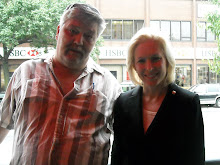
Glendale residents Abignew Marczak and his wife Barbara have complained about the pollution from trains in the neighborhood.


Two antiquated diesel trains that belch out clouds of pollution as they haul waste through Queens may get an environmentally friendly makeover if a federal grant is approved in the spring.

Several organizations partnered with the city and applied for a grant from the federal Environmental Protection Agency to outfit the two locomotives with more fuel-efficient engines that will reduce the emissions and pollution that are inhaled by Queens residents.

“We are just so thrilled, and it’s very gratifying that people have latched on to this idea of having a cleaner and greener neighborhood,” said Mary Parisen, co-chair of Civics United for Railroad Environmental Solutions, a collection of civic associations around the borough.

“This is a small step, but it’s in the right direction,” she said.

But the grants must still be approved by the EPA for its 2011 budget, and if actually selected in March, the outlays are scheduled to begin in May and be completed in October 2012.

“We’re really hoping that this grant does come through in March,” Parisen said.

The first grant would be used to refurbish a 1980s locomotive owned by CSX Transportation. The train now transports garbage from a station in the Bronx through Astoria, Jackson Heights, Woodside, Elmhurst, Maspeth, Middle Village and Ridgewood before terminating in Glendale.

The new engine will actually be comprised of three smaller engines, which will allow the locomotive to use them in stages and thus conserve fuel and curb emissions..

Nitrogen oxide, a pollutant released into the atmosphere by the locomotive, will be reduced by 20 tons annually, which is 76 percent. And particulate matter will be reduced by 0.21 tons.

The total grant will cost about $1.8 million, with $1 million coming from the EPA and the rest from CSX Transportation.


The second grant will be used to rebuild a 1973 New York & Atlantic Railway locomotive using a similar technique. That train carries waste from its Fresh Pond base in Glendale through Middle Village, Ridgewood, Maspeth, Blissville and Long Island City and also goes into Brooklyn.


The refurbished locomotive will cut fuel usage by 50 percent, and cut 1.1 tons of nitrogen oxide annually, but 20 tons over the project’s 18-year lifetime. It will reduce particulate matter by 0.44 tons.

The project will cost about $2.5 million, with $1 million coming from the EPA and a majority of the remaining funds from Waste Management Inc., the company employed by the city to move garbage into landfills.

The grant from the EPA is part of the agency’s National Clean Diesel Funding Assistance Program, which aims to make rail travel more green.

The project is especially pertinent for Queens, according to the grant, which said the borough has child asthma rates well above the national average.

That is exactly why CURES had been advocating for reform on how railroads operate in urban neighborhoods in the borough, according to Parisen, and they still have a long way to go. People in the Glendale neighborhood complain that the smell of diesel fuel and the pollution are so strong that they have trouble staying outside for extended periods of time.

But Parisen also recognizes it as a positive development.

“Don’t look a gift horse in the mouth,” Parisen said. “We’re grateful that it’s a start.”

And it is a start for the city as well.

“Repowering the entire NY&A locomotive fleet is the ultimate goal of the city of New York,” the grant said.

But the one NY&A locomotive that is included in the grant is only one of 10 total trains. The other nine are owned by the Long Island Rail Road and were not given permission for this particular upgrade.

The grants enjoyed the support of a gaggle of politicians, nonprofits and even Mayor Michael Bloomberg. It was written by the city Economic Development Corp.

Monday, January 17, 2011

Assembly Member Miller, City Council Member Crowley, LIRR Clean Up Graffiti in Glendale

Aim to Restore Quality of Life in Glendale

Assemblyman Miller pointing to a recently repainted trestle on Otto Road.

Assemblyman Mike Miller and Council Member Elizabeth Crowley (D-Queens) have begun several programs to keep the rail clean for the community. There is already progress on the New York and Atlantic Railway line running through Glendale and Ridgewood. This effort is a response to complaints from local residents regarding unsightly graffiti on the train trestles.

People should not have to live with gang graffiti in their neighborhood and I am proud to announce that the graffiti along the rail trestles has been painted over” Assemblyman Miller said. “I am committed to preserving the quality of life in this community and I am glad to say that I have finally gotten this done. I will continue to work with the Long Island Railroad to ensure that any future incident is handled in a timely manner.”

"I commend our community members for coming together and taking it upon themselves to organize neighborhood clean ups and beautification efforts," said Council Member Elizabeth Crowley (D-30, Queens). "Sometimes small changes make big differences and I am pleased that the LIRR, New York and Atlantic Railway and the DSNY are stepping up their efforts to join local residents in cleaning up our community."

Assemblyman Miller continued, “In addition, in working with Senator Addabbo, Assemblyman Andrew Hevesi, Council Member Elizabeth Crowley, the Rail Company and Citizens United for Rail Environmental Solutions (CURES), we are still working on fixing many more issues with sanitation to increase the frequency of trash pick up and vermin eradication under the trestles, and we have begun working with organizations for the homeless that has agreed to house any indigents who are living in the area.”

Anyone who witnesses any crime of trash dumping, graffiti spraying, or anything else related to the train trestles is being asked to notify Assemblyman Mike Miller’s office at 718-805-0950. 

Friday, July 30, 2010

NYPD: Man Killed by LIRR Train in Flushing - Newsday

Read original...

 Emergency vehicles respond at the Broadway stop on the LIRR in Flushing, N.Y., where a man was struck by a train according to New York City police. Photo credit: Adam Abramson


A man was struck and killed by an LIRR train in Flushing on the Port Washington line, according to New York City police.

The incident occurred at the Broadway station late in the evening rush, and at least a dozen emergency vehicles responded to the scene.

There are 10 to 15 minute delays in both directions on the line, according to the Long Island Rail Road website.

Friday, July 2, 2010

Bloomberg Can Make Slight Improvements, but City Hall Doesn't Have Money, Power to Improve Transit by Adam Lisberg - NY Daily News

Mayor Bloomberg misled the public about transportation matters during mayoral campaign...He made promises he knew he couldn't keep...But what else is new..?

Read original...


New Yorkers can mull Mayor Bloomberg's campaign promises as they are forced to settle for longer commutes after N, W train cuts. Lombard for News

New York wakes up this morning with two fewer subway lines, 36 fewer bus routes, longer waits and more crowded rides all across town.

Perhaps you can use the extra time on your commute to think about how Mayor Bloomberg promised you free crosstown buses last summer.

It was the splashiest part of his 34-point transit plan: He said most riders on the M50 and other crosstown routes use free transfers off another bus or subway, so charging them was a waste of time.

"The lost revenue is trivial," he said. "We've done the survey."

The mayor promised more: The F train would start running express on unused tracks again. Three closed LIRR stations in Queens would reopen. Staten Island would get a train line on the North Shore.

A year later, none of that has come true. The MTA doesn't have enough money to keep all its trains and buses running, much less expand them or let people ride them for free.

One insider says Bloomberg's city staff never thought free buses could work, even as the campaign staff ran with it.

"That was the laugher," he said. "He had to know it was a joke. Nice campaign fodder, though."

Other parts of Bloomberg's plan are coming true. Most of them were already underway at the MTA, or can be done with minimal cost to the city, but they're real.

Countdown clocks have been arriving in subway stations along the 4-5-6 line. New high-speed bus routes are coming to First and Second Aves. Bloomberg has no control over the MTA, but gets along well with new MTA boss Jay Walder.

Just last week, Bloomberg jump-started his campaign pledge for expanded commuter van service, starting in neighborhoods hit by the MTA's service cuts.

New Deputy Mayor Stephen Goldsmith, who privatized buses when he was mayor of Indianapolis, tweeted the next night: "Looking for all good ideas to improve NYC service levels."

The big things take money, however - money the city and the MTA don't have.

When a Staten Islander asked Bloomberg a few weeks ago if he could help with the bus cuts, the mayor brushed him off and said his hands were tied.

"You are getting the short end of the stick, and you should be out there screaming," Bloomberg said. "I don't know what else to tell you."

It was an admission of reality: City Hall can work on the margins to make life easier for straphangers, but it doesn't have the money or power for big transit changes.

That shouldn't surprise anyone in New York - unless they believed what Bloomberg promised them last year.

Saturday, May 8, 2010

The Stink Train by Robert Pozarycki - www.timesnewsweekly.com - Times Newsweekly

Read original...

Civic Coalition Calls For End To Rail Noise, Odors

More than 100 residents and civic activists took part in a march through Glendale and Ridgewood last Saturday, Apr. 24, organized by Civics United for Railroad and Environmental Solutions (CURES) in an effort to call attention to quality-of-life problems caused by local freight rail traffic. The march started at the corner of 69th Street and Otto Road and proceeded to Mafera Park in Ridgewood, where a press conference was held regarding legislation aimed at forcing rail companies to seal container cars filled with rotting trash.

Fed up with loud noise and noxious fumes emanated by
local freight rail traffic, scores of residents took to the streets of Ridgewood and Glendale last Saturday morning, Apr. 24, calling for train reforms which they hope will improve their quality of life.

More than 100 residents, civic leaders and elected officials turned out for the event organized by Civics United for Railroad and Environmental Solutions (CURES) to support efforts to reform freight operations along rail lines running through both neighborhoods as well as Maspeth and Middle Village.

Starting with a march from the intersection of 69th Street and Otto Road in Glendale to Mafera Park in Ridgewood and ending with a press conference and cleanup, participants carried banners and offered chants urging local rail companies to change the way they operate in the area, including ending noisy overnight operations, sealing container cars full of rotting garbage and retrofitting diesel locomotives with fuel-efficient hybrid engines.

The CURES coalition, which is comprised of more than a dozen community groups in the Community Board 5 area, was formed late last year in response to numerous complaints that arose from residents around Ridgewood, Glendale, Maspeth and Middle Village regarding local train lines in each neighborhood.

Among the civic groups taking part in CURES which were represented at the rally include the Citizens for a Better Ridgewood, Farmers Oval Civic Association, Glendale Civic Association, Glendale Property Owners Association, Juniper Park Civic Association, Liberty Park Home Owners Association and the Maspeth West End Block Association.

Leading the charge was Glendale resident Mary Parisen, who co-chairs CURES along with her neighbor Mary Arnold. Parisen spoke of a host of problems related to the hauling of container cars full of rotting household garbage through local communities along lines operated by the New York and Atlantic Railway (NYA) and CSX.

As previously reported in this newspaper, local residents have complained over recent months about the unpleasant aroma of putrefying garbage in cars stored—sometimes for many hours—along the CSX line heading northbound from the Fresh Pond Railyard in Glendale through Middle Village. The noxious odors, neighbors living near the tracks claimed, have made it nearly impossible to leave their windows open during warm weather or stand outside without feeling nauseated.

Arnold told the Times Newsweekly the quality of life problems related to train traffic are also forcing residents to leave the community. She noted that some landlords have a difficult time renting their properties to prospective tenants since they are located close to local rail lines.

Changing the locomotives

Following last Saturday’s rally, CURES members were informed by the New York and Atlantic Railway (NYA), which operates out of the Fresh Pond Railyard in Glendale, will upgrade its fleet of 11 locomotives with equipment designed to reduce their emissions. The $1 million effort will reportedly be funded through a grant from the U.S. Department of Transportation’s Congestion Mitigation and Air Quality program.

“It’s an improvement,” according to a CURES statement regarding the NYA plan, which noted that the U.S. Environmental Protection Administration (EPA) “has gone on record to say that locomotive repowering is what we need to reduce diesel emissions.” Locomotive repowering would require the current diesel engines used by each locomotive to be replaced with engine designs that are more fuel efficient.

Click on images to enlarge...

“The NYA announcement is a very small step in addressing the quality of life problems of people living near the railroad tracks,” added Robert Holden, president of the Juniper Park Civic Association, which is part of the CURES coalition. “Lowering emissions on NYA locomotives by one-third is fine, but what about CSX locomotives which are the ones causing the problems in Middle Village? CSX and NYA are currently using the railroad track area in Middle Village as a rail yard and crews work on trains at 4 and 5 a.m.”

“Finding a quick solution to this unbearable air and noise pollution problem is our number one concern,” Holden concluded. “Middle Village residents finally getting a good night’s sleep would be a cause for a celebration.”

Sealing the stink train

Among those in attendance were Assemblyman Andrew Hevesi, who informed residents during the press conference that he has introduced several bills in the state legislature aimed at requiring freight operators to put hard lids atop cars containing putrescible waste, which would block foul odors from spreading to nearby homes.

Joining Hevesi at the conference were several other elected officials including Assemblyman Mike Miller, State Sen. Joseph Addabbo and City Council Member Elizabeth Crowley.

Hevesi touted the legislation he introduced into the State Assembly as a possible solution to the problem. In addition to a bill requiring all train companies to apply hard, impenetrable seals atop cars containing putrescible waste, he also authored a bill that would increase penalties against companies which ignore this requirement.

The assemblyman previously described the legislation at the JPCA’s Mar. 25 meeting in Middle Village. During the session, he informed residents that the proposed bills would force shipping companies to install the solid lids at waste management facilities, which are under state jurisdiction. Train yards and tracks fall under federal oversight and are exempt from state regulation under the Interstate Commerce Clause in the Constitution.

Arnold noted that the proposed legislation is “a step in the right direction,” adding that CURES would continue to work with local lawmakers and railroad operators to ensure that other reforms are implemented in the weeks and months ahead.

Thursday, January 21, 2010

Hevesi, Miller Pose New Law to Ban Noisy Trains by Jeremy Walsh - YourNabe.com

Read original...

State elected officials from the Glendale area are working on legislation to ban locomotives from idling near homes, the latest development in a clash between residents and a freight railroad operating in the neighborhood.

State Assemblyman Andrew Hevesi (D-Forest Hills) said he and Assemblyman Mike Miller (D-Glendale) were adapting the language from a bill introduced in March by Assemblyman Fred Thiele (R-Bridgehampton). That legislation would prohibit locomotives from idling for longer than 15 minutes when within 200 feet of a residence in Nassau and Suffolk counties. It made no progress during 2009 and was reintroduced Jan. 6.

Hevesi said there has been some question about whether such legislation would be constitutional because railroads are governed by the federal government.

“If the courts don’t like it, let’s have a court fight,” he told Community Board 5 last week.

Representatives from Civics United for Railroad Environmental Solutions, the group formed to pressure the New York & Atlantic Railway, praised the announcement.

“We are all so happy about the progress made by our local legislators,” CURES co-founder Mary Arnold said. But she had harsh words for the railroad’s recent contention that a month of operations along its entire line from Queens out to Long Island burns less fuel than the boilers on a single block of homes in Glendale. She argued that all the railroad’s diesel locomotives date back to the 1970s and boast outdated technology.

“I don’t think anybody would be standing up and cheering about having a new automobile if they had a 1972 Chevy,” she said.

New York & Atlantic officials have said they have been working with the city Economic Development Corp. to get grants to replace the engines in their locomotives with high-tech, cleaner models.

CURES will hold its next meeting Jan. 28 at Borough Hall to discuss the solid waste issue. The so-called “garbage trains” have been an issue in the neighborhood since 2008, when Christ the King High School began to complain that trains loaded with garbage containers were being left on tracks near the school for hours waiting for the interstate railroad CSX to pick them up to take them out of the city.

The school sued the railroad and the two parties worked out an agreement whereby CSX changed its pickup schedule and the New York & Atlantic moved the rendezvous location further away from the high school.


*
The new arrangement has not sat well with neighbors further east on the tracks, however. Many complain of locomotives idling outside their homes at 5 a.m.

Thursday, November 5, 2009

Judge Questions Defense’s Statements in Seminerio Case by Anna Gustafson - Queens Campaigner

Read original...

After the attorney representing former state Assemblyman Anthony Seminerio argued that his client was a hardworking public servant who bent over backward for his constituents, U.S. District Judge Naomi Reice Buchwald expressed reservations about the defense’s statements.

“Someone who is elected is supposed to support his constituents without being paid more than his salary,” Buchwald said.

It was a phrase Buchwald frequently repeated several times throughout the defense’s daylong arguments at the Oct. 30 pre-sentencing hearing for Seminerio, a politician from Richmond Hill who pleaded guilty in June to taking money from Jamaica Hospital administrators in exchange for lobbying state health officials on their behalf.

“Mr. Seminerio admitted what he did was wrong, but it was not the full-fledged scheme the government alleges,” said Pery Krinsky, an attorney for Seminerio.

Krinsky spent the day in Manhattan federal court last Thursday refuting prosecutors’ statements that the former lawmaker created a sham consulting agency that he used as a bully pulpit to squeeze money out of such organizations as the Jamaica Chamber of Commerce and Long Island Rail Road.

Seminerio twice wrote to the state Ethics Committee, in 1996 and 2001, to advise them of Marc Consultants, his company, and he was advised that it was fine for him to make money as a consultant provided he did not make financial gain at the expense of the public nor advocate for state legislation that would exclusively benefit the groups or individuals who were paying him, Krinsky said. He therefore found nothing wrong with accepting money from a variety of Queens groups, according to his lawyer.

Prosecutors had said last week that Seminerio had accepted money from various organizations not as a consultant but rather as bribe money to help the groups by advocating for them in Albany.

“The government has said Mr. Seminerio provided no bona-fide services,” Krinsky said. “… Mr. Seminerio provided very real consulting services for very real clients. Mr. Seminerio did make introductions, did open doors for people.”

Buchwald, again, said she was not persuaded by the defense’s arguments.

“Making phone calls and opening doors seems to be a great deal of what elected officials are expected to do for their constituents,” Buchwald said.

The judge also asked whether Seminerio had any clients who were not constituents, to which Krinsky said there was one: Winston Financial.

Prosecutors charged that Seminerio extorted Jamaica Chamber of Commerce President Robert Richards in 1999. After Seminerio threatened he would squash any legislation that would help the chamber if Richards refused to become a client, the chamber president began paying Seminerio about $700 per month for so-called consulting fees, the government said.

Jo-Anne Rickert, Seminerio’s chief of staff, painted a different picture, saying Richards and Seminerio had a longstanding close relationship and that Richards would frequently spend all day in the former lawmaker’s Albany office.

“He came to our office every day,” Rickert said. “He read the paper, made phone calls, acted up with the girls. He’d spend the day with us .… He was so proud Tony was his daughter’s godfather.”

Rickert said she had not known during that time that the Jamaica Chamber of Commerce was a consulting client of Seminerio’s.

Krinsky also said that while a former LIRR administrator had told prosecutors that Seminerio “called the Long Island Rail Road more frequently than other politicians and tried to get people jobs,” the total number of people he tried to help was about five.

“In approximately an eight-year period, Mr. Seminerio called to assist people in obtaining jobs at the Long Island Rail Road,” Krinsky said. “He sought jobs for one to two of his constituents about every two years.”
Buchwald emphasized to defense attorneys that Seminerio had been caught on tape saying he expected to land jobs for people after finding state funding for the MTA subsidiary.

“Any time that I would give them a $250,000 contribution, or $500,000, for repairs on the rail in to here, I need two jobs,” Seminerio said about the LIRR to former Assemblyman Brian McLaughlin, who wore a wire at the request of the federal government, according to court transcripts, to reduce his own jail term for corruption. “Even if I didn’t have anybody, then I find two people and get them jobs.”

Saturday, June 6, 2009

LIRR Took Wrong Track Clearing Brush, Locals Say by Nicholas Hirshon - NY Daily News

Read original...

A Long Island Rail Road effort to clear brush that blocks passing trains in Forest Hills has devastated a plentiful array of trees and shrubs that added natural beauty to the urban landscape, angry locals charge.

The stretch of decimated plant life - along the north side of tracks parallel to Austin St. from 71st to 82nd Aves. - reminded residents of a 2007 LIRR sweep that turned mighty trees into mere stumps.

"I was really hoping to prevent the mass clearing," said Nate Grove, 36, who lives in an Ascan Ave. co-op. "There's no ground coverage, there's no saplings and limbs have been removed from big, healthy trees."

Beginning April 24, railroad officials sent about 1,250 notices to locals to warn they would soon remove overgrown trees and vegetation that "interfere with safety and train service reliability."

The letter from LIRR President Helena Williams said tree branches and limbs often grow into utility wires and obscure train crews' sightlines.

The LIRR also notified the local community board and the Forest Hills Gardens Corp., a private company that owns and maintains an exclusive enclave that borders in part on the tracks.

Grove met with LIRR brass on May 8, and said he left the meeting realizing the work would result in a different look than he wanted.

But he said he was shocked at the extent of the clearing, which started the week of May 11 and ended last Friday.

"I thought they could have been a lot more generous with leaving more coverage," he said.

Residents of the Tennis View Apartments, a two-building co-op near the tracks, said the destruction was like déjà vu of a brush-clearing push two years ago on the other side of 71st Ave.

"They cut down 100-year-old trees," co-op president James Versocki said. "There were other alternatives. They could have replaced [them] with evergreens."

Another Tennis View co-op owner, Edward McGinnis, griped that the trees cut down in 2007 had provided not only pleasant scenery but also a train noise barrier for the adjacent West Side Tennis Club.

But LIRR spokesman Salvatore Arena insisted the railroad made efforts "to preserve a tree buffer where possible," adding, "Safety is always our overriding concern."

Saturday, April 11, 2009

Amateur Sleuth Debunks Genovese Tale by Vladic Ravich - Queens Tribune

Read original...

The infamous story of Kitty Genovese defined the nation’s stereotype of the callous and dangerous nature of city crime. The national media picked up on a New York Times story that described the brutal murder of Catherine (Kitty) Genovese, who was stabbed by Winston Moseley after parking her car at the LIRR station in Kew Gardens.

The original story began: “For more than half an hour 38 respectable, law-abiding citizens in Queens watched a killer stalk and stab a woman in three separate attacks in Kew Gardens. Twice the sound of their voices and the sudden glow of their bedroom lights interrupted him and frightened him off. Each time he returned, sought her out and stabbed her again. Not one person telephoned the police during the assault; one witness called after the woman was dead.”

Local lawyer and amateur historian Joseph De May has pored over the case, including the media reports, the trial, and other subsequent research, to figure out exactly what happened that night. On his Web site, A Picture History of Kew Gardens, NY, De May addresses each piece of evidence to debunk the sensationalist coverage that has entered Queens history as fact.

“The problem here is that people were told a story that on its face seemed incredible,” said De May. “It contradicted everything they knew about each other and themselves. It never dawned on them that people who see and hear a murder simply do not get involved.”

“The popular notion is that people sat and watched or listened for a solid half hour as a woman was being murdered and didn’t want to get involved. That particular scenario did not occur. But it’s that notion that makes it a good story.”

De May researched the story by filing for legal briefs and transcripts from the killer’s trial. He also read a book by the main police investigator working on the case and then compared this evidence to the reporting that shocked the nation. “The first paragraph tells one story, the rest of the article and the photograph [in the original article] tell a different story,” said De May. “It was blatantly contradictory.”

At 3:20 a.m. on March 13, 1964, Winston Moseley chased Kitty Genovese onto Austin Street, near a bar known to generate loud noise late at night. Kitty screamed as she was beaten and stabbed by the assailant. It was a cold night and many residents were asleep with their windows closed.

Realizing that his car was parked and could be used to identify him, Moseley ran to it and backed it onto 82nd Road.

Meanwhile, Kitty made her way around to the rear of the two story Tudor building where “none of the witnesses from the Mowbray Apartments could see her,” according to De May’s interpretation of the trial evidence.

De May says we know of five witnesses who were still at their windows when Moseley returned on foot about 10 minutes later. They watched from their apartment windows for a few minutes as Moseley appeared to search the area and follow Genovese.

Only one witness saw that second attack and he delayed calling the police because he was heavily intoxicated at the time. Kitty later died of her wounds. Her screams during the second attack may not have been heard because the initial wounds had punctured her lungs.

Residents later said that some people called the police right after the first attack. At the time, the police said that only one person called and he had waited until after the second attack to do so.

De May points out six errors in the above quoted first paragraph from initial reporting on the story: “Not all of the 38 witnesses were eyewitnesses; with the exception of three people, it is almost certain that none of the eyewitnesses saw any of the stabbings; the police were called right after the first attack; none of the eyewitnesses could have watched Kitty or her attacker for half an hour because they were only visible to them for a few moments; there were only two separate attacks not three; and the second attack occurred in the ground floor hallway of a building where only one of the 38 witnesses could have seen it. Kitty was still alive when the one witness called police.

The argument laid out by De May does not question the horrific nature of the murder or the validity of the so-called “bystander syndrome” that seeks to explain that people will often not call the police because they assume someone else has done so. “We know for a fact that one of the witnesses was going to call the police when his wife stopped him, saying 30 people must have already called – that’s a classic case of bystander syndrome.

“There were a number of other cases: the guard that was trampled to death in Green Acres shopping center in Valley Stream during a rush for an electronics sale, or the woman who collapsed and died in King’s County hospital, while other patients and the staff ignored her for an hour.

“I am not saying that people that night were blameless, and that some of them did not react badly, but however badly they acted, the media should not go making up Friday the 13th hyped-up stories. They should have focused on what actually happened. The idea that 38 people didn’t lift a finger – that didn’t happen,” said De May.

Monday, July 21, 2008

60th Anniversary Means Free Rides on AirTrain JFK - RecordOnline.com - The Times Herald Record

Read original...


The Port Authority is offering free rides on its AirTrain JFK on Friday to celebrate the 60th anniversary of John F. Kennedy International Airport, the country’s leading international gateway.

The 8-mile long AirTrain connects the terminals at the airport with the Long Island Rail Road and New York City subway stations in Jamaica and Howard Beach in Queens. The fare is normally $5 one-way.

JFK welcomed its 1 billionth passenger in 2000, and has seen another 300 million since then.

Judy Rife

Sunday, June 15, 2008

LIRR Old Montauk Line Blocked by Downed Trees in Forest Park...

The Old Montauk Branch of the Long Island Railroad is currently blocked by downed trees in Forest Park. The attached photos were taken this evening.


Neither the Long Island Railroad nor the New York & Atlantic Railway have any notice of this condition on their websites. Passenger traffic is scheduled on this section of track tomorrow morning.


The New York & Atlantic Railway moves all the freight for Long Island through Forest Park, approximately 20,000 carloads per year.


Click on photos to enlarge...

Photos by Manny...

Updated:

Tracks cleared...

Monday Morning June 16th

Wednesday, June 11, 2008

Power Outage Affects 70,000, Stalls A-Train Subway Service -- Newsday.com

Read original...

Service on the A train and along the Long Island Rail Road's Far Rockaway branch has been restored after an earlier LIPA power outage knocked out service to subways in the Rockaways and power to LIRR signals, slowing several commuter trains running through that area.

According to Long Island Power Authority, at 3 p.m. Wednesday there were 30,739 outages in the Far Rockaway peninsula, and 44,231 in the Hempstead area. Check power outage map.

As a result of the outages, the 1:05 p.m. LIRR train from Flatbush Avenue, scheduled to arrive in Far Rockaway at 2:03 p.m., was operating 20 minutes late. Additionally, the 1:36 p.m. LIRR train from Far Rockaway, scheduled to arrive in Flatbush Avenue at 2:33 p.m., was operating 25 minutes late. Forty passengers were on the trains.

On the subways, the MTA also reported that, because of a train with mechanical problems at the Broadway Junction Station, Inwood-bound A trains were running local from the Euclid Avenue Station to the Hoyt-Schermerhorn Station. Customers on the A should expect delays.

LIRR service through the Rockaways was back by 2:17 p.m. and subway service was restored around 2:42 p.m., according to the MTA's Web site.

Saturday, April 12, 2008

Person Killed by LIRR Train in Bayside Queens - There Were 90 Minute Delays as Result of Accident

Man struck, killed by train at Bayside LIRR station - Times Ledger

An unidentified man died Friday afternoon after he was struck by a train in Bayside, according to the FDNY.

The accident occurred just before noon on the eastbound track of the Long Island Rail Road in Bayside, according to a fire department spokesman. The entire train was evacuated and dozens of train riders gathered at the overpass on the east side of Bell Boulevard to watch the FDNY and MTA track workers inspect the scene.

Andrew Wong, 18, said he was waiting at the station's platform when he saw a man jump onto the tracks. One visibly disturbed train rider, who declined to give his name, said he was exiting the train when he noticed fire department officials gathered at one section of the train and saw the man's body.

Police, fire department, Metropolitan Transit Authority and LIRR officials spent nearly an hour trying to recover the man's body, which was recovered around 1 p.m., FDNY said.

Although the accident occurred on the eastbound track, the train was heading west toward Penn Station, said Susan McGowan, a LIRR spokeswoman. This track was used for trains traveling in both directions due to track work between the Bayside and Shea Stadium stations this afternoon, McGowan said.

LIRR service was suspended in both directions for 90 minutes and was restored at 1:30 p.m., McGowan said. Train customers were able to use their LIRR tickets to board the Q13 bus to Flushing and take the 7 subway, she said.

Police and the medical examiner were still investigating the incident Friday afternoon. However, several riders at the scene said they saw the man running across the tracks, apparently trying to make the train.

LIRR: Port Washington service restored after track fatality - Newsday.com

Service on the Port Washington branch of the Long Island Rail Road, suspended for more than an hour Friday after a westbound train struck and killed a person in Bayside, has been restored, LIRR officials said.

Trains in both directions were stopped about noon while police investigated the accident, LIRR spokesman Joe Calderone said.

Service was restored at 1:20 p.m., spokesman Sam Zambuto said. Trains were running up to 90 minutes late after service was restored, he said.

During the suspension, the No. 7 subway train accepted LIRR tickets between Woodside and Main Street and Flushing, Calderone said.

The person was killed shortly before noon after being struck by the 11:40 a.m. train out of Port Washington, which was due to arrive at Penn Station in Manhattan at 12:25 p.m., Calderone said.

The train continued to Woodside, where passengers disembarked, he said.

Police were investigating the accident, Calderone said.

The victim's name was not released pending notification of next of kin.

Friday, April 4, 2008

Town Hall Meeting Attendees Give Thumbs Down To Congestion Pricing by Stephen Geffon - Queens Ledger

Queens Ledger

Just before the City Council made their final decision to recommend Mayor Bloomberg's congestion pricing plan to the state legislature, residents of South Queens gave the plan a giant "thumbs down" at a town hall meeting on March 25 at JHS 210 in Ozone Park.

Councilman Joseph Addabbo, who sponsored the meeting, said he is against the plan because he believes it will not benefit his constituents. Addabbo, who was one of the 20 council members who voted against congestion pricing, added that New York City's transportation system must get better before the discussion about congestion pricing continues.

The councilman and his staff handed out red, yellow, and green index cards to the audience. Addabbo asked them to indicate if they were against the plan (red), unsure (yellow), or in favor of congestion pricing (green). Two votes were taken, before and after the plan presentation by Rohit Aggarwala, director of the Mayor's Office of Long-term Planning.

In the first vote residents expressed their disapproval by a margin of 48-2. The second poll showed that no resident had been persuaded to change his or her mind.

In his 45-minute PowerPoint presentation, Aggarwala extolled the benefits the congestion pricing plan would bring to city residents: cleaner air, funding for major transit improvements, less traffic that will lead to quicker bus commute times, less cut-through traffic and noise pollution in neighborhoods citywide, quicker commutes and lower fuel costs for those who continue to drive.

Democratic District Leader Lew Simon, a resident of Rockaway, told Aggarwala, "I listened to all your great plans, but I see nothing to improve our district, which includes Rockaway, Broad Channel, Howard Beach, and Ozone Park. All I see is that your money is going to go to Manhattan."

Simon advocated reactivating the Old Rockaway Beach Line, which he said is a complete win for every part of his district. He said that if activated the train would take 32 minutes from Penn station to Rockaway and to Ozone Park in 18 minutes.

Regarding the congestion pricing plan, Simon told Aggarwala, "Are you going to give us all these promises or no promises, take our money from us and give us nothing? I'm vehemently against the Mayor's proposal. It's a waste of our time. It's utterly ridiculous."

David Quintana of Ozone Park called congestion pricing a "regressive tax". He said, "It's really about Manhattan where people walk to work, making life better for Manhattanites."

A Howard Beach resident discussing the plan with a friend was overheard by a reporter to remark, "Taxation without representation."

Frank Gulluscio, a resident of Howard Beach and a Democratic District Leader, said congestion pricing is not an option for south Queens residents, adding, "It's no way of raising more money.

Betty Braton, a Howard Beach resident and chairwoman of Community Board 10, said that while the board has not taken a position in regard to the mayor's congestion pricing plan, that it is the board's position that there must be significant transportation improvements in place in southern Queens prior to the establishment of any congestion pricing plan.

"Community Board 10 believes that the current discussion regarding the mayor's proposal must include ways to improve public transportation and traffic flow in the 'outer' boroughs rather than be focused only on the concerns in Manhattan," said Braton.

Thursday, March 27, 2008

LIRR Train Collision in Queensat Jamaica Station

Read original...

About two dozen people are being evaluated for minor injuries following a Long Island Rail Road train derailment at Jamaica Station in Queens.

Eyewitness News is told the rear two cars of a Hempstead-bound train derailed and hit the last two cars of a Huntington-bound train shortly after 10:30 a.m.

The cause of the derailment is not known.

All eastbound service out of Penn Station, Flatbush Avenue and east of Jamaica is suspended because of the derailment.

The trains involved were the 935 from Flatbush Avenue Brooklyn to Hempstead and the 934 from Penn Station to Huntington.

The LIRR says there were about 150 people on each train, about two dozen or so in the two derailed cars.

LIRR officials tell Eyewitness News the Huntington train was already in the station and the Hempstead train was just pulling in when the derailment occurred.

Right now, the LIRR is reporting 30 to 45 minute delays eastbound through Jamaica.

There are no reports of service disruptions westbound toward Penn Station.

Newsday...

Eastbound service on the Long Island railroad was suspended for nearly one hour because a train bumped another causing a derailment at Jamaica station.

The railroad says the accident at 10 a.m. Thursday involved a six-car train, the 9:35 a.m. from Flatbush Avenue, Brooklyn due in Hempstead at 10:28. A train behind it, the 9:34 a.m. from Penn Station to Huntington was also affected.

The New York City fire department spokesman Chris Villarroel said it was a "minor low impact collision" between two LIRR trains.

The LIRR said no one was injured, however Villarroel said passengers were checked at the platform as they got off the train.

Monday, June 11, 2007

NY1: Queens Congressman On Board With Congestion Pricing Plan...

Watch video...


Queens Congressman Joseph Crowley said Sunday that he is on board with Mayor Michael Bloomberg's congestion pricing plan.

Crowley says he supports the idea of charging drivers $8 to enter the lower half of Manhattan during commuting hours.

"Most of my constituents do not drive into Manhattan from the hours of 6 a.m. to 6 p.m. Monday through Friday. In fact, if they are like me, they avoid it like the plague,” said Crowley. “But there is no question, putting that aside that Manhattan is a congested place, and that the city, in many respects, is becoming less and less livable. And we have to do something about that."

Crowley also says he supports the mass transit improvements that are expected to be implemented along with congestion pricing, including several new Metro-North stations in the Bronx and LIRR stations in Queens.