



7 years ago
Showing posts with label arlo guthrie. Show all posts
Showing posts with label arlo guthrie. Show all posts
Friday, November 23, 2007
Thursday, August 9, 2007
For Arlo Guthrie, 'Alice' brought what he wanted - International Herald Tribune
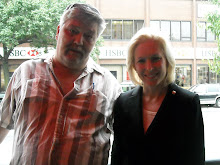
I had the pleasure of meeting Arlo after his free show at Lincoln Center on August 2nd. What a nice guy, my 14 year old daughter mentioned to him that she went to school in Howard Beach, she was delighted when he knew where her school was and shared with her that he went to PS 63 in Ozone Park (a few blocks from our house). He told her how he had to walk from Rockwood Park to Ozone Park every morning for school back then, too. He played about ten numbers, a few of his oldies like Alice's Restaurant and Stealin', he did one of his dad's songs and he ended the show with Good Night, Irene...
Read original...

 For Arlo Guthrie, 'Alice' brought what he wanted
Wednesday, August 8, 2007
WASHINGTON, Massachusetts: This year has already marked several milestone anniversaries in the life of Arlo Guthrie, unrepentant litterbug and patriarch of one of America's iconic musical families.
On July 10, the silver-haired singer-songwriter celebrated his 60th birthday here at his hillside compound in the Berkshires, surrounded by his four children and a brood of grandchildren. The party, a low-key burgers-and-beer affair, came in the middle of a rare solo tour by Guthrie and coincided with the release of a new live recording titled "In Times Like These," on which Guthrie is accompanied by the University of Kentucky Symphony Orchestra.
Two noteworthy 40th anniversaries have also rolled around, or soon will. One is pegged to the release of "Alice's Restaurant," the 18-minute song and album of the same name that put Guthrie on the pop-music map during the hippie-fied Summer of Love. Last month Rolling Stone magazine named Guthrie's album one of the rock masterpieces of 1967, along with the Beatles' "Sgt. Pepper's Lonely Hearts Club Band." The other, more solemn anniversary commemorates the death of Guthrie's father, the folk-music legend Woody Guthrie, who died of Huntington's disease in 1967, at age 55.
Between concert gigs and birthday candles, Tom Brokaw scheduled an interview with Guthrie, and the celebrity photographer Annie Leibovitz showed up at Camp Guthrie to snap a family portrait for Vanity Fair. "She was a real pro, as nice as she could be," says Guthrie, still slightly dazed from the glossy home invasion. "But man, it took all day."
Given all that's happened in recent weeks - Vanity Fair? Sixtieth birthday?
He looks like he just stumbled out of the Woodstock festival parking lot - one might expect to find Guthrie in a nostalgic frame of mind.
Or not.
Reflective, maybe. Contented, absolutely. Nostalgic? Not his style, sorry.
He happily talked about the life of the folk singer and the benefits of yoga, about why taking musical risks is so important and why the "Ricky Nelson syndrome" of recycling audience-pleasing hits is a drag.
"If you do anything for 40 years, you can do it comfortably," says Guthrie, sitting by his backyard swimming pool one morning in late July. "And it will always be good. But unless you're willing to risk it being bad, it can never be great."
He'll ramble on, too, replete with Arlo-esque flourishes, about why he may never tackle another acting job or write another kids' book, both of which he's done. Or, conversely, why he just might, provided the right offer comes rumbling down life's highway. "After I finished the first book," Guthrie said with a grin, "my publisher asked what the next one was about. What 'next one,' I said. This ain't Harry Potter."
To make the light in Guthrie's eyes really shine, bring up the Guthrie Center in nearby Great Barrington, which sponsors a variety of community-building projects ranging from puppet shows to yoga. "It's all the positive remnants of the '60s," he said. "Everything that's gotten lost over the past 10 to 15 years."
Or mention Pete Seeger, Guthrie's lifelong friend and mentor. "Pete and my dad both realized the history of people in song was being lost," Guthrie says with genuine emotion. "When I look at what I'm doing here, I agree with them philosophically. It's why I do songs like 'St. James Infirmary' and 'Goodnight Irene' " on the new album. "I'm not just a singer-songwriter doing songs in the key of me."
As far as "Alice," goes, though, Guthrie doesn't live there anymore. "To be honest, I had no idea it was the anniversary of the Summer of Love until someone e-mailed me about Rolling Stone," Guthrie said.
"I left the entertainment industry part of my life behind in 1983, when we decided not to work with major record companies anymore," said Guthrie, who launched his own label, Rising Son Records, that year and whose music business now includes all four children.
"Woodstock. The 'Alice's Restaurant' movie. 'City of New Orleans.' I recommend it to anyone who's 18. But as a life? No thanks."
If any mile marker has proved meaningful, Guthrie continued, it was the day he outlived his father. Huntington's disease, a genetically inherited neurological disorder for which there is no cure, struck Woody Guthrie in his late 40s. Arlo Guthrie made the decision years ago not to be tested.
"I spent the day talking to my dad about it, as it were," he says, visions of another classic Arlo monologue about fame, family and fate dancing in the air. "I said, 'All right, there's progress. And if my kids live a day older than I get to be, we're moving in the right direction, anyway.' "
Clearly they're moving forward musically. Abe Guthrie is a guitarist, keyboard player and vocalist who's toured with his dad for 20 years when not fronting his own band, Xavier. Sarah Lee Guthrie records and performs with her husband, the alt-folkie Johnny Irion. Cathy Guthrie comprises one half of the duo Folk Uke. Her performing partner is Amy Nelson, daughter of Willie, the duo's name playing not only on their chirpy, ukulele-based sound but on their R-rated lyrics as well. When their two famous fathers join them onstage, Arlo and Willie are introduced as the Horse You Rode in On.
"Cathy was going to be the smart one and go to college," Guthrie says with a laugh. "After a year, she tells me she's learning the ukulele. 'It's not serious,' she says. 'It's only four strings.' "
" 'Yeah,' I say, 'it starts with four strings. But pretty soon you're up to five strings, then six.' "
Annie Guthrie runs the family business office. Along with her three siblings, she's moved back to the Berkshires compound her parents bought in 1969. The farmstead has expanded over the decades to include several dwellings, a business office and home recording studio, and 400 acres, or 160 hectares. Scattered about are vestiges of Guthrie's troubadour past, including a 1954 tour bus Guthrie piloted himself when his kids were in diapers.
Twenty years ago, Guthrie bought an old U.S. Coast Guard building in Roseland, Florida, intending to make it his wintertime base. In 2005, he built an addition for his record company and mail-order business. Two hurricanes came along, and tore the addition apart. Guthrie had no insurance and was stuck with roughly $1 million in damages. He was cited by the local code enforcement board this year for maintaining an unsafe building. News accounts of his head-butting with the local authorities drew parallels to "Alice's Restaurant," his famous song about being busted for littering one Thanksgiving Day in the mid-'60s.
Two weeks ago, Guthrie attended a board hearing in Florida and was granted a 90-day reprieve.


Thursday, July 12, 2007
Brooklyn Daily Eagle: ‘Just an Average Guy’ - Arlo Guthrie...
Read original...
 CONEY ISLAND — Arlo Davy Guthrie was born in the Coney Island section of Brooklyn on July 10, 1947, son of legendary folk song singer/writer Woody Guthrie. Arlo was a name taken from a character in a story that his mother had read in her childhood. She was a dancer and teacher with the Martha Graham Company, and later, she ran a children’s dance school in Sheepshead Bay.
 CONEY ISLAND — Arlo Davy Guthrie was born in the Coney Island section of Brooklyn on July 10, 1947, son of legendary folk song singer/writer Woody Guthrie. Arlo was a name taken from a character in a story that his mother had read in her childhood. She was a dancer and teacher with the Martha Graham Company, and later, she ran a children’s dance school in Sheepshead Bay.
The modest Guthrie household in Coney Island, and later in the Howard Beach area of Queens, where the family moved when he was six, was usually filled with music, and Arlo grew up in the presence of such folk artists as Pete Seeger, Cisco Houston, Lee Hays, Jack Elliott, and Leadbelly. He remembers from his early years — before the onset of his father’s terminal illness (Huntington’s chorea) in the mid-’50s — the beach walks and family games with his parents and songs like “Goodnight, Little Arlo,” that his father made up.
A somewhat shy boy, Arlo was poor at sports, but his musical talent became evident in his early childhood. By the age of three he was playing the harmonica, and by six he had learned the rudiments of guitar playing from his mother.
Brought up in his mother’s Jewish faith, Arlo was Bar Mitzvahed in his mother’s Lower East Side dance studio. The loft was filled with ritual blessings, square dancing, harmonica playing and songs performed by “The Weavers” and other folk groups. The ceremony has been described as the first and only hootenanny Bar Mitzvah in history.
When Arlo was in the sixth grade, he entered the Woodward School, Brooklyn’s progressive educational institution. He sang before an audience for the first time at ten, when Cisco Houston brought him onstage at Gerde’s Folk City in Greenwich Village. In his early teens he began to write songs, and during his high school years he played with a folk/bluegrass band.
Arlo was just past his teen years when in 1967 he burst onto the folk scene with an 18-1/2 minute story-song called “Alice’s Restaurant.” It was a year that the antiwar movement embraced young and old, and most of its members lived in traditional communities. But for a growing number of disillusioned young people, opposition to the war was an impetus to seek out “alternative” lifestyles. “Alice’s Restaurant” was a timely ballad which perfectly encapsulated the mood of the time. It also demonstrated Arlo’s unique perspective and contagious twinkle-in-the-eye humor. The recording earned Arlo a gold record for sales exceeding $1 million.
For a time Arlo retired “the long one,” as “Alice’s Restaurant” was called, from his concert performances, saying that he had forgotten the words. But as the thirtieth anniversary of his now infamous garbage dumping arrest approached, he began to perform it again. He seemed to have a love-hate relationship with the tale. As he began playing the song to thunderous applause, he quipped “You may have heard this one before. I know I have!”
Through the course of repeated performances, as many of his tales do, “Alice” grew longer. Arlo recorded an updated version of his most famous anthem. The same revamped album includes Arlo’s famous “pickle” ditty “The Motorcycle Song.”
The new version was recorded live at The Guthrie Center, Guthrie’s spiritual center and church, which is located where the events of “Alice’s Restaurant” took place. (Yes, there really is an Alice; her last name is Brock). It’s the same place from whence he took out the garbage and dumped it over a hillside. His arrest for littering not only prevented him from being drafted for service to Vietnam, but also provided the plot for “Alice’s Restaurant.” In 1991 Arlo was able to buy Alice’s church building and establish The Guthrie Center in Housatonic, Massachusetts, as an interfaith spiritual center with programs for children who are recovering from abuse. “I’m just your average small town monk with a church … have been for years,” he says.
“Alice’s Restaurant,” starring Arlo was made into a movie and released in 1969. American Classics Movie Companion reviews it as follows: “A finely wrought, and often strikingly funny, cinematic snapshot of the 1960s. After illegally dumping a load of garbage, a young man gets tangled up with both the local police and the draft board.”
Arlo’s book “Mooses Come Walking” includes his poem by that name which he performs at concerts. Alice Brock did illustrations for the book. He dedicated the book to his two grandchildren and received a favorable review from the New York Times. “I’ve been a record, a movie, a performer and part of a TV show, but I have never been a book about a moose. I’m thrilled.” he says.
Arlo has recorded many other successful albums. His newest “Mystic Journey” contains all new material. Arlo appeared on the TV family drama “Byrds of Paradise.” He played the role of Alan Moon, a warmed-over hippie and 45-year-old high school student. The show ran from March to June 1994. In the last episode he performed his “Moon Song” which is included in the “Mystic Journey” album. When the series ended, according to Arlo, a Hawaiian (locale of the series was Hawaii) asked him what he was going to do next. “Oh, I guess I’ll just go back to singing,” he said. “You sing too?” asked the friend. Like his father Woody, Arlo became the spokesman for a generation of many young Americans who felt alienated from society. He has given benefit performances for the Black Panthers, the American Indian movement, and many other causes. A cause especially close to Arlo’s heart is the Committee to Combat Huntington’s Disease, which he helped his mother establish. He has had to live with the 50-50 possibility of contracting his father’s affliction later in life.
He performed at Carnegie Hall in 1981 with Pete Seeger. Arlo converted to Roman Catholicism in 1977, and subsequently became a member of the 3rd Order of St. Francis, the lay auxiliary of the Franciscans. He is a vegetarian, and on his farm he and his family have a menagerie of pet ducks, dogs and other animals.
Arlo owns a church, spends most of the year making personal appearances, writes poems about mooses, sings half-hour long songs, plays a middle-aged high school student on TV, and records the same album twice. Quite a record for “just your average guy” as he describes himself! Brooklyn’s opinion of its native son Arlo is definitely not that of “an average guy.” He was crowned 2001’s King of Brooklyn at the Welcome Back to Brooklyn festival on June 10. As usual with newly crowned “royalty,” Arlo was also given his spot on the Celebrity Path at Brooklyn Botanic Garden. His daddy Woody was honored with his place in 1986.
Photo above Arlo & Bob Guthrie
Attention: Governors Island Show July 28th:
Ribbon of Highway/Endless Skyway: A Tribute in the Spirit of Woody Guthrie, 1:30 pm
This is a show specifically designed to showcase Woody's songs, words and spirit. The show, originated by singer-songwriter Jimmy Lafave, focuses on the entire scope of Guthrie's career so that all of his music, known and unknown, recorded and unrecorded, can be experienced by the audience.
Subscribe to:
Posts (Atom)