Showing posts with label dept of the interior. Show all posts

Wednesday, February 23, 2011

Feds Reject Plan for Full-Blown N.Y. Casino by Tom Precious - BloodHorse.com

Read original...


New York racetrack casinos lost a major potential competitor Feb. 18 after federal officials rejected a plan for a sprawling, full-blown casino just 90 miles from Manhattan.


The U.S. Department of Interior formally ended a bid for an off-reservation casino to be built in the southern Catskills resort region by the Stockbridge-Munsee Community Band of Mohicans.


The Wisconsin-based tribe struck a deal late last fall in the final weeks of the outgoing administration of former New York Governor David Paterson for the casino rights in return for settling a long-standing land claims lawsuit by the tribe for what it maintains is ancestral land in central New York.


Racetrack-based casinos, which in New York can offer video lottery terminals, expressed concerns that they could not compete with the massive casino, complete with table games, that the Mohicans were proposing to build not far from the Monticello harness racetrack.


Genting New York, the developer of the long-stalled casino at Aqueduct racetrack that is expected to open this summer, has gone so far as to say it would be scaling back some plans for the new facility as a result of the competition from the proposed Catskills casino. Officials at racinos from Yonkers to Saratoga Springs openly worried about business dropping off by a Catskills casino.


The bid by the Wisconsin tribe was also opposed by New York Indian tribes, which urged the federal regulators to reject the out-of-state Indian bid for what would have been a lucrative casino.


"By rejecting this ill-conceived compact, the Department of Interior has allowed New York State to go back to the drawing board and put together a gaming policy that makes sense,'' said the New York Gaming Association, a group representing New York racetrack casinos.


The tracks say they should be allowed to operate full-scale casinos at their facilities.


"We are extremely pleased with DOI's decision and look forward to working with Gov. (Andrew) Cuomo and the state Legislature to develop a gaming policy that maximizes revenue, creates jobs and keeps the racetrack casino economic engine churning,'' the group said.

Friday, February 18, 2011

New York Racetrack Casinos Issue Statement on Rejection of Catskill Compact


The New York Gaming Association, representing racetrack casinos in New York, today issued the following statement about the Department of Interior’s rejection of a proposed casino in Sullivan County.

“By rejecting this ill-conceived compact, the Department of Interior has allowed New York State to go back to the drawing board and put together a gaming policy that makes sense. That new policy will hopefully capitalize on existing resources like our racetrack casinos, which already put more than $1 billion per year in tax revenue toward state coffers and could help bolster our sagging economy even further if allowed to operate full-scale casinos.

“We are extremely pleased with DOI’s decision and look forward to working with Gov. Cuomo and the state Legislature to develop a gaming policy that maximizes revenue, creates jobs and keeps the racetrack casino economic engine churning.”

Friday, July 30, 2010

Obama Cabinet Member Takes Tour of Jamaica Bay by Ivan Pereira - YourNabe.com

Read original...


U.S. Rep. Anthony Wiener (from l.), U.S. Interior Secretary Ken Salazar and Park Ranger Dandelion Dilluvio remove an invasive vine in Jamaica Bay during Salazar's visit to the ecosystem. Photo by Christina Santucci
The U.S. secretary of the Interior paid a visit to Jamaica Bay Monday and borough elected officials said they hope his trip will have a positive impact on the future of its environment.

This is the first time Ken Salazar visited the 31-square-mile ecosystem and got up close with its fauna and flora, according to U.S. Rep. Anthony Weiner (D-Forest Hills), who accompanied the secretary during the tour.

“There are a lot of, ‘Oh, wow,’ moments when you visit Jamaica Bay,” the congressman said.

Salazar, who was touring several Gateway National Recreation Area sites, including the Statue of Liberty, walked the path of the bay’s wildlife refuge and took a boat tour of the bay along with park rangers, Weiner and Rep. Gregory Meeks (D-Jamaica).

Park experts explained to Salazar how Jamaica Bay’s environment is closely tied to the nearly 400 species of birds, fish and other wildlife that populate the area. The ecosystem serves as a home to many of the animals during their migratory patterns, according to Barry Sullivan, the superintendent of the Gateway National Recreation Area.

“It’s unbelievably important to the ecosystem, not just for the city ... but also for the entire Atlantic coast,” he said.

Leaders and environmentalists say the bay’s importance to the area means it should qualify for more preservation projects.

Its saltwater marshland has been dissipating for decades and more than 70 percent of the ecosystem has been lost. Over the last 10 years, city, state and federal governments have been providing funding, planning to stop the decay and restoring some of the lost marshland.

The U.S. Army Corps of Engineers has been restoring several sections of the marshland, including Elders Point West. In the winter, the city announced it was dedicating $100 million over the next decade to enhance its wastewater treatment plants around the ecosystem so the facilities discharge less nitrogen, which causes the plants to decay.

Dan Mundy Jr., a member of the Jamaica Bay Ecowatchers, an environmental group that has been advocating for protecting the bay, said projects are coming along well.

“The results for the sites of growth are doing very good so far,” he said.

Weiner said he thinks Salazar’s visit will help bring more funding and attention to the environment since the secretary has had a hands-on experience with the bay.

“So much about the [restoration projects] is about oiling the squeaky wheel. This is not a well-known park,” he said.

Additional photos from the Rockaway Wave...

MMS' Failure Will Continue Without Real Reform - Op/Ed by Rep. Edolphus Towns - The Huffington Post

Read original...


British Petroleum's (BP) Deepwater Horizon oil rig exploded off the Gulf Coast more than 100 days ago and we have witnessed the devastation ever since. Oil has washed ashore from Texas to Florida and the lives of millions of Americans have been put on hold. The magnitude of the spill exposed the inadequacy of BP's emergency response and raised serious questions about the effectiveness of the Department of Interior's oversight of offshore drilling.

The BP oil spill was just the latest chapter in a long history of regulatory and ethical failures at the Interior Department and the Minerals Management Service (MMS). It is apparent that over the last decade, MMS essentially permitted the oil industry to police itself -- allowing BP and other companies in the industry to pick and choose which regulations they would follow. At the same time, the number of oil rigs in the Gulf of Mexico expanded dramatically and further into much deeper waters while the agency remained at approximately the same size.

After the oil spill, Secretary Salazar proposed a sweeping reorganization of MMS that would split the agency into three separate departments, The Bureau of Ocean Energy Management, the Bureau of Safety and Environmental
Enforcement and the Office of Natural Resources Revenue. To get a better understanding of the proposed changes, I convened a House Oversight and Government Reform Committee hearing recently where we were able to ask Interior Secretary Salazar and Michael Bromwich, the new director of the Bureau of Ocean Energy Management (BOEM), critical questions about the reorganization.

According to Secretary Salazar, the necessary checks and balances have been implemented to prevent unethical behavior within the three new entities. The ethics and enforcement standards for all employees were strengthened, and more rigorous safeguards were implemented to separate royalty collection from the safety and environmental oversight tasks.

We also discussed concerns related to conflicts of interest and revenue collections. Secretary Salazar explained that recommendations from the Department's Inspector General have been adopted and he highlighted the termination of the Royalty-in-Kind program that will reduce the likelihood of fraud or collusion within the oil and gas industry. He also stated that as the department evaluates new areas for oil and gas exploration, they will conduct a thorough environmental analysis and examine the potential safety and spill risks before approving plans to drill.

Michael Bromwich was chosen to lead BOEM because of his experience as an Inspector General at the Justice Department and his demonstrated ability to turn around failing institutions. After leaving the Justice Department he helped reform police departments around the country before working in private practice where he conducted several internal investigations for companies in a variety of industries. Mr. Bromwich expressed to the committee that he is determined to promptly respond to any allegations or evidence of misconduct or unethical behavior between BOEM employees and the oil and gas industry. He also made clear that he is determined to improve the bureau's ability to respond to issues and crises, like the Deepwater Horizon spill, as quickly as possible.

I am encouraged by Secretary Salazar's and Director Bromwich's dedication to put common sense reforms in place that will strengthen the oversight of the oil industry. Although the agency has much work to do, I remain optimistic reform will occur.

Thursday, May 20, 2010

Chairman Ed Towns Opens Investigation into MMS, Deepwater Horizon Oil Spill...

Read original...

Chairman Towns Opens Investigation into MMS, Deepwater Horizon Oil Spill

A satellite image from yesterday shows the slick’s dangerous drift toward the loop current, which would take the spill down the Keys and into the Atlantic (h/t Deep Sea News)

Chairman Edolphus “Ed” Towns today announced that the Committee on Oversight and Government Reform has opened an investigation into potential lapses in oversight by the Minerals Management Service (MMS) in the years leading up to the Deepwater Horizon oil spill on April 20, 2010 in the Gulf of Mexico. The Committee has been concerned for many years with mismanagement and corruption at MMS, and the magnitude of the recent spill once again raises serious questions about the effectiveness of MMS’s oversight of offshore oil drilling.

“The inadequacy of BP’s and Transocean’s emergency response, and reports that BP may have failed to adopt adequate ‘blowout’ measures are deeply troubling and suggest problems with MMS’s approach to offshore drilling,” said Chairman Towns. “We need to understand if proper safeguards were in place before the Deepwater Horizon spill occurred, and if not, we need to know why.”

In a letter to the Department of the Interior Secretary Ken Salazar, the chairman requested information on management, operations and effectiveness of MMS, including matters relating to the Deepwater Horizon incident. Additionally, the chairman is interested in “revolving door” issues, conflicts of interest within MMS and MMS’s apparent lack of oversight of offshore oil rigs.

MMS is responsible for the regulation and oversight of offshore oil drilling. During the last decade, MMS has essentially permitted the oil industry to police itself under a system of “performance-based safety regulation.” For example, in 2000, MMS reportedly issued an alert requiring oil companies to have a backup system to activate “blowout preventers,” one of the components that may have failed, contributing to the Deepwater Horizon explosion and exacerbating the scope and scale of the oil spill.

In 2006, the Committee held five hearings to examine problems associated with MMS. At a September 13, 2006, hearing, Inspector General Earl Devaney bluntly described a “culture at the Department of the Interior that sustains managerial irresponsibility and a lack of accountability.” Similarly, in 2008, the Interior Department’s Inspector General found that MMS has given too much deference to oil companies, resulting in oil royalty payment contracts that disproportionately favored the companies.

Chairman Towns is concerned that regulatory failures at MMS may have been exacerbated by an institutionalized conflict of interest that has resulted in an emphasis on collecting oil drilling royalty payments, rather than ensuring safety. Nearly half of the agency’s annual budget comes from the oil industry in the form of fees and rentals, known as “offsetting collections.” In other words, while MMS has the power to shut down unsafe operations, it has an enormous incentive to keep the oil flowing.

“This Committee has been concerned with the effectiveness of MMS for many years and the Deepwater Horizon disaster has now exposed what appears to be continuing major problems at the agency,” said Chairman Towns. “It is time to take a hard look at the policies within MMS to determine whether they ensure safe offshore drilling.”

###

Documents and Links

Letter from Chairman Edolphus Towns to Secretary Ken Salazar

Saturday, May 15, 2010

Committee Eyes Gov't Role in Spill by Jake Sherman - POLITICO.com

Read original...

The House’s top oversight committee Friday announced an investigation into the massive oil spill in the Gulf of Mexico, and signaled it will focus on the beleaguered government agency in charge of regulating drilling.

Rep. Ed Towns, the New York Democrat that chairs the House Oversight and Government Reform committee, said that failures at the Mineral Management Service, the oil drilling regulatory body, “may have been exacerbated by an institutionalized conflict of interest that has resulted in an emphasis on collecting oil drilling royalty payments, rather than ensuring safety.”

The Obama administration has said it is going to revamp MMS, and the president Friday said that "for a decade or more, there's been a cozy relationship between the oil companies and the federal agency that permits them to drill.” Both Senate and House lawmakers have also expressed concerns about coziness between industry and government.

The Oversight committee is going to hold hearings on the spill, aides say, but Friday Towns began the investigation by sending a letter to Interior Secretary Ken Salazar, requesting a slew of documents, including inspection records for the Deepwater Horizon rig that exploded, sending thousands of barrels of oil into the Gulf of Mexico.

Towns is also requesting information on how often oil rigs are inspected, and if such visits are announced or unannounced, emergency preparedness, studies presented to the Interior department and the department’s preliminary investigations into the Gulf explosion. Towns will also look at allegations that the regulator is cozy with industry – he is asking for a list of MMS employees who have formerly worked for the oil industry.

Further, Towns will look into the theory that a last-ditch safety mechanism failed, causing the leak, requesting information on the fail-safe mechanisms on oil rigs. House Energy and Commerce Committee Chairman Henry Waxman (D-Calif.) and Michigan Democratic Rep. Bart Stupak surmised in a hearing last week that the blowout preventer – the mechanism meant to stop such a leak – failed.

Rep. Darrell Issa of California, the committee’s top Republican who last year proposed removing the MMS from the Interior department, Friday praised the Obama administration’s proposed breaking up of the royalties-collecting agency.

Sunday, December 27, 2009

Shinnecocks Mull Boro Gaming Bid by Howard Koplowitz- TimesLedger Newspapers

Read original...

The Shinnecock Indian Nation on Long Island is one step closer to federal recognition, which could pave the way for the tribe to open up a casino either at Aqueduct Race Track or Belmont Park.

The U.S. Department of the Interior’s Office of Recognition has issued a preliminary ruling that the Shinnecock should be added to the list of federally recognized tribes in the country.

“As a result of this finding, our more than 30-year quest for federal recognition is finally within our grasp,” Shinnecock Board of Trustees Chairman Randy King said in a statement. “We look forward to reclaiming our rightful place on this list, which will enable us to qualify for federal programs long denied to our people. To be denied the ability to partner with the federal government on housing, health care, educational and economic justice initiatives is no longer tolerable.”

The tribe has been recognized by New York state since colonial times, but the Shinnecock have been fighting for federal recognition since 1978.

“This preliminary ruling makes clear that our placement on the federal list is only a matter of time. We look forward to improving the quality of life for our people, who have waited far too long for this day,” said Shinnecock Trustee Richard Bess.

In 2007, the tribe proposed a casino at Aqueduct Race Track, but it did not have the blessing of the area’s elected officials. State Assemblywoman Audrey Pheffer (D-Rockaway Beach) said the proposal was too ambitious because it included space for poker and blackjack tables.

The proposal was later rescinded.

Shinnecock spokeswoman Beverly Jensen said the tribe is waiting on federal recognition before fully developing plans for a casino.

“The plan is this: We don’t have a plan,” she said. “We are definitely going to look into a casino. Right now we need that federal recognition recognized.”

Jensen said the Shinnecock reservation in Southampton is not suitable to build a casino so the tribe is looking to build one elsewhere.

“We don’t have enough room. We have a very small reservation,” she said.

Jensen said the tribe has all options open as to where to build a casino once it is federally recognized.

“At the moment, we are looking at any place and we are looking at all places,” including Belmont and Aqueduct, she said. “We are not site-specific at this time.”

Reach reporter Howard Koplowitz by e-mail at hkoplowitz@cnglocal.com or by phone at 718-229-0300, Ext. 173."

Friday, March 27, 2009

One-Third of U.S. Bird Species Endangered, Survey Finds by Cornelia Dean - NYTimes.com

Read original...

Habitat destruction, pollution and other problems have left nearly a third of the nation’s 800 bird species endangered, threatened or in serious decline, according to a study issued on Thursday.

Described as the most comprehensive survey of American bird life, the report, "The U.S. State of the Birds," analyzed changes in the bird population over the last 40 years. “This report should be a call to action,” Interior Secretary Ken Salazar said at a news conference in Washington.

Citing surveys by government agencies, conservation organizations and citizen volunteers, the report said that the population of grassland birds had declined by 40 percent and birds in arid lands by 30 percent. It estimated that 39 percent of bird species that depend on American coastal waters were in decline.

Many forest birds are threatened by urban sprawl, logging, wildfires and “a barrage of exotic forest pests and disease,” the study said.

In Hawaii, the home of more than a third of American bird species, the situation is particularly grim, the report said. Most of that state’s bird species are in danger.

Climate change will make things worse, and work is urgently needed to prevent “a global tragedy” of bird loss, the report added.

But there was also an upbeat side to the news conference. The study found that herons, egrets, ducks and other birds that benefit from wetlands conservation were rebounding. Findings like this “show us that conservation can really work,” Mr. Salazar said.

Other speakers agreed. The report’s gloomy assessment makes it “a key document,” said John Hoskins of the United States North American Bird Conservation Initiative, an umbrella group for public and private efforts. But its data also show that “when agencies, organizations and individual citizens work together to conserve precious resources, some really good things happen,” Mr. Hoskins said.

The report draws on data collected by the federal Fish and Wildlife Service and the United States Geological Survey, organizations like the American Bird Conservancy and the Cornell Lab of Ornithology, and volunteer participants in the Christmas Bird Count of the National Audubon Society.

John Fitzpatrick, the director of the Cornell laboratory, which also oversees citizen bird-counting, said that a wealth of data gathered in such volunteer efforts had helped scientists make major strides in assessing the health of bird populations and in drawing more general conclusions about the environment.

Beyond taking part in counting efforts, the report urged ordinary citizens to assist conservation by drinking shade-grown coffee (coffee-growing in the shade helps preserve the winter habitat of species like warblers), donating unused binoculars for distribution to biologists in the tropics, reducing pesticide use, landscaping with native plants and keeping pet cats indoors.

“Education is urgently needed to make the public aware of the toll of pet cats,” Darin Schroeder of the American Bird Conservancy said at the news conference.

Thursday, March 19, 2009

Partnership Releases First State of the Birds Report...

Read Report...

Secretary Salazar Releases Study Showing Widespread Declines in Bird Populations, Highlights Role of Partnerships in Conservation
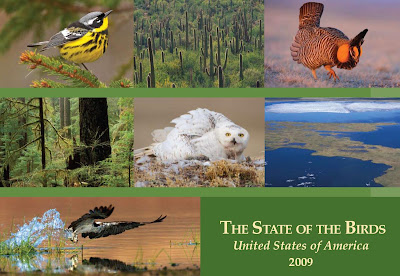

Secretary of the Interior Ken Salazar today released the first ever comprehensive report on bird populations in the United States, showing that nearly a third of the nation’s 800 bird species are endangered, threatened or in significant decline due to habitat loss, invasive species, and other threats.

At the same time, the report highlights examples, including many species of waterfowl, where habitat restoration and conservation have reversed previous declines, offering hope that it is not too late to take action to save declining populations.

Just as they were when Rachel Carson published Silent Spring nearly 50 years ago, birds today are a bellwether of the health of land, water and ecosystems,” Salazar said. “From shorebirds in New England to warblers in Michigan to songbirds in Hawaii, we are seeing disturbing downward population trends that should set off environmental alarm bells. We must work together now to ensure we never hear the deafening silence in our forests, fields and backyards that Rachel Carson warned us about.”

The report, The U.S. State of the Birds, synthesizes data from three long-running bird censuses conducted by thousands of citizen scientists and professional biologists.

In particular, it calls attention to the crisis in Hawaii, where more birds are in danger of extinction than anywhere else in the United States. In addition, the report indicates a 40 percent decline in grassland birds over the past 40 years, a 30 percent decline in birds of arid lands, and high concern for many coastal shorebirds. Furthermore, 39 percent of species dependent on U.S. oceans have declined.

However, the report also reveals convincing evidence that birds can respond quickly and positively to conservation action. The data show dramatic increases in many wetland birds such as pelicans, herons, egrets, osprey, and ducks, a testament to numerous cooperative conservation partnerships that have resulted in protection, enhancement and management of more than 30 million wetland acres.

“These results emphasize that investment in wetlands conservation has paid huge dividends,” said Kenneth Rosenberg, director of Conservation Science at the Cornell Lab of Ornithology. “Now we need to invest similarly in other neglected habitats where birds are undergoing the steepest declines.”

“Habitats such as those in Hawaii are on the verge of losing entire suites of unique bird species,” said Dr. David Pashley, American Bird Conservancy’s Vice President for Conservation Programs. “In addition to habitat loss, birds also face many other man-made threats such as pesticides, predation by cats, and collisions with windows, towers and buildings. By solving these challenges we can preserve a growing economic engine – the popular pastime of birdwatching that involves millions of Americans – and improve our quality of life.”

“While some bird species are holding their own, many once common species are declining sharply in population. Habitat availability and quality is the key to healthy, thriving bird populations,” said Dave Mehlman of The Nature Conservancy.

Surveys conducted by the U.S. Fish and Wildlife Service and U.S. Geological Survey, including the annual Breeding Bird Survey, combined with data gathered through volunteer citizen science program such as the National Audubon Society’s Christmas Bird Count, show once abundant birds such as the northern bobwhite and marbled murrelet are declining significantly. The possibility of extinction also remains a cold reality for many endangered birds.

“Citizen science plays a critical role in monitoring and understanding the threats to these birds and their habitats, and only citizen involvement can help address them,” said National Audubon Society’s Bird Conservation Director, Greg Butcher. “Conservation action can only make a real difference when concerned people support the kind of vital habitat restoration and protection measures this report explores.”

Birds are beautiful, as well as economically important and a priceless part of America's natural heritage. Birds are also highly sensitive to environmental pollution and climate change, making them critical indicators of the health of the environment on which we all depend.

The United States is home to a tremendous diversity of native birds, with more than 800 species inhabiting terrestrial, coastal, and ocean habitats, including Hawaii. Among these species, 67 are Federally-listed as endangered or threatened. In addition, more than 184 species are designated as species of conservation concern due to a small distribution, high-level of threats, or declining populations.

The U.S. Fish and Wildlife Service coordinated creation of the new report as part of the U.S. North American Bird Conservation Initiative, which includes partners from American Bird Conservancy, the Association of Fish and Wildlife Agencies, Cornell Lab of Ornithology, Klamath Bird Observatory, National Audubon Society, The Nature Conservancy and the U.S. Geological Survey.

The report is available at www.stateofthebirds.org.

Contact: Pat Leonard, Cornell Lab of Ornithology, 607-254-2137, pel27@cornell.edu

Tuesday, January 27, 2009

Rep. Weiner and Interior Secretary Salazar Tour Lady Liberty's Crown...

(From left to right: Interior Secretary Salazar, Rep. Weiner, and Rep. Sires)

Representative Anthony Weiner (D-Brooklyn and Queens), newly minted Interior Secretary Ken Salazar, Senator Menendez (D-NJ), and Representative Albio Sires (D-NJ) visited the Statue of Liberty's crown Friday. Rep. Weiner has led the fight to re-open Lady Liberty's crown, urging Interior Secretary Salazar to provide public access to the crown, which has been closed since the 9/11 attacks.