Showing posts with label laguadia airport. Show all posts

Thursday, June 2, 2011

Rep Joe Crowley Applauds Delta, US Airways Agreement that Will Create New Jobs in Queens

Airline Slot Exchange Paves Way for Delta’s $117 Million Investment in LaGuardia Airport

Congressman Joe Crowley (D-Queens, the Bronx), a chief deputy whip in the Democratic leadership of the House of Representatives, applauded the revised agreement reached today between Delta Airlines and US Airways to transfer takeoff and landing slots between LaGuardia and Washington Reagan National Airports. This agreement paves the way for Delta to move forward with its $117 million planned investment to build a new terminal at LaGuardia Airport, generating thousands of new jobs in Queens and increasing economic activity in and around the airport.

This deal is a win-win for New York’s 7th Congressional District. Not only will this deal improve air service and reduce noise pollution, it will also create thousands of new jobs for Queens,” said Congressman Crowley. “In today’s economic climate, we should do all we can to encourage private sector employers, such as Delta, to create jobs.”

Under the agreement, Delta airlines would operate an additional 110 slots at LaGuardia Airport, and would give up some of its slots at Washington Reagan National Airport in Washington, D.C. Subsequently, the airline would begin a multi-million dollar construction program at LaGuardia to connect the existing Delta and US Airways terminals. An estimated 6,000 new jobs would be created as a result of this agreement, including construction, airport operational and tourism-related jobs. Additionally, Delta would phase out use of older, loud turbo-prop planes for quieter jets – resulting in less air noise polluting the communities around the airport.

Since 2009, Crowley has led efforts in support of a deal, including spearheading a bipartisan letter to Transportation Secretary Ray LaHood that encouraged the department to quickly approve the transfer of slots.

Saturday, January 29, 2011

Planners Seek Expansion at Kennedy and Newark Airports by Patrick McGeehan- NYTimes.com

Read original...


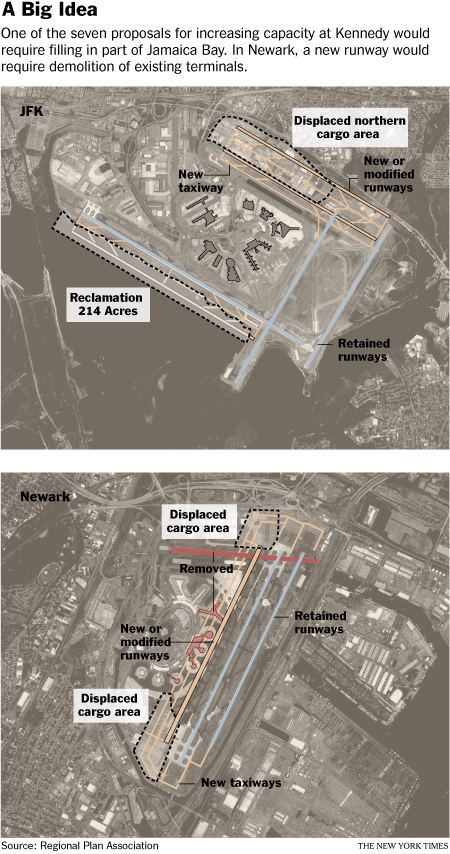
The bay runway at Kennedy Airport could get a sibling built on a filled-in portion of Jamaica Bay under an airport expansion proposal.
The New York region’s two largest airports, already choked with crowds and delays, may need to be radically reconfigured so they can make way for vitally needed additional runways that would help accommodate a projected increase of almost 50 million air travelers per year within two or three decades, according to a new study.
The study, from the Regional Plan Association, calls for as much as $15 billion to be spent at Kennedy and Newark Liberty International Airports. At Newark, all three terminals would have to be at least partially razed, then rebuilt; at Kennedy, part of Jamaica Bay might have to be filled to create space for one or more new runways.
The proposed expansions would amount to the most ambitious reshaping of any of the region’s major airports in several decades. They would require significant changes in the region’s airspace, a modernization of the system for controlling air traffic and at least one act of Congress.
If the proposals are accepted by the Port Authority of New York and New Jersey, which operates Kennedy, Newark and La Guardia Airports, they would surely encounter stiff resistance from local and national advocates for the environment, the report admits. They would also have to survive the political tug of war between the governors of New York and New Jersey, who jointly control the Port Authority.
The report, which was financed in part by the Port Authority, was scheduled to be presented at a daylong conference on the future of the airports in Manhattan on Thursday.
Christopher Ward, the executive director of the Port Authority, was scheduled to attend the conference and was expected to discuss the report as fodder for planning. Asked for comment, a spokesman for Mr. Ward said only that “we look forward to examining this study.”
The study considered a spectrum of options that stretched to the fantastic: a new airport on an island in New York Bay. But the cost was deemed to be “exorbitant.”
Elected officials and business leaders have discussed airport expansion for years, but have been reluctant to broach the idea publicly to avoid stirring up opposition too soon, said Kathryn S. Wylde, the president of the Partnership for New York City. But, Ms. Wylde added, “It’s become very clear that our economic future depends on investment both in the technology and facilities upgrades and runway expansion at the regional airports.”
For years, the local airspace has been too clogged to consider adding any more traffic. Indeed, federal regulators have placed limits on the number of flights each hour to and from the region’s airports. But the federal government is planning to upgrade the nation’s air traffic control system with a program known as NextGen that will allow more planes to squeeze into the region, said Jeffrey M. Zupan, a transportation analyst who is one of the report’s authors.
Once the first phase of NextGen is in operation, the Port Authority should seek to have the caps on flights lifted and begin making room for new runways and gates to accommodate the increasing traffic, the report says. It estimates that traffic at the three airports will increase steadily from about 104 million passengers annually last year to 150 million passengers within 20 to 30 years. Mr. Zupan said that the airports currently cannot handle more than about 110 million passengers a year.
The Port Authority has been grappling with how to alleviate congestion at its major airports; in 2007, it acquired a long-term lease on Stewart International Airport near Newburgh, N.Y., with the purpose of making it the region’s fourth major airport. That goal has yet to be realized, and the new plan suggests that the Port Authority’s money and efforts would be better spent at Kennedy and Newark.
The question of the Port Authority’s mission arose again this month when New Jersey’s governor, Chris Christie, asked for $1.8 billion to build and repair roads and bridges in North Jersey. New York’s senior senator, Charles E. Schumer, demanded that the Port Authority refuse that request, because, he said, the agency should devote its resources to grand plans that would benefit the economy of the entire region.
The cost estimates are preliminary and vary widely depending on which of several options for expanding Kennedy would be chosen, according to the report. The authors laid out seven proposals for adding runway space at Kennedy, some of which would require filling in more of the bay than others.
At Newark, they concluded, the only feasible way to expand would be to add a runway between the existing terminals and the two main runways in use there now. Doing that would require the demolition of all of Terminal B and parts of Terminals A and C, Mr. Zupan said.
Rebuilding the terminals in Newark could cost as much as $5 billion, which could raise the total cost of the expansion to $15 billion, the report says. But it estimates that not expanding the airports could cost the region $16 billion a year in lost airfare, as well as up to 125,000 jobs and $6 billion in annual wages.
At Kennedy, expansion could cost anywhere from $1 billion to $3.5 billion, depending on whether one or two runways are added and how they are configured, the report says. It lays out seven possible configurations at Kennedy, some of which involve reorienting the flight path into and out of the airport. Doing so would bring those flights into closer conflict with planes going to and from La Guardia, which the Federal Aviation Administration might find unacceptable, Mr. Zupan said.
Among the alternatives, he said, would be to fill in part of Jamaica Bay and construct a new runway parallel to the existing runway used by the giant trans-Atlantic passenger jets. Getting approval for that option would entail not only overcoming opposition from environmental groups but also changing the federal law that created the Gateway National Recreation Area, which explicitly prohibits expanding the airport into the bay.
A section of the bay known as Grassy Bay contains a deep trench that was dug during construction at the airport in the 1950s, the report says. That trench has some negative effects on the surrounding bay, which might be ameliorated if it were filled in during the construction of a runway, Mr. Zupan said.
But John Waldman, a professor of biology at Queens College, said he was skeptical about that trade-off and imagined it would not occur without a “fierce battle.” While he said that filling the trench to level the bottom of the bay probably would be beneficial, he said he could not see the benefits outweighing the cost of encroaching on one of the “ecological jewels” of the region.
“I don’t see that as a clear trade of equal value,” Professor Waldman said.

Friday, April 30, 2010

Port Authority Chief: Tear Down Queens' LaGuardia Airport by Doug Feiden - NY Daily News

Read original...

Aerial view of LaGuardia Airport in Queens. Watts/News

Port Authority boss Chris Ward said Tuesday that LaGuardia Airport should be torn down - and then completely rebuilt as soon as money is available.

The facility that whisks millions of travelers on their not-so-merry way is a chaotic and unwieldy mess that's not fit for the 21st century, Ward argued.

"LaGuardia should not be the gateway for domestic flights into New York City," Ward told a Crain's New York Business breakfast forum. "It should fundamentally be torn down and rebuilt again."

The stark comments from the PA's executive director seemed to startle business executives at the Grand Hyatt. Demolishing the 72-gate, 680-acre facility has never been publicly debated.

"LaGuardia was built over decades, and it's not the kind of integrated aviation facility that the 21st century really demands," he said.

"On top of that, we've layered in post-9/11 security, and because of that you have an experience for the air traveler which is unnecessarily chaotic and difficult to manage."

Like the subways, LaGuardia is part of most New Yorkers' DNA - even though it's an ugly, unmanageable horror show that conjures up the romance of aviation for almost no one.

Ward said the PA lacks the cash right now to dismantle the airport but disclosed that the agency has hired planning consultants to "reimagine" the modern, state-of-the-art launch pad that will one day take its place.

The total teardown wouldn't happen overnight, PA officials say: It would be phased in over time so operations could continue while airport demolition is underway.

"I think candidly, over time, building piece by piece, LaGuardia has to be completely redone," he said.

"It will improve aeronautical efficiency, get more flights in and out, improve gate utilization - and give the flying public a state of the art terminal that they really deserve."

Monday, June 22, 2009

Mayor Bloomberg Swats Away Geese Protests by Erin Einhorn - NY Daily News

Read original...

Canada geese soar through the sky along with a jet. Sumlin/AP

As President Obama takes heat from insect-rights activists for swatting a fly during an interview, Mayor Bloomberg says he can sympathize.

"I had pickets outside my house for geese last night," Bloomberg said of protesters angry that the city is gathering up to 2,000 geese near airports and gassing them.

"We are sending some of these geese for a well-deserved rest up in the sky, wherever geese go," Bloomberg said. "They're a danger to human beings flying, and we're doing what's appropriate."

The city announced the "removal" of the geese after migrating birds stopped both engines on US Airways Flight 1549, forcing the plane to make an emergency landing on the Hudson River.

Wildlife experts told the city that killing was the only effective way to control the problem.

As for Obama, Bloomberg says the President is a hero.

"I'm sure what the President thought about was that particular fly might be spreading something like the H1N1 flu, and he was going to risk his own life with his hands - bare hands - without Purell, and he protected the public by hitting that fly and we owe him a great debt of gratitude," Bloomberg said.

Monday, May 25, 2009

JFK Has Most Bird Strikes, FAA Reports by Stephen Geffon - Queens Chronicle

Read original...

The National Transportation Safety Board is investigating whether Canada geese, pictured here, are to blame for the majority of bird strikes. (photo by Ray G. Foster)


The full extent to which birds collide with airplanes had been unknown to the general public — until last week.

After initial reluctance, the Federal Aviation Administration released a comprehensive report on the dangerous bird problem at the nation's airports, an account that resulted in Kennedy International Airport scoring headlines for all the wrong reasons.

The FAA report, which tracked the period between January 1990 and November 2008, found that, since 1990, Kennedy has led the nation with 1,811 reported bird strikes. By comparison, LaGuardia had 954 avian collisions. The report only captured about 20 percent of all wildlife strikes and included the cost of repairs to the planes from the bird strikes — estimated to be more than $267 million.

And, at the heart of the controversy, one bird species seems to be garnering the nation’s attention: Canada geese.

JFK, the nation’s sixth busiest airport, is located near the Jamaica Bay Wildlife Refuge, a 9,000-acre stretch of small islands and marshes that is home to 330 bird species. The Wildlife Refuge is also a veritable breeding ground for gulls and geese which, along with mourning doves, comprise the majority of birds that hit planes, according to the FAA.

While the National Transportation Safety Board has not completed its investigation, authorities believe that a flock of Canada geese were sucked into the two jet engines of US Airways Flight 1549 shortly after takeoff from LaGuardia Airport on January 15. The bird strike caused the plane’s engines to immediately shut down, forcing the pilot to land in the Hudson River.

At a news conference last week, Sen. Chuck Schumer (D-NY) said the federal government should “create a new program that would devote millions of dollars to wildlife mitigation focusing on reducing bird strikes at the New York City airports and airports around the country.” Schumer also announced this week he will introduce new legislation requiring the FAA to make bird strike data mandatory.

Doug Adamo, spokesman for Gateway National Recreation Area’s Jamaica Bay Region, said officials are not currently performing habitat management to enhance bird habitats or nesting sites in the area to attract birds.

But officials at Kennedy seem to be taking matters into their own hands. This year, the airport expects to install the Avian Radar System, manufactured by Accipiter, which tracks birds’ course, speed and altitude within six miles and 3,000 feet of the airport.

City Council Transportation Committee Chairman John Liu (D-Flushing) said that although he does not plan to hold any hearings to look at bird strikes, he will work closely with federal authorities to find strategies to solve the problem and will consider everything from “more sophisticated electronic deterrence” to the “scarecrow” effect.

The scarecrow method is exactly what it sounds like — the use of falcons to scare birds out of a plane’s flight path, an environmentally friendly form of bird control known as a type of falconry.

“It’s something we have to look at, obviously,” Councilman Eric Ulrich (R-Ozone Park), a member of the Transportation Committee, said. Falconry is still a viable alternative option, he said.

The Port Authority currently has a five-year, $3 million contract with Falcon Environmental Services, Inc. to perform falconry at Kennedy Airport.

While Kennedy has been using falcons for decades to frighten gulls from its flight paths, they are not currently used at LaGuardia, Port Authority spokesman Pasquale DiFulco said.

Falconry wouldn’t work at LaGuardia, he said, because it is “effective against gulls, not geese.” Gulls are the primary birds at issue at Kennedy, but not at LaGuardia, where geese pose the main threat, DiFulco said.

However, veteran falconer Andrew Barnes of Falcon Environmental Services disagreed.

“It is the best tool we have available to us,” Barnes said.

Regardless of the method ultimately chosen to combat bird strikes, Queens officials agree: something has to be done to prevent another destructive accident.

“Active bird management and habitat alternation methods must be enhanced to ensure the safety and well being of air passengers,” said Assemblywoman Audrey Pheffer (D-Ozone Park).

Sunday, March 15, 2009

Not Much Room to Make Kennedy, LaGuardia Runways Safer -- Newsday.com

Read original...

For New York City's two airports, there's not much room for improvement when it comes to making runways longer, and therefore safer, according to a study by the U.S. Department of Transportation.

Kennedy Airport is bounded largely on the south and east by Jamaica Bay and its marshlands, on the west by Howard Beach and on the north by the Nassau Expressway and Belt Parkway. LaGuardia Airport is bordered on three sides by the waters of the East River and by Flushing and Bowery bays, and on its south by the Grand Central Parkway.

The hemmed-in airports are on the Department of Transportation's list of 11 airports around the country that are struggling to meet federal requirements that runways be surrounded by safety areas.

The extra space around runways is designed to give planes room to stop in an emergency.

A study by the department's inspector general found that New York City's airports have "inadequate" runways when compared with the ideal safety standard. The study's results were made public last week.

The study was an audit of the FAA's Runway Safety Area program. An RSA is a rectangular area surrounding a runway that is a safety zone for aircraft during landings and takeoffs.

In the past 10 years nationwide, 75 aircraft have careened off runways, causing 12 fatalities and nearly 200 injuries, according to the report.

A 6-year-old boy was killed in December 2006 when a plane left the runway at Midway Airport in Chicago, slammed through a fence and crashed into his family's car in traffic.

In November 2005, Congress mandated that the nation's airports enhance passenger safety with improvements to their runway safety areas by 2015.

Pasquale DiFulco, a spokesman for the Port Authority, which operates both airports, said work to improve runways has been ongoing.

"Our runways are safe," DiFulco said yesterday. "We would not be able to operate our airports had the Federal Aviation Administration not certified these runways."

According to the inspector general's report, there's still work to be done. At Kennedy, runway safety improvements are planned for this year and next during a rehabilitation project, but the airport has two more runways that need improvement, according to the report. No cost estimate was included in the report.

It may take up to seven years to complete the work at Kennedy because of "careful sequencing" so that planes can continue to fly uninterrupted, the report says.

At LaGuardia, work could take eight years and includes extending runway decks over Flushing Bay. The FAA estimates the costs of the improvements at $36.5 million for LaGuardia, the report says. The upgrades are in the design phase.

Some runways at each airport have added safety features that make use of air-filled concrete blocks, which collapse when an airliner's weight is on them at the end of a runway.

The crumbling concrete in these Engineered Material Arresting Systems stops a plane's wheels from rolling, bringing the craft to a rapid stop. The system is described as "flypaper for aircraft," DiFulco said.

Plans call for adding the system to other runways at the two airports, except for those at Kennedy that have what the report called "adequate" land for a safety area.

Tuesday, July 10, 2007

UsA Today: Problems at JFK ripple through U.S. aviation by Alan Levin...

By Todd Plitt, USA TODAY - Traveler Lor-e Phillips, whose flight home to Los Angeles was canceled, waits with her luggage last month in the JetBlue terminal at JFK Airport. JFK is projected to handle more than 460,000 flights this year.

NEW YORK — John F. Kennedy International Airport has long been known as the nation's gateway to the world, but by 6 p.m. on a recent Monday it looked more like a dysfunctional parking lot.

A conga line of arrivals sat on an unused runway more than a mile from the gates. The main taxiway was clogged by a dozen jets waiting to depart. Another dozen, mostly hulking wide-body arrivals from Europe, were clustered at the northwest corner of the airport — an area chosen to keep them clear of the growing chaos.

As some jets waited for hours to move, the frustration increased. An unidentified pilot on Comair Flight 5233, which had arrived from Burlington, Vt., about 90 minutes earlier, asked the tower for help getting to his gate because his jet's air conditioner was broken. "Our cabin temperature is getting up into the 90s right now," the pilot said.

"Call your company and tell them to find gates for all those guys in front of you," a controller replied, according to a recording of the conversation provided by LiveATC.net, a website for aviation professionals that monitors air-traffic communications. "I can't move anyone out."

JFK, one of the nation's most storied airports — and the most popular for flights into and out of this country — is choking on delays, creating a ripple effect throughout the U.S. aviation system. More than four decades after Eero Saarinen's wing-roofed TWA terminal here helped introduce modern architecture, jetways and other innovations to airports, JFK's terminals often are a crowded mess — symbolic of how a range of vexing problems in the aviation system come together in New York.

Increasing competition has fueled a dramatic rise in domestic flights in recent years, putting more stress on the most tangled piece of airspace in the world.

It's an area roughly 20-by-20 miles that sees well over 1 million flights a year, including those passing through nearby LaGuardia and Newark Liberty International airports. JFK handles nearly 400 international flights a day, but domestic flights now outnumber international ones by 2 to 1.

Air traffic analysts and federal officials say JFK and its neighboring airports are examples of what busy hubs could look like in the future. Airports in several metro areas, notably San Francisco, are seeing increased flight delays stemming from congestion.

Through May this year, about four in 10 flights at JFK, LaGuardia and Newark were at least 15 minutes late, the nation's worst delays for the period in the past decade, according to the federal Bureau of Transportation Statistics.

On Feb. 14, an ice storm crippled JFK, which led JetBlue Airways to strand aircraft on the ground for up to 10 hours in an incident that drew national attention to airlines' struggles with delays.

A USA TODAY examination of the reasons behind the delays at JFK finds several factors, some of them entrenched and difficult to change:

The patchwork of air routes available to jets over New York, last updated 20 years ago, requires controllers to put aircrafts in holding patterns nearly every day because they simply run out of room. The Federal Aviation Administration (FAA) is trying to revamp the flight lanes, but the effort faces intense opposition from local communities concerned about increasing noise in several areas. Opposition could delay the FAA's effort for years.

Tension between the FAA and its controllers heightens the delays. The Port Authority of New York and New Jersey, which manages the region's airports, has found that fewer aircraft have reached runways each hour in recent years because controllers have added more space between planes than required.

The increased spacing comes in the wake of a dispute between the controllers union and the FAA over how to discipline controllers who allow planes to get too close to one another.

FAA Deputy Administrator Bobby Sturgell says the FAA has imposed measures to encourage controllers to run planes closer together. But the plan has become emblematic of the ongoing debate of how to maintain safety while allowing more air traffic.

Airline competition has helped to clog JFK. During the past two years, Delta Air Lines has sharply increased flights as the number of international flights also has risen.

Officials at JetBlue, the 7-year-old carrier that has become JFK's leading airline, carrying 11.6 million passengers into and out of the airport, have taken the unusual step of endorsing limits on flights because they say that at peak times, airlines are scheduling more flights than JFK can handle.

Construction to prepare JFK for the mammoth Airbus A380 — set to begin airline service this year in Asia and Europe — has blocked key taxiways. That's added to flight delays because controllers can't efficiently move jets from one side of the airport to the other. During the construction, one taxiway was moved and others were reinforced.

The problems illustrate how fragile the aviation system has become at its busiest airports, says John Hansman, a professor at the Massachusetts Institute of Technology who studies air traffic.

"A few things start to go wrong, and then it cascades," he says.

In recent months, the problem has prompted a flurry of activity by airlines, the Port Authority and the FAA.

Delta has successfully lobbied the FAA to make more use of JFK's four runways so additional jets can land each hour. The airline industry's Washington trade group, the Air Transport Association, last month demanded that the FAA add flight routes in the New York area. The Port Authority formed a task force to address delays. In response, the FAA has sent a team to New York to study JFK's problems.

"We are putting a lot of focus on it," Sturgell says. "We know it's important to our national system as well as the citizens flying into and out of the New York area."

Sturgell says JFK's problems won't be solved without new technologies the agency plans to introduce in coming decades, such as satellite-based navigation that will allow aircraft to safely fly closer together.

"It speaks to the limitations of the current air traffic system," Sturgell says.

A boost from JetBlue

Built on marshland in Jamaica Bay about 12 miles from Manhattan, JFK originally was known as Idlewild, the name of the golf course that once was on the site.

By the late 1990s, its distinctive terminals had become worn, top carriers such as Pan Am had gone out of business and the bulk of traffic into New York City had moved elsewhere. LaGuardia and Newark both had far more flights.

But in 2000 an upstart airline, JetBlue, saw potential in the underutilized airport and began offering low-cost flights there.

Within three years, it was the airport's top airline, and it has continued to grow. It now has about 344 flights a day.

Other carriers followed JetBlue's growth, particularly Delta. During the past two years, it and its partners nearly doubled the number of daily flights at JFK to 382.

Now JFK handles more flights a day than its New York rivals and has grown at a faster rate since 2000 than any other large U.S. airport, according to FAA data.

JFK is on a pace to handle 460,000 flights this year, 33% more than 2000, the Port Authority says.

'Stacked full of airplanes'

The impact of that growth shows on days such as Monday, June 11.

Late that afternoon, a line of intermittent storms moved up the East Coast, slowing air travel. FAA air traffic managers at the agency's Command Center near Washington, D.C., ordered controllers at JFK to halt most domestic departures but allowed arrivals to continue.

As more and more jets arrived, controllers ran out of places to put them. Barking orders in staccato bursts, they tried to keep taxiways clear by moving arrivals to an unused runway. But the effort couldn't keep the taxiway in front of Delta's terminal clear.

The pilots of Delta Flight 133 from Athens, one of the jets that had been sent to the far side of JFK, radioed shortly after 5:30 p.m. to say the airline was holding taxiway "lima-alpha" open for them so they could reach the terminal. The controller replied that the taxiway was full of planes.

Controller Barrett Byrnes, president of the local controllers union and one of those on duty in the tower that day, says the scene has become typical.

"It's not every night, but it's most nights," Byrnes says. "When you overburden an airport, as delays begin to happen, you are never able to recover from them. Once the delays start, it's over."

Inefficient routes

Former controller Steve Kelley recalls being struck 20 years ago by the inefficient routes that planes in the New York area followed. Little has changed since then.

Nowhere else in the world do so many aircraft converge into such tight confines as New York.

If the weather is bad at JFK, for example, one of the airport's runways is unusable because the route required for a low-visibility approach interferes with flights at other airports. JFK's four long runways could handle more flights, but the area's controllers can't accept more aircraft.

Kelley, who now manages the FAA's effort to redesign flight corridors on the East Coast, says using modern technology such as highly accurate aircraft routes guided by satellite would help reduce delays at JFK and other area airports.

For example, the delays on June 11 were triggered by a few small thunderstorms. One of the features of the FAA's plan would allow planes to use additional routes outside the region, so they would have more paths to fly around storms, Kelley says.

However, the FAA's experience in New York shows it won't be easy to make such changes.

The prospect of rerouting aircraft across the region has created bitter opposition. Public meetings on the plan have been contentious. Virtually no elected official in the region has endorsed the idea.

The FAA has concluded that the number of people affected by noise from aircraft would drop because of plans to keep more planes over the ocean, rivers and highways, but some communities that rarely hear aircraft noise would get more of it.

Area congressmen have asked the Government Accountability Office to study the FAA's plan.

"I'm extremely concerned that this airspace redesign is a colossal mistake," says Rep. Robert Andrews, D-N.J.

More space between planes

Looming in the background of JFK's delays are disputes between controllers and FAA managers.

Two years ago, the FAA found that controllers at the New York Terminal Radar Approach Control center, which handles aircraft below 18,000 feet in a roughly 50-mile radius around the city, routinely were bringing planes slightly closer together than the rules allowed (typically 3 nautical miles).

The facility's union president, Dean Iacopelli, says that since then, several controllers have been disciplined for minor traffic-directing infractions that previously would not have drawn punishment.

The FAA's move has led controllers to put more space between planes, prompting a decline in capacity at New York's airports, says Tom Bock, the manager of airspace and operational enhancements for the Port Authority.

Iacopelli says controllers are simply trying to follow the directions they are receiving from management. The FAA is investigating ways to allow controllers to squeeze more aircraft together while staying within their guidelines, Sturgell says. The agency recently eased its rules regarding minor infractions.

Byrnes and Iacopelli say declines in staffing at New York facilities also have added to delays. Controllers have had increasingly tense relations with the FAA since it imposed pay cuts last year. The FAA says staffing levels are adequate and that it's hiring more controllers.

Endless wait times

As darkness fell on JFK on June 11, delays continued to stack up.

Some of the storms that blocked domestic routes drifted over the Atlantic Ocean, forcing a halt to departures to Europe.

By evening, every flight leaving JFK was late and some jets sat for hours waiting to leave. One pilot waiting for departure clearance asked the tower how long he should expect to wait.

"If I had that answer, I'm in the wrong job," a controller responded, according to a recording of the conversation provided by LiveATC.net. "… I couldn't even begin to tell you."