Showing posts with label arts. Show all posts

Sunday, July 4, 2010

Funding for Art Supplies, Music Instruments Falls by 68% at City Schools by Meredith Kolodner - NY Daily News

Read original...


It's not a pretty picture.

Spending on arts supplies and visits by cultural institutions has dropped drastically at city schools over the last three years, even as overall education spending has grown, a new report shows.

While education spending increased by about 13% between 2006 and 2009, funding for arts supplies, musical instruments and other equipment fell by 68%, the report by the Center for Arts Education found.

Spending on partnerships with city cultural institutions decreased by 31% - although the system did hire 139 more full-time arts teachers.

By some measures, the result has been a reduction of arts classes. The percentage of high school students taking three or more arts classes dropped to 28% last year from 46% during the 2006 school year, Education Department data show. And only 39% of elementary school students met state arts education mandates.

Arts advocates say the drop is linked to the Education Department's 2007 decision to stop requiring principals to spend a specific amount of their budget on the arts.

"Given the extreme pressure schools are under to raise test scores, and the greater autonomy principals have over school budgets, it is not surprising that we are witnessing a shift away from the arts," the report states.

The Education Department vigorously disputed the report's conclusions, saying more students are getting at least the basic arts requirements. For example, 84% of high schools offered the mandated two semesters of arts to students last year, up from 76% during the 2006 school year, agency data shows.

"We firmly believe that the investment in licensed teachers of arts is where schools should be headed," said Paul King, director of the Education Department's arts program.

The report's author, though, remains concerned about the state of arts next year.

"These declines and this lack of compliance happened during a period of historic school budget growth," said Doug Israel of the Center for Arts Education. "Now we're seeing real cuts. What comes next?"

Tuesday, June 22, 2010

Reductions in Arts Deprive City of Stability and Future by Council Member Jimmy Van Bramer and Academy Award Nominated Actress Sigourney Weaver...

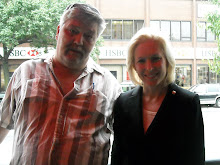
Council Member Jimmy Van Bramer met with three-time Academy Award nominee and New York City native, Sigourney Weaver and her husband Jim Simpson to discuss the vital role that Arts and Culture plays in the lives of New Yorkers and the financial impact these institutions have on our economy. From left to right: Jim Simpson, Sigourney Weaver and Council Member Jimmy Van Bramer.

Published as an op/ed in NY Daily News - June 22, 2010

It’s no secret – New York City is facing a very difficult budget year, with record deficits. The administration and the City Council are balancing multiple priorities and one idea remains constant: no budget cut is a simple reduction. The repercussions of our choices are heavy, and we need to remember the true value of arts and cultural organizations to our city.

As chair of the Committee on Cultural Affairs, Libraries and International Intergroup Relations, and as an actress who is native New Yorker and avid supporter of the arts, we are both very aware of the benefits these institutions provide for our city, especially during an economic downturn. From the multitude of museums to the unique galleries and performance spaces, cultural institutions in all five boroughs embody the vitality of New York City.

Artists and art lovers flock here from all over, making our cultural institutions an economic powerhouse – driving tourism, creating thousands of union jobs, and providing educational opportunities for our children and adults alike. The arts cannot be considered a luxury – they make New York the destination of choice of people all over the world.

Our cultural institutions provide critical revenue to help balance the budget. The investments we make in culture and the arts create a ripple effect throughout our economy, generating revenue that keeps our city strong. According to the Alliance for the Arts, the arts industry in New York City generated an estimated economic impact of $21.2 billion in 2005, the equivalent of 160,000 fulltime jobs, $8.2 billion in wages and $904 million in taxes to the city.

But now the arts – the pulse and life stream of our city – are in danger. Anytime we reduce funding for the arts, we undermine our ability to stimulate our economy. The proposed 40% reduction in funding for culturals will have serious effects. Many of our smaller community-based institutions, including neighborhood theatres and performing art venues, will face extinction. And other institutions will be crippled by this loss in needed funding.

The city’s Executive Budget pointed out that tourism is one of the few success stories in what is a bleak economic portrait. However, it is important to note there would be far fewer tourists currently if there were no attractions to draw them here – like the Broadway shows and the multitude of museums that have made New York City a metropolis of culture and art. In addition to the crowds that these institutions attract, they also provide business for other sectors of our economy like hotels and restaurants. Can we really afford to cut back in an area that fiscally and culturally stimulates our economy?

While we can numerically measure the economic impact of cultural institutions, the less tangible effects that these cultural institutions have on our society are truly priceless. The loss of inspiration for a child who will be deprived of these experiences cannot be ignored. The cultural institutions, which embody and promote this creativity and empowerment for our youth are in danger. By making concessions that deprive the arts, we undermine the future and stability of our city.

We must make sure that New York City remains a place where the arts thrive. This is how the city will weather this economic storm, and it is the only way that New York City can ensure its place as the cultural and financial capital of the world.

Jimmy Van Bramer, represents the 26th District in the New York City Council and chairs the Cultural Affairs, Libraries and International Intergroup Relations Committee. Sigourney Weaver is a three time Academy Award-nominated actress and New York City native who co-founded The Flea Theater in New York. Both are enthusiastic supporters of theater and culture in New York City.

Wednesday, April 21, 2010

New York Seeks to Limit Art Vendors at Parks by David Chen - NYTimes.com

Read original...

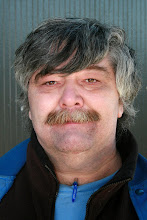
Under proposed new rules, the number of vendors who can sell art at city parks would be limited. Noel Donaldson at a popular spot at Union Square Park.

Street vendors who have become fixtures at some of Manhattan’s busiest parks — hawking paintings, kitschy souvenirs and all sorts of ephemera — may find themselves a lonelier crowd, as the Bloomberg administration proposes to cut their numbers by 75 percent.

Vendors of art in the broadest sense now face no limits in places like Central Park South.

On Friday, the Department of Parks and Recreation is scheduled to hold a hearing on a proposal to slice the number of vendors allowed in parts of Central Park and all of Union Square Park, Battery Park and the High Line Park. If the proposal is approved, as expected, the restrictions would begin to take effect in a month.

Adrian Benepe, the parks commissioner, said the change was needed because vendors block sidewalks and hamper pedestrians, creating hazards. But, he also said, too many vendors are turning the parks into “year-round flea markets” and “selling stuff that you wouldn’t consider expressive art” as protected by the First Amendment, like “refrigerator magnets, small sculptures that are mass produced, books, DVDs, CDs, signs with funny slogans.”

“The artists can vend,” Mr. Benepe said. “The people who sell other goods can vend. And everybody will adjust. This is not the end of art. It is just a very slight and strategic moving of where people can sell art.”

To some art vendors, though, the administration’s proposal smacks of an attempt to remove them as much as is legally permissible — or at least to hurt their incomes — as if they were eyesores or nuisances to tourists and corporations. And one casualty, they believe, will be the kind of spontaneous and messy mingling of art and commerce that makes New York so New York.

“New York City is not a hospital operating room, yet Mike Bloomberg is continuing the sterilization campaign that Rudy Giuliani started in Times Square,” said Robert Lederman, a longtime foe of Mr. Benepe’s and the founder of A.R.T.I.S.T., an advocacy group with approximately 2,000 members. “And the parks commissioner, Adrian Benepe, sees himself as a real estate agent who’s trying to get the maximum price per square foot for all of our public parks.”

The proposed regulations would limit the number of vendors of printed texts and visual arts in congested areas of the four parks, which are among the city’s busiest, to a total of 81, compared with the more than 300 there now. Vendors would be limited to designated areas on a first-come-first-served basis. The rules would also dictate the dimensions of a seller’s table, as well as a table’s proximity to public property like monuments and benches.

One supporter of the proposal is Edward Wallace, a former councilman who helped to write the original 1982 law that allowed vendors to sell “expressive matter” under the First Amendment’s right to free speech.

Mr. Wallace, who is now a lawyer and a lobbyist but does not represent any clients in the current battle, said his goal was simply to allow poets and other artists the liberty to speak freely on street corners. “This is the law of unintended consequences,” Mr. Wallace said.

Some constitutional law experts were uncertain whether the city would be able to change the rules, as planned.

Ira C. Lupu, a law professor at George Washington University Law School, said that while it was true that “the city can regulate the place, not the content,” it also had to give “reasonable access to the distribution of art.” And reasonable, he said, “is a term of art.” He also said he was troubled by the first-come-first-served provision.

“I don’t know what that means,” Professor Lupu said. “I would be constitutionally more comfortable with a lottery system that you could do online a week ahead of time.”

Lee Stuart, the executive director of New Yorkers for Parks, an advocacy group, said the plan had the right balance between protecting the parks, and granting the vendors enough room. “I don’t think this is a blanket restriction at all,” she said.

But several artists were dubious about the plan. At the southeast corner of Central Park, Dario Zapata, a caricature artist from the South Bronx, said: “The First Amendment is protection for artists. What will happen if the city limits us to eight spots here? Maybe hundreds of people will sleep on the benches to get a spot.”

Some pedestrians said they were troubled by the idea, too. Walking through Union Square, glancing at paintings, was Kristan Hibron, who studies marketing management at Pace University and works for an outdoor advertising company. “I love that I can come into New York and have a huge, diverse collection of art to choose from,” she said. “I really appreciate it. I respect artists. And this is one of the only venues they have for selling. They need to make money.”

Friday, November 28, 2008

A Call to Brooklyn Artists “Gowanus Basin: A Sense of Place”. December 5th -22nd, 2008

The Gowanus Canal Conservancy (GCC) invites visual artists to participate in a benefit art exhibition and sale, "Gowanus Basin: A Sense of Place”, on December 5-22, 2008. This event has come about very quickly, due to the imminent availability of a new retail space in Gowanus, on Bond Street between Union and Sackett.

The primary objectives of this exhibition are to raise funds for GCC, to bring focus on Gowanus as the center of northwest Brooklyn neighborhoods, to generate public interest in the preservation of the Gowanus landscape, and to foster opportunities for local artists.

Very prompt action is requested by interested local artists -- the Opening Reception will be on Friday, December 5, 6-8:30 pm. Regular gallery hours over the following 3 weeks are Thursdays 3-8 pm, Fridays 3-6 pm, Saturdays and Sundays 11 am - 7 pm. There will be a Final Day Sale on Monday, December 22, 11 am - 7 pm.

Submitted artwork should be representational views of streetscapes, landscapes, or interiors, and specifically of locales in the Gowanus Basin area of Brooklyn [the neighborhoods of Gowanus, Park Slope, Carroll Gardens, Boerum Hill, Cobble Hill]. Artwork must be 2-dimensional media: painting, photography, original prints, etc. and must be framed or canvas edges painted or taped. No wood strips attached to canvases will be accepted. Artwork must be securely wired for hanging. Artwork should be priced generally between $100 and $1000, and there are no size restrictions. Artists may request either a 2' or 4' wide space, and on acceptance artists will be notified of their space assignment.

Accepted artists will be responsible for hanging their artwork on 12/4, 2-9 pm, or 12/5, 11 am-3 pm. Accepted artists will also be asked to gallery-sit for at least one 2.5-3.5 hour shift during the show. Artists will have the option to participate in the "Final Day Sale" on Monday, December 22, when retail prices will be lowered by 20%. Any unsold artwork must be removed from the gallery on Tuesday, December 23, by either the artist or a designated representative. Artist’s payment checks for sold artwork will be distributed at that time.

The Gowanus Canal Conservancy will serve as the gallery operator, and artwork will be consigned to them for the duration of this exhibition. The Conservancy will also be responsible for all sales transactions and accounting for them, retaining 35% of sales as a donation (40% for sales over $400); provide liability and property insurance for the temporary gallery space during this exhibition; create and provide artwork labels based on information provided by artists; generate publicity by sending out postcards, e-mails, blog postings, press releases and placing local paper ads.

To apply to exhibit at this show, send an email with your name, telephone number, artwork media, price range, and 3 sample images [in small jpeg files] by 5 pm on Monday, December 1, to Lauren@Gowanus.org. If accepted you will hear back by 5 pm on Tuesday, December 2, and will be expected to send by email your list of artwork for the exhibition with pertinent information (title, medium, size, price) by 5 pm on Wednesday, December 3.

The Gowanus Canal Conservancy is a 501(c)(3) non-profit organization located at 509 Court Street, Brooklyn, NY 11231. For more information please visit www.gowanuscanalconservancy.org., or call Lauren Collins at the Conservancy office, 718-858-0557.

Sunday, June 10, 2007

Queens Chronicle: Students Display Creativity At Queens Museum Photo Exhibit by Steffon Fynes

Students from John Adams and Richmond Hill high schools last Saturday put their creativity on display for all to see at the Queens Museum of Art.

The “Crossroads Expo” was the culmination of the students’ enrollment in Photography for Art and Creative Expression, an after-school program run by the nonprofit group South Asian Youth Action.

Manauvaskar Kuball, known to most of his students as Manny, led the photography program. “I wanted to introduce kids from the community to photography as a use for creative expression and change, and for them to feel a sense of pride in their work and express their lives through their work,” he said.

A native of the neighborhoods near the two high schools, Kuball taught and discussed ideas about photography with students, and encouraged them to find their own source of inspiration for their work.

Michelle Manzano, a junior at Richmond Hill High School, showed her love for sunsets in her photograph titled “Sunset over Richmond Hill.” Jonahiry Rosario, a sophomore at Richmond Hill, showed her love for colors and her family in the photograph titled “ People I Love.”

The program also allowed students to develop an appreciation for photography and deepen their passion for the art form. “Photography is fun, it shows how you see things, depending on which angle you look at it from,” said Tarnjeet Kaur, a junior at Richmond Hill. She shared this insight in her symbolic and touching photography “My Sunshine and My Son,” whose subjects are her husband and her son.

Melinda Ramesh, a sophomore at Richmond Hill , discovered the beauty of her neighborhood in her piece, named “Cosmo Graffiti.” Ramesh hopes to take up photography as a profession.
The exhibit attracted family members and friends of the students, along with other spectators who were visiting the museum at that time. A ceremony to open the exhibit featured a performance by hip-hop artist Chee Malabar, with his words expressing the same themes as the photographs —love of family, community and culture.

Wednesday, May 16, 2007

Seattle PI: The arts, reading are key to this nation..by Joel Connelly...

WITH A VIEW of culture more befitting the Third Reich than the Third Millennium, reactionaries in Congress set out in the mid-1990s to kill the National Endowment for the Arts.

They took a program largely responsible for bringing music and dance to public schools and tried to demonize it, cherry-picking a few controversial grants to such folk as the late homoerotic artist Robert Mapplethorpe.

Efforts to smash the NEA were eerily reminiscent of the famous statement by Reichmarshal Hermann Goering: "When I hear the word 'culture,' I reach for my revolver."

Seattle became a hotbed of resistance to the knuckle draggers of the late 20th century. Corporate Council for the Arts (now ArtsFund) boss Peter Donnelly and Seattle Opera Director Speight Jenkins were leaders in a national battle that preserved the NEA, albeit as an agency parched for resources.

A decade later, the NEA is back on its feet. Its chairman is Dana Gioia, a former General Foods executive turned poet, critic and American Book Award winner. Gioia is a first-rate Bush appointee who knows his portfolio. He has championed such programs as Shakespeare in Communities and a "Big Read" effort designed to reacquaint America with the classics.

"He has made it impossible to vote against the endowment," Jenkins joked Monday, after Gioia spoke to ArtsFund's Celebration of the Arts luncheon.

Nearly 1,000 people turned out to hear Gioia. With its sculpture garden and expanded downtown digs, the Seattle Art Museum has local scribes mouthing and penning this-puts-Seattle-on-the-map platitudes. Beethoven's Ninth Symphony was performed, and quite well, last weekend in Bremerton.

What is misleading with this rosy picture? Answers came from Gioia in a sharp, blunt speech deserving of a hearing beyond the Westin ballroom.

"Across the country, school district by school district, arts are being removed from our public education," Gioia warned.

As well, he added, "The arts don't live in the media. ... Our society has chosen not to make arts part of our public culture." By contrast, pop culture is glorified. Our schoolchildren can name NBA stars and contestants on "American Idol." But, asked Gioia: "Can they name a living American poet, a famous architect, a classical musician, a philosopher or a theologian?"

It wasn't always so. In the 1950s, CBS broadcasts of the New York Philharmonic "Young People's Concerts" under conductor Leonard Bernstein popularized classical music for baby boomers.

Gioia is not just concerned with cultural literacy. The United States has experienced "a universal decline in reading" over the past 20 years, argued the NEA boss. "The problem is worse among young Americans."

That which the gods would destroy, they must first cheapen. What Gioia was warning about is not just the country becoming a cultural "dustbin" -- to use Sir Thomas Beecham's World War II-era description of Seattle -- but of a broader threat to citizenship.

In his 1968 campaign that challenged the Vietnam War, poet-politician Eugene McCarthy loved to evoke an ancient Celtic poet, Cadoc the Wise.

To love his land, a man must love justice, intoned Cadoc. (This was pre-gender equality.) To love justice, a man must love learning. To love learning, a man must appreciate poetry and song.

Gioia put it a bit differently Monday. With children, he said, the arts awaken a sense of the world. With teenagers, arts and culture help provide an understanding of what their adult identity will be. With adults, arts and culture "keep us alert and alive to the potentials within us."

In real spending, the NEA's budget topped out at $170 million in 1994. The "Gingrich Congress" cut it back to $99 million. The endowment budget has climbed back to $124 million.

With help from Congress' newly empowered appropriator, Rep. Norm Dicks, D-Wash. -- "the most steadfast champion the NEA has in the House," in Gioia's words -- the endowment hopes to climb back to '94 levels. President Bush's budget proposes a small increase to $128.4 million.

OK, such is the good news. The bad news is that education budgets in schools are getting whacked across the country. The Bush budget would eliminate the Department of Education's $35 million arts-in-education program. Chancellor Joel Klein announced early this year plans to discontinue Project ARTS, which has funneled more than $680 million into New York City schools. In Florida, a House budget recommended cutting state arts grants from $32.6 million to $9.6 million.

Cadoc was wise without opinion polls. Nowadays, we have evidence of the value of arts to young and old alike.

Surveys show that kids who participate in the arts are four times more likely to be recognized for academic achievement. They're three times more likely to be elected to class office. They are four times more likely to join in a science or math fair.

And adults? "People who read are overwhelmingly more likely to participate in civic life at every level," Gioia said. "They do charity work at more than twice the level. If we lose this in a democracy, we lose the most positive foundation for participation in American society."

Or as famed jazz musician Wynton Marsalis warned on a recent trip to Capitol Hill: "Our kids are uncultured and culturally ignorant all over this country. It's important for us, in this time, to set another tone for what our nation is about."

P-I columnist Joel Connelly can be reached at 206-448-8160 or joelconnelly@seattlepi.com.