As an apex predator, the eagle helps maintain an important balance of mammals and birds within natural communities, and may serve as a bellwether to human society as well. Roblee tells us, "We can end up with nuisance problems, with some species becoming too numerous, it can result in over-browsing of certain plant communities, so we need top predators, and the Bald Eagle is an important one."
Sunday, February 6, 2011
The Bald Eagle Making An Impressive Comeback In New York State | wgrz.com
As an apex predator, the eagle helps maintain an important balance of mammals and birds within natural communities, and may serve as a bellwether to human society as well. Roblee tells us, "We can end up with nuisance problems, with some species becoming too numerous, it can result in over-browsing of certain plant communities, so we need top predators, and the Bald Eagle is an important one."
Sunday, July 4, 2010
Soundtrack of Mating Calls Helps Put Flock of Endangered Waldrapp Ibis at Bronx Zoo in the Mood by Barry Paddock - NY Daily News
Six endangered Waldrapp Ibis chicks like the one above (l.) were born at the Bronx Zoo several weeks ago. The birds mated after a soundtrack of mating calls was piped into their enclosure. Watts for News
A low-libido colony of endangered birds in the Bronx got their groove back - thanks to love songs piped into its home.
The flock of 21 Waldrapp ibis living at the Wildlife Conservation Society's Bronx Zoo had produced no chicks for seven years.
After zookeepers piped in a sexy soundtrack of mating calls recorded halfway around the world, they turned frisky and have hatched six offspring from three sets of parents.
It's a coup because the birds are extremely endangered - there are just 400 left in the wild - and rarely reproduce in captivity.
"The whole species is at risk," said Mark Hofling, a zoo ornithologist who oversees the species survival plan for ibis in North America.
"They had pretty much stopped courtship behavior," Hofling said of the Bronx birds. "They were just going through the motions."
Two years ago, Dr. Alan Clark of Fordham University recorded the flock's own mating calls, hoping to create aural Viagra by playing them on an endless loop.
There was too much outdoor ambient noise on the tape, so Clark tried again last year at the Philadelphia Zoo's indoor display.
The recordings, played back in the Bronx last spring, did seem to get them in the mood, but they still produced no chicks.
So this spring, Clark upped the ante and visited a semiwild flock in Austria, returning with the perfect recordings of the birds' three distinct mating calls: a chirrup, a whoop whoop and a shrum shrum.
When they found the right sounds, they were played mornings and afternoons from an iPod hooked to speakers on the ibis' wire mesh enclosure near JungleWorld.
And the birds got busy.
They built nests, preened and necked. Several couples laid eggs, and the six chicks hatched in May. The birds grew to adult size, about 2 pounds, in six weeks.
Now zoo officials are trying the same technique on Caribbean and Chilean flamingos, also experiencing a dry spell.
"If it works with this one species, there's the possibility we can apply it to a wide range," said Dr. Nancy Clum, chief ornithologist at the zoo.
It took some experimenting to isolate the right flamingo calls.
"It can sound like a lot of noise," Clum said of the recordings. "You don't want to be playing a vocalization to them that's actually an alarm call."
Meanwhile, the zoo is installing a professional sound system for the ibis for next spring's mating season.
The adult fowl have pink featherless heads splotched with black spots. They can live into their 30s.
"They have beautiful glossy plumage," Hofling said. "People come and say, 'Oh, that's an ugly bird.' I tend to disagree. They're unique."
The mating success doesn't mean the ibis are on the road to repopulation.
"The reasons that made them endangered - human encroachment, pesticide use - are still with us," Hofling said.
Saturday, April 17, 2010
Ivory-Billed Woodpecker Search Ends by Jorge Ribas : Discovery News
The active search for the long-lost bird of science and myth -- the ivory-billed woodpecker -- is officially ending. At least it is for the Cornell Lab of Ornithology.
“The preliminary conclusion we’ve come up with at this point is that it’s unlikely that there are recoverable populations of ivory-billed woodpeckers in those places that have received significant search efforts over the past five years,” Ron Rohrbaugh, director of the Lab’s Ivory-billed Woodpecker Research Project, told Discovery News.
The exhaustive, five-year search took biologists and volunteers throughout the historic range of the bird. With one team stationed in Arkansas, another, smaller team traveled from North Carolina to Florida to Texas.
In 2007 I headed into Arkansas’ Black Swamp to follow the team as they trudged through the muck to find evidence -- any evidence -- that Ivory-billed Woodpeckers still exist. Striking deep into an almost alien landscape with black tupelo and bald cypress trees reaching high overhead. All we found on my visit were mud-colored cottonmouths, giant bullfrogs and the tantalizingly similar (at least to my untrained eyes) pileated woodpeckers.
But no ivory-bill.
“I think we’d say that (the searches) are suspended until any new information would come about that would provide impetus for starting up systematic searching again,” he said.
That first impetus was seven solid sightings and a video shot by David Luneau. It spurred Cornell to launch the extensive search and to publish an article in 2005 in the journal Science that concluded that the bird was still alive. But since then, nothing conclusive has emerged.
“We’ve been unable to acquire definitive evidence for the persistence of ivory-bills in Arkansas or any of those other states,” Rohrbaugh said. “We continue to get occasional bits of information that are substantive, and we can follow up. But nothing has led to anything definitive just yet.”
Cornell’s decision in 2005 to declare the bird re-discovered caused excitement and uproar in the birding community. Rohrbaugh acknowledged the controversy, but said it’s all part of the scientific process.
“Obviously some other scientists have looked at that same information and come to different conclusions,” he said. “And you know, that’s how science works; that’s OK.”
Still, he stands by their original hypothesis.
“When we apply the scientific method and our own video analysis to that information, the interpretation is that that bird is an ivory-billed woodpecker,” he said.
And despite the results, Rohrbaugh said he believes all the time, money and effort were worth it.
“We had what I perceive to be strong evidence of an ivory-billed woodpecker at least for a short period of time in Arkansas,” he noted. “One path is to say, ‘OK, the bird was there. We're not going to do anything about.’ ... That seems insane. You have one of the most critically endangered birds on the planet; why wouldn’t you follow up? And the other path is to mount a significant standardized search of the area, which is what we did.”
So the question remains: Is the ivory-bill still out there?
“I do think it’s possible,” he said. “We haven’t searched every place. It would be impossible to put together teams to search all of the ivory-billed woodpecker’s historic range. We’ve done the best we could.”
No doubt individual sightings will continue, and Rohrbaugh cautions against declaring the bird officially extinct.
“We have to be sure that the bird is really gone before we give up. As soon as one decides that a species is extinct, there are a lot of consequences,” he said. “That bird can lose protection under the Endangered Species Act, its habitat can be lost, and there’s a change of attitude among scientists and the public to submit new observations because they might be scoffed at.”
So instead of heading back into the swamp, Cornell will sift through all the data they’ve collected over the years. Rohrbaugh said a book on their findings will be published next year.
Friday, April 9, 2010
Record-setting Year for Peregrine Falcons; Eagle Count Poised to Set Record - NYS Dept. of Environmental Conservation
Last year proved to be a record-setting year for peregrine falcons in many productivity categories according to a new report released recently by DEC. In addition, preliminary results of an annual mid-winter survey indicate that the bald eagle population in New York State may be at an all-time high since the state began its re-population efforts more than 30 years ago.
Peregrines' Progress
DEC surveys found 73 territorial pairs of state endangered peregrine falcons present in the state in 2009, with 42 pairs recorded upstate. That's a slight increase from 2008, when 67 pairs were recorded statewide. Also in 2009, 61 pairs bred and produced 132 young, also slightly up from 2008.
"The 2009 report shows that it was a successful year for New York State's efforts to restore our peregrine falcon population," DEC Commissioner Pete Grannis said. "The record-breaking numbers are a positive sign not only for the environment but also for the work carried out by DEC's endangered species program."
New York State has the largest population of peregrines in the eastern United States. Peregrines raise one to five young in nests located mainly on cliffs, bridges and buildings. They are known for their high speed-more than 200 mph-dives on their bird prey.
They had disappeared as nesting birds from the eastern United States by the early 1960s due to pesticide (DDT) residues, which caused eggshell thinning. Once DDT use was banned in the United States, an experimental restoration program began, involving widespread releases of captive raised birds from the Peregrine Fund, a global non-profit organization focused on conserving birds of prey. Through this program, 169 young peregrines were released in New York State from the mid-1970s through the late 1980s.
In 1983, the first new pairs nested at two bridges in New York City, and in 1985 two pairs returned to nest on Adirondack cliffs. The population has grown steadily since then. There are now about 20 pairs in the metro New York area and 27 in the Adirondacks, a pair at every major bridge between New York City and Albany, and about 10 pairs scattered through the rest of the state.
At many of the urban nest locations, wooden nest trays have been placed to increase the falcons' productivity. Peregrine falcons do not build nests of sticks like most raptors, but instead lay their brownish eggs in whatever substrate is available. Protection and management is necessary to continue this species' success in New York, which means working with building and bridge authorities so that whenever possible their work is done in a way that does not negatively impact nesting peregrine falcons. DEC has had excellent cooperation from many agencies and volunteers in protecting, managing and monitoring this endangered species.
In the Capital Region, a pair of nesting birds can be seen at the Dunn Memorial Bridge during the spring and summer seasons. A webcam operates during the nesting season at this site and several others in New York State. For links to these sites and other information, including a link to view the new 2009 peregrine falcon report in full text, visit the Peregrine Falcon page on DEC's website.
Eagles Excel
New York has conducted annual surveys of bald eagles since 1979, and the highest official winter count occurred in 2008 with 573 bald eagles spotted. DEC's preliminary results for 2010 indicate that sightings may exceed this number as regions of the state continue to provide favorable wintering habitat for both New York's resident eagles and visitors from Canada. As of January 31, 459 eagles had been sighted, well ahead of 2008's record pace. New York's survey efforts are part of a national initiative that monitors the locations and numbers of bald eagles wintering in the lower 48 states.
The number of wintering and breeding eagles in New York reached its nadir in 1975 when, due to the ravages of habitat loss, indiscriminate killing, and DDT contamination, the state could document only one non-reproductive pair of eagles. That year, DEC launched its effort to restore bald eagles to New York. The aggressive program, led by DEC biologist Peter Nye, included years of collecting bald eagles from Alaska and transporting and releasing the young birds to carefully selected habitats around the state. Nye and other DEC staff continue to monitor New York's growing population. DEC's work has since been emulated by many other states. The state's Endangered Species Act has also played an essential role in the recovery of bald eagles, as well as other vulnerable species, by enabling DEC to protect critical breeding, foraging and migratory habitat.
Amazing Success Story
"The resurgence of the bald eagle has been one of New York's most amazing environmental success stories," Commissioner Grannis said. "This has been due to the tremendous commitment of many DEC staff over the past three decades and the ongoing cooperation of individuals and communities that recognize the importance of protecting essential habitat bald eagles need to thrive."
Bald eagles generally require and seek out open water where they find their preferred food-fish or waterfowl. Several areas of New York, with essential open-water wintering habitats, host hundreds of eagles each winter, many coming from northern Canadian provinces. By early January, the birds have arrived at their annual wintering grounds, providing a good opportunity to track how the overall population is faring.
At the start of the survey in early January, DEC works with the New York State Police Aviation Unit to conduct aerial observations of the state's largest known wintering habitats. This information is supplemented with reports from dozens of volunteers throughout the state who are on the ground.
During last month's aerial survey, 101 eagles were identified along the St. Lawrence River (a record), 30 along Lake Champlain, 277 in southeast New York (the Hudson and Delaware river basins), and 51 in western New York (Allegheny River and Lake Erie basins). This winter's count is expected to be higher than previous years because of prolonged periods of cold weather and extensive ice conditions - factors which can draw more eagles in from Canada and concentrate them within a few suitable wintering habitats in New York. Additional eagle reports will be added to these totals as volunteers' ground counts are reviewed.
For the past several years, as many as 15,000 bald eagles annually were counted across the nation, with the northeast region seeing the greatest increase in overall numbers of wintering eagles since 1986. The 2010 survey was especially important as it marked the next scheduled update for a comprehensive 25-year national and regional trend analysis.
The good news in winter eagle numbers comes on the heels of another record-breaking breeding season for bald eagles in New York. In 2009, 173 breeding pairs were confirmed to have successfully raised (fledged) 223 young.
More information about bald eagles in New York State can be found on the Bald Eagle page of DEC's website.Saturday, December 20, 2008
The State of the Oceans - The True Cost of a Shrimp Dinner! - YouTube - cspanjunkie.org
The State of the Oceans - CSPAN - Running Time: 10:57
Monday, February 18, 2008
Educator Takes in Turtles as Animal’s Population Declines By Sara Foss - The Daily Gazette Schenectady
(U.S. Fish and Wildlife Service Photo)
DELMAR — The turtle’s name is Sammy. Like most snapping turtles, he has a craggy face, thick skin and strong jaws. But Dee Strinsa, who has handled amphibians and reptiles since she was a child, isn’t afraid. She lifts the turtle out of his tank, balancing him on the palm of her hand as if it’s the easiest thing in the world.
“He only bit me once,” Strinsa remarks.
Sammy landed in Strinsa’s care after he lost his eye and part of his nose when he was struck by a car; now, he lives at Five Rivers Educational Center, so disabled he cannot return to the wild. There are other turtles nearby: a plastic container inhabited by five box turtles and a soft-shell turtle, native to Florida, who’s named Bisquik, “because he’s flat as a pancake.” Bisquik once lived in a school classroom. There’s also a 7-year-old sulcata tortoise, which is native to Africa and can grow over 24 inches tall.
“She eats like a horse,” Strinsa notes, while showing off the turtles and tortoise who live at Five Rivers. “I don’t know what I’m going to do with her when she gets older.”
Strinsa is the water education specialist at Five Rivers, but she also cares for abandoned and injured reptiles and amphibians, and runs educational presentations for school groups and the public. One of her goals is teaching people about a species that has seen its population steadily decline over the years; earlier this month, she gave a talk, titled “Where Have All the Turtles Gone?” at Thacher Nature Center in Voorheesville.
Taking Her Work Home
Like her office, Strinsa’s Duanesburg home is filled with turtles — 28, to be exact. They live in a heated room off the kitchen, along with two tree frogs, a toad and four or five pythons.
There are red-eared sliders and painted turtles, as well as spotted and Blanding’s turtles. Many of these turtles had serious problems when they arrived: A diamondback terrapin, for example, refused to eat. “Now I can’t get it to stop,” Strinsa said.
Strinsa is also raising a dozen wood turtles for the New York State Department of Environmental Conservation; in the spring, when the water is warmer, these turtles will be released into the Vlomankill creek near Five Rivers as part of a state effort to reintroduce the species to the area.
They will be 3 years old — mere infants, considering wood turtles can live nearly 60 years.
“Historically, wood turtles have been out there, but we haven’t seen any for a long time,” said Strinsa, who has released 18 wood turtles into the wild during the past couple years. “Wood turtles need a huge amount of territory. They’re in streams in the winter, but they’ll wander around in the summer. They’ll wander about a mile.”
The state has tried similar releases in the past, with mixed results.
What Strinsa is doing is a bit of an experiment, said Al Breisch, the amphibian and reptile specialist with the New York State Department of Environmental Education’s Endangered Species Unit. “Any of these releases you’d have to call experimental because they’re not a very easy thing to do,” Breisch said. “We’re hoping it expands. We say they’re experimental because every project requires follow-up to see if it will succeed.” He said the goal is to move from this experimental phase to a more “traditional management approach,” where developers receive information about turtle species in the area they’d like to develop and use that information when drawing up plans.
“The re-establishment of a population is a desperate measure,” Breisch said. “That’s when you’re starting to see things go away. I’d rather put effort into protecting habitat.”
He added, “We don’t want to encourage people to start their own [re-establishment] projects.”
Threatened Species
In New York, box turtles and wood turtles are species of special concern; the Blanding’s turtle is listed as threatened. Virtually every turtle species in the state — even the more common snapping and painted turtles — are listed at some level of concern, Breisch said. “Turtles are the most severely impacted group of vertebrates by humans,” he said.
Re-establishing a turtle population is challenging for several reasons. Their life span is long, which means they don’t reach sexual maturity until they are in their teens. As a result, Breisch is still waiting to see whether turtles that were released into the wild more than a decade ago will reproduce; if this doesn’t happen, the project cannot be considered successful. Turtles also get programmed to their habitats; if they are removed from their home, they have a tendency, when set free in a new location, to just wander forever in search of their home.
In the early 1990s, the state reintroduced more than 100 box turtles in the Jamaica Bay Wildlife Refuge on Long Island.
To prevent them from leaving to look for their home habitat, the state built an enclosure and left them inside of it for months. Eventually, the turtles were permitted to move outside of the fence. Some stayed in the area, others were killed by predators, others left.
Around the same time, six box turtles were introduced, in an enclosure, in the Albany Pine Bush. After they were moved outside the enclosure, three stayed in the Pine Bush and the others wandered away.
Because of the mixed success of the box turtle projects, the state decided to introduce baby turtles, rather than full-grown turtles, to the wild in future releases. In 1996, they began covering Blanding’s turtle nests; when the eggs hatched, half were released into a pond, and the other half were sent to the College of Veterinary Medicine at Cornell University to be raised.
Eventually, 55 Blanding’s turtles were released in a preserve in Dutchess County. About half of the turtles, Bresich said, have survived; for the first time, females — those who are 18 this year — will be able to nest.
“Because we used hatchlings, they didn’t have time to develop the cues that would tell them where their habitat was,” Breisch said. With the adult turtles that were released, “everybody was already set in their ways.”
Dwindling Population
For years, the state’s turtle population has been declining.
This is the result of several factors: loss of habitat because of development and road construction, hunting for food, and the pet industry.
Many of the turtles purchased as pets are abandoned. “It’s mostly habitat loss,” Strinsa said. “Their habitat is just disappearing.”
Breisch agreed. “Development has expanded into areas I didn’t think it would expand into 25 years ago,” he said. “There’s development on marginal land I used to think would be set aside for wildlife.”
Breisch recalled driving in New Scotland and seeing a box turtle walking on the road. When he got out of the car to look at it, he said that it was a Gulf Coast box turtle — in other words, a species that isn’t native to New York. “There were no houses within a quarter of a mile,” he said. “How did it get here?”
“Most pets have a short life,” Breisch said. “People get a turtle, and they [have to be] willing to make a commitment to it.”
Strinsa grew up on Chatauqua Lake, where her father worked as a fishing guide. Her mother, she said, remembers her playing with snakes as a child. “I grew up playing in a swamp,” she recalled.
Licensed Rehabilitator
As an adult, she became a licensed wildlife rehabilitator.
She was eventually hired at Five Rivers as a water education specialist, but much of her work revolves around reptiles and amphibians “They knew I had all sorts of animals,” she said. “It sort of evolved.”
At one time, Strinsa rehabilitated an average of 10 turtles a year, but that figure has dropped to three or four.
She once rehabbed a milk snake that’s spine was broken by a dog that shook it so hard eggs flew out; Strinsa placed the snake in a plastic sleeve-like cast, and the snake laid the rest of its eggs.
Once, she hatched the eggs of a turtle that had been killed by a car.
Strinsa is “an amazing person,” Breisch said. “She really gets into this. She’s concerned about the welfare of the animals.”
Strinsa has an older wood turtle she uses in her presentation, but she doesn’t bring the baby wood turtles she’s raising to Five Rivers.
“I don’t want them to interact too much with people,” she said. “I don’t want them to walk up to something that’s going to eat them.”
Turtles can be fun, but they’re often more than people bargained for.
“Turtles live a long time,” Strinsa said. “A turtle is dirty.” But they have their good qualities as well. “Turtles are personable,” she said.
“People think they’re going to make a great pet, and they don’t.”
Saturday, December 29, 2007
Searching for Green in Gotham - NYS Dept. of Environmental Conservation
New York City is my laboratory. When spring peepers begin chorusing in March, I am transformed from sleepy bookworm into mad scientist, keen to identify every plant and animal I find in my travels through Gotham. On starry summer nights, I creep through Central Park, in search of owls that flit from tree to tree in the shadow of skyscrapers. In autumn, I spend hours with my neck craned to the skyline, watching hawks heading south in migration. During winter, I keep warm in science libraries, thumbing through vivid accounts of wild New York written by early naturalists in whose footsteps I now follow. I am on a mission to determine what plants and animals inhabited my city in the past, and which ones live here still. Why have some species disappeared, while others flourished? Is there any rhyme or reason to these local extinctions? By answering such questions, it might be possible to develop strategies to protect our remaining biodiversity.
I know, I know. To some, New York City is regarded as the land of rats, roaches and other nasty things. Worse, many scientists don't take urban ecology studies seriously. I am often teased by those who do "serious" research in the rainforests of faraway Shangri-las. Compared to them, I feel like an outsider to real science. However, important biological information that has relevance to "wild" places can be discovered in urban areas if you know where to look. Cities like New York afford wonderful opportunities to study changes in biodiversity through time. There is often a history of investigation for particular urban locations made by naturalists dating back as far as the early 19th century, recorded in scientific papers, museum specimens and field notes. This historical record can then be compared to what still exists today in order to understand how and why changes have occurred.
Does the study of New York City's urban ecology have any relevance to other places? Absolutely. Today, most people in North America, South America, Europe and Australia live in cities. By 2025, almost two-thirds of the world's people will live in urban areas. Understanding the effects of rapid development will help conservation biologists decide what kinds of species and habitats to monitor in the coming years as urban sprawl affects natural areas throughout the world. Rather than a strange place to study nature, New York City might be the perfect laboratory to study a habitat that people, plants and wildlife share together. Understanding changes in diversity in New York City through time can shed light on the future of biodiversity everywhere.
Here in Gotham, my favorite species are wildflowers and other plants that grow in our parks. No special skills are needed to find them, and they won't run or fly away when you do. Plants define natural areas in the five boroughs: from the meadows and woodlands of the Bronx to the ponds and forests of Staten Island, to the sandy ocean beaches and salt marshes of Brooklyn and Queens-and even to the baseball fields of Manhattan's Central Park. Native plants (those found here before Europeans arrived) tell us about what New York City was like in the past and our connection to other places near and far. For example, a native tree such as the sweetgum (Liquidambar styraciflua) commonly grows in moist woodlands in all five boroughs and ranges south to Guatemala. Another native species found here, skunk cabbage (Symplocarpus foetidus), is also native to eastern China. American chestnut (Castanea dentata) trees still exist in New York City and so do native orchids. We have at least one globally endangered plant, Torrey's mountain mint (Pycnanthemum torrei), found in fewer than 20 other locations in North America.
New York City also has many non-native plants such as dandelions, hawkweeds and bittersweet. To the casual observer, these invasive plants make natural areas in New York City look vibrant. But looks can be deceiving. These non-native plants tell a tale of disturbance and development, extinction and invasion.
Non-native plants such as purple loosestrife, Asiatic dayflower, garlic mustard and porcelainberry can outcompete native plants creating a landscape of sameness that can adversely affect birds and insects.
Some of these non-native European species are so aggressive they can sprout through the asphalt in parking lots. Alien plants such as porcelainberry (Ampelopsis brevipedunculata), mugwort (Artemisia vulgaris) and Asiatic dayflower (Commelina communis) have run rampant in meadows throughout the city, making it virtually impossible for native species to keep a toe-hold. We have little idea how others such as purple loosestrife (Lythrum salicaria) affect the diversity of our native insects and birds. Overall, in the last 50 years many of our natural areas have become dominated by a handful of nonnative generalist species, creating a landscape of sameness.
As a result, we are losing the diversity that is characteristic of New York City. In order to help combat this invasion and preserve native plant species, we urban scientists needed some weapons of our own: an inventory of what plants once lived here but are now gone (extirpated), and a comprehensive list of what remains (extant). In the past two decades, my colleagues and I have compiled a list of more than 2,100 New York City plant species, 1,369 (65%) native plants and 739 (35%) non-native. New York City is home to about 60% of the native species ever recorded in New York State-an area 150 times larger. Pockets of native plants still thrive in New York City because some of the finest natural areas were set aside as parkland beginning in the mid 19th century, including Central Park in Manhattan and Prospect Park in Brooklyn. Most of the Bronx parks were established in 1888 as part of New York City's first environmental movement, whose motto was "More Parks Now!" By the late 19th century, clubs and organizations with strong interests in plants and wildlife had been established. These included the Torrey Botanical Club (1867), the American Museum of Natural History (1869), the Linnaean Society of New York (1878), the Staten Island Institute of Arts and Sciences (1881), the New York Botanical Garden (1891) and the Wildlife Conservation Society (1895). Today, we have a good idea of what plants and animals were previously found in each borough because of the collections, notes and writings made by members of these organizations.
Since the first comprehensive studies began, native herbaceous plants such as wildflowers, sedges and grasses have been most abundant. Approximately 30% of our botanical diversity comes from just three families of plants whose members generally prefer much sunshine. These include asters and goldenrod species (Asteraceae), grasses (Poaceae), and sedges (Cyperaceae). The abundance of species in these and similar sunloving plant families indicates that from the 19th to mid 20th century, most of New York City's natural areas were composed of open fields and meadows. Closed canopy forests were rare. Since the Second World War, we have lost nearly half of our native herbaceous species. By comparison, only about a fifth of woody shrubs and trees have become extinct in New York City. Certain groups of our native plants have been particularly prone to extinction. Gone are the majority of our native ferns, violets, sedges, grasses, and pondweeds. We have lost 24 of the 30 species of native orchids ever found here. All 21 of the native orchids once found on Manhattan Island have been eliminated. Nine entire plant families (all composed of herbaceous species) have been extirpated from New York City. Sadly, here in the Big Apple, native herbaceous plants, especially wildflowers, appear to have a dim future for a variety of reasons.
Pockets of native plants still thrive in New York City because of its magnificent parks. Half of all the plants ever catalogued in New York State, are found in the city.
In our parks in the last 75 years, development for landfills, highway expansion, baseball fields, buildings and water treatment facilities has caused a net loss of open space for living things. Native herbaceous plants are forced to exist on ever smaller parcels of land. Many sun-loving native plant species are being shaded out as the forest around them has matured. In the few remaining meadows and fields, our native species are losing the war of competition with aggressive non-native plants.
Increased use of city parks has had a negative effect too, especially on erodible slopes and sensitive wetlands. Perhaps the most important lesson to be learned from New York City is that the designation of an area as a park is not sufficient to ensure the preservation of its native plants, or to prevent the invasion of nonnative species. This is most evident in Pelham Bay Park in the Bronx, the second largest park in New York City. Since 1947, at least 145 native plant species have been extirpated, while 136 non-native species became established during this same time frame. Every habitat in that park has a greater percentage of non-native species than just a half-century ago.
In each New York City borough, a wave of extinction threatens our native flora. Not surprisingly, Manhattan and Brooklyn, the two boroughs that developed the fastest in the 19th century, have been affected most. They have the least amount of parkland and have lost approximately 70% of their native species. Even Queens, where most parks were established from the 1920s through the 1960s, lost roughly 62% of its native flora. An alarming trend is clearly evident: in every borough except Staten Island, more native species have been eliminated than still exist. If other boroughs are any indication, the same trend is going to happen to native plant species diversity on Staten Island in the coming years.
Being a true-blue scientist with ear pressed to the ground, I am always listening for solid ideas to help save New York City's remaining plant diversity and prevent further degradation of our natural areas.
Perhaps collecting seeds of native plants for propagation and translocation, or removing acres of non-native plants that carpet our parks could stop the loss of native species. Such endeavors are part of the solution, but we can't forget to preserve one of our most important habitats: the classroom. Growing there now are young New Yorkers in whose eyes I can read two fundamental questions: Why should we care if our native species go extinct? Why is preserving our diversity important?
These are good questions, and ones that people throughout the world are trying to answer. In the last decade, urban naturalists from as far as Italy and Russia have documented the remaining plant species of their cities, found rare native plants and published scientific papers about changes in local biodiversity. Closer to home, the "Chicago Wilderness" movement has sparked public support and fueled a wave of enthusiasm to save or restore pockets of native plants and animals in the urban environment. In more than one California city, people are working to transform abandoned landfills into meadows, wetlands and forests. Perhaps a new perspective is needed, too: besides restoring parks at street level, green space can be created for native species atop buildings, especially in industrial areas. In New York City, just such an idea is taking root. Almost 600 acres of warehouse roofs are being planted with hardy, drought-resistant grasses and wildflowers for climate control. These and similar solutions, especially if they involve young people, are music to my ears.
Right now in New York City, a renewed environmental movement is afoot to preserve our remaining wild plants and places. Naturalist foot soldiers are combing our parks, continuing to note species new to the city. Graduate students from city universities are conducting ecological studies of urban oases. Reporters from the Village Voice and even the New York Times are reminding everyone that good things can still be found in our town. However, the future of New York City's remaining biodiversity depends on more than the efforts of naturalists, scientists and concerned citizens. We need to ignite the imagination of all New Yorkers, from school kids to taxi drivers to the Mayor.
Who cares about the 2,100 plant species that compose New York's parks, yards and city streets? Why is biodiversity important? I don't know, but I can hear the flowers thinking.
Urban ecologist Dr. Robert DeCandido was born and raised in the Bronx. He has studied bird migration, night hunting peregrine falcons, Gotham's nesting owls and American kestrels, and flora of the Big Apple.
Photo: Robert DeCandido
Tuesday, December 4, 2007
NY Times - A Rising Number of Birds at Risk by Anthony DePalma
View Audubon 2007 Watchlist...
Relentless sprawl, invasive species and global warming are threatening an increasing number of bird species in the United States, pushing a quarter of them — including dozens in New York and New Jersey — toward extinction, according to a new study by the National Audubon Society and the American Bird Conservancy.
The study, called WatchList 2007, categorized 178 species in the United States as being threatened, an increase of about 10 percent from 2002, when Audubon’s last study was conducted. Of the 178 species on the list, about 45 spend at least part of the year in this region.
Among the most threatened is the rare Bicknell’s thrush, a native of the Catskill and Adirondack highlands whose winter habitat in the Caribbean is disappearing. Although less at risk, the wood thrush — whose distinctive song was once emblematic of the Northeast’s rugged woodlands — is on the list because a combination of acid rain and sprawl has damaged its habitat and caused its numbers to decline precipitously over the last four decades.
The Audubon list, which was released Wednesday, overlaps the federal government’s official endangered species list in some cases. But it also includes a number of bird species that are not recognized as endangered by the federal government but that biologists fear are in danger of becoming extinct.
“We’re concerned that there’s been almost a moratorium on the listing of endangered birds over the last seven years under this administration,” Greg Butcher, Audubon’s bird conservation director and a co-author of the new study, said in a telephone interview. Placing a threatened bird on the new watch list can bring it the kind of attention it needs to survive even if the federal government does not act, he said.
“When we pay attention to these birds and do the things we know need to be done, these birds recover,” Mr. Butcher said. “All these birds have a chance to rebound if we put the right actions in motion.”
Those actions include channeling new development to established areas, being vigilant about new invasive species that can devastate habitats and limiting carbon dioxide emissions, which contribute to climate change.
The national watch list is divided into two categories: 59 species, including the whooping crane and the lesser prairie-chicken, are on the “red list” for species that are declining rapidly and facing major threats; 119 are on the “yellow list” for species that are declining or rare but are not yet endangered.
In New York, 10 birds — including the Henslow’s sparrow — are on the red list. The cerulean warbler, the short-eared owl and 35 other birds are on the yellow list. New Jersey’s list includes many of the same birds as New York’s. The count in Connecticut is similar, Mr. Butcher said.
The region’s coastal location raises issues of particular concern. Mr. Butcher said he was especially worried about beach birds like the piping plover, the least tern and the black skimmer, as well as birds whose habitat is the region’s disappearing salt marshes. They include the saltmarsh sharp-tailed sparrow and the clapper rail. And he noted that migratory shore birds, including the red knot and the semipalmated sandpiper, would face increasing difficulties in this region.
“As sea level rises, and the salt marshes disappear, these species don’t have anyplace to go,” Mr. Butcher said. “In New York and New Jersey, so many people live close to the coast that we do what we can to safeguard people but we don’t necessarily protect the natural habitat.”
NY Times - Kill the Cat That Kills the Bird? by Bruce Barcott
Last summer, even as he talked about facing jail time, Jim Stevenson couldn’t stop looking for birds. “There’s a couple yellow-crowned night herons,” he said, pointing out his living-room window. “They roost in that chinaberry tree.” He rested his eyes on the blue-gray birds. “Anyway, the cops pulled me over and searched my van and found the gun, and —”
A movement caught his eye. “Roseate spoonbill. And there’s a male orchard oriole.”
Stevenson is a bearish, ruddy-faced 54-year-old former science teacher who is known as the ornithological guru of Galveston, Tex. Ten years ago, he moved to this Gulf Coast barrier island because of its abundant shorebirds. Enormous flocks of American avocets, willets, sanderlings, dowitchers and plovers feed in the shallow, fertile estuary of Galveston Bay. Stevenson built his house amid a clump of trees so he could always be watching birds; he lives in a bird blind. Birds are his obsession and his profession. He is the director of the Galveston Ornithological Society and publisher of the quarterly newspaper Gulls n Herons. For money, he leads bird-watching tours.
Stevenson apologized for the paucity of species that day. “This part of summer you don’t have a lot of migration,” he said. “There’s still plenty to see, though. We go out tomorrow, I’ll load your wagon.”
By that he meant he would show me birds I could tick off my life list. Serious birders compile a list of every species they have seen in their lifetimes. I hadn’t come to Galveston to load my wagon, though. I had come to find out why Jim Stevenson had become the most notorious cat killer in America.
The story went something like this: On the evening of Tuesday, Nov. 7, 2006, Stevenson took a break from watching the election returns to look at some birds at San Luis Pass, a ripply channel connecting Galveston Bay to the gulf. Stevenson parked his white Dodge van with “Galveston Ornithological Society” bannered on its side, near the end of the San Luis Pass bridge, a tollway that connects Galveston Island to Follets Island. He found a spot in the low grass-speckled dunes and waited. Soon enough, he saw a handful of piping plovers, a federally listed endangered species. Then he saw something else: a scraggly cat stalking the plovers. A colony of about a dozen feral cats had been sleeping under the bridge. The cats liked to wander into the dunes for the same reason Stevenson did: the birds.
“Piping plovers are tame, abiding little creatures,” Stevenson told me. “They roost in the dunes and can’t see or hear a cat creep up on them.”
Stevenson said he tried to protect the birds by capturing the cat. He failed and returned home frustrated. Late that night, he worried the problem. “The American taxpayers spend millions of dollars to protect birds like piping plovers,” he said, “and yet here are these cats killing the birds, and nobody’s doing anything to stop it.”
The next morning, Stevenson decided to act. He loaded his .22 rifle in the van and took off for San Luis Pass. He spotted the same cat under the bridge. Stevenson put the animal in his sights and pulled the trigger.
“The cat dropped like a rock,” he said.
Up on the bridge, a tollbooth attendant named John Newland heard the shot. Newland, a quiet man in his 60s, often fed the cats under the bridge. He called them his babies. Newland bolted out of his tollbooth and saw Stevenson’s van. “I got you!” Newland screamed. “You quit shooting my cats!”
Stevenson fled, but the cops caught up to him near his house. A Galveston police officer cuffed him, read him his rights and threw him in jail.
With one shot of his rifle, Stevenson found himself cast as the Bernhard Goetz of birders. His cat slaying became a national flash point in the strange Sylvester-and-Tweety feud between birders and cat fanciers, which the resolution of Stevenson’s case last month has done little to pacify. For more than 20 years, the two sides have exchanged accusations and insults over the issue of cats killing birds. Depending on whom you talk to, cats are either rhinestone-collared mass murderers or victims of a smear campaign waged by lowdown cat haters. The National Audubon Society has declared that “worldwide, cats may have been involved in the extinction of more bird species than any other cause, except habitat destruction.” The American Bird Conservancy, a smaller, feistier group, runs a campaign to persuade cat owners to lock up their pets.
Cat defenders respond: They’re cats! They chase birds.
Much of the controversy focuses on the nation’s population of 50 to 90 million feral cats (exact figures are impossible to ascertain), former pets and their offspring that live independent of humans. Feral cats may not have owners, but they do have lobbyists. Alley Cat Allies, a national organization founded by an ex-social worker named Becky Robinson, harnesses a fierce coalition of celebrities, cat experts and feral-cat-colony caretakers to fight for the rights of wild cats. Her allies include Roger Tabor, a leading British naturalist; Jeffrey Masson, the outspoken author of “The Nine Emotional Lives of Cats” and “When Elephants Weep”; and, fittingly, Tippi Hedren, the actress best known for starring in the 1963 Alfred Hitchcock thriller, “The Birds.” Which, as you will recall, was a film in which Hedren spent two hours dodging attacks by murderous birds.
Both sides weighed in on Stevenson’s shooting. Cat advocates called him cruel and criminal. The blog Cat Defender (“Exposing the Crimes of Bird Lovers”) labeled him the Evil Galveston Bird Lover. The president of the Houston Audubon Society condemned Stevenson’s “illegal methods of controlling these animals,” but other bird-watchers hailed his actions. One Texas birder, a fourth-grade science teacher, suggested that Stevenson be given a medal for his actions.
Like Goetz, who sparked a national debate when he shot four would-be robbers in a New York subway in 1984, Stevenson fired his gun during a time of heightened fear and anxiety. Bird populations are plummeting worldwide. Earlier this year BirdLife International found that 1,221 of the planet’s 9,956 bird species were threatened with extinction, an increase of 35 species since 2006. Although hopeful stories like the 2004 purported sighting of an ivory-billed woodpecker — a species long thought extinct — tend to capture the public’s imagination, the larger story is a depressing and seemingly inexorable march toward oblivion. In June, the National Audubon Society reported that an analysis of 40 years of data from its annual Christmas bird count showed an alarming decline in nearly two dozen once-ubiquitous American songbirds. Since 1965, the common grackle has lost 61 percent of its population. Eastern meadowlarks are down 72 percent; northern bobwhites, 82 percent.
The primary cause of those losses is well known. Habitat destruction — industrial and agricultural development and suburban sprawl replacing forests and fields — is by far the biggest threat to bird populations. What is less understood is the extent to which a complex combination of secondary factors contributes to the decline. Power poles electrocute tens of thousands of birds. Estimates of birds killed in collisions with automobiles and glass windows every year run to the hundreds of millions.
Where cats sit in this continuum is a huge point of contention. Over the past 10 years or so, however, a growing body of research has implicated cats as a serious factor in the loss of native birds in specific habitats — mostly islands, often shorelines and sometimes inland areas. The World Conservation Union now lists the domestic cat as one of the world’s 100 worst invasive species.
As a person fond of cats and fascinated by birds, I tracked the issue for years without joining either camp. Stevenson’s situation seemed to present a perfect microcosm of the problem. Which was the higher ethical duty, to save the bird or leave the cat unharmed?
At the center of it stood Jim Stevenson, unrepentant and sure. “What I did was not only legal,” he told me. “It was right.”
What are our obligations to cats and birds? It’s a tough question even for some cat advocates. Jeffrey Masson, a well-known Freud scholar as well as a cat fancier, faced the predicament a few years ago when he moved to
Masson, like Jim Stevenson in Galveston, found himself caught in a classic squeeze between two equal but conflicting values: the rights of individual animals set against the health of the overall ecosystem. It’s a battle that rages in philosophy departments across the country. “From an animal-welfare perspective, confining cats and shooting the cat, in the Galveston example, is wrong,” says J. Baird Callicott, a philosophy professor at the University of North Texas. Callicott, a past president of the International Society for Environmental Ethics, taught one of the nation’s first environmental ethics courses in 1971. He went on to say, however, that “from an environmental-ethics perspective it’s right, because a whole species is at stake. Personally, I think environmental ethics should trump animal-welfare ethics. But just as personally, animal-welfare ethicists think the opposite.”
Out of curiosity, I boiled down the Jim Stevenson case and sent it to a few environmental-ethics professors. Most agreed with Callicott: Shoot the cat.
“You’re trading a feral cat, an exotic animal that doesn’t belong naturally on the landscape, against piping plovers, which evolved as natural fits in that environment,” reasons Holmes Rolston III, a Colorado State University professor who is considered one of the deans of American environmental philosophy. “And it trades an endangered species, piping plovers, against cats, which as a species are in no danger whatsoever. Suffering — the pain of the cat versus the pain of the plover eaten by the cat — is irrelevant in this case.”
Ultimately, Jeffrey Masson sided with the animal-welfare school. Confining his cats indoors, he decided, would be unfair to the cats. “A cat needs to hunt to survive — that is, they have the instinct to hunt,” he said. “Even if you could extinguish that instinct, should you? We already take their sexuality away. There are people who declaw their cats. How far do we take this before we completely destroy the animal?”
One point in the case against cats is undisputed: they destroy island ecosystems. A variant of the African wildcat, domestic cats probably first cozied up to humans in Egypt several thousand years ago. They populated the globe by riding the coattails of trade and empire. Cats were welcome members of sailing expeditions because of their small size, their agreeable temperament and their talent for killing shipboard rats. The British navigator James Cook was a veritable Johnny Appleseed of the cat. Cook brought tabbies on his 18th-century voyages around the Pacific, many of which were dropped off or stolen along the way.
The newcomers came ashore teeth first. Most oceanic islands had no mammalian predators before human contact, so native birds evolved with little ability to elude cats. Many were ground-nesters. Some lost, or never gained, the ability to fly. In Hawaii, at least 30 species or subspecies of forest birds were decimated or extirpated between 1870 and 1930, partly because cats ate them. In 1894, a lighthouse keeper’s cat on an island off New Zealand proudly presented his owner with dead specimens of a bird then unknown to science, thus discovering and extinguishing the Stephens Island wren in a single year. Forty years ago, when the Swiss ecologist Vinzenz Ziswiler added up the number of birds wiped out by introduced predators, he found that cats were implicated in 17 of 43 extinctions. The cat’s only rivals were the rat (14 extinctions) and the mongoose (9). As the naturalist Christopher Lever once wrote, “The list of species they have helped to exterminate or endanger reads like a roll call of avian disaster.”
But continents and islands are different. Continental birds had defenses against clawed mammals, so cats weren’t a problem. Or such was the comfortable conventional wisdom until recently in the United States, which has 1 in 4 of the world’s cats. The idea was challenged in 1987, when two biologists found that cats in a small English village were killing a surprising number of birds — nearly 300 by 78 cats in a single year. American biologists followed up with a study of cat kills in rural Wisconsin. John Coleman, a wildlife ecologist with the Great Lakes Indian Fish and Wildlife Commission, and Stanley Temple, a University of Wisconsin professor, estimated that the state’s 1.4 to 2 million rural cats were killing between 8 million and 219 million birds every year.
Though that range was so large as to be of limited value, alarms went off in the birding world. If cats were taking out that many birds in a single state, imagine the carnage nationwide! Conservation groups urged cat owners to keep their pets indoors. The American Bird Conservancy suggested cat leashes.
Cat defenders scrambled to stay ahead of the story. They pointed out deficiencies in the Wisconsin study and said, correctly, that the situation couldn’t be simplified into a kills-per-cat formula. Some cats were expert hunters. Others didn’t hunt at all. The Wisconsin study dealt only with rural cats, and the authors didn’t look at whether the cats were taking down rare species or common starlings.
Cat advocates love to attack the Wisconsin study, but the more you delve into the scientific literature, the more the Wisconsin study looks like a red herring used by cat defenders to divert attention from more grounded research. In the past decade, at least a dozen studies published in top scientific journals like Biological Conservation, Journal of Zoology and Mammal Review have chronicled the problem of cat predation of small mammals and birds. The takeaway is clear: cats are a growing environmental concern because they are driving down some native bird populations — on islands, to be sure, but also in ecologically sensitive continental areas. At hot spots along the Pacific, Atlantic and Gulf Coast, cat predation is a growing threat to shorebirds and long-distance migrants. And as wild habitat becomes more fragmented by human development, even some inland species are under increasing pressure from both house cats and their feral cousins.
In southern New Jersey, feral cats are killing migrating shorebirds, including a number of endangered species. In the scrubland canyons of Southern California, researchers have found that where coyote populations decline, the nonbird-eating carnivores are often replaced by domestic cats. Cat predation then leads to a decline in the abundance of native birds like the California quail, the greater roadrunner and the cactus wren.
On the big island of Hawaii, the problem approaches crisis proportions. The feral cats of Mauna Loa, the island’s active volcano, are decimating Hawaiian petrels, a seabird that nests in the volcano’s lava crevices and takes off on foraging runs to the Aleutian Islands — a round trip of more than 4,500 miles.
Several years ago, Fern Duvall, a wildlife biologist with the Hawaii Department of Land and Natural Resources, compared two Hawaiian islands: one with a high feral-cat population, the other without any cats at all. He looked at fledging rates of seabirds, which measures the percentage of chicks that successfully leave the nest. On the cat island, only 13 percent of the chicks made it out alive. On the cat-free island, 83 percent survived.
Cats aren’t the only bird killers in Hawaii. Mongooses prey on birds, too. The difference, Duvall says, is that mongooses tend to take one or two birds and be satisfied. Cats can go postal. “We’ve had as many as 123 wedgetail shearwaters in one colony killed by a single cat,” he said. “Adult shearwaters are clumsy on the ground, and cats will come in at night and rip the skulls off the shearwater chicks. When you come upon the aftermath in the morning, it’s pretty horrendous.”
A few years ago, the State of Hawaii’s Department of Health considered a feeding ban on public lands as a way to tamp down the feral population. Cat advocates descended on the state capital, and state officials quickly realized they were throwing rocks at a hornet’s nest. “The public outcry killed it,” Fern Duvall recalled. “The health department didn’t realize what it was getting into. People who own cats are very emotionally attached to them — even feral cats that aren’t their own — and they’re extremely vocal.”
The day after our initial meeting in Galveston, Jim Stevenson and I drove down the Texas coast looking for birds. San Luis Pass was our first stop.
As we strolled through patches of spartina grass, it wasn’t hard to see why birds and birders would flock here. Galveston Bay is a shallow, fertile 600-square-mile estuary where the Trinity and San Jacinto Rivers mix with the saltwater of the gulf to produce an eruption of life. The hourglass of one of the main North American flyways narrows to its waist here, and the bay provides a safe, nourishing pit stop for neotropical migrants making their way to and from Central and South America. Stevenson swung his arms in an arc and named the birds around us like a trick shooter nailing tossed cards: “Four stilts, two laughing gulls, three godwits, a flock of royal terns, clapper rails and — there he is — one piping plover.”
We watched the plover dash across the sand in short spurts, hunting for insects and worms. Piping plovers live and breed on beaches from Newfoundland to North Carolina. They winter along the southern Atlantic and Gulf Coast. Hat makers nearly wiped them out during the 19th century, but the passage of the Migratory Bird Treaty Act of 1918 allowed them to recover. Postwar prosperity brought vacation houses and beach resorts (and cats) to the Atlantic coast, disturbing millions of acres of plover nesting ground. At last count, the species’ Atlantic population was down to fewer than 1,800 pairs.
“At night, the plovers tend to roost under the dunes against the bridge,” Stevenson said. “They sleep on the ground. It’s easy pickings for those cats.”
Under the bridge, I spotted an old plastic tray and a golf ball hanging down on a fishing line — a toy for the cats. A couple of gnarled ferals peeked out from some bushes.
Until the early 1980s, municipalities contained feral cats the old-fashioned way: they shot them. Or they trapped and killed them. “It was considered pest control,” says Roger Tabor, the British biologist. Tabor helped change that in the 1970s with his research on feral cats in London. He found that ferals weren’t loners. They lived in highly social colonies, and killing them didn’t work. If you removed some cats, others simply took their place. Tabor called it the vacuum effect.
Other methods were tried. A cat birth-control pill failed because you couldn’t control who ate it — set out a dish of spiked cat chow and you might affect the local raccoon population. Feeding bans were, as in Hawaii, shouted down or ignored. In the early 1980s, a number of cat activists began experimenting with a technique known as trap-neuter-return, T.N.R., which involved capturing feral cats, spaying or neutering them, then returning them to their colonies. T.N.R. seemed to work, and the movement spread. There are now several hundred groups that practice T.N.R. in the United States.
The problem with T.N.R., bird advocates contend, is that it doesn’t eliminate the problem. “We appreciate the neutering,” says Jim Cramer, a spokesman for the U.S. Fish and Wildlife Service’s New Jersey field office. “The problem is the release. Even neutered, well-fed cats are hunters.”
Stevenson said he tried to work with the local feral cat people. “People have dumped cats at San Luis Pass for years,” he told me. “I’ve tried to have dialogue with the trap-neuter-return people, tried to tell them their cats are wreaking havoc with wild bird populations. A few years ago, we ran an ad offering to pay for an outdoor enclosure, to keep the cats in. We got no takers. I’ve encouraged city officials to do something about the cats out there, and they did nothing.”
We talked about the drop in bird population. “We’ve lost 40 percent of our migrant songbirds in the last 25 years — a lot of this is why,” he said, peering out at dozens of new vacation condominiums going up along the shore. “We’ve taken away their food source and their habitat. Double whammy. Then they get here, and those migrants, man, they’re beat. For the cats, it’s easy pickings. They’re popping birds like they were M & M’s.”
In the late afternoon, we turned around and headed for home. Our route took us back past the San Luis Pass bridge just when John Newland happened to be out feeding the feral cats. Stevenson dropped me off — he wanted nothing to do with the toll taker — and I greeted Newland as he poured out about four pounds of Meow Mix. “I feed them twice a day,” he told me in a Texas twang. The sound of the food hitting the tray drew cats from between the rocks.
“How many cats are there?” I asked.
“I’d say about 15 to 20,” he said. “I can’t keep up with the babies. But the babies don’t last long. Maybe 1 out of 10 survive. We got coyotes, owls, hawks out here. I’ve seen owls carry my babies off.”
I asked him about Jim Stevenson.
“I’ve got pictures of the cats he shot,” Newland said angrily. “He shot a mother and a baby in their bed, splattered all over the wall.” Newland pointed to some grimy blankets strewn on a concrete shelf — feral-cat beds. “He shot one off the rocks here; you can see the bloodstain. The one he got caught doing was right there by that food tray. He shot her there, pregnant, and she died.”
This was the first I’d heard of Stevenson shooting more than one cat. “This wasn’t the first time your cats were shot?” I asked.
“Three days before he killed that pregnant cat, my coworkers heard four shots, saw a car going off toward the beach. It was his little Chevy compact.”
I left Newland and caught up to Jim Stevenson and his Chevy compact a few hundred yards from the bridge. “The toll taker says that wasn’t the only cat you shot,” I said. “He says you’ve been shooting at the cats for a while.”
Stevenson grew quiet. “What I would say to that,” he finally told me, “is that if that’s so, why doesn’t he have any evidence to support that accusation?”
We drove along in silence for a while. Then Stevenson spotted a dead bird on the side of the road. He stopped to check it out. “It’s a yellow-bellied cuckoo,” he said. He held the dead bird tenderly in his palm, ran his fingers through its soft feathers and explained in great detail the cuckoo’s fascinating toe structure.
Shortly after leaving Galveston, I traveled to Portland, Ore., to see the Wildlife Care Center, an emergency room operated by the city’s Audubon Society. Every year the center cares for 3,000 injured and diseased animals. In the process, center officials have compiled a rare and significant set of data. Since 1995, they have analyzed how all the wild animals admitted have been injured. The results are remarkable. Estimates for cat-injured animals, mostly birds, accounted for nearly one-quarter of all admittances. Other causes paled: car accidents (14 percent), window strikes (5 percent), dog-caused injuries (3 percent).
“The biggest complaint we get is cats,” Bob Sallinger, conservation director of the Portland Audubon Society, told me. “The statistics are actually misleading. We only record an injury as cat-caused if the person saw the cat injure the bird. I’m kind of a stickler on that. A huge number of the injuries we record as ‘unknown’ are consistent with cat injuries, and the birds recorded as ‘orphaned’ are often that way because their mothers were caught by cats. . . . We often say that up to 40 percent of the injuries we see are cat related.”
On the morning I visited, a woman came in with an injured scrub jay. “One of my cats caught it,” the woman explained. Glancing at a “Cats Indoors!” brochure, she said somewhat sheepishly, “My cats are indoor-outdoor. I half expected a lecture from the people here, but I felt responsible for the bird, so I came anyway.”
Sallinger skipped the lecture and gave the bird to Karen Munday, an urban-wildlife specialist, who took it into an adjoining room and laid it out.
“This one’s got a wing abrasion and puncture wounds,” she said. That’s likely a fatal diagnosis. A cat’s teeth and gums contain enough bacteria to overwhelm a bird’s immune system. “What usually kills the bird isn’t the puncture; it’s the infection,” Munday explained. “A bird is more likely to survive a gunshot than a cat bite.”
Despite the number of cat-caused injuries, bird and cat advocates have achieved a rare détente in Portland. Sallinger works with the Feral Cat Coalition of Oregon to keep cats in check near critical wildlife refuges.
Later that afternoon, I met up with Carma Crimins, a feral-cat-colony caretaker, in Portland’s Sellwood district. Since 1995, the Feral Cat Coalition of Oregon has spayed or neutered more than 30,000 ferals. Given the superfecundity of cats, a little back-of-the-envelope math shows that their T.N.R. program has kept at least 100,000 potential ferals out of the system.Crimins, a stylish woman in her early 50s, manages two colonies in the city. One lives behind a small grocery store; the other, in an abandoned factory.
Crimins led me to the grocery-store colony. A half-dozen cats prowled around an open-air storage area, climbing up rusting grocery carts and lying on flattened boxes. “There’s Betty, Anita, Helen, the boys Tom and Vic and mother Maybelle,” Crimins said. This was a controlled population. A few years ago, Crimins said, 40 to 50 cats lived here. Using the T.N.R. method, Crimins swept up the little kittens and put them into good homes. Feral kittens are easily socialized to humans. It’s extremely difficult — some say impossible — for adult ferals to adjust to our presence. Crimins trapped the adults and had them spayed or neutered. Without constant batches of kittens, the colony stabilized at about 10 cats, where it remains today.
As Crimins told me this, I noticed that the cats had all vanished. “Where’d they go?” I asked.
“They’re still here, watching us,” Crimins said. “They don’t know you, so they’re hiding out.”
It occurred to me that this was the crux of the feral-cat problem. If you came at the feral-cat advocates with blunt force — with feeding bans or old-fashioned trap-remove-and-kill programs — they would fight, claws extended, in the political arena. But if they lost, they wouldn’t give up. They would vanish into cracks and crevices, slinking out to feed their cats when the coast was clear.
As his court date approached, Jim Stevenson was confident that a jury would vindicate his decision. “The cat was chasing an endangered species,” he told me. “I’d tried for years to get people to do something about those cats. So I decided that I needed to take that cat out.” The charge against him, animal cruelty, carried a maximum penalty of two years in prison and a $10,000 fine.
The state’s case hinged mainly on the contention that the murdered cat was a pet belonging to John Newland, the tollbooth attendant. “They’re using the term ‘feral cat,’ but that’s not the situation here,” Paige Santell, the Galveston County assistant district attorney, told me. (Until recently, killing a feral cat was a legal gray area in Texas. State legislators, inspired partly by the Stevenson case, made it illegal earlier this year. )
If the state proved that the cat belonged to Newland, however, it could have devastating ramifications for T.N.R. programs across the country. Endangered birds are protected by the Endangered Species Act, and all migratory birds are protected by the Migratory Bird Treaty Act. If feral-colony caretakers are held to be legally responsible for the cats, they could conceivably be charged with violations of either act by aiding and abetting the killing of endangered or migratory birds. Before the trial, in fact, Stevenson’s lawyer, Tad Nelson, considered reading John Newland his Miranda rights — just to make the point — but decided against it. (“He’s just a sweet old man who loves cats,” Nelson said. “There’s no reason to beat him up over this.”)
Bringing the Endangered Species Act into play could force states and the federal government to take a more active role in managing feral cats. It could potentially lead to the development of a new kind of wildlife management, one that recognizes the cat’s half-domesticated, half-wild ecological niche and its unique political position in America. Industrial and residential development is carving the continent into islands of wildlife habitat. Birds are increasingly left with isolated patches of forest and seashore, surrounded by hostile territory. The feral cats under the San Luis Pass bridge are important only because the piping plovers have nowhere else to go. The rest of Galveston Island has been given over to vacation condos and seafood restaurants.
The same predicament is unfolding all over the country. Bob Sallinger told me about the loss of bird habitat in Portland, which is widely considered one of the greenest cities in America. “Habitat loss is the No. 1 problem, no doubt,” he said, “but that’s all the more reason to deal with these secondary problems. We don’t have the luxury of saying, Well, there’s all this habitat out there, and the birds will recover. It’s not, and they won’t.”
The cat killer’s trial lasted a full week. Jurors heard testimony for three days and then retired to consider Jim Stevenson’s fate. On Nov. 16, the jury returned to the courtroom and addressed the Galveston County district judge, Frank Carmona. After two days spent struggling with Stevenson’s act and the problem of cats and birds, the 12 jurors pronounced themselves hopelessly deadlocked. They simply couldn’t decide. The case was dismissed.
The war between cats and birds — and among their protectors — continues.
Bruce Barcott is a contributing editor at Outside magazine. His book, “The Last Flight of the Scarlet Macaw: One Woman’s Fight to Save the World’s Most Beautiful Bird,” will be published by Random House in February.
Thursday, October 4, 2007
11 new species discovered in remote Vietnam - Independent Online Edition > Nature
By Emily Beament
Published: 26 September 2007
Two types of butterfly and a red-spotted snake are among 11 new species discovered in tropical forests in Vietnam, it was revealed yesterday.
The species, which include five orchids and three other plants, are exclusive to the remote forests in the Annamites Mountains of Thua Thien Hue, commonly known as Vietnam's "green corridor".
Another 10 kinds of plant, including four orchids, are still being examined and are also thought to be new species.
The discoveries have come in the same province where several mammal species were discovered in the 1990s, and could represent the "tip of the iceberg" said Chris Dickinson, WWF's chief technical adviser in the area.
"You only discover so many new species in very special places and the 'green corridor' is one of them," he added.
The new snake is called the white-lipped keelback and has a yellow-white stripe along its head with red dots covering its body. It lives by streams and catches frogs and other small animals.
Three of the new species of orchid have no leaves and live on decaying matter, like fungi, while the other new plants include an aspidistra with almost black flowers, and a yellow-flowered species of arum with funnel shaped leaves.
One of the new butterflies, which is among eight to have been discovered in the province since 1996, is a skipper which has quick, darting flight habits. All the new species were discovered in the past two years.
But the WWF warned that endangered species in the area, which is one of the last remaining lowland wet evergreen forests in the south-east Asian country, are under threat from illegal logging, hunting, extraction of natural resources and development.
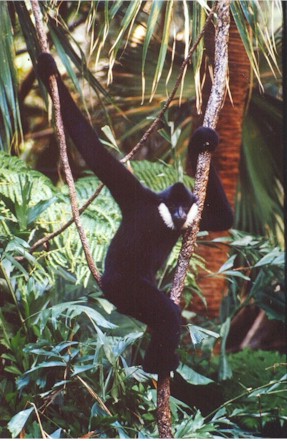
The "green corridor" is home to many threatened plants and animals, including one of the world's most endangered primates, the white-cheeked crested gibbon, the WWF says.
It is also considered to be the best place to conserve the Saola – a unique type of wild cow which was discovered by scientists only in 1992.
Hoang Ngoc Khanh, director of Thua Thien Hue provincial forest protection department, said: "The area is extremely important for conservation and the province wants to protect the forests and their environmental services, as well as contribute to sustainable development."
Tuesday, August 14, 2007
Independent (UK)Online Edition: World's birds on death row: Race against time to save 189 species from extinction...
The biggest and most wide-ranging bird conservation programme the world has ever seen will be launched next week with the aim of saving every one of the planet's critically endangered species from extinction.
The task is urgent. There are now no fewer than 189 birds in this most precipitous category – 51 more than there were just seven years ago. Scientists say that if no action is taken then all of them could be gone within the next 10 years; 15 are already classified as "possibly extinct ".
The death of bird species is now happening faster than at any time in history. Without human interference, the natural rate of loss would be one bird each century. But extinctions are accelerating and running at 50 times that rate. In the past 30 years alone, 21 have gone – three of them since 2000.
BirdLife International, which acts as a scientific and conservation " United Nations" for bird organisations worldwide, now aims to stop the rot. So next week at Birdfair, the three-day festival for British enthusiasts co-organised by the RSPB and the Wildlife Trusts, Birdlife will launch a project to pull each and every one of the 189 species back from the brink.
This danger list includes six owls, three albatrosses, 16 birds of prey, 10 hummingbirds, 17 parrots, four woodpeckers, six ducks and umpteen pigeons, plovers, wrens, warblers, finches, curlews and larks.
Their names are some of the most evocative in the bird world: the gorgeted wood-quail, sapphire-bellied hummingbird, Alagoas foliage-gleaner, Pernambuco pygmy-owl and Iquitos gnatcatcher (some of which have never been photographed), Bulo Burti boubou (a shrike, discovered in Somalia in 1988), the kakapo (the world's only flightless, nocturnal parrot), and the turquoise-throated puffleg, a hummingbird so rare no one has seen it since 1850. There are, happily, no British birds on the list.
BirdLife's project, called "Preventing Extinctions: Saving the World's Most Threatened Birds", will launch what are in effect 189 different races against time.
For each bird there will be a "species guardian", a local body that will work with BirdLife to carry out the conservation. And, for each of the 189 at risk, BirdLife is also seeking a "species champion" – a company, organisation or institution that will "adopt" a threatened bird and provide regular funding.
Donations from individuals are also, of course, very welcome. Some £20,000 is needed to kick-start a protection project for each species of bird, and, to save all 189, BirdLife calculates it will need to raise at least £19m over the next five years.
Dr Mike Rands, chief executive of BirdLife International, told The Independent on Sunday: "Through this innovative approach every single critically endangered bird can be saved from extinction. We know the priority conservation actions needed for each species – what we need now is the support of companies, organisations or even individuals. This is an enormous challenge, but one that we are fully committed to achieving."
TV's Springwatch presenter and wildlife film-maker Simon King said: " This is a exciting and ambitious project and deserves to be supported by every nature lover in the country."
Birdfair, which he, Bill Oddie and tens of thousands of other enthusiasts will attend at Rutland Water next weekend, has singled out four of the most pressing cases as the focus of its fund-raising. The birds' plight illustrates the desperately urgent work that needs to be done. There is the Bengal florican, the world's rarest bustard, now down to fewer than 1,000 in south-east Asia through loss of its wet grassland habitat; the Restinga antwren – a mere 10 square kilometres of its Brazilian beach-scrub habitat remains, and even that's under threat; Belding's yellowthroat, a warbler of Mexican wetlands, now confined through development to just a few marshes; and the Djibouti francolin, which is blighted by habitat loss, climate change and hunting.
Other emergency projects will try to save the long-billed apalis (a warbler of central east Africa suffering through destruction of woodland); the dwarf olive ibis (a forest dweller endemic to the west African island of São Tomé, suffering from tree-clearance); the Puerto Rican nightjar (confined to the south-west of the island, under pressure from development and feral cats); the Mindoro bleeding heart (a ground-living pigeon endemic to one Philippine island, it was once common but now nearly all of its wooded habitat is gone); and the white-shouldered ibis (a wetland species of south-east Asia, whose habitat has been wrecked through logging and intensive agriculture).
Some of the birds on the list, such as the black stilt, are now down to just a handful of individuals, while others, including the red-headed vulture, still number in the thousands but have lost nearly 90 per cent of their population in the past 10 years.
There is concern, too, about some long-lived species, such as the three albatrosses on the list and the Philippine eagle, whose young are not surviving to replace the adults who will die out in the next decade or so.
The task is to stop these birds following into oblivion the 72 species that were lost in the 20th century, the most costly era for extinctions in recorded history. Those that will fly no more include the slender-billed grackle, a songbird endemic to Mexico not seen since 1910; the thick-billed ground-dove (1927); robust white-eye (small Australian songbird, 1928); the Hawaiian oo (one of four honey-eaters that became extinct after Europeans arrived, 1934); the red-moustached fruit-dove (1950); laughing owl (1970); the Alaotra grebe (killed off in Madagascan waters by fishing and an introduced carnivorous fish, 1988); and the po'o-uli (a honeycreeper, presumed extinct in Hawaii through habitat destruction and disease-carrying mosquitoes, 2004).
What gives BirdLife hope is some recent successes. In the 10 years between 1994 and 2004, 16 species were saved from extinction, all as a result of targeted conservation. They include the Norfolk Island green parrot, which in the Nineties was down to just four females of breeding age, but which now can boast 200-300 and is rapidly increasing; the Bali starling, which poaching eradicated in the wild but which thanks to captive breeding is now thriving once more; and the Chatham Island taiko, a seabird from the petrel family – it was reduced to just four pairs in 1994 but control of predators has seen it start to recover, with 11 chicks hatching in 2006.
And, in a demonstration of how apparently insuperable obstacles can be overcome, only last week Timor-Leste, formerly the deeply troubled land of East Timor, announced its first national park just five years after gaining independence.
The Nino Konis Santana National Park covers 304,000 acres and includes the territory of the yellow-crested cockatoo, one of the species on BirdLife's list. It continues to be severely threatened by illegal trapping for the exotic bird trade, but the safeguarding of its home is a good omen for the work ahead with the other 188 critically endangered birds.
Additional reporting by Rachel Wolff
SOS: species on the BirdLife International list
White-winged guan ¿ Trinidad piping-guan ¿ blue-billed curassow ¿ gorgeted wood-quail ¿ Djibouti francolin ¿ Himalayan quail ¿ crested shelduck ¿ Laysan duck ¿ Campbell Islands teal ¿ pink-headed duck ¿ Madagascar pochard ¿ Brazilian merganser ¿ Amsterdam albatross ¿ waved albatross ¿ Chatham albatross ¿ Galapagos petrel ¿ Jamaica petrel ¿ magenta petrel ¿ Chatham petrel ¿ Fiji petrel ¿ Beck's petrel ¿ Mascarene petrel ¿ Balearic shearwater ¿ Townsend's shearwater ¿ New Zealand storm-petrel ¿ Guadalupe storm-petrel ¿ Alaotra grebe ¿ Junin grebe ¿ white-bellied heron ¿ white-shouldered ibis ¿ giant ibis ¿ northern bald ibis ¿ dwarf olive ibis ¿ Christmas frigatebird ¿ Chatham Islands shag ¿ California condor ¿ white-collared kite ¿ Cuban kite ¿ Madagascar fish-eagle ¿ white-rumped vulture ¿ Indian vulture ¿ slender-billed vulture ¿ red-headed vulture ¿ Ridgway's hawk ¿ Philippine eagle ¿ Bengal florican ¿ New Caledonian rail ¿ Samoan moorhen ¿ Makira moorhen ¿ Siberian crane ¿ black stilt ¿ Javan lapwing ¿ sociable lapwing ¿ St Helena plover ¿ Eskimo curlew ¿ slender-billed curlew ¿ Jerdon's courser ¿ Chinese crested tern ¿ Kittlitz's murrelet ¿ silvery wood-pigeon ¿ blue-eyed ground-dove ¿ purple-winged ground-dove ¿ Grenada dove ¿ Mindoro bleeding-heart ¿ Negros bleeding-heart ¿ Sulu bleeding-heart ¿ Polynesian ground-dove ¿ Negros fruit-dove ¿ Marquesan imperial-pigeon ¿ kakapo ¿ yellow-crested cockatoo ¿ Philippine cockatoo ¿ blue-fronted lorikeet ¿ New Caledonian lorikeet ¿ red-throated lorikeet ¿ Malherbe's parakeet ¿ orange-bellied parrot ¿ night parrot ¿ Lear's macaw ¿ glaucous macaw ¿ spix's macaw ¿ blue-throated macaw ¿ yellow-eared parrot ¿ grey-breasted parakeet ¿ indigo-winged parrot ¿ Puerto Rican amazon ¿ Sumatran ground-cuckoo ¿ black-hooded coucal ¿ Siau scops-owl ¿ Anjouan scops-owl ¿ Moheli scops-owl ¿ Grand Comoro scops-owl ¿ Pernambuco pygmy-owl ¿ forest owlet ¿ Jamaican pauraque ¿ Puerto Rican nightjar ¿ New Caledonian owlet-nightjar ¿ short-crested coquette ¿ sapphire-bellied hummingbird ¿ Honduran emerald ¿ chestnut-bellied hummingbird ¿ purple-backed sunbeam ¿ dusky starfrontlet ¿ Juan Fernandez firecrown ¿ black breasted puffleg ¿ turquoise-throated puffleg ¿ colourful puffleg ¿ Tuamotu kingfisher ¿ Sulu hornbill ¿ rufous-headed hornbill ¿ Okinawa woodpecker ¿ imperial woodpecker ¿ ivory-billed woodpecker ¿ Kaempfer's woodpecker ¿ Gurney's pitta ¿ Araripe manakin ¿ Kinglet calyptura ¿ Minas Gerais tyrannulet ¿ Kaempfer's tody-tyrant ¿ Rondonia bushbird ¿ Rio de Janeiro antwren ¿ Alagoas antwren ¿ Restinga antwren ¿ Stresemann's bristlefront ¿ Bahia tapaculo ¿ Royal cinclodes ¿ Masafuera rayadito ¿ Alagoas foliage-gleaner ¿ Uluguru bush-shrike ¿ Bulo Burti boubou ¿ Sao Tome fiscal ¿ Isabela oriole ¿ Sangihe shrike-thrush ¿ caerulean paradise-flycatcher ¿ Seychelles paradise-flycatcher ¿ Tahiti monarch ¿ Fatuhiva monarch ¿ black-chinned monarch ¿ Banggai crow ¿ white-eyed river-martin ¿ Archer's lark ¿ Raso lark ¿ Taita apalis ¿ long-billed apalis ¿ Liberian greenbul ¿ millerbird ¿ blue-crowned laughingthrush ¿ Mauritius olive white-eye ¿ Rota bridled white-eye ¿ Sangihe white-eye ¿ white-chested white-eye ¿ Faichuk white-eye ¿ golden white-eye ¿ Niceforo's wren ¿ Munchique wood-wren ¿ Iquitos gnatcatcher ¿ Socorro mockingbird ¿ Cozumel rhrasher ¿ Pohnpei starling ¿ Bali starling ¿ olomao ¿ puaiohi ¿ Somali thrush ¿ Taita thrush ¿ Rueck's blue-flycatcher ¿ Cebu flowerpecker ¿ Mauritius fody ¿ Sao Tome grosbeak ¿ Azores bullfinch ¿ Nihoa finch ¿ ou ¿ Maui parrotbill ¿ nukupuu ¿ akikiki ¿ Oahu alauahio ¿ akohekohe ¿ po'o-uli ¿ Bachman's warbler ¿ Belding's yellowthroat ¿ Semper's warbler ¿ Montserrat oriole ¿ Guadalupe junco ¿ hooded seedeater ¿ Entre Rios seedeater ¿ Carrizal blue-black seedeater ¿ mangrove finch ¿ pale-headed brush-finch ¿ cone-billed tanager ¿ cherry-throated tanager
How 'IoS' readers can help
We are asking every reader to support BirdLife's Preventing Extinctions project in its efforts to protect endangered species. For full details, and to make a donation, visit: www.birdlife.org