![]() |
| Click on image to enlarge |
Showing posts with label forum south. Show all posts
Monday, April 18, 2011
JFK Expansion Options Debated by David J. Harvey - The Forum Newsgroup
Read original...
John F. Kennedy Airport is one of the nation’s busiest airports and travellers face frequent delays. As air travel around New York increases, it could get worse. A new report on air traffic capacity contains, among several options to alleviate overcrowding, the possibility of expanding JFK Airport into Jamaica Bay. Local residents and conservation groups have reacted in an uproar.
At the beginning of the year, the Regional Plan Association (RPA)—an independent urban research and advocacy group—released a report on the growth of aviation traffic in New York City.
The report’s authors predict that passenger volume in New York will grow from 104 million passengers in 2010 to 150 million passengers in the 2030s. This growth, without improvements to the current aviation infrastructure, could cost billions of dollars in lost wages and business income. The report predicts that by 2030, as many as 125,000 jobs, $6 billion in wages and $16 billion in business sales would be lost yearly due to airport congestions and delays.
Among the possible solutions for accommodating increased commuter traffic is expanding JFK into Jamaica Bay. One proposal suggests an expansion of nearly 400 acres—almost two-thirds the size of LaGuardia Airport—while another would involve no reclamation of the bay.
After RPA released their report, a tide of criticism rose in the community that left some residents calling the RPA tools for the Port Authority.
On April 7, at the American Legion Hall on Crossbay Boulevard in Broad Channel, Dan Mundy of the Jamaica Bay Eco Watchers hosted a presentation to counter the RPA report.
Mundy opened the presentation by arguing that the central premise of the RPA report—that New York will have a significant rise in airline traffic—is based on a growth that would bring the city’s aviation to “a crippling halt.”
Congressman Anthony Weiner (D-Kew Gardens) who flew in from Washington D.C. and was running late for a flight back to Washington, spoke briefly during Mundy’s presentation and promised he would do everything in his power to stop expansion into the bay.
“I have made it very clear that while there is ability for the Secretary [of the Interior] to make minor changes to the map, this is not minor, this is major, I’m against this, and I’m not going to let it happen,” Weiner said.
One of the biggest complaints Mundy had with the RPA report was that previous reports about air traffic growth were always overestimated.
“It’s a doomsday prediction,” he said. “We went back 55 years and looked at all these reports. What we found was that the predictions were always overstated.”
A 1969 RPA report predicted that by the year 2000 there would be at least 250 million air passengers per year in the New York area—there were actually 90 million. Mundy said that by following historical data, an increase to between 115 and 125 million air passengers by 2030 could be predicted, rather than the 150 million predicted in the RPA report.
RPA Director of Transportation Richard Barone, one of the report’s authors, defended the current report and joked that he “wasn’t even born when [the 1969] report came out.”
“[The 1969] predictions were very optimistic, it was a period of very aggressive growth in air travel,” he said, adding that the old RPA reports used a six percent growth rate.
The recent report was based on a conservative, two percent growth rate, he said.
Barone said the RPA had attended the meeting to get input and hopes to return to the area and present updates.
“Obviously in the report we state that expanding into Jamaica Bay is huge deal,” Barone said. “We’re not opposed to making changes.”
Despite Barone’s concessions, and insistence that the RPA has no other agenda than presenting their analysis to “start a conversation,” the immediate response after he finished speaking was vitriolic. “I should take that as a direct insult to my intelligence,” said John, a local resident.
Don Riepe, Director of the American Littoral Society’s Northeast Chapter, pointed out that the bay has been reclaimed for development since New York City was founded. At one time, the bay was twice its current size, spreading out as salt marshes across Brooklyn and Queens. Today, the bay’s wildlife, including migrating hawks, peregrine falcons, osprey, herons and more than 100 types of finfish, compete for less and less livable space, Riepe said.
He noted that JFK already has problems with animals trying to coexist with planes. Last year, the city euthanized thousands of geese over fears the migrating birds would cause an incident like the forced Hudson River emergency landing. JFK now has a full time biologist on staff to deal with local wildlife.
“Just because you have an urban airport doesn’t mean you won’t have wildlife,” Riepe said.
Bradford H. Sewell, Senior Project Attorney for the Natural Resources Defense Council, explained that proposed changes would alter the flight paths, adding to noise pollution over the bay—disturbing the natural “soundscape” of the bay. He added that new flights would pass, at an elevation of 1,000 to 1,500 feet, directly over the Jamaica Bay visitor center. If the frequency of traffic doubles at the airport, flights could pass overhead every 30 seconds.
“I hope that we can double our efforts … because the impacts of this sort of expansion into Jamaica Bay would be unacceptable,” said Sewell, who has had prior experience in airport expansion battles.
In the RPA report, there are four proposals for the expansion of JFK. Three include reclaiming some of the bay. The report’s authors noted—based on NY Port Authority reports—that the area of expansion is a dead zone, depleted of oxygen as a result of dredging. Mundy, Riepe and Sewell all refute that claim.
Vinnie Calabro, a Jamaica Bay fisherman and charter boat captain, said the area the NY Port Authority considers a dead zone is teeming with wildlife, and is the site of several recent catches.
“We’ll be on the boat some days looking at the people on the tarmac reading the New York Timesand we’ll catch another one of these big fish.” said Calabro. “They don’t realize what’s going on. They’re caught up in the headlines, but there are headlines right here in the bay. We have to speak out.”
One RPA proposal that does not include expansion of JFK into the bay, which Barone said was overlooked by Sewell, would require upgrading the airport’s air traffic control with NextGen capabilities. NextGen, being implemented by the Federal Aviation Administration over the next few years, includes Global Positioning Systems and operational and procedural changes.
The biggest hurdles JFK must overcome—be aided by NextGen—is reducing flight delays and optimizing capacity, said the report.
Despite the report’s findings, no one is planning an actual airport expansion so far.
Edward Knoesel, manager of the New York Port Authority’s Environmental Services Aviation Department, said that the RPA report was commissioned by the Port Authority, stressing that the organization has a responsibility to look into their facilities and plan for the future of commerce and travel in the tri-state area.
“The RPA is a long-standing, very respected organization,” he said. “They have produced a series of options for further study. … The Port Authority is not proposing to do any fill in Jamaica Bay.”
“We’re not proposing to do any expansion at any airport,” Knoesel added. “What were doing is taking a look at what the RPA proposed and what [the community says] and see what is feasible.”
Saturday, February 5, 2011
It's Time to Fight for Social Security by David M. Quintana - Leader-Observer/Queens Chronicle
It s time to fight for Social Security - LeaderObserver
Save Social Security - Queens Chronicle
America is a community. We look out for each other as a nation. We build schools for our children, fund police for our safety and provide a secure retirement for our seniors. We don't toss aside our most vulnerable citizens when they need our help the most.
I urge every working class American to deliver a message that we are unified and standing strong against cuts while fighting for improvements. It's time to send Congress and the President a strong clear message about the Social Security Trust Fund.
Sincerely,
Save Social Security - Queens Chronicle
Saving Social Security - Forum South
Dear Editor:
America is a community. We look out for each other as a nation. We build schools for our children, fund police for our safety and provide a secure retirement for our seniors. We don't toss aside our most vulnerable citizens when they need our help the most.Instead, each generation of American workers invests in the Social Security Trust Fund under the guarantee that someday when they retire or get too sick to work, that Social Security will be there for them.
Now, our community and that safety net is coming under a fierce right-wing attack..
Republicans in the House are chomping at the bit to gut Social Security, threatening to raise the retirement age and cut benefits that millions of seniors depend on to survive. Claiming Social Security is in crisis is simply not true, but that doesn't stop these mendacious Republicans from saying it. Even with no changes to the system, reports show Social Security can pay out full benefits until at least 2037.
That's why cutting benefits now, including raising the retirement age, must remain completely off the table. Social Security is the economic backbone of a retirement free from poverty and homelessness for aging and sick Americans no longer able to work. Raising the retirement age is a job-killer for young Americans while cuts to benefits will force the elderly to choose between food and rent. That is not the America we believe in and we must do everything in our power to stop cuts from happening.
But stopping cuts should not be good enough. We can do much better.
Right now, Bill Gates doesn't pay the same percentage of his income into Social Security that most Americans pay. Neither does Derek Jeter, Mayor Bloomberg or for that matter even President Obama. The reason why: the Social Security payroll tax is capped at $106,800 per individual costing tax payers billions of dollars in lost revenue from the people most able to invest. The cap risks the long-term health of the program while currently giving wealthier Americans a tremendous tax cut.
It's never been more important to stand up and fight than now. Scurrilous right-wing Republicans are willing to lie and to do anything to tear down Social Security. They're talking about shutting down the government, holding the debt ceiling hostage. Whatever it takes to destroy Social Security and prop up big banks, insurance companies and Wall Street, they're going to do it.
That's why cutting benefits now, including raising the retirement age, must remain completely off the table. Social Security is the economic backbone of a retirement free from poverty and homelessness for aging and sick Americans no longer able to work. Raising the retirement age is a job-killer for young Americans while cuts to benefits will force the elderly to choose between food and rent. That is not the America we believe in and we must do everything in our power to stop cuts from happening.
But stopping cuts should not be good enough. We can do much better.
Right now, Bill Gates doesn't pay the same percentage of his income into Social Security that most Americans pay. Neither does Derek Jeter, Mayor Bloomberg or for that matter even President Obama. The reason why: the Social Security payroll tax is capped at $106,800 per individual costing tax payers billions of dollars in lost revenue from the people most able to invest. The cap risks the long-term health of the program while currently giving wealthier Americans a tremendous tax cut.
It's never been more important to stand up and fight than now. Scurrilous right-wing Republicans are willing to lie and to do anything to tear down Social Security. They're talking about shutting down the government, holding the debt ceiling hostage. Whatever it takes to destroy Social Security and prop up big banks, insurance companies and Wall Street, they're going to do it.
I believe in a robust community that will keep Social Security strong for future generations of Americans and we all need to stand up and be heard to make it happen.
I urge every working class American to deliver a message that we are unified and standing strong against cuts while fighting for improvements. It's time to send Congress and the President a strong clear message about the Social Security Trust Fund.
Join me in calling your member of Congress to keep Social Security safe, stable, and secure for generations to come.
Sincerely,
David M. Quintana
Thursday, January 20, 2011
My Letter to the Editor on the GOP Healthcare Repeal Bill...
January 19, 2011
Dear Editor:
The GOP is gearing up for this week's House vote on repealing the health care bill -- and the time for us to take a stand is right now. We need to be clear about what Republicans are trying to do: take away health care from 32 million uninsured Americans who have no other lifeline. These folks -- our family, friends, neighbors, loved ones -- need us to advocate for them, to speak out strongly and compassionately.
Speaker Boehner and the Republicans have grievously misled the public about health care reform from day one, and it's time to get real about the consequences of a repeal: families going into debt from medical costs they can't afford. Women losing coverage for life-saving mammograms and critical maternity care. Seniors having to choose between their medication and buying food. And $230 billion added to the deficit (over 10 years).
This is why I'm saying: we simply can't turn our backs on our fellow Americans and the future of this country by allowing a repeal of health care.
What would this repeal mean? It would be a gigantic step backwards -- a disastrous move for our fellow citizens and for the direction of our nation. We must talk about the devastating results of losing health care reform:
- Women would be unable to get preventative services that save lives, because their gender is a pre-existing condition
- With over 9% unemployment, young people who can't afford skyrocketing premiums would be kicked off their parents' plans
- And seniors, some of our most vulnerable citizens, could lose essential prescription coverage that their lives depend on
We cannot sit idly by while Boehner and the GOP try to roll back reforms that dramatically improve the lives and well-being of millions of Americans. This touches all of us. Adequate, affordable health care can't be the luxury for a precious few in this country -- every single one of us needs and deserves it.
I would urge everyone reading this to call their Congressional representative and demand that they vote against this bill, this is not the time to backslide on healthcare for our family, friends, loved ones and neighbors.
Sincerely,
David M. Quintana
Friday, January 7, 2011
Resident Asks for Better Enforcement at Park By Eric Yun - Forum News
Read original...
A Ridgewood resident is urging his community to stop the rampant abuse at Grover Cleveland Park. During the summer, the park creates traffic nightmares, and park goers trash the park and drink alcohol illegally.
John Perricone started Ridgewood Residents for Grover Cleveland Park in early August. He lives around the block from the park, and he’s tired of the antics of unruly athletic leagues and other park users.
“The park gets overcrowded, there’s noise from parties, and illegal food vendors are there,” said Perricone. “Everyone should have the right to the park.”
In the height of the summer season, athletic leagues use the fields for games. Leagues must be registered with the Parks Department, and Perricone does not believe many of the groups have registered. He also suggested Parks should give preferences to leagues local to the neighborhood.
“If I want to play ball, I’m not going to travel all the way to Juniper Valley Park,” Perricone said. “Local groups should be given preference with park permits.”
Problems with athletic leagues have led to traffic nightmares. Cars are constantly double parked on Stanhope Street and block fire hydrants and driveways. Perricone says his neighbors have been threatened when they politely asked people to move their cars.
Perricone said problems with parking could be alleviated if police removed illegal food vendors. Vendors are not allowed to operate within 75 feet of a public park. The 104th Precinct has said that police officers have issued summons to illegal vendors but many are properly licensed to sell at the park.
Perricone wishes there was a better relationship between the Parks Department, the 104th Precinct and the community. “When you contact Parks they say they are trying to get more patrol, and when you contact the police they say you have to contact Parks,” he said.
While the park is quiet during the winter months, Perricone hopes to gather enough community support to stop the illegal activity by the summer. Working closely with Citizens for a Better Ridgewood, he has started a Facebook page and contacted elected officials.
By the spring, when the permit process begins, Perricone hopes to meet with the Parks Department to discuss ways to ease the strain the community feels. The best way to accomplish the goals is to have a huge amount of community support and stories, he said.
To join Ridgewood Residents for Grover Cleveland Park, visit its website at queensprogressnow.blogspot.com
A Ridgewood resident is urging his community to stop the rampant abuse at Grover Cleveland Park. During the summer, the park creates traffic nightmares, and park goers trash the park and drink alcohol illegally.
John Perricone started Ridgewood Residents for Grover Cleveland Park in early August. He lives around the block from the park, and he’s tired of the antics of unruly athletic leagues and other park users.
“The park gets overcrowded, there’s noise from parties, and illegal food vendors are there,” said Perricone. “Everyone should have the right to the park.”
In the height of the summer season, athletic leagues use the fields for games. Leagues must be registered with the Parks Department, and Perricone does not believe many of the groups have registered. He also suggested Parks should give preferences to leagues local to the neighborhood.
“If I want to play ball, I’m not going to travel all the way to Juniper Valley Park,” Perricone said. “Local groups should be given preference with park permits.”
Problems with athletic leagues have led to traffic nightmares. Cars are constantly double parked on Stanhope Street and block fire hydrants and driveways. Perricone says his neighbors have been threatened when they politely asked people to move their cars.
Perricone said problems with parking could be alleviated if police removed illegal food vendors. Vendors are not allowed to operate within 75 feet of a public park. The 104th Precinct has said that police officers have issued summons to illegal vendors but many are properly licensed to sell at the park.
Perricone wishes there was a better relationship between the Parks Department, the 104th Precinct and the community. “When you contact Parks they say they are trying to get more patrol, and when you contact the police they say you have to contact Parks,” he said.
While the park is quiet during the winter months, Perricone hopes to gather enough community support to stop the illegal activity by the summer. Working closely with Citizens for a Better Ridgewood, he has started a Facebook page and contacted elected officials.
By the spring, when the permit process begins, Perricone hopes to meet with the Parks Department to discuss ways to ease the strain the community feels. The best way to accomplish the goals is to have a huge amount of community support and stories, he said.
To join Ridgewood Residents for Grover Cleveland Park, visit its website at queensprogressnow.blogspot.com
Thursday, November 25, 2010
Albert Road Reconstruction Stirs Ozone Park Residents by Patricia Adams - Forum News
Read original...
City Begins Land Acquisition Process
Ozone Park property owners turned out in full force on Tuesday evening for what was originally billed as an emergency meeting of the Ozone Park Civic Association. The meeting was called after a “boiler plate” letter was sent to more than 500 residents who live on streets within the confines of HW411B, the street and sewer reconstruction of the Albert Road area.
Inclusion of the term eminent domain the letter sent a wave of panic through many residents who feared they may lose their property. Thankfully, despite the initial stress caused by the letter, there are no cases where a home or any other significant land parcels are in danger of being lost.
Department of Design and Construction fell under criticism because it failed to send details advising individual homeowners about how their property would be affected, if at all. “They [the city] could have spared the community this hysteria had they done their due diligence,” explained Councilman Eric Ulrich (R-Ozone Park).
But despite his criticism of the agency’s dissemination of information to the public, Ulrich says he is confident that the project will now move ahead. “I believe that construction will start as early as 2012. The acquisition process has begun and the project is fully funded. It will move forward.”
Ozone Civic President, Howard Kamph said at the end of the meeting he was happy with his decision at the last minute to allow the crowd to interact directly with the agency personnel. Kamph expressed concern over some additional provisions of the project which he said would include bike lanes and the return of Cohancy Street to a two-way. “If this project ever gets done, it will be a miracle,” Kamph said. “I’ve been hearing about it since I got here in 1981 and I have the DOT letters to prove it.”
Complete lists detailing the project were made available to all residents in attendance on Tuesday evening. Representatives from DDC reviewed individual properties with residents and advised them of any changes intended at their location. All homeowners were especially relieved to be informed that no residences were in jeopardy and that only a handful of structures, namely garages or sheds, are involved. The major alterations will be comprised mainly of residents losing some footage at curbside and other instances such as small retaining walls installed by homeowners. In all instances where the city would be acquiring property not already owned by them, financial compensation will be offered.
The original estimate to begin construction is early in 2013 and is expected to continue for approximately one year.
Ozone Park property owners turned out in full force on Tuesday evening for what was originally billed as an emergency meeting of the Ozone Park Civic Association. The meeting was called after a “boiler plate” letter was sent to more than 500 residents who live on streets within the confines of HW411B, the street and sewer reconstruction of the Albert Road area.
Inclusion of the term eminent domain the letter sent a wave of panic through many residents who feared they may lose their property. Thankfully, despite the initial stress caused by the letter, there are no cases where a home or any other significant land parcels are in danger of being lost.
Department of Design and Construction fell under criticism because it failed to send details advising individual homeowners about how their property would be affected, if at all. “They [the city] could have spared the community this hysteria had they done their due diligence,” explained Councilman Eric Ulrich (R-Ozone Park).
But despite his criticism of the agency’s dissemination of information to the public, Ulrich says he is confident that the project will now move ahead. “I believe that construction will start as early as 2012. The acquisition process has begun and the project is fully funded. It will move forward.”
Ozone Civic President, Howard Kamph said at the end of the meeting he was happy with his decision at the last minute to allow the crowd to interact directly with the agency personnel. Kamph expressed concern over some additional provisions of the project which he said would include bike lanes and the return of Cohancy Street to a two-way. “If this project ever gets done, it will be a miracle,” Kamph said. “I’ve been hearing about it since I got here in 1981 and I have the DOT letters to prove it.”
Complete lists detailing the project were made available to all residents in attendance on Tuesday evening. Representatives from DDC reviewed individual properties with residents and advised them of any changes intended at their location. All homeowners were especially relieved to be informed that no residences were in jeopardy and that only a handful of structures, namely garages or sheds, are involved. The major alterations will be comprised mainly of residents losing some footage at curbside and other instances such as small retaining walls installed by homeowners. In all instances where the city would be acquiring property not already owned by them, financial compensation will be offered.
The original estimate to begin construction is early in 2013 and is expected to continue for approximately one year.
Sunday, July 18, 2010
Forum News: Ulrich Tours FDNY Training Center
Read original...
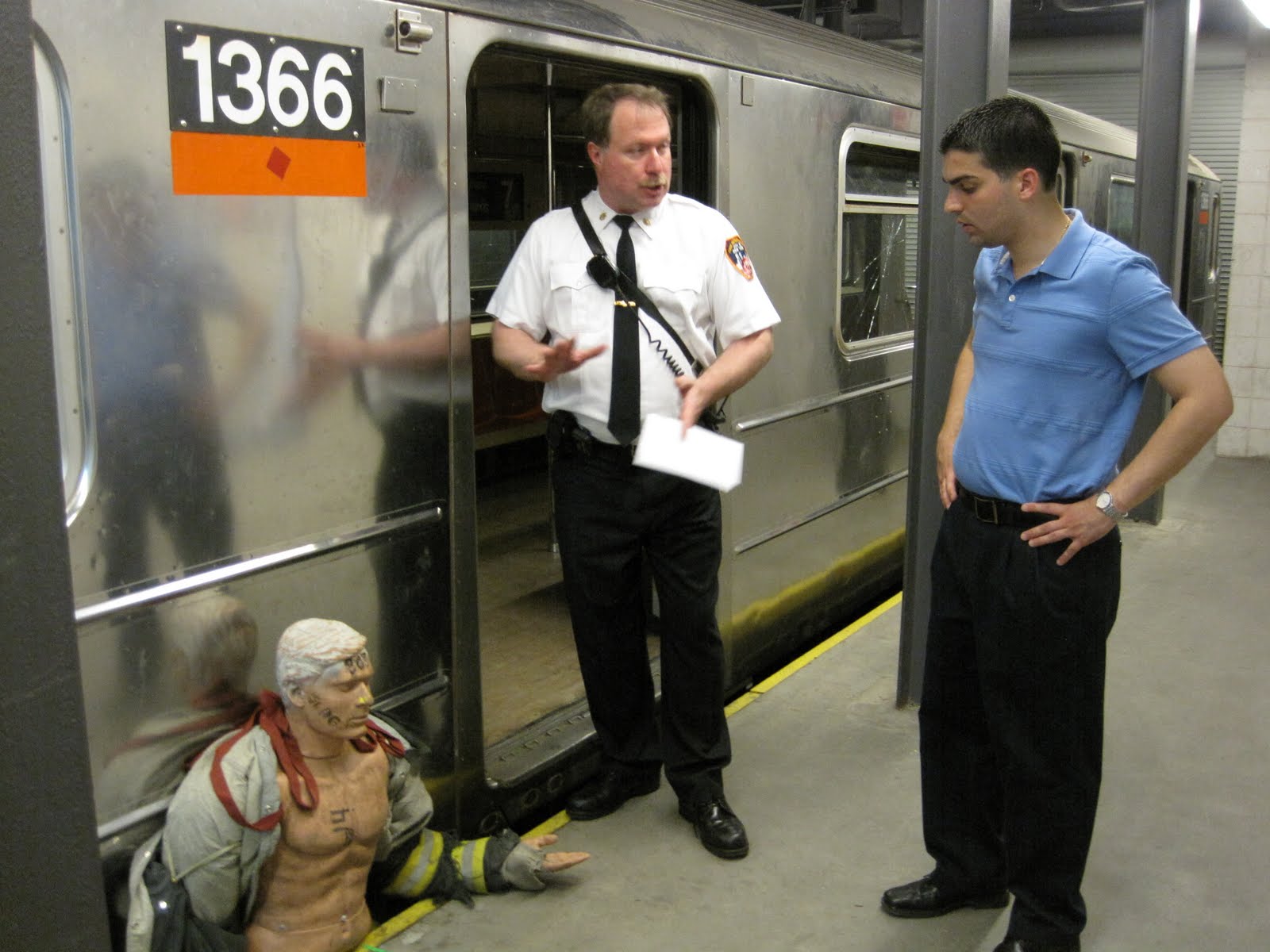
Council Member Eric A. Ulrich (R- Queens) recently toured the New York City Fire Academy at Randall’s Island to get a firsthand look at the training exercises that prepare firefighters for a wide range of emergencies across the five boroughs.
The academy is situated on 27 acres on Randall’s Island near the RFK Bridge. Informally known as “The Rock,” the site includes training space for simulations of incidents such as high-rise, house and store-front fires, subway accidents, automobile wrecks and fires, construction accidents and confined-space rescues.
In addition, the training facility features classrooms, physical fitness facilities and a heavy-duty storm draining system to accommodate water runoff from fire simulations. During the tour, Ulrich also took time to pay tribute to the 343 fallen 9/11 heroes at the memorial dedicated to FDNY members who died as a result of the terrorist attacks. The tour was arranged by Rockaway resident and FDNY Battalion Chief William Mundy.
Ulrich said, “This was truly an eye-opening experience that confirms what I’ve always believed - that a well trained and well funded fire department is crucial to the safety of all New Yorkers. I applaud the Bureau of Training and the three FDNY units which operate at the academy for their exemplary work in training the many men and women who put their lives on the line to protect our great city.”
Battalion Chief Thomas Robson, Executive Officer of the Bureau of Training said, “What we try to do with training is look at where we have lost firefighters and mimic the kinds of things you find in different types of fires and emergencies. We have a training school that I truly believe is unmatched anywhere in the country.”
Council Member Eric A. Ulrich (R- Queens) recently toured the New York City Fire Academy at Randall’s Island to get a firsthand look at the training exercises that prepare firefighters for a wide range of emergencies across the five boroughs.
The academy is situated on 27 acres on Randall’s Island near the RFK Bridge. Informally known as “The Rock,” the site includes training space for simulations of incidents such as high-rise, house and store-front fires, subway accidents, automobile wrecks and fires, construction accidents and confined-space rescues.
In addition, the training facility features classrooms, physical fitness facilities and a heavy-duty storm draining system to accommodate water runoff from fire simulations. During the tour, Ulrich also took time to pay tribute to the 343 fallen 9/11 heroes at the memorial dedicated to FDNY members who died as a result of the terrorist attacks. The tour was arranged by Rockaway resident and FDNY Battalion Chief William Mundy.
Ulrich said, “This was truly an eye-opening experience that confirms what I’ve always believed - that a well trained and well funded fire department is crucial to the safety of all New Yorkers. I applaud the Bureau of Training and the three FDNY units which operate at the academy for their exemplary work in training the many men and women who put their lives on the line to protect our great city.”Battalion Chief Thomas Robson, Executive Officer of the Bureau of Training said, “What we try to do with training is look at where we have lost firefighters and mimic the kinds of things you find in different types of fires and emergencies. We have a training school that I truly believe is unmatched anywhere in the country.”
Friday, June 11, 2010
DOT Discusses Ways to Improve Busy Intersection by Patricia Adams - Forum News
Read original...
The NYC Department of Transportation (DOT) made a presentation to Community Board 10 last week regarding the intersection at Liberty Avenue and Rockaway Boulevard.
The project which is nearing the implementation phase is designed to address intersection safety and traffic improvements.
The original study for the problem area was launched after a child pedestrian fatality occurred at Crossbay Boulevard and Liberty Avenue. The intersection was also identified by NYPD as a challenging location. A request for review by the Queens DOT Borough Commissioner Maura McCarthy prompted the study which falls within the Woodhaven Boulevard Congested Corridors study area.
Representatives pointed out that the area has many existing conditions contributing to congestion and safety threats. Seven bus lines, the Rockaway Blvd. subway station and an elevated train which runs over Liberty Avenue all converge on the intersection.
Other major problems include a peak traffic volume of more than 2,000 vehicles an hour, complex physical geometry and very large pedestrian volume-- a large percentage of them children.
According to a scale of severity-weighted scale ranking Queens’ intersections, Rockaway & Woodhaven Boulevard ranks in the 99th percentile with nearby Rockaway Blvd. and 94th street close behind in the 89th percentile.
A total of 207 injuries were documented from 2004-2008 with two pedestrian fatalities included.
Following the conclusion of the study the DOT has made several recommendations to
address concerns. At Crossbay and Woodhaven Boulevards, two streets will be converted to plaza space, expansion in the north bound left turn lanes and added capacity at
Rockaway Boulevard.
At Rockaway Boulevard and Liberty Avenue proposed solutions include constructing a pedestrian refuge island,while expanding an existing one and installing a traffic signal at 96th street and a more direct crosswalk.
Among the overall benefits, according to the DOT, is the reduction of conflict between pedestrians, vehicle and bus traffic. All intersections will be more crosser-friendly at a rate of 3.5 feet/sec and more easily navigable for both drivers and pedestrians. The plan also offers reduced crossing distances, more public space and simpler, safer left turns.
Later in the week DOT Commissioner Maura McCarthy and other representatives from DOT made an additional presentation for community members and media to kick off a study to look at congestion along Liberty Avenue from Woodhaven Boulevard to the Van Wyck Expressway.
The NYC Department of Transportation (DOT) made a presentation to Community Board 10 last week regarding the intersection at Liberty Avenue and Rockaway Boulevard.
The project which is nearing the implementation phase is designed to address intersection safety and traffic improvements.
The original study for the problem area was launched after a child pedestrian fatality occurred at Crossbay Boulevard and Liberty Avenue. The intersection was also identified by NYPD as a challenging location. A request for review by the Queens DOT Borough Commissioner Maura McCarthy prompted the study which falls within the Woodhaven Boulevard Congested Corridors study area.
Representatives pointed out that the area has many existing conditions contributing to congestion and safety threats. Seven bus lines, the Rockaway Blvd. subway station and an elevated train which runs over Liberty Avenue all converge on the intersection.
Other major problems include a peak traffic volume of more than 2,000 vehicles an hour, complex physical geometry and very large pedestrian volume-- a large percentage of them children.
According to a scale of severity-weighted scale ranking Queens’ intersections, Rockaway & Woodhaven Boulevard ranks in the 99th percentile with nearby Rockaway Blvd. and 94th street close behind in the 89th percentile.
A total of 207 injuries were documented from 2004-2008 with two pedestrian fatalities included.
Following the conclusion of the study the DOT has made several recommendations to
address concerns. At Crossbay and Woodhaven Boulevards, two streets will be converted to plaza space, expansion in the north bound left turn lanes and added capacity at
Rockaway Boulevard.
At Rockaway Boulevard and Liberty Avenue proposed solutions include constructing a pedestrian refuge island,while expanding an existing one and installing a traffic signal at 96th street and a more direct crosswalk.
Among the overall benefits, according to the DOT, is the reduction of conflict between pedestrians, vehicle and bus traffic. All intersections will be more crosser-friendly at a rate of 3.5 feet/sec and more easily navigable for both drivers and pedestrians. The plan also offers reduced crossing distances, more public space and simpler, safer left turns.
Later in the week DOT Commissioner Maura McCarthy and other representatives from DOT made an additional presentation for community members and media to kick off a study to look at congestion along Liberty Avenue from Woodhaven Boulevard to the Van Wyck Expressway.
Thursday, May 20, 2010
Forum News: State Delays Reservoir Redevelopment By Conor Greene - Forum News Group
The Parks Dept might want to argue with the Snapping Turtle (below pic) as to whether or not the Ridgewood Reservoir is a wetlands...It should be noted, that the snapping turtle is New York's official state reptile and is the largest freshwater turtle in the state...Furthermore, I have been told by a Herpetologist that the turtle pictured is probably between 15-20 years old...
Read original...
Parks Explains Need to Cut Down 65 Trees for Phase One
While the city Parks Department is prepared to move forward with its phase one redevelopment of Ridgewood Reservoir, it appears that the second phase - which will determine the future use of the property - is on hold as the state decides whether the land should be designated a wetland.
As has been reported, the state Department of Environmental Conservation is currently investigating whether to classify the property on the Queens-Brooklyn border, which contains three basins, as wetlands. Doing so would complicate the Parks Department’s proposed plans for the site, which range from keeping it entirely natural to building ball fields in one of the basins.
“The determination to regulate an area is based on its characteristics and functions as a wetland,” wrote DEC spokesman Thomas Panzone. “In the years since the reservoir was decommissioned, the basins, or part of the basins, have developed some wetland characteristics such as seasonally or permanently wet areas and wetland-dependant vegetation.”
Panzone added that the agency’s investigation comes as a result of a request to map the reservoir as a wetland. That request was made by the public through local elected officials, according to activists that have been lobbying for the site to be kept in its natural state.
Those activists, including David Quintana of Ozone Park, were surprised to learn this week that Parks plans to cut down 65 trees as part of phase one. That aspect of the project, estimated at $7.6 million, includes new lighting and fencing along the perimeter of the basins and better handicap accessibility.
Parks says that, of the 65 trees, nine are dead and the remaining 56 are invasive species, have weak root systems or are compromising existing infrastructure. Three are being removed to create the ADA path. A parks spokeswoman added that “all of our plans for phase one were approved by all the appropriate agencies, and we will continue working with them as we move forward to develop this site.”
Quintana and others who attended a recent Queens Civic Congress meeting on parks say they were also surprised by comments made by borough Parks Commissioner Dorothy Lewandowski regarding the potential wetlands designation. According to several in attendance, she suggested the site might not qualify for wetland designation because the basins are not large enough individually, and would have to be connected to meet the size standards.
The DEC said that while wetland designation is normally based on size, “under certain circumstances other factors can be considered.”
There was also talk the DEC might instead classify the site a dam, which could require stripping the basins of vegetation, according to several attendees. The DEC noted that, while the Ridgewood Reservoir system contains a dam, it “can be managed in a number of reasonable ways.” Panzone added, “DEC is not aware of any proposal for stripping the basins and has not issued any such order.”
When asked about Lewandowski’s comments that the DEC is looking at it as a dam, the Parks spokeswoman responded, “That is not what the commissioner said and there is no discussion or plans of stripping the basins. As mentioned in the [prior] statement, the conditions on the site are being reviewed.”
Parks had been set to present three options for phase two to local community boards earlier this year, but that was delayed by the possible DEC intervention and wetland classification. Those pushing for the site to remain natural say they are hopeful the state’s involvement will prevent the city from building ball fields on the property.
“I think DEC s going to stall them, and that should be a long process,” said Quintana.
Steven Fiedler, who attended the meeting as a member of the Juniper Park Civic Association, said there is another complicating factor aside from the potential wetland investigation. He says there are two 46-inch pipes on Seneca Avenue and Vermont Place that the DEC wants sealed before any phase two work moves forward.
“That’s a huge undertaking that sets phase two back,” said Fiedler, who also chairs Community Board 5’s Parks Committee. “In my opinion, you are not going to see it for five years.”
Gary Giordano, district manager of CB 5, echoed the sentiment that state involvement is a good thing. “Whatever the technicalities of classification are, speaking for myself, and I think for some board members too, I’m hopeful that with the state DEC being involved, there is more of a likelihood that the reservoir basins will remain in very much a natural state,” he said.
Giordano added that he doesn’t expect to see any phase two plans in the near future. “I don’t think they are going to show anything, even to the community boards, until [the DEC investigation is complete] because one of the options may be an issue with DEC if it is to put ball fields in one of the basins,” he said. “I would think that certainly would be an issue with DEC. Sometimes more is less, and I don’t think anyone on our board wants to see those ball fields in the basins.”
A number of elected officials have thrown their support behind keeping the site dedicated for passive recreation, including Assemblyman Mike Miller (D-Woodhaven).
Monday, May 10, 2010
Forum News: Outrage Over City’s Decision to Cut Dry Harbor Playschool by Conor Greene - Forum News Group
Read original...
Parents are upset about the city Parks Department’s sudden decision to eliminate its five playschool programs in Queens with little warning, including one based in Dry Harbor Playground for nearly four decades.
According to Charles Suffel, whose daughter attends the Glendale-based pre-kindergarten program, the city did not provide any advance notice that the program is in its last year. He only found out by making numerous phone calls to the department after becoming concerned when no registration date was set for next year’s enrollment.
While the city is blaming budget cuts, Suffel isn’t convinced that is the main reason behind the decision, considering parents pay $1,300 for their child to attend the program four days a week, and have offered to pay more if needed. “It’s a wonderful program that is academic-based, and the kids love it,” he told The Forum. “I called Parks, got bounced around, and finally got an unnamed person who tells me the program is cancelled.”
Suffel, whose daughter was to attend the school next year as a four-year-old, says it was only through that phone call that parents and teacher Roberta Maureau found out the program is slated to be cut after June. After contacting Councilwoman Elizabeth Crowley (D-Middle Village) and state Senator Joseph Addabbo (D-Howard Beach), Suffel is convinced that the true reason behind the decision is that Parks wants out of the education business.
“We looked into having another department take it over, but nobody wants to touch it, and now they’re stalling Elizabeth Crowley” said Suffel. “I really feel that they know if they wait long enough, we’ll have to enroll our children elsewhere.” Despite offers to pay up to $2,000 per student, Parks hasn’t even agreed to sit down with the officials and parents to try to reach an agreement to keep the valued neighborhood program open.
It is the lack of information, and Parks’ refusal to discuss the matter, that has parents upset, added Suffel. “We weren’t notified about any of this and ended up scrambling to get on the waiting list” for the universal pre-kindergarten program. “We’re not getting any information back, and the elected officials aren’t getting any calls back. It’s on purpose, because if they told us we would have had time to fight it.”
In a statement, Parks pinned the decision solely on the need for budget cuts. “Because of the financial crisis, every agency has to make budget cuts, and one of the steps Parks has put into place is the closing of programs where equal or better options are available... With the rise of universal preschool, we felt this phase out is a responsible and necessary cost-savings measure for New Yorkers as we all try to do more with less.”
The five playschools in Queens, which offer morning and evening two-hour sessions for three-and-four-year-olds, are attended by 75 children, according to Parks. The five full- time playschool staff members will be reassigned to Parks recreation centers. The department didn’t respond to claims that the decision isn’t financially driven or say how much will be saved by eliminating the five playschools.
Crowley has been on the phone with Parks officials on a nearly daily basis since word spread of the decision, trying to come up with ways to keep the program open, according to her spokeswoman. An effort to find a new provider, such as the Greater Ridgewood Youth Center, ultimately proved unsuccessful due to too many hurdles.
Parks wouldn’t consider turning the program into a parent’s co-op, so Crowley is pushing to keep the program open for at least one more year. “We need to find an alternative agency to take over the operation of the school, and I will continue to do everything I can to keep this school open for our kids,” said Crowley in a statement.
Addabbo said he is also still fighting to keep the program running, but realizes the parents need to know one way or the other soon. “I’m working on keeping those parents with a viable option for their children,” said Addabbo. “We’re trying to arrange a meeting, so the door isn’t shut yet, but it’s closing quickly because parents have to make other arrangements for their children, and we don’t want these parents shut out.”
According to Suffel, the community is in danger of losing one of the programs that makes the neighborhood a great place for families. “It’s a real shame. A middle class, well-kept neighborhood is losing a program, and we’re willing to pay for it” he said, adding that the program is great because of Maureau. “She is a great teacher... I felt horrible because I had to tell her the program was canceled – they never notified her.”
Addabbo agrees that the program is clearly of value to the neighborhood. “Parents have told me how well it’s run and the service it provides to the working parents of the area,” he said. “Preschools are certainly needed throughout our communities, and the thought of closing any is of concern to me.”
No matter what Parks says, Suffel isn’t buying Parks’ claims that the decision is strictly financial. “It’s not a budget situation, and if it was, offer us the chance to make up the shortfall, and don’t change the story every time. We’ve requested meetings with Commissioner [Adrian] Benepe but don’t get anything. They just don’t want to hear it.”
Parents are upset about the city Parks Department’s sudden decision to eliminate its five playschool programs in Queens with little warning, including one based in Dry Harbor Playground for nearly four decades.
According to Charles Suffel, whose daughter attends the Glendale-based pre-kindergarten program, the city did not provide any advance notice that the program is in its last year. He only found out by making numerous phone calls to the department after becoming concerned when no registration date was set for next year’s enrollment.
While the city is blaming budget cuts, Suffel isn’t convinced that is the main reason behind the decision, considering parents pay $1,300 for their child to attend the program four days a week, and have offered to pay more if needed. “It’s a wonderful program that is academic-based, and the kids love it,” he told The Forum. “I called Parks, got bounced around, and finally got an unnamed person who tells me the program is cancelled.”
Suffel, whose daughter was to attend the school next year as a four-year-old, says it was only through that phone call that parents and teacher Roberta Maureau found out the program is slated to be cut after June. After contacting Councilwoman Elizabeth Crowley (D-Middle Village) and state Senator Joseph Addabbo (D-Howard Beach), Suffel is convinced that the true reason behind the decision is that Parks wants out of the education business.
“We looked into having another department take it over, but nobody wants to touch it, and now they’re stalling Elizabeth Crowley” said Suffel. “I really feel that they know if they wait long enough, we’ll have to enroll our children elsewhere.” Despite offers to pay up to $2,000 per student, Parks hasn’t even agreed to sit down with the officials and parents to try to reach an agreement to keep the valued neighborhood program open.
It is the lack of information, and Parks’ refusal to discuss the matter, that has parents upset, added Suffel. “We weren’t notified about any of this and ended up scrambling to get on the waiting list” for the universal pre-kindergarten program. “We’re not getting any information back, and the elected officials aren’t getting any calls back. It’s on purpose, because if they told us we would have had time to fight it.”
In a statement, Parks pinned the decision solely on the need for budget cuts. “Because of the financial crisis, every agency has to make budget cuts, and one of the steps Parks has put into place is the closing of programs where equal or better options are available... With the rise of universal preschool, we felt this phase out is a responsible and necessary cost-savings measure for New Yorkers as we all try to do more with less.”
The five playschools in Queens, which offer morning and evening two-hour sessions for three-and-four-year-olds, are attended by 75 children, according to Parks. The five full- time playschool staff members will be reassigned to Parks recreation centers. The department didn’t respond to claims that the decision isn’t financially driven or say how much will be saved by eliminating the five playschools.
Crowley has been on the phone with Parks officials on a nearly daily basis since word spread of the decision, trying to come up with ways to keep the program open, according to her spokeswoman. An effort to find a new provider, such as the Greater Ridgewood Youth Center, ultimately proved unsuccessful due to too many hurdles.
Parks wouldn’t consider turning the program into a parent’s co-op, so Crowley is pushing to keep the program open for at least one more year. “We need to find an alternative agency to take over the operation of the school, and I will continue to do everything I can to keep this school open for our kids,” said Crowley in a statement.
Addabbo said he is also still fighting to keep the program running, but realizes the parents need to know one way or the other soon. “I’m working on keeping those parents with a viable option for their children,” said Addabbo. “We’re trying to arrange a meeting, so the door isn’t shut yet, but it’s closing quickly because parents have to make other arrangements for their children, and we don’t want these parents shut out.”
According to Suffel, the community is in danger of losing one of the programs that makes the neighborhood a great place for families. “It’s a real shame. A middle class, well-kept neighborhood is losing a program, and we’re willing to pay for it” he said, adding that the program is great because of Maureau. “She is a great teacher... I felt horrible because I had to tell her the program was canceled – they never notified her.”
Addabbo agrees that the program is clearly of value to the neighborhood. “Parents have told me how well it’s run and the service it provides to the working parents of the area,” he said. “Preschools are certainly needed throughout our communities, and the thought of closing any is of concern to me.”
No matter what Parks says, Suffel isn’t buying Parks’ claims that the decision is strictly financial. “It’s not a budget situation, and if it was, offer us the chance to make up the shortfall, and don’t change the story every time. We’ve requested meetings with Commissioner [Adrian] Benepe but don’t get anything. They just don’t want to hear it.”
Sunday, April 18, 2010
Boards Rally Against Mayor's Proposed Cuts by Conor Greene - Forum News
Read original...
Members of community boards from across Queens gathered on the steps of Borough Hall on Tuesday to demand that the Bloomberg administration rethinks its plans to reduce the groups’ budgets again this year.
Under Mayor Bloomberg’s proposed $64 billion city budget for the fiscal year starting July 1, each of the borough’s 14 local community boards would face a funding reduction of more than $17,000. That comes after several budget cuts reduced each board’s funding from about $206,000 several years ago to $144,000, according to one district manager.
On Tuesday, more than 100 board members, residents and district managers joined Borough President Helen Marshall to get the word out about how detrimental these cuts would be. They were joined by several City Council members, including Karen Koslowitz (D-Forest Hills) and Eric Ulrich (R-Ozone Park), who both vowed to fight against these cuts as the budget process unfolds.
“There is no question that reducing the board to a fulltime district manager and one part-time individual will limit the board’s ability to perform their city-charter mandated functions,” said Marshall. “These boards help us to perfect democracy by bringing City Hall to neighborhoods directly affected by proposals that affect land use, city services, parks and a multitude of other issues.”
While the funding reductions are being necessitated by the economic crisis, there was also a feeling among some board members and district managers the cuts are part of an ongoing effort to reduce the board’s roles before eventually eliminating them all together.
Betty Braton, chair of CB 10, said there are “two undercurrents” to the decision to cut funds, and Frank Gulluscio, district manager of CB 6, agreed that “Money aside, there is a mission there.” Patricia Dolan of the Queens Civic Congress later said, “This mayor, for reasons we will never understand, wants to undermine neighborhoods, not just in Queens, but around the city.”
The Council members on hand indicated they wouldn’t let the boards’ budget be cut without a fight. “It’s a horrible situation when we have to fight for something that makes sense,” said Leroy Comrie (D-St. Albans), adding that it is “embarrassing” that the Bloomberg administration keeps targeting the boards for cuts.
Ulrich vowed that there is “no way the mayor can balance the books… on the backs of community boards.” He called it “ridiculous that we have to fight for peanuts so that we can serve our communities.”
Vincent Arcuri, chairman of CB 5, likened board members to “tribal leaders” who have their finger on the pulse of the local community. “We are needed – we are one of the most basic forms of government in the United States,” he said.
Gulluscio called the current funding levels “bare bones” and said budget cuts are impacting the board’s ability to perform duties such as community outreach, since there often isn’t money for necessities such as printing and postage. He noted that the Bloomberg administration’s handling of the boards is not consistent with a letter sent out by the head of the mayor’s Community Affairs Unit, Nazli Parvizi.
“Community Boards provide New Yorkers with a voice and the ability to be increasingly helpful and productive in their neighborhoods,” wrote Parvizi. “Whether advising on unprecedented land use reforms or fighting for crucial social services, Community Board members work to strengthen and celebrate this great city.” She goes on to note that the Bloomberg administration“ has long recognized the value of community boards as local experts within the larger structure of city government.”
Formerly known as “Community Planning Boards” and “Little City Halls,” the boards were strengthened when the 1975 City Charter was adopted, giving boards roles in neighborhood land use, preparation of the capital and expense budget and delivery of local city services. The role of the boards was reaffirmed in the 1989 charter. Each board has up to 50 members who serve staggered terms of two years on a volunteer basis.
Funding Reduction Would Severely Impact Board’s Role
Members of community boards from across Queens gathered on the steps of Borough Hall on Tuesday to demand that the Bloomberg administration rethinks its plans to reduce the groups’ budgets again this year.Under Mayor Bloomberg’s proposed $64 billion city budget for the fiscal year starting July 1, each of the borough’s 14 local community boards would face a funding reduction of more than $17,000. That comes after several budget cuts reduced each board’s funding from about $206,000 several years ago to $144,000, according to one district manager.
On Tuesday, more than 100 board members, residents and district managers joined Borough President Helen Marshall to get the word out about how detrimental these cuts would be. They were joined by several City Council members, including Karen Koslowitz (D-Forest Hills) and Eric Ulrich (R-Ozone Park), who both vowed to fight against these cuts as the budget process unfolds.
“There is no question that reducing the board to a fulltime district manager and one part-time individual will limit the board’s ability to perform their city-charter mandated functions,” said Marshall. “These boards help us to perfect democracy by bringing City Hall to neighborhoods directly affected by proposals that affect land use, city services, parks and a multitude of other issues.”
While the funding reductions are being necessitated by the economic crisis, there was also a feeling among some board members and district managers the cuts are part of an ongoing effort to reduce the board’s roles before eventually eliminating them all together.
Betty Braton, chair of CB 10, said there are “two undercurrents” to the decision to cut funds, and Frank Gulluscio, district manager of CB 6, agreed that “Money aside, there is a mission there.” Patricia Dolan of the Queens Civic Congress later said, “This mayor, for reasons we will never understand, wants to undermine neighborhoods, not just in Queens, but around the city.”
The Council members on hand indicated they wouldn’t let the boards’ budget be cut without a fight. “It’s a horrible situation when we have to fight for something that makes sense,” said Leroy Comrie (D-St. Albans), adding that it is “embarrassing” that the Bloomberg administration keeps targeting the boards for cuts.
Ulrich vowed that there is “no way the mayor can balance the books… on the backs of community boards.” He called it “ridiculous that we have to fight for peanuts so that we can serve our communities.”
Vincent Arcuri, chairman of CB 5, likened board members to “tribal leaders” who have their finger on the pulse of the local community. “We are needed – we are one of the most basic forms of government in the United States,” he said.
Gulluscio called the current funding levels “bare bones” and said budget cuts are impacting the board’s ability to perform duties such as community outreach, since there often isn’t money for necessities such as printing and postage. He noted that the Bloomberg administration’s handling of the boards is not consistent with a letter sent out by the head of the mayor’s Community Affairs Unit, Nazli Parvizi.
“Community Boards provide New Yorkers with a voice and the ability to be increasingly helpful and productive in their neighborhoods,” wrote Parvizi. “Whether advising on unprecedented land use reforms or fighting for crucial social services, Community Board members work to strengthen and celebrate this great city.” She goes on to note that the Bloomberg administration“ has long recognized the value of community boards as local experts within the larger structure of city government.”
Formerly known as “Community Planning Boards” and “Little City Halls,” the boards were strengthened when the 1975 City Charter was adopted, giving boards roles in neighborhood land use, preparation of the capital and expense budget and delivery of local city services. The role of the boards was reaffirmed in the 1989 charter. Each board has up to 50 members who serve staggered terms of two years on a volunteer basis.
Friday, January 22, 2010
Sen Addabbo to Governor Paterson: "You're Not a Leader" by Patricia Adams - Forum News
Read original...
“It’s an absolute embarrassment.” That is how Senator Joe Addabbo described Gov. David Paterson’s failure to deliver on a promise made three weeks ago to finally name a Video Lottery Terminal operator at Aqueduct Racetrack. “If we judge the governor by the leadership decisions he makes he will not be judged well.”
And then there is the indecision. The senator says that there is no reason in the world that the decision has not yet been made and he says at this point other action must be taken. “David Paterson is clearly not a person of leadership or decision. He’s in true jeopardy. He is in the process of tossing away 200 million dollars. It’s absurd.”
Now after eight months of waiting and procrastination, Addabbo contends there must be an alternative plan of action. “We are investigating any and all possibilities to settle this matter outside the governor’s office.”
The extreme urgency of the situation is further compounded due to the impending close of the state’s fiscal year—it’s slated to include the $200 million upfront money from the chosen VLT bidder. “Can you imagine if this deficit has to be applied to next year—it’s a state disaster in the making.”
According to Addabbo the governor is not paying attention; the consequences of his “fence parking” are presenting a grave danger to the financial health of the state. Widespread concerns from civic and community leaders throughout the Aqueduct community are being expressed in the form of letters, e-mail and phone calls to elected officials.
“We have to take action to address this issue outside of the governor’s office,” Addabbo stated. The senator says he will again speak to the Democratic State Senate Leader John Sampson and Assembly Speaker Sheldon Silver. “They have to pressure the governor too—both sides of this decision have to force a decision.”
In the process to choose the vendor all necessary reports are in according to Larry Love, legal counsel to Assemblywoman Audrey Pheffer. “All the information on these bidders is in. Their financials are in. The only thing missing is a decision.”
Love says the governor has put off the decision long enough and has to pick someone. “To be losing that kind of money—how foolish.” Pheffer maintains that she and Addabbo have been struggling with this process for what seems an endless time.
“We don’t know for sure that the vendor chosen will be the absolute perfect choice. But what we do know is that without any choice we are losing at least $1 million per day,” said the senator. And if Addabbo’s figures are on the money, the delay has already cost the state and the local economy almost $250 million in desperately needed revenue, since the last stall in the process ensued.
The Aqueduct situation was introduced for discussion at civic meetings this week in Ozone Park and again in Woodhaven. “The people here want answers,” Joe Addabbo told The Forum. “They’re certainly not being unreasonable—they—we all have waited patiently for far too long.”
To that end Addabbo says he will take action and will likely be joined by his colleague in the assembly and many civic and community organizations. “We’re in the process of having discussions about some plan of action for the very near future, and it could very well come in the form of a rally to be held at Aqueduct.”
As part of the trickle down-effect of the stunted process, an already struggling New York Racing Association has recently been hit with pollution violations for dumping manure into Jamaica Bay. The racing operator is recorded as having more than a dozen violations which could amount to fines totaling hundreds of thousands of dollars.
The possible fines come on the heels of talk by NYRA about requesting a state bailout of about $30 million if a bidder is not chosen almost immediately to begin development of the property at Aqueduct.
Sen. Addabbo has stated that he is focusing on a tentative rally date no more than two weeks away.
“It’s an absolute embarrassment.” That is how Senator Joe Addabbo described Gov. David Paterson’s failure to deliver on a promise made three weeks ago to finally name a Video Lottery Terminal operator at Aqueduct Racetrack. “If we judge the governor by the leadership decisions he makes he will not be judged well.”
And then there is the indecision. The senator says that there is no reason in the world that the decision has not yet been made and he says at this point other action must be taken. “David Paterson is clearly not a person of leadership or decision. He’s in true jeopardy. He is in the process of tossing away 200 million dollars. It’s absurd.”
Now after eight months of waiting and procrastination, Addabbo contends there must be an alternative plan of action. “We are investigating any and all possibilities to settle this matter outside the governor’s office.”
The extreme urgency of the situation is further compounded due to the impending close of the state’s fiscal year—it’s slated to include the $200 million upfront money from the chosen VLT bidder. “Can you imagine if this deficit has to be applied to next year—it’s a state disaster in the making.”
According to Addabbo the governor is not paying attention; the consequences of his “fence parking” are presenting a grave danger to the financial health of the state. Widespread concerns from civic and community leaders throughout the Aqueduct community are being expressed in the form of letters, e-mail and phone calls to elected officials.
“We have to take action to address this issue outside of the governor’s office,” Addabbo stated. The senator says he will again speak to the Democratic State Senate Leader John Sampson and Assembly Speaker Sheldon Silver. “They have to pressure the governor too—both sides of this decision have to force a decision.”
In the process to choose the vendor all necessary reports are in according to Larry Love, legal counsel to Assemblywoman Audrey Pheffer. “All the information on these bidders is in. Their financials are in. The only thing missing is a decision.”
Love says the governor has put off the decision long enough and has to pick someone. “To be losing that kind of money—how foolish.” Pheffer maintains that she and Addabbo have been struggling with this process for what seems an endless time.
“We don’t know for sure that the vendor chosen will be the absolute perfect choice. But what we do know is that without any choice we are losing at least $1 million per day,” said the senator. And if Addabbo’s figures are on the money, the delay has already cost the state and the local economy almost $250 million in desperately needed revenue, since the last stall in the process ensued.
The Aqueduct situation was introduced for discussion at civic meetings this week in Ozone Park and again in Woodhaven. “The people here want answers,” Joe Addabbo told The Forum. “They’re certainly not being unreasonable—they—we all have waited patiently for far too long.”
To that end Addabbo says he will take action and will likely be joined by his colleague in the assembly and many civic and community organizations. “We’re in the process of having discussions about some plan of action for the very near future, and it could very well come in the form of a rally to be held at Aqueduct.”
As part of the trickle down-effect of the stunted process, an already struggling New York Racing Association has recently been hit with pollution violations for dumping manure into Jamaica Bay. The racing operator is recorded as having more than a dozen violations which could amount to fines totaling hundreds of thousands of dollars.
The possible fines come on the heels of talk by NYRA about requesting a state bailout of about $30 million if a bidder is not chosen almost immediately to begin development of the property at Aqueduct.
Sen. Addabbo has stated that he is focusing on a tentative rally date no more than two weeks away.
Thursday, January 21, 2010
Parks to Solicit Phase One Reservoir Bids - Forum News
Read original...

The city Parks Department is expected to solicit bids for phase one of the planned improvements at Ridgewood Reservoir in the coming months, but didn’t make any major changes to the plan after hearing from officials at a recent meeting.
According to a statement released by Parks last week, phase one is expected to go out to bid within the next three months. Work in that phase includes replacing existing perimeter fencing around the reservoir’s three basins and upgrading lighting and pathways.
While no changes to the plan were made after a meeting held several weeks ago at the Borough Presidents office, the plan was previously altered in response to input from various local elected officials, according to Parks. Changes include preserving a stairway on the north side, facing access panels to lights away from the walkway and increasing fence height at areas where there are dangerous conditions on the other side.
However, other ideas reportedly raised at the recent Borough Cabinet meeting that have been rejected by Parks include raising the height of the perimeter fencing from four feet to six feet and preserving some of the 19th-century gates that are part of the decommissioned reservoir’s history.
The entire project, which might include filling in at least one of the reservoir’s three basins for construction of ball fields, is being funded by a $26 million budget allocation. The first phase is expected to cost between $7 million and $8 million, and Parks is currently “consulting sister agencies and the state regarding the three conceptual design plans… to ensure there are no regulatory issues with any of the ideas proposed for the site due to its history as a reservoir,” the spokeswoman wrote in a statement.
The three plans – one dedicated to passive recreation, one for active recreation and one combining the two options - are expected to be presented to the community at the end of February or in early March, according to Parks.

The city Parks Department is expected to solicit bids for phase one of the planned improvements at Ridgewood Reservoir in the coming months, but didn’t make any major changes to the plan after hearing from officials at a recent meeting.
According to a statement released by Parks last week, phase one is expected to go out to bid within the next three months. Work in that phase includes replacing existing perimeter fencing around the reservoir’s three basins and upgrading lighting and pathways.
While no changes to the plan were made after a meeting held several weeks ago at the Borough Presidents office, the plan was previously altered in response to input from various local elected officials, according to Parks. Changes include preserving a stairway on the north side, facing access panels to lights away from the walkway and increasing fence height at areas where there are dangerous conditions on the other side.
However, other ideas reportedly raised at the recent Borough Cabinet meeting that have been rejected by Parks include raising the height of the perimeter fencing from four feet to six feet and preserving some of the 19th-century gates that are part of the decommissioned reservoir’s history.
The entire project, which might include filling in at least one of the reservoir’s three basins for construction of ball fields, is being funded by a $26 million budget allocation. The first phase is expected to cost between $7 million and $8 million, and Parks is currently “consulting sister agencies and the state regarding the three conceptual design plans… to ensure there are no regulatory issues with any of the ideas proposed for the site due to its history as a reservoir,” the spokeswoman wrote in a statement.
The three plans – one dedicated to passive recreation, one for active recreation and one combining the two options - are expected to be presented to the community at the end of February or in early March, according to Parks.
Thursday, November 26, 2009
Assemblymember Mike Miller Opens Woodhaven Assembly District Office - Forum News
Read original...
Democratic Assemblyman Mike Miller recently announced the opening of his new district office on Woodhaven Boulevard, replacing his old temporary location on Myrtle Avenue.
The new office address is 83-91 Woodhaven Boulevard, which is located in a newly-constructed building on the northbound side near Park Lane South. Since his election in September, the assemblyman had been operating out of the same building used by his predecessor, Anthony Seminerio.
Miller took office after winning a special election to replace Seminerio, who resigned after pleading guilty to influence peddling in connection. Seminerio was accused of forming a consulting company in order to shake down area hospitals in return for political favors.
Miller’s spokeswoman, Sierra Perez-Sparks, said that the assemblyman began using Seminerio’s old Myrtle Avenue office because it allowed him to immediately begin serving constituents of the 38th District, which includes Glendale, Woodhaven, Richmond Hill and Ozone Park. Now that his operations are up and running, his staff has made the move to their new office in Woodhaven, she said, which is more central to the entire district.
The new office can be reached by phone at (718) 805-0950 or fax at (718) 805-0953. It will be open seven days a week.
Democratic Assemblyman Mike Miller recently announced the opening of his new district office on Woodhaven Boulevard, replacing his old temporary location on Myrtle Avenue.
The new office address is 83-91 Woodhaven Boulevard, which is located in a newly-constructed building on the northbound side near Park Lane South. Since his election in September, the assemblyman had been operating out of the same building used by his predecessor, Anthony Seminerio.
Miller took office after winning a special election to replace Seminerio, who resigned after pleading guilty to influence peddling in connection. Seminerio was accused of forming a consulting company in order to shake down area hospitals in return for political favors.
Miller’s spokeswoman, Sierra Perez-Sparks, said that the assemblyman began using Seminerio’s old Myrtle Avenue office because it allowed him to immediately begin serving constituents of the 38th District, which includes Glendale, Woodhaven, Richmond Hill and Ozone Park. Now that his operations are up and running, his staff has made the move to their new office in Woodhaven, she said, which is more central to the entire district.
The new office can be reached by phone at (718) 805-0950 or fax at (718) 805-0953. It will be open seven days a week.
Thursday, July 2, 2009
Ridgewood Reservoir Plans to be Presented in Fall by Conor Greene - Forum News:
Read original...
Survey, Meeting Results Released by Parks Dept.
Mark K. Morrison, Queens Parks Commissioner Dorothy Lewandowski and Kevin Quinn - Parks Capital - Photo by Conor Greene
The city Parks Department will release three conceptual plans for the future of Ridgewood Reservoir this fall, now that the results of public input generated through listening sessions and paper surveys have been released.
At a meeting Tuesday night in Oak Ridge, the findings of the March 30 and May 2 listening sessions was presented, along with the feedback of 253 paper surveys distributed at prior meetings and in parks. Using this information, landscape architect firm Mark K. Morrison Associates (MKM) will present the three plans to Parks Commissioner Adrian Benepe in late September. The plans will also be presented to community boards.
Under an agreement with city Comptroller William Thompson, one of the three plans must be dedicated to passive recreation, with no major development of the basins. The others will likely include athletic fields and other facilities for active recreation.
According to the combined results of the two listening sessions, residents favor construction of a boardwalk as their top choice for all three basins. The only options among the top three priorities for any of the basins that involve development was at basin three, where a nature center was the second choice, followed by recreational opportunities.
However, some audience members took exception with the paper surveys, questioning where they were distributed and why they weren’t handed out to all meeting participants or sent to local community boards. Also, some questioned why the results of a 2007 survey on Ridgewood Reservoir were not taken into consideration. Of the 253 paper survey respondents, 11% ranked baseball or softball fields as the highest priority in terms of the new facilities they would like build at the reservoir site.
Kevin Quinn, the department’s Queens team leader for capital projects, stressed that the surveys don’t take into account the wishes of every resident. “We didn’t go around and ask every single person in Queens what they want,” he said. “It’s not going to be statistically perfect, but I think it’s a good start… What I want to know is, do you disagree with the results?”
When asked why the 2007 survey was dismissed, Quinn said there were concerns that it was flawed or not thorough enough. “We spent a lot more time on this survey,” he said. Still, many in the room felt the prior results should also be taken into account. “To me, its mind boggling that you threw it out,” said Lou Widerka.
Ozone Park resident David Quintana also questioned the validity of the paper surveys, and accused Parks of using them to get the results they favored. “These surveys have no transparency at all,” he said.
Several others questioned whether those surveyed knew the questions pertained specifically to Ridgewood Reservoir, as opposed to the entire Highland Park property, which includes the reservoir along with existing ball fields that are in poor condition.
“I really feel there should have been a distinction between Highland Park and Ridgewood Reservoir because a lot of people don’t know about the reservoir,” said Woodhaven resident Maria Thompson. “If you wanted a survey of Highland Park, you should have made a survey on Highland Park.”
Quinn said that Parks saw this as a chance to also solicit information about Highland park in general. He said that that contract with MKM only pertains to the reservoir section, but that Parks is looking into the overall conditions of Highland Park.
Widerka and several others also argued that if the city would simply fix the existing fields at Highland Park, there would be no debate over whether or not the basins should be preserved. “If you fix Highland Park, there would be no issue of ballfields in the basins,” he said. “Fix Highland Park, preserve the reservoir and then everyone will be happy. It’s easy and here we are banging our heads against the wall.”
Vincent Arcuri, chairman of Community Board 5, said that the city needs to “bite the bullet” and look at the conditions at the existing fields. “We have not paid proper attention to Highland Park in recent years,” he said. “You ask anyone what’s needed at Highland Park and they’ll tell you the same thing – those fields are garbage.” Instead of building fields in the reservoir basins, Arcuri said Parks has to “be realistic” and address the existing fields.
Senator Joseph Addabbo (D-Howard Beach), who was represented at the meeting by Jeff Gottleib, and Councilwoman Elizabeth Crowley (D-Middle Village), who was in attendance, both said they don’t want the basins developed.
While the future of the actual basins remains up in the air, everyone seems to agree that the perimeter area around the basins is in need of upgrades to improve access and safety. As a result, contract bid documents for phase one work, which includes new fencing, lighting and pathways, will be completed by the end of the summer. If a contract is awarded by late fall, construction could begin in early winter 2010.
Survey, Meeting Results Released by Parks Dept.
Mark K. Morrison, Queens Parks Commissioner Dorothy Lewandowski and Kevin Quinn - Parks Capital - Photo by Conor GreeneThe city Parks Department will release three conceptual plans for the future of Ridgewood Reservoir this fall, now that the results of public input generated through listening sessions and paper surveys have been released.
At a meeting Tuesday night in Oak Ridge, the findings of the March 30 and May 2 listening sessions was presented, along with the feedback of 253 paper surveys distributed at prior meetings and in parks. Using this information, landscape architect firm Mark K. Morrison Associates (MKM) will present the three plans to Parks Commissioner Adrian Benepe in late September. The plans will also be presented to community boards.
Under an agreement with city Comptroller William Thompson, one of the three plans must be dedicated to passive recreation, with no major development of the basins. The others will likely include athletic fields and other facilities for active recreation.
According to the combined results of the two listening sessions, residents favor construction of a boardwalk as their top choice for all three basins. The only options among the top three priorities for any of the basins that involve development was at basin three, where a nature center was the second choice, followed by recreational opportunities.
However, some audience members took exception with the paper surveys, questioning where they were distributed and why they weren’t handed out to all meeting participants or sent to local community boards. Also, some questioned why the results of a 2007 survey on Ridgewood Reservoir were not taken into consideration. Of the 253 paper survey respondents, 11% ranked baseball or softball fields as the highest priority in terms of the new facilities they would like build at the reservoir site.
Kevin Quinn, the department’s Queens team leader for capital projects, stressed that the surveys don’t take into account the wishes of every resident. “We didn’t go around and ask every single person in Queens what they want,” he said. “It’s not going to be statistically perfect, but I think it’s a good start… What I want to know is, do you disagree with the results?”
When asked why the 2007 survey was dismissed, Quinn said there were concerns that it was flawed or not thorough enough. “We spent a lot more time on this survey,” he said. Still, many in the room felt the prior results should also be taken into account. “To me, its mind boggling that you threw it out,” said Lou Widerka.
Ozone Park resident David Quintana also questioned the validity of the paper surveys, and accused Parks of using them to get the results they favored. “These surveys have no transparency at all,” he said.
Several others questioned whether those surveyed knew the questions pertained specifically to Ridgewood Reservoir, as opposed to the entire Highland Park property, which includes the reservoir along with existing ball fields that are in poor condition.
“I really feel there should have been a distinction between Highland Park and Ridgewood Reservoir because a lot of people don’t know about the reservoir,” said Woodhaven resident Maria Thompson. “If you wanted a survey of Highland Park, you should have made a survey on Highland Park.”
Quinn said that Parks saw this as a chance to also solicit information about Highland park in general. He said that that contract with MKM only pertains to the reservoir section, but that Parks is looking into the overall conditions of Highland Park.
Widerka and several others also argued that if the city would simply fix the existing fields at Highland Park, there would be no debate over whether or not the basins should be preserved. “If you fix Highland Park, there would be no issue of ballfields in the basins,” he said. “Fix Highland Park, preserve the reservoir and then everyone will be happy. It’s easy and here we are banging our heads against the wall.”
Vincent Arcuri, chairman of Community Board 5, said that the city needs to “bite the bullet” and look at the conditions at the existing fields. “We have not paid proper attention to Highland Park in recent years,” he said. “You ask anyone what’s needed at Highland Park and they’ll tell you the same thing – those fields are garbage.” Instead of building fields in the reservoir basins, Arcuri said Parks has to “be realistic” and address the existing fields.
Senator Joseph Addabbo (D-Howard Beach), who was represented at the meeting by Jeff Gottleib, and Councilwoman Elizabeth Crowley (D-Middle Village), who was in attendance, both said they don’t want the basins developed.
While the future of the actual basins remains up in the air, everyone seems to agree that the perimeter area around the basins is in need of upgrades to improve access and safety. As a result, contract bid documents for phase one work, which includes new fencing, lighting and pathways, will be completed by the end of the summer. If a contract is awarded by late fall, construction could begin in early winter 2010.
Friday, June 26, 2009
City to Discuss Ridgewood Reservoir's Future by Conor Greene
Read original...
The future of Ridgewood Reservoir and Highland Park will be discussed on Tuesday, when the city Parks Department releases the results of input residents provided at three prior listening sessions.
Highland Park, which includes the 50-acre Ridgewood Reservoir, is one of eight large parks across the city that is being redesigned as part of Mayor Michael Bloomberg’s PlaNYC initiative. The property, which is on the Brooklyn-Queens border, supplied drinking water to city residents until the 1960s. Since, a natural habitat that is home to a wide variety of plant and animal life, including endangered species, has flourished. There is now debate as to whether the land should be developed for active recreation or preserved in its natural state.
Initially, $48.8 million was earmarked for Highland Park, but it was recently announced that the allocation has been reduced to $19.8 million due to the economic crisis. About $7.5 million already allocated to replace lighting and fencing around the reservoir’s three basins is not affected by the cuts. A contract was awarded to Manhattan-based landscape architect Mark K. Morrison Associates for that initial phase, which began several months ago. That portion of the project is expected to take a year- and-a-half to complete.
The landscape architect firm is now charged with creating three plans for the reservoir: one that preserves the site’s natural features, one that involves building athletic fields in the three basins and a compromise plan under which only the largest of the three basins is filled in for development of sports fields. It is not clear how the funding reduction will affect those plans, as Parks has said it is waiting until the budget is finalized until the plans are revised. In a statement, a spokesman said that the funding cut will be spread out over six years. “If the reduction in funding is not restored or supplemented by another funding source, a new phasing strategy will be implemented,” the spokesman said.
Over the past year, the Parks Department has held three listening sessions to gain public feedback on the future of the 50-acre property. During those meetings, many Queens residents pushed to have the reservoir preserved and argued that a portion of the funding should instead be used to fix up the existing ballfields in Highland Park, which are in poor condition. In April, Community Board 5 approved a resolution requesting that between $10 million and $15 million of the funding be used to accomplish that.
In a statement, Parks announced it is holding Tuesday’s session “to discuss community ideas and concerns for the Ridgewood Reservoir redevelopment. The meeting will summarize what we have learned at previous meetings from community input and discussion, and to relay the results of the paper surveys that have been distributed over the past weeks.”
The meeting will be held at 7 p.m. Tuesday in the Park’s Oak Ridge office at Forest Park. Attendees can enter at Park Lane South and Forest Parkway or at Woodhaven Boulevard and Forest Park Drive. For details call 311 and ask for the Forest Park Administrator’s Office.
The future of Ridgewood Reservoir and Highland Park will be discussed on Tuesday, when the city Parks Department releases the results of input residents provided at three prior listening sessions.
Highland Park, which includes the 50-acre Ridgewood Reservoir, is one of eight large parks across the city that is being redesigned as part of Mayor Michael Bloomberg’s PlaNYC initiative. The property, which is on the Brooklyn-Queens border, supplied drinking water to city residents until the 1960s. Since, a natural habitat that is home to a wide variety of plant and animal life, including endangered species, has flourished. There is now debate as to whether the land should be developed for active recreation or preserved in its natural state.
Initially, $48.8 million was earmarked for Highland Park, but it was recently announced that the allocation has been reduced to $19.8 million due to the economic crisis. About $7.5 million already allocated to replace lighting and fencing around the reservoir’s three basins is not affected by the cuts. A contract was awarded to Manhattan-based landscape architect Mark K. Morrison Associates for that initial phase, which began several months ago. That portion of the project is expected to take a year- and-a-half to complete.
The landscape architect firm is now charged with creating three plans for the reservoir: one that preserves the site’s natural features, one that involves building athletic fields in the three basins and a compromise plan under which only the largest of the three basins is filled in for development of sports fields. It is not clear how the funding reduction will affect those plans, as Parks has said it is waiting until the budget is finalized until the plans are revised. In a statement, a spokesman said that the funding cut will be spread out over six years. “If the reduction in funding is not restored or supplemented by another funding source, a new phasing strategy will be implemented,” the spokesman said.
Over the past year, the Parks Department has held three listening sessions to gain public feedback on the future of the 50-acre property. During those meetings, many Queens residents pushed to have the reservoir preserved and argued that a portion of the funding should instead be used to fix up the existing ballfields in Highland Park, which are in poor condition. In April, Community Board 5 approved a resolution requesting that between $10 million and $15 million of the funding be used to accomplish that.
In a statement, Parks announced it is holding Tuesday’s session “to discuss community ideas and concerns for the Ridgewood Reservoir redevelopment. The meeting will summarize what we have learned at previous meetings from community input and discussion, and to relay the results of the paper surveys that have been distributed over the past weeks.”
The meeting will be held at 7 p.m. Tuesday in the Park’s Oak Ridge office at Forest Park. Attendees can enter at Park Lane South and Forest Parkway or at Woodhaven Boulevard and Forest Park Drive. For details call 311 and ask for the Forest Park Administrator’s Office.
Filling the Vacancy: Who Will Replace Seminerio? by Pat Adams - Forum News
Read original...
The vacancy created by the resignation of Tony Seminerio from his seat in the 38th Assembly District has left obvious concerns about who will fill the seat and answer the concerns of constituents in the district largely comprised of Richmond Hill and Glendale.
According to New York State law a vacancy in a state position filled through the election process which occurs before September 20th would normally be filled in the general election which follows the vacancy. Morgan Hook, a spokesperson for Governor Paterson, said that there has been no decision yet as to whether the governor will issue a proclamation ordering a special election as of yet.
“We are still checking with local government and the Board of Elections in an evaluation of the situation,” said Hook. “If the governor decides that the seat will be filled in a special election, once a proclamation is ordered, it [the special election] would have to be held no sooner that 30 days and no more than 40 days following the issuance of the proclamation.”
Donna Marie Catalbiano, executive director of the Forest Park Senior Citizens Center founded by Tony Seminerio is among those who will seek to replace him. “For thirty years Tony Seminerio did great things for the community. He was the founder of the Forest Park Senior Citizens Center and he continued to fund it for many years. He always did good things for the community and despite these allegations he will be missed as a friend to the community.
Catalbiano has recorded many civic and community credits in addition to her work over the last 14 years at the senior center. In 1985 she organized a group of parents to expand PS 64 and get a gymnasium and auditorium built at the school. The structures were officially added in 1990-1991. Catalbiano also found a way to open the senior center for one additional day a week at the same level of funding it was taking to open 3 days a week. “I think the community needs a person like me,” said Catalbiano. “Over the years I have many accomplishments.”
In preparation to make her run for the seat Catalbiano formed a committee several months ago. “We have not done any fundraising and actually kept the news pretty quiet out of respect for Tony Seminerio. Now, we’ll begin the campaign for the seat.” And Catalbiano says that she will seek the seat with the backing of the Queens County Republicans.
As for the seniors she may have to leave behind, Catalbiano says she will never abandon them. Joe Palladino, the president of the senior center says he has known her for over fourteen years. “I am the one who hired Donna,” Palladino says. “I’m like gum under her shoe and she’ll never get rid of me or any of us here. But,” he says, “When Donna goes to Albany, she’ll be even more of a help to us here and for many other seniors. She’s a hard worker and a fighter. The best thing about her—she’s honest and she doesn’t take any bull. We all need that.”
Other potential challengers for the seat include Nick Comaianni and Albert Baldeo. Comaianni is the president of District 24’s Community Education Council and a life-long resident of the 38th District. He has served as a member of Community Board 9 and Chairman of the Community Board’s Education Committee. Albert Baldeo is an attorney who has run against former senator Serf Maltese and who most recently bowed out of the Democratic primary race against now Senator Joe Addabbo.
The vacancy created by the resignation of Tony Seminerio from his seat in the 38th Assembly District has left obvious concerns about who will fill the seat and answer the concerns of constituents in the district largely comprised of Richmond Hill and Glendale.
According to New York State law a vacancy in a state position filled through the election process which occurs before September 20th would normally be filled in the general election which follows the vacancy. Morgan Hook, a spokesperson for Governor Paterson, said that there has been no decision yet as to whether the governor will issue a proclamation ordering a special election as of yet.
“We are still checking with local government and the Board of Elections in an evaluation of the situation,” said Hook. “If the governor decides that the seat will be filled in a special election, once a proclamation is ordered, it [the special election] would have to be held no sooner that 30 days and no more than 40 days following the issuance of the proclamation.”
Donna Marie Catalbiano, executive director of the Forest Park Senior Citizens Center founded by Tony Seminerio is among those who will seek to replace him. “For thirty years Tony Seminerio did great things for the community. He was the founder of the Forest Park Senior Citizens Center and he continued to fund it for many years. He always did good things for the community and despite these allegations he will be missed as a friend to the community.
Catalbiano has recorded many civic and community credits in addition to her work over the last 14 years at the senior center. In 1985 she organized a group of parents to expand PS 64 and get a gymnasium and auditorium built at the school. The structures were officially added in 1990-1991. Catalbiano also found a way to open the senior center for one additional day a week at the same level of funding it was taking to open 3 days a week. “I think the community needs a person like me,” said Catalbiano. “Over the years I have many accomplishments.”
In preparation to make her run for the seat Catalbiano formed a committee several months ago. “We have not done any fundraising and actually kept the news pretty quiet out of respect for Tony Seminerio. Now, we’ll begin the campaign for the seat.” And Catalbiano says that she will seek the seat with the backing of the Queens County Republicans.
As for the seniors she may have to leave behind, Catalbiano says she will never abandon them. Joe Palladino, the president of the senior center says he has known her for over fourteen years. “I am the one who hired Donna,” Palladino says. “I’m like gum under her shoe and she’ll never get rid of me or any of us here. But,” he says, “When Donna goes to Albany, she’ll be even more of a help to us here and for many other seniors. She’s a hard worker and a fighter. The best thing about her—she’s honest and she doesn’t take any bull. We all need that.”
Other potential challengers for the seat include Nick Comaianni and Albert Baldeo. Comaianni is the president of District 24’s Community Education Council and a life-long resident of the 38th District. He has served as a member of Community Board 9 and Chairman of the Community Board’s Education Committee. Albert Baldeo is an attorney who has run against former senator Serf Maltese and who most recently bowed out of the Democratic primary race against now Senator Joe Addabbo.
Friday, June 5, 2009
Debate Over Mayoral Control Continues by Conor Greene - Forum News:
Read original...
With the state law granting the mayor full control over city schools set to expire, the debate over the system is underway in Albany and in town hall meetings, including one hosted by Senator Joseph Addabbo last week in Middle Village.
A 2002 vote by the state legislature established the school governance system known as mayoral control, which allowed Mayor Bloomberg to abolish the local board of educations and hire a chancellor to run the public school system. However, due to a sunset provision, the law expires on June 30 unless lawmakers renew it.
“This is an opportunity to make this process a better process,” said Senator Addabbo (D-Howard Beach) at last Wednesday’s town hall session, which was also attended by Deputy Mayor Dennis Walcott, who oversees the city’s Education Department for the Bloomberg Administration. “The legislature shouldn’t vote without input” from residents and other stakeholders, added Addabbo.
Walcott called himself a “firm believer in mayoral control” and said there have been “significant improvements in the system” since it was established seven years ago. He cited areas such as test scores and the number of seats created through new construction as examples of progress made since Mayor Bloomberg was granted full authority. “The bottom line for me is accountability, transparency and parental involvement.”
However, many of the parents, teachers and officials who spoke later in the meeting argued that mayoral control has stifled their voices, making it hard to seek out answers from administrators and has left local superintendents with little power.
Jo Ann Berger, who has three children in PS 153 in Maspeth, said parents have been relegated to “leaving voicemails and never getting a call back” when they seek information from administrators. “There is little to no response to parents… There is no place a parent can to go” due to the elimination of local offices, she added.
Berger also took issue with the Bloomberg Administration use of test scores to gauge progress, especially since students spend three months prepping for the exams. “That’s what you are basing our performance on? I don’t think that’s fair,” she said.
Another bone of contention for many is the Panel for Educational Policy (PEP), which was formed along with Community Education Councils after the Boards of Education were abolished. Under the old system, the mayor appointed two of the seven Board of Education members, while he appoints eight of the 13 PEP members.
That has led critics to argue that the members don’t hold real power – especially after three members appointed by Mayor Bloomberg were fired in 2004 for questioning a Department of Education plan. At last week’s hearing, Dermot Smyth, a teacher at IS 5 in Elmhurst, said that the teacher’s union supports mayoral control, despite several “little flaws we’re looking to address.” He argued that the panel needs “independent voices who can work collaboratively with the chancellor” instead of political appointees.
Ozone Park resident and blogger David Quintana agreed that the mayor’s appointment of eight of the 13 PEP members means “he has a slam dunk on anything he does.” He called the local school boards “the most basic form of democracy we have.” Instead, they have been replaced with “powerless” local Community Education Councils. “Parental involvement has gone down the drain under this administration.” To prevent the PEP from being controlled by the mayor, the teacher’s union has suggested that the city comptroller, the public advocate and City Council speaker each appoint a member, leaving the mayor with five appointees.
Marge Kolb, president of the District 24 PTA Presidents’ Council, said there “needs to be a lot of adjusting” to the current system. She agreed that PEPs “should not be controlled by the mayor” and argued that some members should have educational credentials. “I don’t know where the mayor came up with the curriculum he purchased, but it wasn’t in consultation with educational professionals,” she said.
Former Assemblyman Michael Cohen, who was in office for the initial vote granting mayoral control in 2002 said he was “very uneasy voting for this bill [because] it is giving the mayor absolute control over the system.” Instead, he agreed that the city needs “accredited educational professionals to make educational policy.”
Community Board 6 District Manager Frank Gulluscio said his office has received numerous complaints from parents who feel the current system has stifled their opinions. “We want to be heard. We don’t just want lip service,” he said echoing the complaints his office has heard regarding mayoral control.
The harshest criticism of the evening towards the Bloomberg Administration’s governance of the school system came from Juniper Park Civic Association President Robert Holden, who accused officials of lying to the public.
“At one time I was for mayoral control. Then I saw the mayor in action. Then I saw Deputy Mayor Walcott in action. They just do as they please,” he said before criticizing the city’s decision to build a high school in Maspeth despite strong community opposition. “You just completely lie. You don’t tell the truth, you hide things,” he said to Walcott. “We have a dictator who says you will have this whether it’s good or not.”
Councilwoman Elizabeth Crowley (D-Middle Village) said that city officials “really don’t have much oversight on how [the $22 billion budgeted for education] is spent.” She also argued that the current system “doesn’t give fair representation” to community members. She also hears “a lot of complaints” about students being “taught for tests.”
“I do believe for the most part that the quality of education has improved over the years,” said Crowley. However, she added that much of the gains are because elected officials have made education “a top priority” for funding.
A recent Quinnipiac University poll shows that New Yorkers support mayoral control, with 55 percent saying the system should continue.
State Senator Joseph Addabbo, Deputy Mayor Dennis Walcott and Councilwoman Elizabeth Crowley listen (top photo) as residents weigh in on mayoral control. The Forum Newsgroup/photos by CONOR GREENE
With the state law granting the mayor full control over city schools set to expire, the debate over the system is underway in Albany and in town hall meetings, including one hosted by Senator Joseph Addabbo last week in Middle Village.A 2002 vote by the state legislature established the school governance system known as mayoral control, which allowed Mayor Bloomberg to abolish the local board of educations and hire a chancellor to run the public school system. However, due to a sunset provision, the law expires on June 30 unless lawmakers renew it.
“This is an opportunity to make this process a better process,” said Senator Addabbo (D-Howard Beach) at last Wednesday’s town hall session, which was also attended by Deputy Mayor Dennis Walcott, who oversees the city’s Education Department for the Bloomberg Administration. “The legislature shouldn’t vote without input” from residents and other stakeholders, added Addabbo.
Walcott called himself a “firm believer in mayoral control” and said there have been “significant improvements in the system” since it was established seven years ago. He cited areas such as test scores and the number of seats created through new construction as examples of progress made since Mayor Bloomberg was granted full authority. “The bottom line for me is accountability, transparency and parental involvement.”
However, many of the parents, teachers and officials who spoke later in the meeting argued that mayoral control has stifled their voices, making it hard to seek out answers from administrators and has left local superintendents with little power.
Jo Ann Berger, who has three children in PS 153 in Maspeth, said parents have been relegated to “leaving voicemails and never getting a call back” when they seek information from administrators. “There is little to no response to parents… There is no place a parent can to go” due to the elimination of local offices, she added.
Berger also took issue with the Bloomberg Administration use of test scores to gauge progress, especially since students spend three months prepping for the exams. “That’s what you are basing our performance on? I don’t think that’s fair,” she said.
Another bone of contention for many is the Panel for Educational Policy (PEP), which was formed along with Community Education Councils after the Boards of Education were abolished. Under the old system, the mayor appointed two of the seven Board of Education members, while he appoints eight of the 13 PEP members.
That has led critics to argue that the members don’t hold real power – especially after three members appointed by Mayor Bloomberg were fired in 2004 for questioning a Department of Education plan. At last week’s hearing, Dermot Smyth, a teacher at IS 5 in Elmhurst, said that the teacher’s union supports mayoral control, despite several “little flaws we’re looking to address.” He argued that the panel needs “independent voices who can work collaboratively with the chancellor” instead of political appointees.
Ozone Park resident and blogger David Quintana agreed that the mayor’s appointment of eight of the 13 PEP members means “he has a slam dunk on anything he does.” He called the local school boards “the most basic form of democracy we have.” Instead, they have been replaced with “powerless” local Community Education Councils. “Parental involvement has gone down the drain under this administration.” To prevent the PEP from being controlled by the mayor, the teacher’s union has suggested that the city comptroller, the public advocate and City Council speaker each appoint a member, leaving the mayor with five appointees.
Marge Kolb, president of the District 24 PTA Presidents’ Council, said there “needs to be a lot of adjusting” to the current system. She agreed that PEPs “should not be controlled by the mayor” and argued that some members should have educational credentials. “I don’t know where the mayor came up with the curriculum he purchased, but it wasn’t in consultation with educational professionals,” she said.
Former Assemblyman Michael Cohen, who was in office for the initial vote granting mayoral control in 2002 said he was “very uneasy voting for this bill [because] it is giving the mayor absolute control over the system.” Instead, he agreed that the city needs “accredited educational professionals to make educational policy.”
Community Board 6 District Manager Frank Gulluscio said his office has received numerous complaints from parents who feel the current system has stifled their opinions. “We want to be heard. We don’t just want lip service,” he said echoing the complaints his office has heard regarding mayoral control.
The harshest criticism of the evening towards the Bloomberg Administration’s governance of the school system came from Juniper Park Civic Association President Robert Holden, who accused officials of lying to the public.
“At one time I was for mayoral control. Then I saw the mayor in action. Then I saw Deputy Mayor Walcott in action. They just do as they please,” he said before criticizing the city’s decision to build a high school in Maspeth despite strong community opposition. “You just completely lie. You don’t tell the truth, you hide things,” he said to Walcott. “We have a dictator who says you will have this whether it’s good or not.”
Councilwoman Elizabeth Crowley (D-Middle Village) said that city officials “really don’t have much oversight on how [the $22 billion budgeted for education] is spent.” She also argued that the current system “doesn’t give fair representation” to community members. She also hears “a lot of complaints” about students being “taught for tests.”
“I do believe for the most part that the quality of education has improved over the years,” said Crowley. However, she added that much of the gains are because elected officials have made education “a top priority” for funding.
A recent Quinnipiac University poll shows that New Yorkers support mayoral control, with 55 percent saying the system should continue.
State Senator Joseph Addabbo, Deputy Mayor Dennis Walcott and Councilwoman Elizabeth Crowley listen (top photo) as residents weigh in on mayoral control. The Forum Newsgroup/photos by CONOR GREENE
Subscribe to:
Posts (Atom)