Showing posts with label cb5. Show all posts

Saturday, April 30, 2011

Ridgewood Reservoir Due for Makeover Joe Anuta - YourNabe.com

Read original...

One of many holes in the dilapidated chain link fence that surrounds Ridgewood Reservoir allows access to the patch of wilderness. Photo by Joe Anuta
Construction could begin soon on new fencing surrounding the Ridgewood Reservoir despite objections from members of the community and borough lawmakers.

The contract has been awarded to a Maspeth construction company for $6.4 million, according to the city comptroller’s database, and the work is set to be complete by the end of the year.

But several members of Community Board 5 criticized the city’s plan for the renovation, citing unnecessary spending and inadequate protection of wildlife.

“I’m trying to fight them, but the contract is already awarded and registered in the comptroller’s office,” said Steve Fiedler, chairman of CB 5’s Parks Committee. “Nobody wants to listen.”

One of Fiedler’s objections shared by the rest of the board is that the proposed fence, at 4 feet tall, is too short and would invite trespassers into the natural enclave.

“Right now there is an 8-foot fence and they can’t keep [people] out of there,” Fiedler said.

There are innumerable holes cut into the current chain link fence that surrounds the three basins of the reservoirs. Some have been patched, but many still allow unencumbered access to the basins.

Fiedler said people also dump garbage and have been known to play paint ball in the wooded areas of the reservoir.

A representative from the city Parks Department said the new fencing will allow visitors to see the basins.

“New steel bar fencing around the perimeter and fencing of historical reference near seating areas between basins will allow visitors visual access to the natural environments in the basins,” said the representative, who asked not to be identified.


Currently, the 8-foot tall fence allows park-goers to see the park only through the wires and is overgrown with vines in many places.

The city will also combat invasive species like phragmites, a reed that takes over in watery soil, which have plagued the park over the years.

Fiedler and the board also took issue with the type of fencing.

The park currently has more than 4,000 feet of historic, wrought-iron fencing in and around the basins, Fiedler said. In fact, the fencing was so elaborately crafted that the city made a model of it to use in Central Park in Manhattan.

“You cannot get fencing like that anymore,” Fiedler said, lamenting the fact that the vintage metal will likely be thrown away or melted down.
li
State Sen. Joseph Addabbo (D-Howard Beach) also had objections to the department’s plan to install new lighting.

The city plans on installing lights along the path at 15-foot intervals. There are currently dilapidated lampposts located on the outside of the path, but the city’s plan would move them to the inside and install a shade that would shield the animal and plant life from the lights at night.

“We could save money by building on the existing side,” Addabbo said. “I’m not an engineer, but ... I’d like to respectively disagree with the Parks Department.”

The contract is currently under review by city Comptroller John Liu.

In 2008, former city Comptroller William Thompson rejected a plan to turn the reservoir into sports fields.

Monday, February 7, 2011

Queens Center Mall Owners Snap Up Rival at Foreclosure Sale by Nicholas Hirshon - NY Daily News

Read original...

THE FIRM that runs Queens Center Mall, among the nation's busiest shopping centers, landed a struggling rival complex at a recent foreclosure auction.

Sources revealed yesterday that mall giant Macerich was the mystery bidder that snared the Shops at Atlas Park for about $54 million at a highly anticipated sale last week at Queens Supreme Court.
That places two of the borough's largest malls in the same hands.
Though Macerich President Edward Coppola attended the sale on Friday, the group's involvement was initially unknown because it had created a shell corporation named WMAP LLC to bid.
Several insiders confirmed the Macerich link yesterday, including City Councilwoman Elizabeth Crowley (D-Middle Village).
Locals heralded the news.
"They have all the repertoire of shops across the country," said Vincent Arcuri, 71, chairman of Community Board 5 in Glendale. "They should be able to bring in new vital businesses."
Atlas Park was unveiled in 2006 as an outdoor "lifestyle center," but its mix of restaurants and boutiques slumped through recent years. Some residents complained the stores were too upscale in the middle-class area.
Its owners, the family of ex-MTA Chairman Dale Hemmerdinger, defaulted on a $128 million loan to two French banks in 2009, initiating foreclosure.
Storeowners hope Macerich can turn around Atlas Park by employing the same strategies it used to lure tenants to Queens Center after buying the mall in 1995. It now boasts the highest revenue per square foot of any mall in the U.S.
"They're just really excited, eager to basically have a rebirth," said attorney Boris Sorin, who represents eight Atlas Park shops.
Macerich spokeswoman Anita Walker declined to comment, citing a company policy against discussing newly acquired property until the sale has closed. That is set to happen by Feb. 28.

Saturday, January 1, 2011

Ridgewood Site Is Radioactive By Robert Pozarycki - www.timesnewsweekly.com | Times Newsweekly

Read original...

Health Dept. Probes Former Chemical Factory


Despite claims that there is no immediate danger to the public, city officials are investigating the extent of radioactive contamination at and in the vicinity of a former factory on the Brooklyn/Queens border in Ridgewood, it was announced.


The New York City Department of Health (DOH) is in the midst of the second phase of its survey and study of the former Wolff-Alport factory located at 1127-1129 Irving Ave., which is now occupied by an auto body shop and an adjacent grocery store.


According to local activists, Wolff-Alport participated in the Manhattan Project that led to the development of the atomic bomb during World War II. Based on information from the DOH, the contamination does not appear to be related to the project.


The study, which is being funded by the U.S. Environmental Protection Agency (EPA) Office of Brownfield Assessment, aims to determine what locations in the immediate area of the site are contamination and how the problem could be remedied.


During the late 1940s and early 1950s, Wolff-Alport produced thousands of pounds of a sludge containing thorium while extracting rare earth elements found through the processing of monazite sand.


Thorium is a radioactive element with a half-life of 14 billion years, more than three times the age of the earth. Handling thorium in small amounts is considered safe, but prolonged exposure to thorium and its radioactivity could increase the risk of cancer, according to the EPA.


Workers at the factory—perhaps unaware of the presence of radioactive material—dumped the thorium sludge in the nearby sewer regularly from 1945 until the fall of 1947, when the Atomic Energy Commission ordered that the company halt the practice. During inspections conducted during the 1970s and 1980s, Health Department personnel detective radioactive contamination inside the sewers where the sludge was dumped and in parts of the former Wolff-Alport factory.


As recently as July 2009, during the first phase of the study, workers found elevated gamma radiation levels in the sewer under Irving Avenue between Cooper and Eldert streets. While the levels were not considered hazardous to anyone’s health, it confirmed the existence of deposited radioactive material.


Samples of soil and groundwater along Cooper Avenue/Street, Irving Avenue and Moffat Street near the former Wolff-Alport site are in the process of being collected, and the Health Department is seeking agreements with local home and business owners to conduct tests on their properties.


The data collected through the study will be analyzed by the Health Department “to evaluate potential health risks to the area’s workers and residents,” according to a DOH information sheet. “The agency’s report and recommendations will be made available once the surveying and sampling are completed.”


History


According to information from the Health Department provided to the Times Newsweekly, Wolff-Alport processed monazite sand between the mid-1940s until the 1950s through a complex method that involved the use of numerous chemicals such as heated sulfuric acid. This was done to extract rare earth minerals used in a wide variety of products from magnets to camera lenses.


Prior to that, the company took part in the Manhattan Project as part of the World War II effort, it was noted during Community Board 5’s Dec. 12 meeting in Middle Village. District Manager Gary Giordano and Chairperson Vincent Arcuri noted that the factory was one of many businesses across the city which help produce parts for the creation of the bomb that was successfully tested in Alamogordo, N.M. in June 1945 and duplicates that were later dropped on Hiroshima and Nagasaki, Japan, in August of that year.


To prevent the project from being derailed in the event of an enemy attack, the work was spread out across the city rather than being concentrated in a single area, Arcuri noted.


In processing the monazite sand toward the end of the war, the company produced a sludge which contained thorium. After the AEC ordered factory workers to stop dumping the radioactive sludge into the nearby sewer, Wolff-Alport agreed to concentrate the waste as a precipitate and then sell it to the commission for its own use.


According to a report issued in 1987 by the U.S. Department of Energy on the Ridgewood location— found on the DOH’s website—the company sold more than 52,771 pounds of the sludge to the AEC through 1951. The contamination found during the 1970s and 1980s in the buildings and the soil and sewers adjacent to the Wolff-Alport site was likely the result of the processing and storage of the thorium sludge, the report indicated.


When the Energy Department’s report was issued, the level of radiation did not exceed exposure limits, which have since been lowered, the DOH noted. A joint survey conducted by the DOH and the New York State Department of Environmental Conservation (DEC) near the Irving Avenue location found that radiation exceeded normal background levels, prompting a more in-depth study.


The Health Department estimated that a worker at the Wolff-Alport site received a dose of about 120 miliRems (mR) of radiation in a single year. By comparison, the average New Yorker gets a dose of about 360 mR annually, the result of a number of factors including altitude, natural background, medical procedures and fallout from past nuclear testing and the Chernobyl disaster in the Ukraine in 1986.
Moreover, a person who receives a CAT scan of their entire body receives an instantaneous dose of 5,000 mR of radiation, the maximum amount an adult can safely absorb in a single year, according to the U.S. Food and Drug Administration.
Alpha rays are initially given off by thorium as it decays; over time, the element begins to emit gamma radiation. Since the alpha particles cannot be absorbed by human skin easily, handling small amounts of thorium over short periods of time is considered safe.


Prolonged exposure to thorium can lead to increased risks of lung, blood and pancreatic cancer since human organs are more susceptible to increased amounts of radiation.


Two environmental consultants— Louis Berger and Associates and Co- Physics Corporation—are conducting the probe on the DOH’s behalf. Workers from the DOH are supervising the process and members of other agencies— including the Department of Environmental Protection (DEP)— are assisting in the probe.

Thursday, November 4, 2010

Agency Is Still Weighing Wetland Ruling For Reservoir by Robert Pozarycki - Times Newsweekly

Read original...


The New York State Department of Environmental Conservation (DEC) remains no closer to making a decision regarding the potential declaration of the Ridgewood Reservoir on the Brooklyn/Queens border as a wetland, according to an agency spokesperson.


“At this time, DEC has not made any determination to map the ponded or vegetated areas within the Ridgewood Reservoir as regulated freshwater wetlands,” said Thomas Panzone in an e-mail to the Times Newsweekly in response to a state- ment made during Community Board 5’s Oct. 13 meeting that the agency was “90 percent certain” that it would classify the 55-acre site as a wetland.


The co-chairperson of Board 5’s Parks Committee, Steven Fiedler, told board members on Oct. 13 that the statement was made by a DEC representative during a recent meeting convened by State Sen. Joseph Addabbo and community residents regarding the fate of the reservoir.


According to Panzone, “DEC is in communication with New York City Parks and DEP, which have committed to conduct hydrological studies of the reservoir district to determine the current sources of water entering and leaving the reservoir basins.”


“Once these studies are concluded, the [DEC] will determine whether to conduct further studies of the vegetation and make a decision regarding whether to map this area as freshwater wetlands,” Panzone said.


Should the agency declare the reservoir as a wetland, the spokesperson said, the city’s Parks Department would then be required to submit permits to the state agency for any potential improvements it wishes to make in any or all of the basins. 


All applications would be restricted to “certain regulated future activities in the freshwater wetland or 100-foot freshwater wetland adjacent area.”


“The designation would mean that the city would have to demonstrate, through a permit application, that future uses of the area would be consistent with protection and preser- vation of the wetland resources,” Panzone added. He noted that the Parks Department would maintain responsibility for the management and maintenance of the reservoir if the wetland designation is administered.


Formerly used as the source of drinking water for Brooklyn and Queens, the Ridgewood Reservoir was taken completely out of the city’s water system in the late 1980s. Since being shuttered and left inactive, the site has evolved into a natural habitat filled with a wide assortment of plant and wildlife.


In 2004, the city’s Department of Environmental Protection transferred ownership of the reservoir to the Parks Department. The agency later declared its intention of developing the site—along with the adjacent Highland Park—into one of eight regional parks as part of the PlaNYC 2030 master plan launched by Mayor Michael Bloomberg in 2007.


Community and environmental activists fought plans initially put forth by the Parks Department to develop athletic fields in one of the reservoir’s three basins as part of a $50 million overhaul. Funds for the project were eventually scaled back due to the fiscal crisis that gripped the city and country in 2008.


Currently, the Parks Department is in the midst of the first phase of improvements to the reservoir, which includes installing new fencing and lighting around the perimeter of the site. The project would not be affected in any way by any potential wetland declaration, it was noted.

Wednesday, November 3, 2010

Shuttered Forest Park Carousel GetsTurn for Better After Landing Film Role in 'The Sitter' by Lisa L. Colangelo - NY Daily News

Read original...


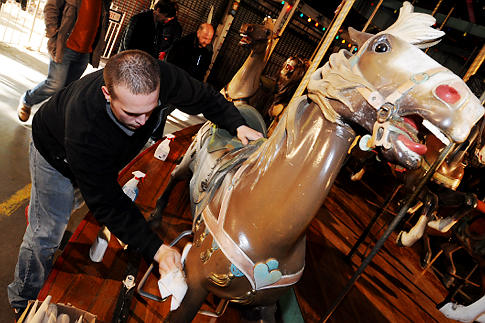
William Adee of Local 52 cleans a Forest Park Carousel horse as film crews get set to shoot 'The Sitter' at shuttered treasure Farriello for News

Fans of the Forest Park Carousel were thrilled to see a glimpse of the shuttered treasure during a flurry of activity at the site this week.
But they shouldn't get their hopes up.
The workers cleaning and fixing the 100-year-old carousel were part of a film crew shooting scenes for "The Sitter."
The movie, starring Jonah Hill of "Superbad" fame and Sam Rockwell, has been described as a loose remake of the 1987 comedy "Adventures in Babysitting."
"It's a major set piece for us," Peter Silbermann, the film's publicist, said of the carousel. "We're shooting in Forest Park for four or five days."
The city-owned carousel has sat dormant for two years while the Parks Department searches for an operator to run it as a concession. Elected officials originally said it would reopen this past summer. But negotiations with a possible vendor appear to have fallen through.
The Parks Department is still actively searching for a concessionaire and plans to issue new request for proposals in January, agency officials said.
Civic leaders have pressed the city to move quickly, worried that the hand-carved masterpiece is deteriorating.
The carousel underwent a top-to-bottom restoration in the late 1980s. But previous operators have done few repairs or attempted historically accurate maintenance of the characters, which include 49 horses, a lion, tiger, deer and two chariots.
"The residents of Woodhaven are excited that our carousel will be showcased in a Hollywood film," said Ed Wendell, president of the Woodhaven Residents' Block Association.
"However, we really hope all this attention will translate into having this carousel open for the children of Queens next summer," said Wendell, who launched a "Save the Forest Park Carousel" page on Facebook.
The city charges movie companies a $300 permit fee to shoot scenes on city property, including streets and parks.
Parks officials and Silbermann said extra care was taken when working with the historic carousel. Some scenes were filmed on a soundstage with replica horses.
"We're not compromising the structure or the horses," Silbermann said.
In addition, 20th Century-Fox, the film's production company, made a "substantial" donation to Forest Park, he said.

Thursday, August 26, 2010

CB 5 Parks Chair: Proposal For Fencing Falls Short by Patrick Clark - www.timesnewsweekly.com | Times Newsweekly

Read original...


Hopes Study Scuttles Reservoir Project Bids


The Parks Department has agreed to include historical replica fencing in its design for the Ridgewood Reservoir project, but the chairman of Community Board 5’s Parks Committee does not think that the city agency is going far enough.


Parks’ design for $7.6 million Phase 1 of the project oringally called for standard, 4’-high wrought iron or chain-link fencing throughout the reservoir, a fact which did not sit well with many community members, including Board 5 Parks Chair Steven Fiedler.


In a telephone interview with the Times Newsweekly, Fiedler said that the 4’ fencing would do little to deter would-be tresspassers, and replacing the historical fencing amounted to “throwing away our heritage.”


In a letter dated May 28, City Council Member Elizabeth Crowley took up the cause, imploring Queens Parks Commissioner Dorothy Lewendowski to preserve the architectural feel of the original fencing.


Noting that in the past, the city has used examples from the Ridgewood Reservoir to model replica fencing, Crowley asked Lewendowski to “ensure that a fence much like the one that was installed in Central Park in 2003 is placed along the main basin at the Ridgewood Reservoir.”


In reponse, Lewendowski assured Crowley, in a letter dated July 15, that “replicated fence will be used at the overlook areas between basins 2 and 3 to maintain the historical integrity of the site.”


Fiedler, however, is not satisfied.


“It’s nothing,” he said. “We have 3,000’ of historical fencing. They want to throw it all out and put in a few feet of replica.”


“All I’m asking them to do is give us a price assessment on taking it out,” Fiedler continued, “sandblasting it, and putting it back in. If the cost turns out to be prohbitive, I can accept that.”


Fiedler also expressed hope that a state Department of Environmental Conservation (DEC) study currently underway would prevent Parks from getting started on Phase 1 of the project.


Speaking to residents at the Citizens for a Better Ridgewood meeting on Monday, July 26, Fieldler expressed his belief that Parks would hold off on awarding the contract until the DEC had determined whether the reservoir would be designated as a wetlands.


“That changes the whole scheme of things for the city,” Fiedler said. “If it’s declared a wetland, the city can’t design anything without state approval.”


Parks spokesperson Trish Bertuccio told the Times Newsweekly that the department is currently reviewing proposals for the project, and that Phase 1 is unaffected by the state’s wetlands study.

Friday, July 30, 2010

CB5 Parks Chair: Proposal for Fencing Falls Short by Patrick Clark, Times Newsweekly...

The Parks Dept has agreed to include historical replica fencing in its design for the Ridgewood Reservoir project, but the chairman of Community Board 5's Parks Committee does not think that the city agency is going far enough.

Parks' design for $7.6 million Phase 1 of the project originally called for standard 4'-high wrought iron or chain-link fencing throughout the reservoir, a fact which does not sit well with many community members, including Board 5 Parks Chair Steven Fiedler.

In a telephone interview with the Times Newsweekly, Fiedler said that the 4' fencing would do little to deter would-be trespassers, and replacing the historical fencing amounted to "throwing away our heritage."

In a letter dated May 28, City Council Member Elizabeth Crowley took up the cause, imploring Queens Parks Commissioner Dorothy Lewandowski to preserve the architectural feel of the original fencing.

Noting that in the past, the city has used examples from the Ridgewood Reservoir to model replica fencing, Crowley asked Lewandowski to "ensure that a fence much like the one that was installed in Central Park in 2003 is placed along the main basin at the Ridgewood Reservoir."

In response, Lewandowski assured Crowley, in a letter dated July 15, that "replicated fence will be used at the overlook areas between basins 2 and 3 to maintain the historical integrity of the site."

Fiedler, however, is not satisfied.

"It's nothing," he said. "We have 3,000 ft of historical fencing. They want to throw it all out and put in a few feet of replica."

"All I'm asking them to do is give us a price assessment on taking it out," Fiedler continued, "sandblasting it, and putting it back in. If the cost turns out to be prohibitive, I can accept that."

Fiedler also expressed hope that a state Department of Environmental Conservation (DEC) study currently underway would prevent Parks from getting started on Phase 1 of the project.

Speaking to residents at the Citizens for a Better Ridgewood meeting on Monday, July 26, Fiedler expressed his belief that Parks would hold off on awarding the contract until the DEC had determined whether the reservoir would be designated as a wetlands.

"That changes the whole scheme of things for the city," Fiedler said. "If it's declared a wetland, the city can't design anything without state approval."

Parks spokesperson Trish Bertuccio told the Times Newsweekly that the department is currently reviewing proposals for the project, and that Phase 1 is unaffected by the State's wetlands study.

Monday, July 19, 2010

Residents Will Have to Wait to Ride Carousel by Justin Chan - The Queens Courier

Read original...

In addition to City Councilman Eric Ulrich, State Senator Joe Addabbo, Assemblyman Mike Miller and Community Boards 5 and 9 have sent letters to the Parks Dept citing the historical and cultural values of the carousel to their constituents and the community at large... I would urge all interested parties to join the Facebook "Save the Forest Park Carousel" page and share your memories of the carousel...


Hundreds of visitors to Forest Park are anxiously waiting for the restoration of its historic carousel, but they will have to wait a while longer.

Although local officials had hoped that the wooden carousel would be running this summer, plans to open it have been delayed for more than a year.

“Parks [the New York City Department of Parks and Recreation] is currently in negotiation with a concessionaire to run the Forest Park Carousel. In addition, the Parks Department is submitting an application for an EPF grant to help further fund the restoration the horses and other historic elements,” said Patricia Bertuccio, a Parks Department spokesperson.

The carousel is one of four that are operated by New York City parks. It is one of the few remaining works of master woodcarver Daniel Carl Muller. Known for his expertise in crafting fanciful figures for carousels, Muller carved the animals on the carousel in the early 1900s.

Despite being renovated several times, the carousel has gradually deteriorated and is in need of another restoration. Unfortunately, its previous vendor, New York One LLC, abandoned it two years ago.

“This isn’t just an amusement ride, it’s a thing of beauty – it’s art. It’s a unique classic wood carousel – there are only two like it in the United States,” said Ed Wendell, president of the Woodhaven Resident Block Association. “I think the message this sends to Woodhaven and the communities that surround Forest Park – Glendale, Ridgewood, Forest Hills, Richmond Hill – is that we don’t particularly respect our past, our history.”

Wendell has been working hard to round up community support for the carousel’s renovation in an effort to restore it to its former glory.

“We're hoping that if enough people speak up we can change this,” said Wendell.

City Councilmember Eric Ulrich has already appealed to Commissioner Carol Ash of the New York State Office of Parks, Recreation and Historic Preservation. In his letter to the commissioner, Ulrich noted that the park has been a “unique and exceptional recreational, historic and cultural icon that has enriched the lives of thousands of children from all across New York City.”

“It’s truly a one-of-a-kind historic centerpiece,” said Ulrich. “If we lose it, Forest Park is just going to be another city park. People travel across the country to visit it.”

Monday, June 21, 2010

Reservoir Plan Foes Get Big Ally by Domenick Rafter - Queens Tribune

The Parks Department’s planned renovation of the former Ridgewood Reservoir may be on life support after local activists opposed to the plan got a powerful ally, City Comptroller John Liu.

Some activists, including a member of Community Board 5, have come out against a plan to renovate the site of the defunct reservoir. Though no plans have been finalized, the renovations could include athletic fields and new parkland. The reservoir, which became inactive in 1989, has since become a natural swampland and many locals want to keep it that way. They met with Liu last week, asking him to freeze contracts awarded in relation to the renovation of the site, which Liu hinted he might do.

“We’re working to figure out a way to make sure the project addresses the concerns, and meets the needs of the community,” Liu said. “Even in a city like New York, there are many opportunities to preserve natural environments.”

The Parks Department renovations would include the removal of dozens of decades-old trees and a century old fence, according to Community Board 5’s Parks Committee.

The Ridgewood Reservoir sits between Ridgewood, Glendale and Cypress Hills, Brooklyn right on the border of Queens and Brooklyn just south of the Jackie Robinson Parkway. It was constructed in 1856 and was used for 133 years as a location to store the back-up water supply for Brooklyn and Queens.

Since closing, the 58-acre site has become a natural marshland teeming with wildlife.

Thursday, June 10, 2010

A Red Light On Park Project? by Ralph Mancini - Times Newsweekly

Read original...


The co-chair of Community Board 5’s Parks Committee announced during the panel’s May 24 meeting at Principe Park in Maspeth that he would seek a stop work order barring the start of the first phase of the renovations to the Ridgewood Reservoir.

Steven Fiedler told attendees that the panel would seek to halt plans by the Parks Department to install new lighting and fencing around the perimeter of the 55-acre site on the Brooklyn/Queens border, which the city plans to transform along with adjacent Highland Park into a new regional park.

According to Fiedler, the main point of contention centers around the proposed installation of a 4’-high fence surrounding the site, which he charged would not be tall enough to keep potential vandals and other trespassers out of the basins. Reportedly, the work would also require the removal of several trees.

Concerns about the height of the fencing were brought to the attention of Queens Borough Commissioner Dorothy Lewandowski, but Fiedler charged that his opinions were not well received.

“She won’t listen and she catches an attitude,” he claimed regarding his past attempts to reach out to Lewandowski about his gripes with the project, which is scheduled to commence in the fall.

The Parks Department is reportedly in the process of receiving bids for phase one work, which would include the installation of stairs and an ADA-compliant ramp.

Thursday, June 3, 2010

Reservoir Plans in Limbo by Chauncey Alcorn - YourNabe.com - Queens

Read original...


The Ridgewood Reservoir, which currently contains 58 acres of wooded area, marshlands and wildlife, was scheduled to receive safety improvements in 2009. More than a year later, those improvements are still on hold and are not likely to begin before December.


Queens park officials last year were scheduled to begin phase one of renovating the former Ridgewood Reservoir, but more than a year later no construction has begun and those same officials Tuesday said that is not going to change anytime soon.

The city Parks Department and Ridgewood residents have battled for years over what to do with the former reservoir, located in Highland Park, which was built in 1856 and used until 1989 to store a back-up water supply for Brooklyn and Queens.

Presently, the site, three wooded basins totaling at least 58 acres, is filled with wildlife, including 100 bird species, according to Gary Giordano, district manager of Community Board 5, which wants the city to leave the reservoir alone.

“Why take a natural place and make it into ballfields when you have ballfields that aren’t being taken care of right nearby in the same park?” he asked. “Thankfully, the mayor had a vision five years ago for a nature preserve and got this project funded with millions of dollars .... If the mayor didn’t have the vision environmentally to do something with the reservoir, that project would never have gotten done.”

But the project has not been completed. Years later, in fact, it has not even begun.

The Queens Parks Department last year hosted a series of meetings with community residents in Ridgewood and Glendale to find out what they want to happen with the reservoir and it became apparent the communities were divided over whether to make it into park space, a natural reserve or a combination of the two.

“None of that stuff has been decided yet,” Queens Parks spokeswoman Trish Bertuccio said.

But the department did decide to move forward with phase one of the project, improving safety measures, which includes repairing concrete stairs in the reservoir, widening turns in the perimeter path, installing or repairing lighting along the path and building an observation path on a causeway between two of the three basins.

Phase one also included building a perimeter fence around the basin, but city officials and the community board disagree on how tall the fence should be.

“We’ve had issues as far as phase one of the project goes with regards to the Parks Department only wanting a 4-foot fence for a good portion of the reservoir perimeter,” Giordano said. “We don’t think a 4-foot fence is tall enough to keep out the vandals.”


Indecision aside, a Parks official said the phase one proposal first must be approved by city Comptroller John Liu before the project can move forward and that has not happened yet.

“I think it’s safe to say a minimum of six months before anything actually gets on the ground, but that all depends on if the comptroller actually signs off on it and other things,” the official said Tuesday.

After the plan is signed, it must go up for a construction bid.

“Usually the bid cycle lasts about three months. Then we will approve them and that might take another three months,” the official said.

That means the project proposed no later than 2005 is not likely to begin until around December or later, but Giordano said that is not a problem.

“Sometimes it’s worth waiting a little longer to do a better job as opposed to doing something wrong and having to redo it,” he said. “It’s usually better to have it done the first time.”

Tuesday, June 1, 2010

Locals Want New Ridgewood Reservoir Plan by Lisa L. Colangelo - NY Daily News

Read original...

Click on photos to enlarge...

LOCAL ACTIVISTS unhappy with a Parks Department plan to fix up the area surrounding the Ridgewood Reservoir are hoping city Controller John Liu will champion their cause.

They met with members of Liu's staff last week and asked them to freeze a Parks contract on the project unless changes are made.

"We're working to figure out a way to make sure the project addresses the concerns, and meets the needs of the community," Liu said in a statement. "Even in a city like New York, there are many opportunities to preserve natural environments."


Parks officials are still deciding how to turn the decommissioned reservoir - which has naturally devolved into a swampy oasis of green on the Brooklyn-Queens border - into a park. Many community activists and elected officials have said they want the spot to remain wild while others said some of the space should be used for recreational fields.
During his tenure as controller, William Thompson held up contracts until the city agreed to reconsider plans for the site.

The first phase of the project includes fixing up walkways, fencing and lighting, along with a new handicapped-accessible ramp.

But Steve Fiedler, chairman of Community Board 5's parks committee, said that plan would require the removal of dozens of trees and discard 100-year-old historic fencing.


And instead of creating a new ramp near busy Vermont Place, Fiedler and others said the city should fix up an existing ramp on the other side of the reservoir or build an overhead ramp.

"Look at how hard it is to get across," Fiedler said as he tried to cross the street during a recent visit to the site with other supporters.

"It also doesn't make sense to place a 4-foot fence around this," he said. "You really need a 6-foot fence."

Parks officials pointed out only three trees would be removed to create the ramp.


"The first phase of the Ridgewood Reservoir enhancements were extensively discussed with the community and vetted by Queens Community Board 5 in July 2009," said Queens Parks Commissioner Dorothy Lewandowski. "This phase is essential because it will address security, lighting and improve access to the park."

She also said that only "invasive species that are compromising the infrastructure and threatening the delicate biodiversity of the reservoir" will be removed.

Photos by: Sam

Tuesday, May 25, 2010

Bids Go Out on Ridgewood Reservoir Phase One Work by Daniel Bush - Queens Ledger

Read original...

The phase one redevelopment of Ridgewood Reservoir is moving forward, despite continued opposition from community leaders who want to see the plan tweaked.

The Parks Department will begin accepting bids for the $7.6 million project May 28, according to Steve Fiedler, chairman of Community Board Five's Parks Committee. He said construction is scheduled to begin in the fall, which gives the board a few more months to make its case.

“Hopefully we can get the Parks Department to realize the community doesn't like what's going on,” he said.

Phase one work includes new lighting, pathways, stairs, an ADA-compliant ramp, and a controversial four-foot fence around the three-basin reservoir on the Brooklyn-Queens border.

CB5, numerous elected officials, and community groups all support the creation of a taller six-foot perimeter fence to ward off vandals and an enclosed pedestrian bridge over Vermont Place, among other changes.

So far, the Parks Department has rejected the recommendations.

Parks told Fielder a taller fence would disturb views of the reservoir, but he pointed out that thick summer foliage does that anyway. “We don't believe the reason they gave holds any merit at all,” he said.

Queens Parks Commissioner Dorothy Lewandowski caused a stir at a meeting last week when she announced that dozens of trees would be cut to accommodate phase one construction.

The work is part of a larger, $26 million redevelopment of the reservoir, which was decommissioned in 1989.

Thursday, May 20, 2010

Forum News: State Delays Reservoir Redevelopment By Conor Greene - Forum News Group

The Parks Dept might want to argue with the Snapping Turtle (below pic) as to whether or not the Ridgewood Reservoir is a wetlands...It should be noted, that the snapping turtle is New York's official state reptile and is the largest freshwater turtle in the state...Furthermore, I have been told by a Herpetologist that the turtle pictured is probably between 15-20 years old...

Read original...

Parks Explains Need to Cut Down 65 Trees for Phase One


Snapping Turtle at Ridgewood Reservoir - David M. Quintana

While the city Parks Department is prepared to move forward with its phase one redevelopment of Ridgewood Reservoir, it appears that the second phase - which will determine the future use of the property - is on hold as the state decides whether the land should be designated a wetland.

As has been reported, the state Department of Environmental Conservation is currently investigating whether to classify the property on the Queens-Brooklyn border, which contains three basins, as wetlands. Doing so would complicate the Parks Department’s proposed plans for the site, which range from keeping it entirely natural to building ball fields in one of the basins.

“The determination to regulate an area is based on its characteristics and functions as a wetland,” wrote DEC spokesman Thomas Panzone. “In the years since the reservoir was decommissioned, the basins, or part of the basins, have developed some wetland characteristics such as seasonally or permanently wet areas and wetland-dependant vegetation.”

Panzone added that the agency’s investigation comes as a result of a request to map the reservoir as a wetland. That request was made by the public through local elected officials, according to activists that have been lobbying for the site to be kept in its natural state.

Those activists, including David Quintana of Ozone Park, were surprised to learn this week that Parks plans to cut down 65 trees as part of phase one. That aspect of the project, estimated at $7.6 million, includes new lighting and fencing along the perimeter of the basins and better handicap accessibility.

Parks says that, of the 65 trees, nine are dead and the remaining 56 are invasive species, have weak root systems or are compromising existing infrastructure. Three are being removed to create the ADA path. A parks spokeswoman added that “all of our plans for phase one were approved by all the appropriate agencies, and we will continue working with them as we move forward to develop this site.”

Quintana and others who attended a recent Queens Civic Congress meeting on parks say they were also surprised by comments made by borough Parks Commissioner Dorothy Lewandowski regarding the potential wetlands designation. According to several in attendance, she suggested the site might not qualify for wetland designation because the basins are not large enough individually, and would have to be connected to meet the size standards.

The DEC said that while wetland designation is normally based on size, “under certain circumstances other factors can be considered.”

There was also talk the DEC might instead classify the site a dam, which could require stripping the basins of vegetation, according to several attendees. The DEC noted that, while the Ridgewood Reservoir system contains a dam, it “can be managed in a number of reasonable ways.” Panzone added, “DEC is not aware of any proposal for stripping the basins and has not issued any such order.”

When asked about Lewandowski’s comments that the DEC is looking at it as a dam, the Parks spokeswoman responded, “That is not what the commissioner said and there is no discussion or plans of stripping the basins. As mentioned in the [prior] statement, the conditions on the site are being reviewed.”

Parks had been set to present three options for phase two to local community boards earlier this year, but that was delayed by the possible DEC intervention and wetland classification. Those pushing for the site to remain natural say they are hopeful the state’s involvement will prevent the city from building ball fields on the property.

“I think DEC s going to stall them, and that should be a long process,” said Quintana.

Steven Fiedler, who attended the meeting as a member of the Juniper Park Civic Association, said there is another complicating factor aside from the potential wetland investigation. He says there are two 46-inch pipes on Seneca Avenue and Vermont Place that the DEC wants sealed before any phase two work moves forward.

“That’s a huge undertaking that sets phase two back,” said Fiedler, who also chairs Community Board 5’s Parks Committee. “In my opinion, you are not going to see it for five years.”

Gary Giordano, district manager of CB 5, echoed the sentiment that state involvement is a good thing. “Whatever the technicalities of classification are, speaking for myself, and I think for some board members too, I’m hopeful that with the state DEC being involved, there is more of a likelihood that the reservoir basins will remain in very much a natural state,” he said.

Giordano added that he doesn’t expect to see any phase two plans in the near future. “I don’t think they are going to show anything, even to the community boards, until [the DEC investigation is complete] because one of the options may be an issue with DEC if it is to put ball fields in one of the basins,” he said. “I would think that certainly would be an issue with DEC. Sometimes more is less, and I don’t think anyone on our board wants to see those ball fields in the basins.”

A number of elected officials have thrown their support behind keeping the site dedicated for passive recreation, including Assemblyman Mike Miller (D-Woodhaven).

Thursday, April 22, 2010

State Eyeing Ridgewood Reservoir for Wetlands Protection by Dan Bush - Queens Ledger

Read original....


The Department of Environmental Conservation (DEC) is considering classifying the Ridgewood Reservoir a state-regulated freshwater wetlands, this paper has learned.

The designation would subject the city's planned redevelopment of the reservoir to a state review, and would set the stage for a possible confrontation over the site with the Bloomberg Administration.

The city is planning a $26 million project that would convert part of the three-basin reservoir into a recreation area, despite objections from residents who want the site protected as a natural preserve.

Thomas Panzone, a DEC spokesperson, confirmed the state is eyeing the 160-year-old reservoir, which was decommissioned in 1989 and has reverted back into unkempt parkland.

“DEC is reviewing whether or not the Ridgewood Reservoir should be classified as a state-regulated freshwater wetland,” Panzone said in an email. If that happens any planned changes to the site would be subject to review by the state, and could require a permit under the state's Freshwater Wetland regulations, he said.

The Parks Department was not immediately available for comment.

The full implications of a wetlands designation on the city's plans for the reservoir remain unclear. But someone with knowledge of the negotiations between the city and state said the DEC's interest has complicated the city's efforts to remake the reservoir.

It appears likely the city could proceed easily with its phase one plans - to upgrade lights and fencing around the reservoir and rebuild a pathway between the second and third basins - regardless of any state involvement.

But the thought of complex wetlands regulations has raised concerns inside the Parks Department over its phase two plans to replace part of the third basin with an active recreation area. The work could prove difficult if the site were protected.

The phase two plan is deeply unpopular with local preservationists and Community Board 5, which recommended improving the existing ball fields in adjacent Highland Park instead of building new ones inside the reservoir.

“We'd like to see it be a nature preserve,” said Gary Giordano, CB5's district manager. If the wetlands designation allows for passive recreation on the reservoir's pathways “that's a lot more palatable than any kind of recreation development inside the reservoir,” he said.

Assemblyman Mike Miller said a state-regulated wetlands would provide important protection for wildlife within the reservoir, home to over 100 bird species. “It would curtail some of the changes the parks department wants to make,” Miller said, “but it would protect the basins the community wants protected.”

Sunday, April 18, 2010

Boards Rally Against Mayor's Proposed Cuts by Conor Greene - Forum News

Read original...

Funding Reduction Would Severely Impact Board’s Role

Members of community boards from across Queens gathered on the steps of Borough Hall on Tuesday to demand that the Bloomberg administration rethinks its plans to reduce the groups’ budgets again this year.

Under Mayor Bloomberg’s proposed $64 billion city budget for the fiscal year starting July 1, each of the borough’s 14 local community boards would face a funding reduction of more than $17,000. That comes after several budget cuts reduced each board’s funding from about $206,000 several years ago to $144,000, according to one district manager.

On Tuesday, more than 100 board members, residents and district managers joined Borough President Helen Marshall to get the word out about how detrimental these cuts would be. They were joined by several City Council members, including Karen Koslowitz (D-Forest Hills) and Eric Ulrich (R-Ozone Park), who both vowed to fight against these cuts as the budget process unfolds.

“There is no question that reducing the board to a fulltime district manager and one part-time individual will limit the board’s ability to perform their city-charter mandated functions,” said Marshall. “These boards help us to perfect democracy by bringing City Hall to neighborhoods directly affected by proposals that affect land use, city services, parks and a multitude of other issues.”

While the funding reductions are being necessitated by the economic crisis, there was also a feeling among some board members and district managers the cuts are part of an ongoing effort to reduce the board’s roles before eventually eliminating them all together.

Betty Braton, chair of CB 10, said there are “two undercurrents” to the decision to cut funds, and Frank Gulluscio, district manager of CB 6, agreed that “Money aside, there is a mission there.” Patricia Dolan of the Queens Civic Congress later said, “This mayor, for reasons we will never understand, wants to undermine neighborhoods, not just in Queens, but around the city.”

The Council members on hand indicated they wouldn’t let the boards’ budget be cut without a fight. “It’s a horrible situation when we have to fight for something that makes sense,” said Leroy Comrie (D-St. Albans), adding that it is “embarrassing” that the Bloomberg administration keeps targeting the boards for cuts.

Ulrich vowed that there is “no way the mayor can balance the books… on the backs of community boards.” He called it “ridiculous that we have to fight for peanuts so that we can serve our communities.”

Vincent Arcuri, chairman of CB 5, likened board members to “tribal leaders” who have their finger on the pulse of the local community. “We are needed – we are one of the most basic forms of government in the United States,” he said.

Gulluscio called the current funding levels “bare bones” and said budget cuts are impacting the board’s ability to perform duties such as community outreach, since there often isn’t money for necessities such as printing and postage. He noted that the Bloomberg administration’s handling of the boards is not consistent with a letter sent out by the head of the mayor’s Community Affairs Unit, Nazli Parvizi.

“Community Boards provide New Yorkers with a voice and the ability to be increasingly helpful and productive in their neighborhoods,” wrote Parvizi. “Whether advising on unprecedented land use reforms or fighting for crucial social services, Community Board members work to strengthen and celebrate this great city.” She goes on to note that the Bloomberg administration“ has long recognized the value of community boards as local experts within the larger structure of city government.”

Formerly known as “Community Planning Boards” and “Little City Halls,” the boards were strengthened when the 1975 City Charter was adopted, giving boards roles in neighborhood land use, preparation of the capital and expense budget and delivery of local city services. The role of the boards was reaffirmed in the 1989 charter. Each board has up to 50 members who serve staggered terms of two years on a volunteer basis.