![]() |
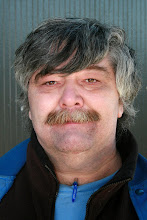
| Queens Borough Community College Professor Bruce Naples wants to create a iPhone app through the Locacios program that will provide a walking tour of the college campus. |
Thursday, December 23, 2010
App-ropriate Way to Learn About Boro: Go on Tour with Smartphone by Nicholas Horshon - NY Daily News
Saturday, November 6, 2010
New Queens Historian Unveils His Agenda for Boro by Anna Gustafson - YourNabe.com
![]() |
| Jack Eichenbaum, of Flushing, speaks during a Queens Preservation Council meeting celebrating his new post as borough historian. Photo by Anna Gustafson |
Flushing resident Jack Eichenbaum, plans to focus on environmental preservation, changes in Queens’ demographics and using technology to document history in his new role as borough historian, he said during a ceremony celebrating his new post last week.
“This is the garden borough and we’re paving it,” Eichenbaum warned last Thursday at Queens Borough Hall.
Eichenbaum, who was appointed historian by Borough President Helen Marshall in June, was joined by a large group of history and preservation buffs as well as civic leaders, at the Queens Preservation Council reception.
“A lot of people don’t know a lot of our historical places, and Jack is the person to introduce these people to them,” Marshall said. “He’s a natural when it comes to these places. He’ll get people to visit these sites and think about how Queens was set up.”
The new historian, who lives in Flushing, has degrees in chemical engineering and physical chemistry and is a former assessor for the city Finance Department. He also taught about urban growth and geography at the City University of New York. He hosts a wide variety of tours of Queens and the city, including Flushing’s Koreatown, Long Island City’s Hunter’s Point, South Richmond Hill, Jackson Heights, Sunnyside, Jamaica and Flushing’s Main Street, among many others.
Just as important as maintaining the borough’s unique architecture is what Eichenbaum called “environmental preservation.”
“Queens has always successfully competed with Manhattan by offering more land, less crowding and a healthier environment,” Eichenbaum said. “Queens had the first nurseries in North America. Queens had the Garden City movement, which encouraged planned communities with setbacks and street trees proximate to railroad stations, such as Kew Gardens, Forest Hills Gardens.”
Queens has an opportunity to revitalize its plentiful amount of waterfront property, Eichenbaum said.
“We have miles and miles of forlorn waterfront that we have to build up into something better,” he said. “The jewel in the crown that could be something splendid is Newtown Creek. There’s Flushing Bay, Little Neck Bay, Jamaica Bay has good waterfront.”
The borough has experienced extensive demographic changes, particularly following the 1965 change in federal immigration laws, and Eichenbaum said he hopes to document the influx of immigrants from throughout the world to Queens.
“Our borough’s ethnic neighborhoods and food have drawn outside visitors,” Eichenbaum said.
The new historian said he plans to work with area colleges to document the changing demographics, including archiving interviews with community leaders from different ethnic groups.
He also stressed the need to attract Queens’ newer residents to the preservation movement in the borough.
“We’ve got to get the second-generation immigrants interested in preservation and history in Queens,” Eichenbaum said.
New technology could be a big boost when it comes to documenting changes in Queens, including using aerial photographs to show shifts in population and buildings trends, Eichenbaum said. Additionally, he said he would like to create walking tours in the borough that individuals could access from their cell phones.
“You could hook into a recorded walking tour for wherever you are in Queens,” he said. “It would be free and maybe funded in part by merchants along the tour.”
Reach reporter Anna Gustafson by e-mail at agustafson@cnglocal.com or by phone at 718-260-4574.
Tuesday, November 2, 2010
Nabes, Forget Me-First by Nicholas Hirshon - NY Daily News
![]() |
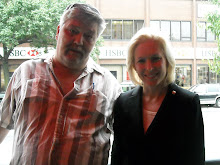
| Jim Van Westering - Queens Preservation Council, Queens Borough President Helen Marshall and new Queens Borough Historian Jack Eichenbaum (left-right) |
Thursday, September 30, 2010
Historians Lobby for State Signage to Recognize Revolutionary War General Nathaniel Woodhull by Nicholas Hirshon - NY Daily News
![]() |
| The cannon at Nathaniel Woodhull School (PS 35) in Hollis is the only marker of death of the Revolutionary War general Nathaniel Woodhull. Historians are lobbying for official state signage. |
Exactly 234 years ago this month, a Revolutionary War general died from wounds incurred during a defiant showdown with the British - a gripping tale of patriotism that began in Queens.
Thursday, July 22, 2010
An Interview with Queens Borough Historian Jack Eichbaum - A Passion For All Things Queens - WNYC
They give lectures and tours and help New Yorkers learn about their neighborhoods. Their positions are mandated by state law...but they don't make a penny for the job. They're the five city historians, one for each borough. This summer, we'll be meeting them and finding out some of the secret knowledge about their respective 'hoods.
Queens Borough Historian Jack Eichenbaum is the new kid on the block. He got his job in June, promising not to hide behind books.
In the Flushing apartment he's lived in for decades, Eichenbaum looks tan and fit in a t-shirt, royal blue track shorts and running shoes. He's lived nearly all of his 67 years in Queens -- a place he believes is still undervalued by the rest of the city.
The people who act like Manhattan is the center of the known universe? Don't even get him started.
"I found too many people who were interesting people who would never come here," he says "'Why would I ever want to go there? To their crowded apartments, and their overpriced restaurants and their dirty air.'"
He isn't always this feisty, but he's a man on a mission.
That's why Queens Borough President Helen Marshall selected Eichembaum, a retired city assessor with a Ph.D. in geography, over six other candidates.
She says his passion for all things Queens is one of the qualities that make him the right man for the job. His predecessor, Stanley Cogan, held the position for 11 years before stepping down earlier this year because of health problems.
Eichenbaum says the thing that most easily dazzles people about his borough is the rich diversity layered throughout the different neighborhoods.
"I mean people still wearing some version of clothing that looks different, smells that are different, music is blaring out of the shops -- and, you know, it’s all right out there."
He notes that Queens hasn't always been this diverse. One of the defining moments for the borough was the changing of the immigration laws beginning in the late '60s. The other was when the Queensborough Bridge and the No. 7 and N trains opened, transforming the mostly rural area into an urban spot in the early part of the 20th century. Although for some, the neighborhoods are still more relevant than the borough.
| QUEENS BY THE NUMBERS |
| Population: 2,306,712 |
| Area: 109.24 square miles (largest of any borough) |
| Number of languages spoken: About 170 |
| Median household income: $55,599 |
| Percent of population below poverty level: 12.3% |
| Source: U.S. Census Bureau |
"When I was growing up, we lived in Bayside," Eichenbaum says. "We never said we live in Queens. The fact that people live in Queens is a relatively late 20th century idea.
Most people lived and grew up, from my era, in neighborhoods of Queens -- and you still write, neighborhood addresses say Bayside, NY; Jamaica, NY; Ozone Park, NY."
Guiding people through those neighborhoods is something he's been doing since the '80s -- and he'll continue to push an educational agenda via walking tours. One thing that often surprises visitors about Flushing is how green it is. Eichenbaum is even on a first name basis with one of the epic trees that line Bowne Street, calling it “Big Mama.”
Further along, there are more landmarks with roots.
"This is Weeping Beech Park," he says. "It’s named for a weeping beech tree planted by of one of the most famous nurserymen, Samuel Bowne Parsons."
His tour is peppered with offbeat facts and trivia.
Scrabble, for example, was invented in Jackson Heights by a man named Alfred Butts. "He invented the game and his wife tested it and they refined it I think in the '30s and '40s," Eichenbaum says.
Eichenbaum happens to a champion Scrabble player himself and has trophies from tournaments he's competed in from Boston to the Dead Sea.
He fondly reminisces about one of his of his most memorable moves, when he spelled out the word "syzygy," which employs 3 Y's and a Z.
What does the word mean? “It has something to do with eclipses or some kind of astronomical movements between bodies when certain alignments," he says, before admitting, "I don’t know exactly.”
What he does know is that he's the guy to school New Yorkers about a borough they still know too little about. That means you, Manhattan.
This week, the borough historian will be answering the burning questions you have about Queens. Follow the link below to post yours.
Ask the Queens historian your Queens questions...
Thursday, July 1, 2010
Author Jeffrey Kroessler Rips Into Ex-rival, Borough Historian Jack Eichenbaum for Being Passive by Nicholas Hirshon - NY Daily News
This grudge isn't history.
A runner-up for Queens borough historian has ripped into the eventual pick, Jack Eichenbaum, as "sadly misinformed" with a "profound ignorance" of efforts to save significant sites.
Author Jeffrey Kroessler posted the critical comments online in response to a recent Daily News article in which Eichenbaum said he'd rather be an educator than fight to landmark buildings.
"Sadly, Mr. Eichenbaum is poised to continue the ineffective pattern set by his predecessors," Kroessler wrote on the blog of the Historic Districts Council.
Eichenbaum responded in a statement that he has a "more inclusive" approach to the job than Kroessler, adding that he wants to emphasize Queens' ethnic diversity and environmental issues.
Some chalked up Kroessler's harsh words to sour grapes over losing out on the post.
But the Internet ire highlights a debate on what role the unpaid borough historian should play in protecting structures in danger of renovations or destruction.
Some preservationists, including Simeon Bankoff of the Historic Districts Council, said Eichenbaum's words do not mesh with the attitude they hoped for from Borough Hall.
On the other hand, Manhattan Borough Historian Michael Miscione noted that Eichenbaum is wise not to be entangled in time-consuming landmarking efforts.
Kroessler's post, titled "No, I am NOT the Borough Historian," notes that despite his multiple books and research, he was not selected for the gig.
Kroessler writes that he's "disturbed" that Eichenbaum, a Flushing tour guide and board member of the Queens Historical Society, "wants to take the history out of historic preservation."
Queens Borough President Helen Marshall announced at a June 8 news conference that Eichenbaum, 67, had been picked as the next borough historian. Eichenbaum had been selected after he, Kroessler and several others were interviewed by a four-member ad hoc committee of archivists and historians.
After Eichenbaum won the position, he invited Kroessler to an October conference he is organizing to foster interaction between the borough's historical groups. Kroessler says he isn't sure he'll attend.
"It's not even July yet," he said. "October is a long time away."
Tuesday, June 22, 2010
No, I Am NOT the Borough Historian by Jeffrey A. Kroessler - Historic Districts Council Newsstand
I applied to be the borough historian of Queens because I thought, oddly enough, that the post should be held by an urban historian. After all, I earned a Ph.D. in urban history, and my dissertation was a history of Queens. I authored the article on the borough in the Encyclopedia of New York State, and rewrote and updated the entry for the second edition of the Encyclopedia of New York City, as well as dozens of other entries about Queens. I wrote the centennial history of the Queens Borough Public Library and co-authored Historic Preservation in Queens. I’ve written quite a bit about Robert Moses and his parks and highways, and my latest book, The Greater New York Sports Chronology, naturally features quite a bit about Queens.
But no, I want to make clear that I am NOT the borough historian.
Jack Eichenbaum is the borough historian. He is an urban geographer, not a historian. He leads interesting and popular walking tours. But as he revealed in a recent interview with the Daily News, he has absolutely no interest in historic preservation, and is sadly misinformed about the role of landmarking in keeping New York a livable city.
Perhaps I am not the borough historian because I am an uncompromising advocate for historic preservation. My wife and I live in the Sunnyside Gardens Historic District, and we worked hard to have our neighborhood designated. As a historian, I was well positioned to counter the misinformation put forward by opponents of designation.
I am disturbed that the man appointed the new borough historian wants to take the history out of historic preservation, calling the designation of historic districts a “frozen-in-time” approach. “A lot of historic districts are just so fussy,” he told the Daily News reporter. This statement displays both a profound ignorance of how landmark designation protects a neighborhood and contempt for those residents of the borough who are working toward such designation in places like Addesleigh Park. Such remarks belong to the Donald Manes era, not today.
Sadly, Mr. Eichenbaum is poised to continue the ineffective pattern set by his predecessors, Hank Ludder and Stanley Cogan. During their tenure, stretching from Donald Manes through Claire Shulman to current Borough President Helen Marshall, preservationists could expect precious little help from Borough Hall. Indeed, quite often we encountered outright opposition. I can recall no instance when the Queens borough historian took a proactive – or even a reactive – role in preservation battles. Actually, I can recall no instance when any of the five borough historians took up the cause of preservation.
I fought to save the Aquacade from the 1939 World’s Fair in Flushing Meadows-Corona Park. There was not a peep of support from Stanley Cogan as Claire Shulman had it demolished. In keeping with that tradition, I doubt we will hear anything from our new borough historian about the importance of protecting the 1850s Ridgewood Reservoir, arguably the most important undesignated place in Queens today. I expect he could lead a tour along the terminal moraine through Forest Park to the reservoir, but I cannot imagine him speaking against the Parks Department plan to install playing fields covered with artificial turf where there is now a thriving wetland. It seems it would be enough to point out that where the playing fields are was once Brooklyn’s water system. Oh well.
Mr. Eichenbaum makes clear he will not work to save “just every old building.” We ought to ask, will he fight to save ANY old building? I for one do not think it is enough to point out the site where St. Savior’s used to be, or where the Aquacade once stood, or where Flessel’s once was. In this regard, Borough President Helen Marshall seems to be more in tune with the temper of her constituents. As she told the Daily News, when people see the history in their own neighborhoods, “they don’t want it to be destroyed.” That was the genesis of walking tours, actually, to bring greater awareness of the historic resources around us and feed the movement to preserve them. They were not born to foster antiquarianism.
The New York State Constitution mandates that every county appoint a historian, a post that is both official and symbolic. His is the voice for the historic resources of the borough, and surely that includes the built environment. Silence sends the wrong message. Instead of fighting to preserve historic sites so treasured by the people of Queens, the new borough historian will install a display of old things in Borough Hall. Now that’s a “frozen-in-time” approach.
Jeffrey A. Kroessler is a member of the HDC Board of Directors.
Sunday, June 20, 2010
Queens' New Borough Historian Jack Eichenbaum Has Plan to Connect Kids with Local History by Nicholas Hirshon - NY Daily News
Just what we need in this era of Bloomberg's over-development of our communities, a borough historian who doesn't feel the need for landmarking of Queens historical buildings...geez..!
Read original...
Queens' new borough historian swears he won't "hide behind books" - but he might hide a few himself to bring the past to youngsters.
Pledging to connect with the public instead of library shelves, Jack Eichenbaum said he will offer scavenger hunts to help students learn the under appreciated legacy of their neighborhoods.
It's among several novel methods Eichenbaum vows to embrace in the prestigious post he assumed last week - at a crucial time when overdevelopment threatens Queens history.
"Books are a way of hiding from people," said Eichenbaum, 67, of Flushing. "I love being outdoors. I love the direct communication with people face to face."
Eichenbaum said he will also undertake digital research to determine, for example, how much of Queens' green space has been paved over in recent years.
Borough President Helen Marshall told the Daily News that she has already lined up a project for Eichenbaum: starting a one-room Queens history museum at Borough Hall in Kew Gardens.
Marshall said the display could feature items from the eclectic collection of the Queens topographical unit, such as a 1686 Bible and teeth from a famous Woodhaven racehorse named Dexter.
Marshall also hailed Eichenbaum's passion for leading walking tours past significant sites. "When people see that history and get into it, they don't want it to be destroyed," she said.
Eichenbaum stressed he will embrace an "educator" role rather than becoming an advocate who leads landmarking rallies to save "just every old building."
Pressed on whether he would seek landmark status to protect historic sites, Eichenbaum replied, "I don't see myself championing those types of causes."
Instead, he said, he will refer preservationists who seek advice on landmarking causes to other experts or museums.
He even dismissed some calls for historic preservation as residents fearing change.
Eichenbaum also bemoaned the "frozen-in-time" approach to the city's historic districts, which protect select blocks from major alterations or demolitions.
"A lot of the historic districts are just so fussy: 'You can't change this, you can't change the colors,'" he said.
Eichenbaum added that he is planning an October meeting of the borough's historical societies to foster interaction and cooperation around Queens.