Showing posts with label rudy giuliani. Show all posts

Sunday, December 26, 2010

Queens Chronicle Editorial - Bloomberg Not Credible on the CityTime Fiasco

Read original...

I wholeheartedly agree with the Chronicle...hopefully this will be Bloomberg's downfall....


Mayor Bloomberg’s blase attitude about the CityTime scandal and his claim that he had no indication of wrongdoing until last week’s federal indictments are insulting to every New Yorker. The idea that he didn’t know there was big trouble surrounding the payroll-modernizing project is laughable for a number of reasons.

First of all, the cost skyrocketed from a little under $70 million when the initiative was launched in 1998 under former Mayor Rudy Giuliani to nearly $750 million this year. Inflation is one thing, but a tenfold jump in the cost of a city contract is a strong indicator that a criminal probe is warranted. Especially when the chief executive responsible for the project is known above all as a financial whiz who made his fortune in information technology.

Advertisement
Bloomberg did not become a billionaire by letting cash fly out the window, and his mayoralty has been marked by a businessman’s attention to the bottom line. Except in the case of CityTime. On that he’s been utterly out to lunch.

Another top city official wasn’t, however, and Bloomberg would have been wise to pay more attention to him. Comptroller John Liu warned the mayor back in March that the project was “hemorrhaging” money and had “ballooned out of control.” It was Liu who pegged the cost through this year at $738 million — more than $100 million above where it was estimated in 2009.

Also, the Daily News has been writing about the cost overruns, conflicts of interest and double dipping among those involved with the project for more than a year.

All of those factors — or really any single one of them — should have set the mayor’s alarm bells ringing long before last week’s arrests.

Variously charged with felony conspiracy to commit wire fraud and money laundering are four of the contractors responsible for the CityTime mess and two close relatives of one of them, Mark Mazer. While innocent until proven guilty, they have a lot of explaining to do and are likely to face significant jail time.

The main defendants — Mazer, Dmitry Aronshtein, Victor Natanzon and Scott Berger — are charged with misappropriating $80 million of the taxpayers’ money. Mazer’s wife and mother are charged with helping to launder the proceeds. The feds have seized $850,000 in cash the defendants allegedly kept in safe deposit boxes.

The prosecutions are in the feds’ hands. But that doesn’t mean the city has no role to play. The City Council should immediately hold hearings to probe the non-criminal aspects of the case, and Bloomberg should be the first person to be called. New Yorkers have a right to hear him say, under oath, what he knew and when he knew it.

Other prime witnesses would be Liu, who can testify about his office’s findings and how they went largely unheeded by the administration, and Joel Bondy, head of the Office of Payroll Administration since 2004, who was finally suspended over the scandal last week.

For the last several years, as the CityTime fiasco was developing, the mayor has been cutting the budgets of every city agency to make ends meet. Teacher layoffs, library closures, reductions in the ranks of the NYPD and FDNY — they’ve all been justified on the basis that the money just isn’t there. But maybe we really didn’t need to close those libraries, let those teachers go or reduce the uniformed services. That’s the even deeper scandal here.

Whether the city could ever recover the lost money is a good question. What other funds are being lost on wasteful projects that haven’t made news yet is another one.

Tuesday, December 14, 2010

Bloomberg Wants to be a Contender for New York's Greatest Mayor Ever by Adam Lisberg - NY Daily News

Read original...

I'd like to nominate Mayor Bloomturd as the greatest tyrant and egotist in NYC History...

Mayor Bloomberg says that he wants to be remembered as New York's greatest mayor, but says he has no interest in running for president in 2012.

Mayor Bloomberg's ego got the best of him Sunday when he confessed he wants to be remembered as "the greatest mayor ever."


The confession from Hizzoner, who usually says he hopes his eventual successor will do a better job than he has done, came as he once again denied any interest in running for President.
"I've got a great job. I want to go out being, having a reputation as a very good, maybe the greatest mayor ever," he said on NBC's "Meet the Press."
"I'm lucky I have three predecessors - Giuliani and Dinkins and Koch - all of whom have been very helpful in trying to make me a better mayor."
Bloomberg appeared on the national political talk show days after he gave a talk about the economy at the Brooklyn Navy Yard that seemed like a stump speech to challenge Obama in 2012.
He again.

Thursday, September 9, 2010

Rudy Giuliani Still: A Noun, a Verb and 9-11 at Cyclones Game...


The Brooklyn Paper mentioned on MSNBC's Countdown with Keith Olbermann...


This video from The Brooklyn Paper lets you in on the fun...


Brooklyn Paper reporter Stephen Brown asked Rudy Giuliani the tough question at a Cyclones game last week — was he rooting for the hometown Cyclones or the visiting Staten Island Yankees? Well, Rudy’s answer earned Brown a mention on a subsequent telecast of “Countdown with Keith Olbermann.”

Tuesday, June 29, 2010

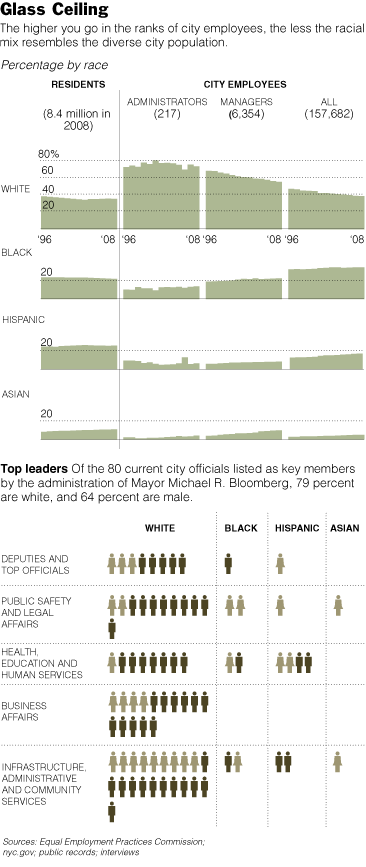
Top Ranks of Bloomberg Managers Are Largely White By David W. Chen and Jo Craven McGinty- NYTimes.com

Read original...


Mayor Michael R. Bloomberg naming Salvatore Cassano fire commissioner in December. In recent months, the mayor has named nine top officials, all of them white and all but one male.Ozier Muhammad/The New York Times


Since winning a third term in November, Mayor Michael R. Bloomberg has announced a parade of major appointments: bringing aboard three new deputy mayors and six commissioners and trumpeting most of those arrivals in the Blue Room at City Hall.

All nine are white. All but one is a man.

Chart (left): Click on image to enlarge

Those selections are hardly anomalous. Despite a pledge he made when he took office to make diversity a hallmark of his administration, Mr. Bloomberg has consistently surrounded himself with a predominantly white and male coterie of key policy makers, according to an analysis of personnel data by The New York Times.

The city’s non-Hispanic white population is now 35 percent, because of an influx of nonwhite immigrants and other demographic changes in the past two decades.

But Mr. Bloomberg presides over an administration in which more than 70 percent of the senior jobs are held by whites, and he has failed to improve on the oft-criticized diversity record of Mayor Rudolph W. Giuliani.

“Obviously, it demonstrates no greater commitment under Bloomberg than there was under Giuliani in appointing minorities to high-level positions in government,” said Abraham May Jr., executive director of the city’s Equal Employment Practices Commission, an independent agency that monitors diversity and discrimination in city government.

Moreover, New York lags behind the three cities closest to its population in diversifying its senior ranks.

In Los Angeles, 52 percent of the top advisers to Mayor Antonio R. Villaraigosa are white; in Chicago, that figure is 61 percent for Mayor Richard M. Daley; and in Houston, it is 55 percent for Mayor Annise D. Parker.

“The numbers — they’re sad,” said Kevin P. Johnson, a former assistant commissioner of the Department of Correction, who was responsible for equal-employment policies, but quit in December because he was frustrated by the administration’s efforts. “It’s terrible in a city with such a large minority population.”

The Times examined diversity in several top management tiers of the Bloomberg administration. Each tier showed a nearly identical pattern:

  • Of the 80 current city officials identified by the Bloomberg administration as “key members” on its Web site, 79 percent are white, and 64 percent are men.
  • Of 321 people who advise the mayor or hold one of three top titles at agencies that report directly to him — commissioners, deputy commissioners and general counsels, and their equivalents — 78 percent are white, and 60 percent male, according to a database created by The Times, based on public records and dozens of interviews with current and former officials.
  • And of the 1,114 employees who must live in the city, under an executive order, because they wield the most influence over policies and day-to-day operations, 74 percent are white, and 58 percent are men, according to the mayor’s office.

In addition to their demographic similarity, many of the recent appointees fall into two broad categories: former Wall Street executives and loyalists from City Hall or the mayor’s re-election campaign.

“Given Bloomberg’s background, we shouldn’t really be surprised,” said Bruce F. Berg, a political scientist at Fordham University who has studied racial diversity in New York City government. “He’s picking from the business world, his key advisers are from the business world, and this is still very much a white male bastion.”

Mr. Bloomberg declined requests for an interview to discuss the findings.

But his press secretary, Stu Loeser, acknowledged in a statement that “there is always more we can do.” Mr. Loeser said, however, that “we’re proud of what we’ve accomplished over the last eight years” in diversifying the city’s management ranks, noting that almost half of the people in citywide programs intended to identify and develop future top managers are people of color.

In addition, he said, managers — the nearly 6,000 employees who rank just below the top level administrators — have become more diverse in recent years under Mr. Bloomberg.

“These talented up-and-coming managers are positioned to be the next generation of assistant and deputy commissioners, then agency heads, of city agencies,” Mr. Loeser said of those in the training programs.

Still, Mr. Bloomberg has conceded that he has fallen short, acknowledging at a news conference last year that “the diversity of our administration has not been as diverse as the city itself.”

The homogenous composition of the administration is especially striking in crucial areas where city personnel deal with issues predominantly affecting minority residents, like education, homelessness and child welfare.

At the Department of Homeless Services, the Department of Education and the Administration for Children’s Services, 80 percent of the top officials are white, according to the Times’s research — including the newly installed commissioner of homeless services, Seth Diamond. And while the Bloomberg administration, early on, featured minority commissioners at the Department of Finance, the Human Resources Administration and the Administration for Children’s Services, all those positions are now held by white men.

“I have chaired and been present at one too many meetings where every senior person happened to be Caucasian, representing the administration,” said Bill de Blasio, the city’s public advocate, and a former City Councilman who was the chairman of the General Welfare Committee. “It’s not really an acceptable situation.”

Since the 1990 census, the city’s non-Hispanic white population has dropped to 35 percent, from 43 percent. And that change is reflected in the overall city government work force, which dropped from 46 percent white in 1994 to 38 percent in 2008.

Still, little change has occurred in the most senior ranks.

Diversity, of course, is one of the most delicate issues and hardest goals to achieve in any workplace. Many employers want a workplace, especially in the public sector, that has highly qualified managers who reflect the broader community and can engage in a vigorous exchange of ideas by people of different backgrounds. So failing to name minority employees to high-level positions, time after time, not only can dampen employee morale, but also send a message that an employer is insensitive or indifferent, according to political analysts and human resources professionals.

“This is the most diverse city in the world, and to be respected and seen as the mayoral administration of that city, you want to be pushing hard to build a much more diverse pool of people from which to draw expertise,” said Andrew White, director of the Center for New York City Affairs at the New School. “So if you’re not making that effort, your pool is going to be severely limited, and you’re going to go for the kinds of people that you’ve always worked with.”

Mr. Bloomberg pledged during his first campaign, in 2001, to hire people of different backgrounds. And shortly after taking office, he underscored his commitment to diversity, saying that “if you have that as a goal, and you have a process that gets lots of input from various communities, you will wind up with an administration that is reasonably diverse.”

More than eight years later, many people credit Mr. Bloomberg with achieving real progress on race relations, by discussing racial issues forthrightly, supporting immigration reform and meeting with different groups regularly on issues like public health, economic development and basic quality-of-life services.

“Even though minorities may not be filling out the ranks of his cabinet, in proportion to their ranks in the population at large,” Professor Berg, of Fordham, said, “Bloomberg goes out of his way, on many occasions, to assuage minority leaders, and include them.”

No longer, some say, is race viewed as the lightning rod in the way it was under Mr. Giuliani.

“Together with a City Hall that listens to every community across the five boroughs,” Mr. Loeser said in a statement, “we’ve helped contribute to creating a city where people are almost universally seen as getting along together better than at any time in memory.”

But while his language has been inclusive, that has not translated into concrete changes in the highest ranks at city agencies.

A telling measure involves the commissioners who are frequently the faces and voices of the administration at City Council hearings and town-hall-style forums. And the numbers suggest that Mr. Bloomberg has fewer people of color than some previous administrations.

According to the mayor’s office, 72 percent of his commissioners and agency heads are white. That percentage is higher than the 63 percent figure during Mr. Giuliani’s first year, in 1994, and his 69 percent in 1998. Mr. Giuliani’s predecessor, David N. Dinkins, who is black, meanwhile, had a cabinet that was slightly more than half white, in keeping with his goal of a “gorgeous mosaic” of an administration.

And comparing the “key members” identified by the Bloomberg administration with people in similar posts in the past yields striking results: 79 percent white under Mr. Bloomberg, about 75 percent white under Mr. Giuliani, and 55 percent under Mr. Dinkins, according to a review of earlier city rosters and interviews with former officials.

To be sure, some sectors of the Bloomberg administration are more diverse. The New York City Housing Authority is dominated by minorities at the top tier and led by two black officials whom the mayor tapped last year: John B. Rhea, the chairman, and Michael Kelly, the general manager.

And at the Police Department, where for the first time ever a majority of patrol officers are minority, Raymond W. Kelly, the commissioner, promoted two Hispanics to department chiefs in the last year and Chief Rafael Pineiro as first deputy commissioner — the highest rank achieved by a Hispanic.

Such moves, though, stand out in part because they have been relatively infrequent, current and former city officials said.

Mr. Johnson, formerly with the Department of Correction, recalled that at regular meetings, a top official at the city’s Department of Citywide Administrative Services would invariably boast about the administration’s diversity record. Afterwards, a few equal employment officers would huddle, and scratch their heads.

“We would say to each other, ‘What are they talking about? This administration is not diverse,’ ” said Mr. Johnson, who is now an investigator for lawyers.

He said that he still had “a lot of respect for the mayor.” But he feels disillusioned, after Mr. Bloomberg’s initial inclusionary talk in 2002.

“The message is: Make me a believer again,” he said.

Thursday, February 18, 2010

Bernie Kerik, Rudy Giuliani's Ex-Head of New York Police, Gets 4 Years in Prison by Sam Dolnick- NYTimes.com


Bernard B. Kerik, a former New York police commissioner who rose to national prominence, was sentenced to four years in prison on Thursday after pleading guilty to eight felony charges, including tax fraud and lying to White House officials.

Under the terms of a plea agreement reached in November on the eve of his trial, the prosecution and the defense recommended that Judge Stephen C. Robinson sentence Mr. Kerik to 27 to 33 months in prison. But the judge departed from the sentencing recommendations, giving Mr. Kerik a longer sentence.


“I think it’s fair to say that with great power comes great responsibility and great consequences,” Judge Robinson said. “I think the damage caused by Mr. Kerik is in some ways immeasurable.”


The sentencing was the end of a legal saga in which federal prosecutors denounced Mr. Kerik, a former detective who rose to the upper echelons of power, as a corrupt official who sought to trade his authority for lavish benefits.


Mr. Kerik, looking thin and clean-shaven as he entered the courtroom in United States District Court here, spoke briefly.


“ I make no excuses,” he said. “I take full responsibility for the grave mistakes I’ve made. Believe me when I say I have learned from this and I have become and will continue to become a better person.


“I know I must be punished,” he continued. “I only ask that you allow me to return to my wife and two little girls as soon as possible.”


As the judge delivered the sentence, Mr. Kerik sat impassionately at the defense table, flanked by his lawyers. Behind him, his supporters — including Geraldo Rivera and Steven McDonald, a former New York City police officer who was paralyzed from the neck down in 1986 — filled the gallery.


Mr. Kerik will begin serving his sentence on May 17. Prosecutors had requested that Mr. Kerik be sent to prison immediately, but Judge Robinson allowed him to surrender later to get his affairs in order in light of the longer sentence. Mr. Kerik has awaited sentencing under strict house arrest at his home in Franklin Lakes, N.J.


The sentence follows a fall from a rarefied perch where he wielded power with a signature mix of brash confidence and tough-guy charm.


He was a close ally of former Mayor Rudolph W. Giuliani, whom he served as a bodyguard and driver. Mr. Giuliani then tapped him for a senior position in the Correction Department, and he went on to become the agency’s commissioner. As testament to his clout, Mr. Kerik had a jail named after him in downtown Manhattan. (The name has since been changed.)


Mr. Kerik later served as police commissioner, and his performance during after 9/11 attacks turned him into a national figure, earning him the respect of President George W. Bush, who nominated him to lead the Department of Homeland Security. That bid quickly collapsed in scandal, marking the beginning of the end of Mr. Kerik’s career.


The case against Mr. Kerik centered on charges that a New Jersey construction company, the Interstate Industrial Corporation, which was suspected of ties to organized crime, had paid for renovations at Mr. Kerik’s home in the Riverdale section of the Bronx. Prosecutors said company officials had hoped Mr. Kerik would help them obtain a city license.


In addition to pleading guilty to two counts of tax fraud and one count of making a false statement on a loan application, Mr. Kerik also pleaded guilty to five counts of making false statements to the federal government while being vetted for senior posts.


Prosecutors had called for Judge Robinson to make an example out of Mr. Kerik, and to punish him for his “egotism and hubris.”


Mr. Kerik’s lawyer, Michael F. Bachner, had asked the judge for leniency, citing his years of public service, and the dozens of letters of support written by family members, former colleagues in the Police Department, and even strangers who said they admired Mr. Kerik’s bravery.


After the sentencing, Mr. Kerik paused outside the courthouse, where he read a statement before being driven off in a black sport utility vehicle.


“I’d like to apologize to the American people for the mistakes I’ve made and for which I have just accepted responsibility,” he said. “As history is written, I can only hope that I will be judged for the 30 years of service I have given to this country and the city of New York. It has not and will not diminish my love for this country.”


When asked if Mr. Kerik intended to appeal the sentence, his lawyer said, “No comment.”


Wednesday, October 28, 2009

The Mayor's Press Pass - The Unexamined World of Mike Bloomberg by Tom Robbins - Village Voice

Read original...

One reason for the remarkably charmed life of Mike Bloomberg's administration as he sails toward re-election has been the waning of the city's news business. This is an odd blessing for a man who made his fortune as a media mogul. But just ask Rudy Giuliani, or David Dinkins, or Ed Koch, and they'll painfully explain.

When this city enjoyed four fat daily newspapers, editors clamored for strong, tough copy to fill them. Whenever scandal hit—make that even a mini-scandal—each one scrambled after the story. Local TV news, which gets its morning bearings from the dailies, gleefully joined the hunt as well. This happy combination produced many full-strength media pile-ons and visible shivers in City Hall.

There was a keen reminder of this changed world when a man named Raymond Harding put himself back in the news this month by pleading guilty to fraud at the state's pension fund. Back in 1997, Harding, the boss of something called the Liberal Party, was the city's top lobbyist, his law firm raking in millions from clients seeking favors from Giuliani's City Hall. These were easy for Harding to arrange since he had personally invented Giuliani as a political player.

It took a while for the dailies to catch on to this scheme, but when they did, the effect was viral: They became a four-man tag team, taking turns serving up tales of greed and insider trading. Giuliani was then at the top of his game and delighted in telling off reporters. But he knew disaster when he saw it. Claiming ignorance that his mentor was making a fortune off his administration, he publicly chided his aides and ordered his pal to lay low.

These days, the papers are onion-skin thin, and exposés are catch as catch can. Newsday, which once gave rival editors panic attacks every morning, doesn't even have a city edition anymore. When Dinkins was in office, the Long Island tabloid investigated even the type of fertilizer he used on the Gracie Mansion lawn. Nowadays, to fill their meager space, editors prefer colorful yarns to investigations. Until this month, one newspaper carried an entire column about empty rooms. We have the Web, with all of its many hardworking blogs, but most of these spend their energies keeping political scorecards with all the obsession of fantasy baseball addicts: Who's on first, and what coaches are in the dugout? The business of government and its many failings goes largely unexamined.

Poor Ed Koch: He was trashed as a miserable miser in multiple front-page stories because he had some 2,000 homeless families sleeping in shelters. Mike Bloomberg has five times as many, and no one even knows about it.

It's not that there's no investigative spadework being done. What's missing is critical mass. Last week, the Daily News's Juan González delivered some excellent fodder for a full-scale media assault in City Hall's Blue Room. He reported that the mayor's billion-dollar plan to relocate the city's emergency 911 call system has become a fiasco. Not only has Bloomberg's team blown its budget and deadlines, but it has also ignored the findings of its own consultant, which found the project was mired in mismanagement. Rather than dump its lead contractor, as the consultant recommended, Bloomberg's top aides insisted that the plan go ahead as is—defects be damned.

This type of project is supposed to be smack in the mayor's sweet spot since it involves computers and communications, the business that made him the city's richest man. It should also be one of those instances where he runs rings around old-school politicians because of his keen business acumen. Instead, here he is, tripped up by the same cost overruns and bureaucrats that plague ordinary humans. Another mayor in another time might have suffered many tough questions the day after such information surfaced. Instead, only the News chased its own story.

The same thing happened this summer, when the Voice reported a scandal at the city's NYC-TV operation, where the top executive was fired and his deputy arrested ("Inside the Mayor's Studio: NYC-TV's Secrets of New York," August 4). Unlike the perennially tainted buildings department that has plagued every mayor, the problems at NYC-TV came from Bloomberg's own supporters. He had repeatedly hailed the station as an example of his innovative approach to government. But instead of minding the store, his aides had traipsed around the world, making their own private movie. This tale also failed to trip the press alarm that scrambles the media into action.

The big story late last week was the stunning court ruling on the illegal Stuyvesant Town rent hikes. But you'd never know from the coverage that Bloomberg had praised the original deal cut by landlord Tishman-Speyer (headed by one of his strongest allies). Or that his top aides had scotched a plan to keep Stuy Town affordable. Or that a hefty chunk of the financing for the deal came from Merrill Lynch, the late investment firm that was a top Bloomberg LP client and which the mayor was barred from dealing with under a Conflicts of Interest Board ruling. That story—told here in detail by Wayne Barrett just last month—also died an orphan.

Bloomberg's biggest claim to mayoral fame as he grabs for the third term that he used to insist he would never seek is his success at the business of education. This is a debate worth having. But Bloomberg consistently wins by default because the other side never fully shows up. As the legislature was considering the renewal of Bloomberg's mayoral control law this year, Brooklyn Assemblyman Jim Brennan issued six lengthy reports on the law's impact on the schools. They were detailed and thoughtful critiques on student achievement, school organization, and contracting. Asked recently how much press he received about them, Brennan paused. "I'm not sure there was any," he said.

There have been scattered stories about instances of grade inflation and test-score manipulations (again, with the News in the lead). The startlingly poor results of national student tests this month prompted even the Post, whose news pages have steadily cheered Bloomberg's education policies, to suggest that fraud was afoot somewhere. But the big picture still escapes us, along with whatever role was played by the education bureaucrats at the Tweed Courthouse.

At the mayor's annual Gracie Mansion Christmas party for the press last year, those in attendance report that Bloomberg took the stage to offer his idea of a joke. "I see that my three best friends in the media—Mort, Rupert, and Arthur—aren't here," he quipped. Then he walked out, right past the grunts who cover him all year.

Actually, the joke's on us. Even as newspaper fortunes sank in recent years, Bloomberg diligently courted media barons like Zuckerman, Murdoch, and Sulzberger, who he understood could make his life difficult if they so chose. Minus their support, as Joyce Purnick's new Bloomberg biography proves, he would have never risked his end run around term limits. But he knew he had little to fear. As Purnick's book also tells us, even his weekend disappearing act to go to his mansion in Bermuda has gone unchallenged.

"He does his radio show Friday morning," a former aide told her. "At 11:05, the latest, he's in his car. At 11:30 he is at the airport. His plane is in the air at 11:40, he's in Bermuda at 2:10. He's on the golf course by 2:30. . . . Almost every weekend, spring and fall."

There's a photo op that's been even more closely guarded than military caskets arriving at Dover Air Force Base: Mayor Mike, golf bags over his shoulder, striding across the tarmac toward Air Bloomberg.

Art by Stan Shaw

trobbins@villagevoice.com


Saturday, October 17, 2009

George, Rudy and Mike: So Happy Together - You Tube

As Rudy Giuliani comes to town to campaign for Mayor Bloomberg, remember that Republicans stick together...

George W. Bush, Rudy Giuliani and Mike Bloomberg...Birds of a feather, stick together...

Bill Thompson for Mayor...http://thompson2009.com/

Wednesday, December 3, 2008

Giuliani's Rudy-in-Nylons Skit Starred Some Witless Crooks by Tom Robbins - Village Voice

Read original...

The genius of the CompStat anti-crime system launched by the Rudy Giuliani administration here in the 1990s was that it didn't believe in coincidence. You would take all those apparently random crimes, put them in a computer mapping program, and—poof!—instant and brilliant results: crime trends to be snuffed out; hot spots to be monitored; repeat offenders otherwise invisible to the naked police eye.

This dazzling program has inspired many imitators and is key to the great fortune Giuliani and his team have since reaped in the private sector as they apply the CompStat method to everything from faulty pharmaceuticals to the sheikhs of Qatar.

The bad news is that I have now applied CompStat to a program listing of the cast of Giuliani's last skit for the annual Inner Circle political roast in March 2001, and the results are not good. This is regrettable because Giuliani loved performing in these events. Once, he famously appeared in a platinum wig, pink gown, and balloon-like breasts, squealing all the while in delight.

The title of his 2001 skit was "The Godfather: The Musical." For this performance, Giuliani happily shaved his legs and pulled on dark nylon stockings so that his character, "Don Giuliani," could high-kick with the Rockettes.

Unfortunately, CompStat, which never lies, reveals that this little satire was a hub of felonry. Already, three of the cast of 27 who appeared onstage with the mayor have been indicted for serious crimes. This is an 11 percent incidence of criminal activity, a rate of wrongdoing higher than the city's roughest neighborhoods. In other words, exactly the kind of non-coincidence that gave precinct commanders sweaty chills when confronted in the war room at police headquarters.

Most notorious of these is Bernie Kerik, who was then the police commissioner. Kerik played a role listed in the program as "The Enforcer." He already stands convicted by his own plea of guilty to lying about a mobbed-up contractor who renovated his apartment. He awaits trial on federal charges for taking other undisclosed gifts.

Then there is Anthony Seminerio, the rascally, roly-poly Queens assemblyman who played himself in Giuliani's "Godfather" send-up. Even though he is a Democrat, Seminerio gave and received enormous love from the Republican Giuliani. Unfortunately, another federal indictment, filed in September, holds that Seminerio engaged in his own serious felonies, exacting bribes totaling $500,000 from those seeking his legislative assistance.

A third cast member from the spoof is now on trial in the Bronx, accused of being the police department's single worst nightmare: a cop killer. At the time of his Inner Circle performance, Lillo Brancato, 32, had the perfect pedigree. He had just finished a short stint on The Sopranos TV show, playing a drug-addled mob wannabe. In the Giuliani skit, he portrayed Rick Lazio, the hapless Long Island politician recruited to fill Giuliani's shoes after the mayor bowed out of the Senate race, citing severe health and divorce problems.

By all recollections, Brancato performed well. Unfortunately, he really was a drug-addled mob wannabe. He lived his life as though he were the character in his biggest role—the confused but earnest son of bus driver Robert DeNiro in the movie A Bronx Tale—gone wrong. His earnings went for cocaine, heroin, and nights in the company of beautiful women at fashionable clubs.

Back then, he impressed with his winning smile, if not his brains. Anthony Marini, a former nightclub manager, remembers the young actor insisting that he came from Avellino, Italy, the southern Italian locale cited as Tony Soprano's ancestral homeland in the fictional series. "He'd say, 'I'm from the same town as Tony Soprano.' I don't think he realized this wasn't a real person," says Marini.

Another brain shortage led directly to Brancato's current troubles. In the pre-dawn hours of December 10, 2005, after a night of drinking and drugs at a strip club, Brancato and his girlfriend's father, an ex-con named Steven Armento, went looking for more narcotics. Brancato drove his silver Dodge Durango to a two-family brick home at Arnow Place and Westchester Avenue in the Pelham Bay section where he thought they'd be able to score from another drugged-up buddy who had been generous with his prescription meds in the past. When the friend didn't answer, Brancato kicked in a window, waking a 28-year-old off-duty cop next door. Daniel Enchautegui calmly called 911, put on his police shield, and went outside to investigate.

In one of those ugly and stupid incidents that The Sopranos captured so well, when Enchautegui encountered the duo, Armento pulled a .357 Magnum revolver and shot the cop just below his heart. Before he collapsed, the officer squeezed off several rounds, wounding the two intruders.

In the Bronx Supreme Court last week, Detective Paul Maldonado, one of the first on the scene, described arriving at a snow-lined residential street lit by Christmas lights. He said he found Enchautegui lying face-up with his head hanging over a small ledge, beside a large snowbank. "His shield was around his neck. His hands were out. A 9mm was near his right hand; a gray cell phone by his left. His eyes were open. I was telling him to hang in there. He just gave a deep breath." Enchautegui was declared dead a half-hour later at Jacobi Hospital.

Armento, 51, was convicted in October of first-degree murder while committing a felony and was sentenced to life in prison without parole. Brancato's defense is that he never knew Armento had a gun. He makes this claim even though the murder weapon, introduced as evidence last week, appeared to have the size and velocity of a small cannon. He also insists that he never broke into anyone's home.

"He didn't commit burglary. He didn't commit murder," Joseph Tacopina, Brancato's lawyer, told the jury last week. Instructing the eight men and eight women on the panel as though they were in a high school physics class, Tacopina told them: "Just follow the bouncing ball on the evidence in this case. It will all come together. Trust me."

Tacopina is as nice-looking as his actor-client and has been on television even more than Brancato. But he has had some trouble with the trust part. In one of those great Giuliani coincidences, he also represented Kerik for a while. That ended badly when the lawyer told the feds that he had given prosecutors what turned out to be inaccurate information at his client's behest. Tacopina may now be a witness against Kerik if the federal charges go to trial.

That is another indication of how tangled and messy the world of Rudy Giuliani has become. The ex-mayor's presidential bid didn't do as well as he had wished, but his supporters now hope he runs for governor. If so, his problems as a casting director may become an issue.

No one faults Giuliani for including Brancato in the cast of his skit since the actor's brainless and abominable crime occurred almost five years later. But you still have to wonder how it is that this top lawman comes to be surrounded by so many dumb crooks, enough of them to light up the scoreboard at one of his own CompStat sessions. For someone who boasts of having smashed the Mafia as a prosecutor, and of having reduced city crime to nothing as mayor, Giuliani seems to have a strange proclivity for those with a criminal bent. It is almost as strong as his penchant for donning tights and makeup in front of large audiences.

trobbins@villagevoice.com

Tuesday, November 25, 2008

Walter Ward Playground to Get $1.7M Makeover by Stephen Geffon - Queens Chronicle

Read original...

Howard Beach children and parents are eagerly anticipating the long-time coming makeover of one heavily used, dilapidated and neglected playground, expected to begin next summer.

A $1.7 million renovation for the aging Walter Ward Playground in Howard Beach, shown above, is scheduled to begin next summer and be completed the following year. (photo courtesy of Stephen Geffon)

At almost 42 years old, the Walter Ward Playground, located at 89th Street and 160th Avenue, is in serious need of the $1.7 million facelift it will soon get.

City Councilman Joseph Addabbo Jr. (D-Howard Beach) secured funding for the revamp after P.S. 207 Parent Coordinator Nina DeBlasio brought to his attention parents’ complaints and concerns about the condition of the aging facility, which was known as P.S. 207 Playground when it first opened in February 1967.

With the funding in place, the city Department of Parks and Recreation will begin replacing the old park and making it accessible to all users. Larger play equipment and adult exercise equipment will be installed, and children of all ages — from toddlers to teenagers — will have a variety of activities for recreation.

The new playground will have tot swings, a play unit for children 2 to 5 years old, two separate units for children 5 to 12 years old and a spray shower feature. As part of the project, the parks department will renovate the handball courts and add new fencing, benches, game tables, lighting, resilient safety surface, drinking fountains and add extensive plantings.

Last week Parks Department representatives Joanne Amagrande-Savarese and Steve Whitesell presented to members of Community Board 10 detailed plans of the reconstruction, which they said will likely take about one year to complete.

Residents and parents began meeting with Whitesell, the park project designer, in late 2006. In September 2008, he showed them a preliminary design sketch for the renovation.

According to DeBlasio, parents applauded the department for its work on the project. “They’re very excited they are getting a new park,” she said. Kelly Sinisgalli, a P.S. 207 PTA Board member, said she is extremely happy with the playground project.

After addressing concern about the placement of a large piece of play equipment near the kindergarten entrance, the final park design was submitted and approved by the parents. It was then unanimously approved by C. B. 10.

Addabbo was approving as well, particularly because a renovation such as this was necessary for a playground with a variety of safety issues.

As it sits now, the park contains three full basketball courts, two handball courts, play equipment and a shaded sitting area. In 1996, then-Mayor Rudy Giuliani funded a $96,000 renovation of the playground, which provided new play equipment and safety resurfacing.

Construction that is expected to begin next summer will not disrupt the basketball courts where the Rockwood Park Summer Basketball League is scheduled to play its 20th season, according to DeBlasio.

Friday, November 14, 2008

Mike Long and Bill Thompson File Lawsuit to Overturn Term Limits Extension by David Seifman - New York Post

Read original...

A group of New Yorkers who aren't usually on the same side - including Conservative Party Chairman Mike Long and city Comptroller Bill Thompson - filed a federal lawsuit yesterday to overturn the City Council's extension of term limits.

"We're not going to let a small group of people silence 8 million New Yorkers," said Thompson at a press conference outside City Hall.

The lawsuit, filed in Brooklyn federal court by civil-rights lawyer Norman Siegel and Randy Mastro, a former deputy mayor under Rudy Giuliani, claims that the council didn't have the right to overturn two public referenda that installed eight-year term limits.

Sunday, November 9, 2008

Giuliani Gives Last-Minute Help to Queens Senator By Ann Farmer and Nicholas Confessore- City Room Blog - NYTimes.com

Read original..

Rudolph W. Giuliani, the former New York City mayor and onetime presidential candidate, has not been quite as active in this year’s State Senate campaign as some had expected him to be. And he has been spending a lot of time lately on the campaign trail for Senator John McCain, the Republican presidential candidate.

[Photo: State Senator Serphin R. Maltese and his wife, Constance, arrived to vote at Public School 128 in Middle Village, Queens. (Photo: Uli Seit for The New York Times)]

But Mr. Giuliani managed to make it back home for an Election Day appearance in the most hotly contested State Senate race in New York: the battle in Queens for the seat held by Serphin R. Maltese, a Republican who is facing off against Joseph P. Addabbo Jr., a Democratic city councilman.

“I’m here for Maltese today,” Mr. Giuliani said when he arrived with the senator at the Fame Restaurant and Diner in Maspeth. It is the kind of neighborhood where the former mayor is often greeted like a king, failed presidential bid or no.

“I wish you were running for president,” a woman called out when he arrived. Another woman shouted, “I love you, I do!”

But the main task at hand was Mr. Maltese, who won re-election in his heavily Democratic district by only a handful of votes in 2006.

“Were going to hold on to it,” Mr. Giuliani said, referring to the State Senate, where Democrats hold 29 seats and Republicans 31. (There are two vacancies.) “We have to win these one by one, and he’s going to win.”

Mr. Maltese seemed grateful for Mr. Giuliani’s help.

“It means a great deal,” the senator said. “He’s extremely popular here, well loved here. You see the enthusiasm for him here.”

Mr. Giuliani wore a red tie with little elephants on it, suitable for Election Day. He ordered a diet soda, while Mr. Maltese ordered a Swiss cheese omelet with home fries and toast.

“He’s getting ready for a big day,” the former mayor said. “I would like a Diet Coke, but feed him — he’s got to work all day.”

According to Kristin Lord, one of the campaign workers accompanying Mr. Maltese, the senator had visited 15 polling places, and none had long lines.

Mr. Giuliani’s foray into Queens drew expressions of approval from his fans.

“Quite a few people said they wished he was running today,” said Allyson Le Doux, 44, a waitress at the Fame Restaurant. Ms. Le Doux, however, said she would be voting Democrat all the way.

“I don’t know much about Addabbo,” she said. ” I‘m just going to vote Democrat down the line.”
Friday, October 10, 2008

Press Release: City Council Candidate Elizabeth Crowley Calls on City Council to Oppose Term Limit Extension

FOR IMMEDIATE RELEASE Contact:

October 7, 2008

James Wu, 347-234-2762


City Council Candidate Elizabeth Crowley Calls on City Council to Oppose Term Limit Extension


NEW YORK – City Council Candidate Elizabeth Crowley today called on the City Council to vote against proposed legislation that would extend term limits by amending the City Charter. Crowley called on the Council instead to support a bill that would require any such extension to be decided by a referendum of the voters. Crowley is running against Anthony Como in a race for the council seat vacated by Dennis Gallagher earlier this year. In June, Como narrowly won a special election to fill the seat temporarily, and city rules require another election be held for the seat this November.

"No candidate in this race has any business supporting this undemocratic move by some city councilmembers to grant themselves an extra four years in office," said Crowley. "From where I stand, the prospect of being able to serve my community for eight years as a councilmember is privilege enough."

Twice in the last fifteen years New York City voters have affirmed a limit of two four-year terms for all elective offices in the city. In 1993, city voters elected to create term limits through a charter amendment, and in 1996 voters rejected a measure to extend term limits to three four-year terms. Although the matter was put to the voters both times, some are making the case that the City Charter allows an amendment to term limits clause to be made through the regular legislative process. Councilmembers Bill deBlasio and Letitia James are putting forward alternate legislation that would create a charter review commission to look at the issue and potentially bring it to the voters for a referendum at a special election to be held in early 2009.

"If term limits are going to be changed, then it must only be done by a referendum of the voters," Crowley said. "The people have already spoken twice on this issue, and the city council has no business doing an end-run around such a mandate. In filling vacant council seats like the one Mr. Como and I are running for," continued Crowley, "the charter ensures that people do not win their seats without going before the voters at a regularly held election. The city's elected officials must uphold the same level of integrity if they want to overturn a decision made by the voters," argued Crowley.

Mayor Bloomberg and others have argued that the extension is needed to enable Bloomberg to use his expertise to help navigate the city through the financial crisis. Crowley also argued that the nation's financial woes do not justify the proposal to extend term limits.

"The city was in a much more immediate crisis in October 2001 when Mayor Giuliani wanted an extra three months in office, and the city got through just fine without compromising term limits then," said Crowley. "Mayor Bloomberg is not the only qualified person to lead this city, and it would not justify extending term limits for all elected officials even if he were. Mr. Como, because he is not term limited, must do the right thing here and respect the rights of New Yorkers to decide this issue," concluded Crowley.

Saturday, October 4, 2008

Term Limit Plan Called Totally Un-American by Jonathan P. Hicks - City Room - Metro - New York Times Blog

Read original...

Some New Yorkers seem thrilled about the prospect of extending the terms for city officials. Others, however, are unhappy about the idea being proposed by Mayor Michael R. Bloomberg to extend to three, from two, the number of terms a city official can serve. Some are even angry about the proposal.

United States Representative Nydia M. Velázquez falls firmly in that latter category.

“It is totally wrong. It is totally un-American. It is totally undemocratic to overturn the people’s will that has been expressed clearly in two different referendums,” Ms. Velázquez said in an interview outside of Brooklyn Borough Hall this morning. “I reject the notion that, because of the fiscal crisis, we should use this as an opportunity to overturn the people’s will.”

She continued: “New York City is one of the most resilient cities in the nation. It was shown after 9/11, when Giuliani wanted to use the attack as an argument to turn back the people’s will. This would be wrong. It’s morally wrong. And I will pose the question: Is it legal?”

More specifically, Ms. Velázquez said that any changes enacted by the City Council after the two referendums would have to be approved by the United States Department of Justice’s civil rights division, since three of New York’s boroughs — Manhattan, Brooklyn and the Bronx — are protected under the federal Voting Rights Act.

“I would certainly call into question the validly of any changes that may occur by the City Council without the approval of the Department of Justice,” Ms. Velázquez said. “A change like that would certainly lead me to call into question the potential of the disenfranchisement of minority voters in New York City. And we will be looking into that.”

Ms. Velázquez is a Democrat who represents the sprawling 12th Congressional District that covers parts of Brooklyn, Manhattan and Queens. The district she represents is one where minority residents make up a majority. In fact, her district is nearly 45 percent Hispanic, about 17 percent Asian and just under 10 percent black, with about 27 percent white.

Ms. Velázquez said she is personally opposed to term limits, saying that she believes voters should be able to decide when they no longer want a public official to serve. But she said that the fact that on two separate occasions New Yorkers approved a two-term limit on city officials should have made the views of any one politician irrelevant.

“This has nothing to do with how effective Mayor Bloomberg has been,” she said. “He has been a good mayor. But this is not about one person. This is about what is right.”

Giuliani Waltzes in Ridgewood by Ben Hogwood - Queens Chronicle

Read original...

Rudolph Giuliani, the former mayor and failed Republican presidential candidate, danced with members of the Peter Cardella Senior Center, in Ridgewood.


Giuliani came to the center on Tuesday to talk about the upcoming elections, particularly the race for state Senate District 15 between incumbent Sen. Serphin Maltese (R-Glendale) and Councilman Joseph Addabbo Jr. (D-Ozone Park). He visited the city between national stops promoting Republican presidential nominee John McCain.

Wednesday, June 25, 2008

Seeing Red for McCain in Queens by Pete Davis - The Queens Courier

Read original...

Since Ronald Reagan won his second presidential term in 1984, New York State has been in the democratic blue column, but some Queens Republicans are hopeful that the state could switch back to republican red this year with John McCain at the top of the ticket.

“We are very excited to have McCain at the top because he has natural appeal to Reagan Democrats, Republicans and Independents,” said Vince Tabone, who is the Executive Vice Chair of the Queens County Republican Party and will also serve as the point man of the Queens effort to elect McCain in November.

The Queens County Republican Party, which originally endorsed former New York City Mayor Rudy Giuliani, quickly switched their support to McCain after Giuliani bowed out of the Republican primary.

During the February primary, McCain took home 51 percent of the Republican vote statewide compared to only 27 percent for runner-up Mitt Romney. McCain’s impressive showing in NY also resonated in Queens with nearly 55 percent of Republican voters selecting McCain compared to 25 percent for Romney.


*
After winning decisively in NY, Tabone said Queens volunteers started making phone calls to voters in other states asking them to vote for McCain and help him clinch the Republican nomination - a tactic that would only intensify as the general election approaches.

Meanwhile, Republican strategists believe that the Democrats selecting Barack Obama over New York State Senator Hillary Clinton may also improve McCain’s chances of being competitive in the state. Clinton garnered 57 percent of the statewide vote during the Super Tuesday primary, but she was even stronger in Queens with 60 percent of Queens Democrats voting for Clinton.

In addition, McCain supporters believe that Clinton’s reluctant exit from the extremely close Democratic nominating dance increases the likelihood that her supporters would be disenfranchised by the entire Democratic Party’s process and switch over to McCain.

“You certainly see him [McCain] in a better position than you could have predicted six months ago because the Democratic primary [competition] has been incredibly divisive,” said Matthew Walter, Director of Communications for the NY Republican State Committee. “The way their primary played out certainly provides fertile ground for John McCain in Queens, NY and all over the country.”

Walter said that while his organization has spent the last few months introducing McCain to the state’s voters, they could now focus on Obama and some of his policies that may not resonate with New York voters.

In addition, Tabone attacked Obama’s voting record as a U.S. Senator, saying his liberal policies would not play well in swing states like Ohio and could leave him more vulnerable in New York.

“He has this wide sweeping rhetoric that suggests that he will be a unifier, but his voting record doesn’t say that at all,” said Tabone, who referenced Obama’s voting record as being to the left of Vermont Senator Bernie Sanders.

Sunday, December 23, 2007

Comment is free: School's Out - The Repub Presidential Candidates Have Repudiated President Bush's Education Policy but Failed to Offer an alternative

Comment is free: School's out

In the 2000 election, President Bush made education reform the centrepiece of his campaign. With his education reform platform - No Child Left Behind, a phrase stolen from the liberal Children's Defence Fund - Bush sought to reassure voters, particularly suburban women, that he was "a different kind of Republican", a compassionate conservative who cared about people, particularly the poor. Where previous Republican platforms called for abolishing the federal department of education, Bush called for an expansion of its powers. Where previous Republican campaigns made thinly veiled appeals to white racism, Bush was constantly photographed with smiling, school uniformed black children. And for the first time ever, it looked like Republicans might steal the education issue from the Democrats.

But what a difference eight years make. Rather than trying to demonstrate their compassion, this year's crop of Republican presidential candidates are crawling over each other to demonstrate their toughness - their lack of compassion - on immigration, torture and a host of other issues. Not surprisingly, given this dynamic, education is hardly at the forefront of Republican stump messages. John McCain's campaign website doesn't even mention education! And if you hear Republican candidates mention No Child Left Behind, it's almost certainly to criticise President Bush's signature education initiative.

Only one major Republican candidate, former Massachusetts governor Mitt Romney, has anything resembling as a fully formed education plan. It's a respectable listing of moderate Republican positions - promote school choice, pay teachers for student performance, improve math and science education. The most noteworthy thing is that Romney's the only candidate in either party who defends, rather than attacks, No Child Left Behind - a gutsy move given strong opposition to the law in Iowa. Romney's playing up education more than his competitors because Massachusetts schools are among the nation's best-performing. Unfortunately for him, Massachusetts' strong student performance - and the policies that produced it - predate Romney's governorship, so he probably doesn't deserve much credit for them.

Former Arkansas governor Mike Huckabee and former New York mayor Rudy Giuliani also claim credit for education reforms under their leadership. Huckabee has some valid claims here. His administration implemented curricular reforms and raised teacher pay, and Arkansas students made real achievement gains - not just on state tests but also the more challenging National Assessment of Educational Progress - during his term as governor. Huckabee's seemingly sincere commitment to arts and music education also appeals to parents.

Such claims are a bigger stretch for Giuliani. His successor, Michael Bloomberg, got the legislature to give him control of New York's schools and, with his chancellor Joel Klein, appears to have had some success. But Giuliani as mayor had little control over his city's schools, and his efforts to claim education accomplishments only raise the question of why he didn't do, sooner, what Bloomberg did.

Giuliani has also tried to emphasise his conservative bona fides by highlighting his support for school choice. But the striking thing about his school choice platform is how limited the proposals are. Giuliani would offer vouchers to military families and students with disabilities, would support charter schools and would try to establish voucher pilot programmes in high-poverty cities. Those proposals are less sweeping than Bush's 2000 campaign proposal to provide a $1,500 voucher for every child in a low-performing school.

In fact, while school choice is probably the one education proposal all the Republican candidates can get behind, they're awfully modest in their proposals, especially compared to ideas Republican candidates routinely offered in the 1990s. Even libertarian Ron Paul, who should be more aggressive than anyone on school choice, proposes only a $5,000 tax credit for parents who homeschool or send their children to private schools. That's more modest than the education tax credit proposals that leading libertarian think tanks espouse, and that have been enacted in many states. And it would do nothing for poor kids who most need education options.

The Republican presidential candidates seem to have both repudiated President Bush's No Child Left Behind and chickened out on their previous support for school choice, leaving them without a compelling vision to offer on education. That's unfortunate, because our education policy is better when both parties have meaningful reform visions that generate serious public debate over education. Perhaps, as we move from the primaries to the general election campaign and the eventual nominee begins focusing on regular moms, dads and educators beyond his base, we'll see some more exciting Republican ideas on education. That's in everyone's interest.

Wednesday, October 31, 2007

Rudy's Three Words

Joe Biden tells it straight about Rudy Giuliani talking about a record of experience.

"A noun, a verb and 9-11"

Thursday, September 6, 2007

The REAL Rudy

The REAL Rudy


"It's just not possible."

That was the sentence we heard over and over from families who had firefighter sons, brothers, husbands and fathers killed on 9/11, from experts on emergency response, and from investigative journalists. It was just not possible that Rudy could so distort what happened on 9/11 and his role on that terrible day.

These experts, these grieving and furious family members, were united only by the fact that this story had to be told. Republicans, Independents, and Democrats could agree on just one thing: the cold hard facts about Rudy's terrible handling of 9/11 and the aftermath.

And so we went to work. We researched, we read, we interviewed. Jason locked himself in a quiet room. Christopher flew across the country at a moment's notice to interview. Lissette went over and over the footage. Leda kept juggling schedules so we could get the film done. Jimmy worked the phones to try and raise some funds.

And here it is... The REAL Rudy: Command Center. The first of a devastating four-part series.

We need your help. We don't have ad budgets, so like all our videos, we are counting on you to spread these to your email list, to your local paper, to blogs, to websites. We are fortunate that today we have the new technology and ability to reach millions, but it only happens when you send the video with notes to as many people as possible.

Wednesday, September 5, 2007

The REAL Rudy

The REAL Rudy


At a recent debate in Iowa, Rudy Giuliani was asked, "In 30 seconds, what is a defining mistake of your life and why?" He made a joke about how he couldn't possibly list all his mistakes in 30 seconds. Ha!

So we gave it a try. Watch The REAL Rudy in 30 seconds.

What is his biggest mistake? Refusing to get working radios to firefighters before 9/11? Cross dressing? 3 marriages? An estranged daughter who supports Obama for president? Locating the emergency command center in the only place in New York City that had already been attacked by terrorists? The list goes on and on...

Vote for Rudy's biggest mistake at TheRealRudy.org.

Enjoy our funny teaser, but get ready for our very serious The REAL Rudy videos to come. We have some very powerful interviews with experts about his so-called 9/11 expertise, and heartbreaking stories from the families whose sons were killed due to his negligence. We don’t want to give it all away, but we promise you will NEVER look at him the same way again.