Showing posts with label queens college. Show all posts

Saturday, January 29, 2011

Planners Seek Expansion at Kennedy and Newark Airports by Patrick McGeehan- NYTimes.com

Read original...


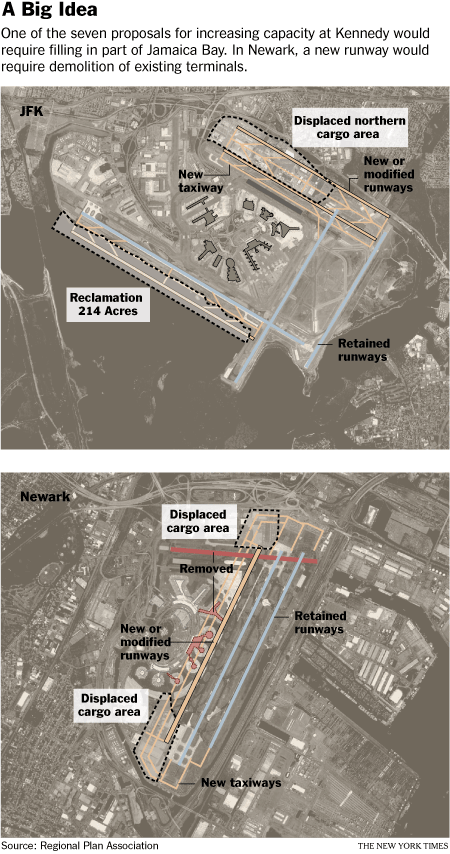
The bay runway at Kennedy Airport could get a sibling built on a filled-in portion of Jamaica Bay under an airport expansion proposal.
The New York region’s two largest airports, already choked with crowds and delays, may need to be radically reconfigured so they can make way for vitally needed additional runways that would help accommodate a projected increase of almost 50 million air travelers per year within two or three decades, according to a new study.
The study, from the Regional Plan Association, calls for as much as $15 billion to be spent at Kennedy and Newark Liberty International Airports. At Newark, all three terminals would have to be at least partially razed, then rebuilt; at Kennedy, part of Jamaica Bay might have to be filled to create space for one or more new runways.
The proposed expansions would amount to the most ambitious reshaping of any of the region’s major airports in several decades. They would require significant changes in the region’s airspace, a modernization of the system for controlling air traffic and at least one act of Congress.
If the proposals are accepted by the Port Authority of New York and New Jersey, which operates Kennedy, Newark and La Guardia Airports, they would surely encounter stiff resistance from local and national advocates for the environment, the report admits. They would also have to survive the political tug of war between the governors of New York and New Jersey, who jointly control the Port Authority.
The report, which was financed in part by the Port Authority, was scheduled to be presented at a daylong conference on the future of the airports in Manhattan on Thursday.
Christopher Ward, the executive director of the Port Authority, was scheduled to attend the conference and was expected to discuss the report as fodder for planning. Asked for comment, a spokesman for Mr. Ward said only that “we look forward to examining this study.”
The study considered a spectrum of options that stretched to the fantastic: a new airport on an island in New York Bay. But the cost was deemed to be “exorbitant.”
Elected officials and business leaders have discussed airport expansion for years, but have been reluctant to broach the idea publicly to avoid stirring up opposition too soon, said Kathryn S. Wylde, the president of the Partnership for New York City. But, Ms. Wylde added, “It’s become very clear that our economic future depends on investment both in the technology and facilities upgrades and runway expansion at the regional airports.”
For years, the local airspace has been too clogged to consider adding any more traffic. Indeed, federal regulators have placed limits on the number of flights each hour to and from the region’s airports. But the federal government is planning to upgrade the nation’s air traffic control system with a program known as NextGen that will allow more planes to squeeze into the region, said Jeffrey M. Zupan, a transportation analyst who is one of the report’s authors.
Once the first phase of NextGen is in operation, the Port Authority should seek to have the caps on flights lifted and begin making room for new runways and gates to accommodate the increasing traffic, the report says. It estimates that traffic at the three airports will increase steadily from about 104 million passengers annually last year to 150 million passengers within 20 to 30 years. Mr. Zupan said that the airports currently cannot handle more than about 110 million passengers a year.
The Port Authority has been grappling with how to alleviate congestion at its major airports; in 2007, it acquired a long-term lease on Stewart International Airport near Newburgh, N.Y., with the purpose of making it the region’s fourth major airport. That goal has yet to be realized, and the new plan suggests that the Port Authority’s money and efforts would be better spent at Kennedy and Newark.
The question of the Port Authority’s mission arose again this month when New Jersey’s governor, Chris Christie, asked for $1.8 billion to build and repair roads and bridges in North Jersey. New York’s senior senator, Charles E. Schumer, demanded that the Port Authority refuse that request, because, he said, the agency should devote its resources to grand plans that would benefit the economy of the entire region.
The cost estimates are preliminary and vary widely depending on which of several options for expanding Kennedy would be chosen, according to the report. The authors laid out seven proposals for adding runway space at Kennedy, some of which would require filling in more of the bay than others.
At Newark, they concluded, the only feasible way to expand would be to add a runway between the existing terminals and the two main runways in use there now. Doing that would require the demolition of all of Terminal B and parts of Terminals A and C, Mr. Zupan said.
Rebuilding the terminals in Newark could cost as much as $5 billion, which could raise the total cost of the expansion to $15 billion, the report says. But it estimates that not expanding the airports could cost the region $16 billion a year in lost airfare, as well as up to 125,000 jobs and $6 billion in annual wages.
At Kennedy, expansion could cost anywhere from $1 billion to $3.5 billion, depending on whether one or two runways are added and how they are configured, the report says. It lays out seven possible configurations at Kennedy, some of which involve reorienting the flight path into and out of the airport. Doing so would bring those flights into closer conflict with planes going to and from La Guardia, which the Federal Aviation Administration might find unacceptable, Mr. Zupan said.
Among the alternatives, he said, would be to fill in part of Jamaica Bay and construct a new runway parallel to the existing runway used by the giant trans-Atlantic passenger jets. Getting approval for that option would entail not only overcoming opposition from environmental groups but also changing the federal law that created the Gateway National Recreation Area, which explicitly prohibits expanding the airport into the bay.
A section of the bay known as Grassy Bay contains a deep trench that was dug during construction at the airport in the 1950s, the report says. That trench has some negative effects on the surrounding bay, which might be ameliorated if it were filled in during the construction of a runway, Mr. Zupan said.
But John Waldman, a professor of biology at Queens College, said he was skeptical about that trade-off and imagined it would not occur without a “fierce battle.” While he said that filling the trench to level the bottom of the bay probably would be beneficial, he said he could not see the benefits outweighing the cost of encroaching on one of the “ecological jewels” of the region.
“I don’t see that as a clear trade of equal value,” Professor Waldman said.

Sunday, January 23, 2011

International Holocaust Remembrance Day Event at Queens College - February 15th

Click on image to enlarge

What: An Evening in Honor of International Holocaust & Dedicated to Combating Genocide
Where: Queens College - Student Union - 4th Floor Ballroom
When: February 15, 2011 7pm - 9pm

Free
Enter Kissena Blvd Gate for Parking...

Sunday, January 2, 2011

Louis Armstrong's Queens House of Jazz Aims to Boost Visits, Become Most Visited Spot in U.S. by Nicholas Hirshon - NY Daily News

Read original...


Among the thousands of photos at the museum are shot of trumpeter in his living room admiring a 1930s portrait. Below, bus that carried Louis Armstrong Orchestra on tour.
The Queens house of jazz great Louis Armstrong is vying to someday rank alongside three of the most visited historic homes in the U.S. - which draw about 40 times its tourist total.

"One day we will be on a par with Monticello and Mount Vernon and Graceland," said Michael Cogswell, the museum director at Satchmo's Corona home. "It takes time to get there. You have to do it step by step."
Cogswell said he hopes two initiatives - cataloging the museum's entire collection online by the end of 2011 and opening a visitor center in 2013 - will raise the home's profile.
Still, Armstrong's tiny 107thSt. residence has far to go before it can match the crowds that flock to the sprawling estates of two founding fathers - George Washington and Thomas Jefferson - and rock legend Elvis Presley.
About 12,000 tourists come to the Louis Armstrong House Museum each year.
By comparison, Jefferson's Monticello in Virginia lures 450,000 visitors annually, Presley's Graceland in Memphis grabs 600,000 and Washington's Mount Vernon in Virginia attracts more than 1 million.
But Armstrong fans contend the African-American trumpeter and singer - famous for hits like "What a Wonderful World" and "Hello Dolly!" - deserves respect for helping to create and popularize jazz.
Though Armstrong died in 1971, the Armstrong museum's website brags his influence remains "universal, unmatched and very much alive today."
To make his work more accessible, the museum recently finished cataloging its three largest collections online, offering the ability to browse the archive's mix of sound recordings, photos, letters and more.
The catalog is available at www.louisarmstronghouse.org.
Cogswell dismissed concerns that posting the archives online may make tourists less likely to visit the physical museum, which is run by Queens College.
"This is our mission - to share Louis Armstrong's legacy with the world," he said, adding online access typically "generates more interest than ever" in historic figures, especially musicians.
"The same thing happened with the birth of recordings back in the early 20th century," he said.
Cogswell and project archivist Ricky Riccardi also noted that researchers must still travel to the Corona home to view or listen to the materials.
"If you actually want to read it and quote from it, then you actually have to come here," said Riccardi, who is working on cataloging the museum's remaining memorabilia.
The museum also recently completed a two-year process to design its long-awaited visitor center opposite the frame house, where Armstrong and his wife, Lucille, moved in 1943 and spent the rest of their lives.
Plans call for a nightclub-like "jazz room" with cafe tables, chairs and theatrical lighting that can host small concerts, lectures and film screenings.
Cogswell said the new setup will allow the museum to host concerts year-round for the first time. Performances are now held outdoors in the house's garden.
"We have to schedule them in the summertime and then pray that it doesn't rain," he said with a laugh.

Wednesday, November 17, 2010

To Build or Not to Build..? Park 51 & Religious Understanding - A Community-wide Dialogue at Queens College on Nov 22nd


Click on image to enlarge

What: To Build or Not to Build? Park 51 & Religious Understanding
A Community-Wide Dialogue

Guest Speakers: Daisy Khan & Jim Riches

When: Novenber 22nd, 2010

Time: 7:15pm - 9pm

Where: Queens College Student Union - 4th Floor Ballroom

Sponsored by: The Queens College Center for Ethnic, Racial & Religious Understanding

More Info: Click here

Sunday, July 4, 2010

Archeologists Urge for Dig to See if Methodist Cemetery Sits Below Site for Flushing Commons by Nicholas Hirshon - NY Daily News

Read previous article...Methodist graveyard may sit beneath proposed site for Flushing Commons

Read original...


Queens College Prof. James Moore says it’s important to 'take another look' for remains at Flushing Commons site, although a 1954 city check found no evidence of an old graveyard. Pace for News

Before the Civil War, a Methodist parish in Flushing buried its dead near where 37th Ave. meets 138th St. today - a fact confirmed by city reports and newspapers.

But in 1954, after a perfunctory excavation failed to find human remains there, the city chalked up the cemetery to local lore - and paved it over for a parking lot.

Decades later, that decision is facing renewed scrutiny from archeologists who want the city to dig up the plot yet again - believing bodies still rest where a complex is set to go up next year.

"I would urge that they take another look," said Queens College anthropology Prof. James Moore. He called the case an issue of "heritage, historic preservation and just simple respect for the dead."

The city Economic Development Corp. has dismissed the calls for excavation as thinly veiled attempts to halt construction of Flushing Commons, a mix of housing and retail on the site of the municipal parking lot.

An EDC spokesman, David Lombino, argued that opponents of the project - who fear its effect on small businesses and traffic - will jump on anything to stop it before a looming City Council vote.

"There are no plans to revisit that determination" of a nonexistent graveyard, Lombino said.

But a Daily News investigation has found the city Corporation Counsel's decision to deem the graves "nonexistent" on Feb. 3, 1954, may have been hasty.

A spokeswoman for the Law Department said that records of the excavation - two weeks of hand-digging in 1953 that did not turn up any bones - were "not readily available" last week.

The spokeswoman, Connie Pankratz, vowed to search in off-site archives in coming weeks.

The EDC insists the cemetery does not exist - though their officials cannot produce records showing how the Public Works Agency carried out the excavation.

"It's hard to say, without reading the [1953] report, whether the hand-testing was adequate," said Christina Rieth, the state's official archeologist.

Moore and Rieth both argued that the modern means of finding graves - including ground-penetrating radar and topsoil stripping - would prove more reliable than hand-digging did in 1953.

They also noted that attitudes toward long-lost cemeteries were much less sensitive in the 1950s - an era before city laws on cultural resources and landmarks existed.

And they figured a lack of detailed record-keeping at the time has left many lingering questions about the 1954 designation.

The city declared the cemetery "nonexistent" despite 20th-century accounts of tombstones in the Brooklyn Eagle and Long Island Daily Press.

A 1950 story in the Long Island Daily Press even reported two specific burials in church records: "C. Silliman" in 1846 and "Hutson grandchild" in 1857.

A city report in 1988 indicated that some bodies from the Methodist graveyard were reinterred in Flushing Cemetery between 1853 and 1867.

A Flushing Cemetery superintendent, however, told The News last week that he could not find any records of the Methodist reinterrments - exposing another potential flaw in the city's stance.

Even if the exhumations took place, the 1988 report suggested at least 30 bodies were unaccounted for. They could still lie beneath the parking lot - and at the center of one of the most controversial projects in Queens.

Friday, June 11, 2010

BioBlitz Competitors to Examine Jamaica Bay by Ivan Pereira - YourNabe.com

Read original...


It will be all fun and games this weekend as scientists and environmentally active volunteers descend into Jamaica Bay for an exploration of its diverse ecosystem.

Brooklyn College will be hosting a BioBlitz competition in the 39-acre greenspace from Friday afternoon into Saturday.

The competition, which has 35 volunteers from the college, other schools such as Queens College and agencies like the U.S. Environmental Protection Agency, will enable visitors to view and classify the fauna and flora in the bay hands-on, according to the event’s co-coordinator, Rebecca Boger.

“It gives a snapshot of what is living in the park,” said the Brooklyn College associate professor, who holds a doctorate in marine science.

“It’s part scientific endeavor and an outreach endeavor for people to learn about science and the park.”

The teams will meet at the aviator center at Floyd Bennett Field at 3 p.m., where a base camp will be set up for the competitors. There the teams will be led by professional experts like Boger and will collect and classify the some 200 different fish, birds and other wildlife they discover over the next 24 hours.

“They’ll get whatever they can find,” she said of the species thriving in the bay. “Insects, you’re going to get a lot.”

Boger said the participants have told her they are excited about the event, which was last held in the fall of 2007, because they have never been to a wildlife ecosystem before. She noted Jamaica Bay is a wonderful spot for an environmental scientist who is studying in the five boroughs.

“It is such a unique park in the sense that it is close to the New York City metro area and  it can be accessed by public transportation,” she said.

The bay has been under the microscope for the last couple of years because of an ongoing ecological problem affecting its saltwater marshlands. Due to an excessive amount of nitrogen in the water, the marshes have been deteriorating at a exponential rate over the last half century.


Federal, state and city environmental agencies have been trying to combat the deterioration, which imperils the wildlife that lives in the bay, through various projects including a restoration of the wetland.

In February, the city Department of Environmental Protection announced it would spend more than $100 million over the next decade to upgrade its wastewater treatment plants located around the bay so the facilities would discharge less nitrogen.

Although the BioBlitz will not focus on the marshland situation, Boger said the participants will gain some knowledge about the bay and it might bring them back to explore it in more depth.

“By indirectly gaining an appreciation for the resources and seeing the importance of these resources, I think that will have a powerful impact,” she said.

For more information on the BioBlitz, send an e-mail to jbbioblitz@yahoo.com.

Sunday, November 16, 2008

Professor President by Sam Goldman - www.timesnewsweekly.com | Times Newsweekly

Read original...

Bill Clinton Talks To Large Crowd At Queens College

Former President Bill Clinton speaks to a packed crowd at Queens College, as Rep. Anthony Weiner looks on.

Queens College's student union became a classroom for
the 42nd President of the United States, as Bill Clinton spoke to students at a Democratic Party rally sponsored by Rep. Anthony Weiner.

Hundreds of students waited outside in the chilly Flushing air for a chance to meet Clinton, who, along with Weiner and several local politicians, would speak to a crowd of over 750.

Weiner's aide Lydon Sleeper functioned as the event's emcee, calling Assembly members Rory Lancman, Nettie Mayersohn and Mark Weprin, City Council Members David Weprin and James Gennaro, and Queens College President James L. Muyskens up to speak.

"For some students, a president may seem something like only slightly more than a medieval king or queen," Muyskens stated, adding that the event demonstrates that "presidents are definitely flesh and blood."


The featured attraction, however, was Clinton, who told the crowd that it was "my great honor to be supported by the people of Queens."

"This is, I think, the most ethnically, racially and religiously diverse county in the United States and we should be proud of that," he stated.

The borough has a special place in his heart, he said, noting that when he was still the Arkansas governor beginning his presidental run in 1992, former Queens Democratic Party Chairman Thomas Manton invited him to speak before the committee, which ended up giving Clinton his first-ever endorsement for president.

He also claimed Weiner as a friend; "I wish every American could be represented by someone in Congress as intelligent and as tough and as committed" as Weiner, Clinton told the crowd.

What the election means

Residents packed the Queens College student union auditorium to hear Clinton and several local officials, including Assemblywoman Nettie Mayersohn (shown with mic at left).

Clinton told the Queens college crowd that the next president has three important issues to tackle.

The first one is to "fix this financial mess." Clinton noted that over two million homes were foreclosed on so far in 2008; there were 1.5 million foreclosures in all of 2007.

This is a problem, he said, that Congress must tackle: "If you want this economy to come back quicker, you cannot have another 2.5 million people lose their homes."

Each foreclosure costs taxpayers $250,000; in Queens, this number can reach as high as $350,000, said Clinton. In addition, he stated, foreclosures hurt the values of adjoining properties, "and for most Americans, the only savings they have anymore is in their homes."

The second issue is growing the economy. According to the ex-president, the economy's growth between 2000 and 2005 left many with a surplus of money and no place to spend it except the housing market.

"No matter how mad you are at Wall Street, think about this: what would you have done if you had been a 30-year-old employee at one of these investment banks, and Anthony (Weiner) and I said, 'We want to open an account. We'll give you $50,000 each, and you invest it and earn good money for us,'" he asked. "And you looked around and you saw nothing was growing in the American economy but housing. You might have tried to find some funny way to keep putting it into housing too."

"America has had no job strategy," Clinton argued, claiming that presidents should come up with platforms that create a source of new jobs approximately every five years.

Clinton also noted that 16 percent of the average household income is spent on healthcare costs, more than any other country.

One of every eight cancer patients are unable to afford their medication, he claimed; before the recent financial collapse, healthcare costs was the leading cause of bankruptcy.

The third issue is America's standing in the world, which he claimed has been damaged.

"We have a staggering unmet set of obligations to our veterans," he said. "There are thousands of them with injuries that will require longterm care."

When finding solutions to these issues, Clinton emphasized cooperation.

"There is still plenty of room for a conservative-liberal debate among options," Clinton stated, "as long as we're going forward together."

"This country needs a two-party system," he added. "We need the right debate."

Clinton refused to give a prediction for the future. "I wish I could tell you exactly what's going to happen," he said. But he would note that the United Stated has gone through some low points in its history.

"You ought to read the history: 'This George Washington couldn't win a military battle if his life depended on it. He can't give a speech that will inspire the troops. His false teeth are wooden and he looks awkward and he just loses,'" Clinton joked. "Then in 1814: 'Oh, we burned the White House today; they're toast.''"

"'Abraham Lincoln is a baboon', an editor in Springfield said. 'Somebody will get rid of him before he can do too much damage,'" he continued.

Finally, according to Clinton, in World War II, Winston Churchill told the British press, "'The United States always does the right thing, after exhausting every other alternative.'"

"In 232 years, everyone who bet against the United States lost money," the ex-president reminded the crowd.

Weiner, in his introduction, emphasized the historic nature of this election.

"Every so often, we enter this period in American civic life when all eyes are on the future," he said. "Every so often we have this moment when all of our neighbors are not talking about themselves and their families but they're talking about their community and their country."

Tuesday, October 28, 2008

Many Turned Away at Clinton Event - Packed Event Denies Students by Tina Grandinetti - theticker.org - Baruch College CUNY

Read original...

On the evening of Thursday, Oct. 23, at the Queens College Student Union Building, hundreds of people lined up in the cold to see former President Bill Clinton speak at a pre-election event sponsored by New York State Rep. Anthony Weiner. The event, which was supposed to start at 7:30 p.m., drew a far larger audience than anticipated. The growing crowd disappointed many eager, and then angry, New Yorkers who were in the end told to go home.

As early as 2 p.m., people began lining up in the hopes of getting a seat in the auditorium. However, as the evening wore on and the line grew longer, people began to worry that they had been waiting for nothing. Indeed, by 8 p.m., when Clinton finally arrived in a motorcade, those in the lines outside had grown increasingly restless. Many of them had received postcards in the mail "personally" inviting them to the event, while others had been instructed to RSVP via e-mail to ensure a seat at the event. With over 1,000 people already in the auditorium, and hundreds still waiting to see if they would get in, many started to give up and go home.

Finally, at around 8:30 p.m., an hour after the event was planned to begin, police officials announced by megaphone that the room had reached capacity and the estimated 500 people still outside, including around 200 Queens College students, would have to go home. While most simply left, many were extremely angry, insisting that they had skipped work to attend the event and felt they had been mistreated.

One official, police officer Paz, said that while many people took their complaints up with police officers, "It's Secret Service who are turning people away. We can let all the people we want into the building, but Secret Service won't allow anyone else into the room where Clinton is speaking, not even me, and I've been working the crowd since the afternoon." According to Paz, "We let over 700 people in and still had to turn away hundreds. We didn't expect this many people to come." The huge attendance reflects a high-energy political season with many New Yorkers eager to hear Clinton's opinion on issues like the economy, Iraq and the democratic campaign this election season. "I guess we'll just have to watch it on television like everyone else," said Paz.

While some people were so disappointed that they shouted, "Vote for McCain," as they walked to their cars, others were still hopeful that they would get a glimpse of the former president. Bertha Cornejo, a longtime Queens resident, said that she had come to see Clinton. She insisted on waiting in the lobby of the Student Union Hall even after most of the crowd had given up. "Maybe he'll come down to say hello to the people who are waiting to see him," said Cornejo.

Police officials said that along with an unexpectedly large turnout, the problem was caused by miscommunication among the event planners who had not been consistent in their decision to let people in based on RSVPs or on a first come, first served basis.


Photo captions: Former President Bill Clinton addressed Queens College along with New York State Representative Anthony Weiner. Media Credit: Zach Stern

Rep Anthony Weiner Brings Bill Clinton to Queens College


Click Image to Watch Slideshow at Picasa...

Tuesday, October 21, 2008

Reminder - Invitation to Forum with President Clinton and Congressman Anthony Weiner at Queens College - Thursday October 23rd - 7:30 pm


Weiner Invites Queens Residents to Free Event with Former President

New York City – Former President Bill Clinton will speak at a Queens forum hosted by Representative Anthony Weiner (D-Brooklyn and Queens) on THURSDAY, OCTOBER 23. The former President and Rep. Weiner will discuss the upcoming presidential elections and take questions. Admission and parking are free.

WHAT: Hosting a Special Pre-Election Forum with Former President Bill Clinton

WHEN: Thursday, October 23 at 7:30 PM

WHERE: Queens College

Student Union Building - 65-30 Kissena Boulevard
(Corner of Melbourne Avenue and Kissena Boulevard)
Flushing

**Admission and parking are free**

Tuesday, October 14, 2008

Weiner Brings President Bill Clinton to Queens...October 23rd at Queens College

Weiner Invites Queens Residents to Free Event with Former President


Former President Bill Clinton will speak at a Queens forum hosted by Representative Anthony Weiner (D-Brooklyn and Queens) on THURSDAY, OCTOBER 23. The former President and Rep. Weiner will discuss the upcoming presidential elections and take questions. Admission and parking are free.

WHAT: Hosting a Special Pre-Election Forum with Former President Bill Clinton

WHEN: Thursday, October 23 at 7:30 PM

WHERE: Queens College
Student Union Building
65-30 Kissena Boulevard
(Corner of Melbourne Avenue and Kissena Boulevard)
Flushing
**Admission and parking are free**

Please RSVP to info@anthonyweiner.com

Friday, April 4, 2008

Facing the Crisis in Darfur...A Look at the Conflict and the Solutions...

Click above to enlarge...
I can't make this event since I have other plans...but I think it's an important issue that needs to be addressed by Congress and the Bush Administration...

Please join Congressman Anthony D. Weiner (Member of the House Judiciary Committee) and Congressman Gregory W. Meeks (Member of the House International Relations Committee) at Queens College for a free screening of the documentary "Darfur Now" followed by a panel discussion with policy experts and witness testimonials...


The official trailer for the documentary, "Darfur Now."

Darfur Now is a call to action for people everywhere to help end the crisis in Darfur. For the first time in history, the US Government has declared a genocide while it is ongoing. In this film, the struggles and achievements of six very different individuals bring to light the situation in Darfur and the need to get involved. From a UCLA graduate in Los Angeles, California, to a Darfurian woman who joins rebel forces, to the Prosecutor of the International Criminal Court in The Hague, to a United Nations humanitarian on the ground in Sudan, to an internationally known actor and activist, and finally to a community leader in a West Darfur refugee camp, the film portrays the heroic efforts of six people responding to a humanitarian tragedy unfolding before our eyes. Written and directed by Ted Braun, the film explores the Darfur conflict through the first-hand experiences of Don Cheadle, Hejewa Adam, Pablo Recalde, Ahmed Mohammed Abakar, Luis Moreno-Ocampo, George Clooney and Adam Sterling. Written by Warner Independent Pictures

Where: Queens College - Colden Auditorium - 65-30 Kissena Boulevard (between 65th Avenue and Melbourne Avenue) Flushing, NY

When: Sunday April 6th - 2:30 pm with panel discussion at 4:30 pm

Cost: Free

Moderated and Hosted by Anthony Weiner and Greg Meeks

Panelists:

Felice Gaer - Director of the American Jewish Committee Jacob Blaustein Institute for the Advancement of Human Rights

Neimat Ahmadi - Member of the Darfur Leader's Network

Adam Sterling - Director of the Sudan Divestment Task Force

Call Congressman Weiner's office for additional details 718-520-9001

Tuesday, September 25, 2007

Jamaica Bay Bio-Blitz on September 7th & 8th...


I attended this event at Jamaica Bay Wildlife Center from about 2 pm on September 7th until roughly 2am on September 8th, 2007...

I tried my best to help at the Registration Desk with some other volunteers from the NY Biology Teachers Association...it got really hairy there in the beginning of the day...


It was well attended, when I left that evening (early morning) there were over 100 participants...

Some 665 species were identified in the 24 hour period, a few of the highlights found was an adult Katy-did, a Praying Mantis, some big grasshoppers and two tree frogs...

I'd like to thank Prof. Gillian Stewart and Prof. John Waldman from CUNY Queens College and Jill Tripp and Nancy Khan from the National Parks Service, Jamaica Bay Institute and Suzi from National Geographic...for organizing this important community event...

I think it's important to recognize the hard legislative work being done on both the City level by City Councilman James Gennaro (Chairman - Environmental Committee) and in Washington, DC from Representative Anthony Weiner (NY 9th)...I'm proud of his 100% rating by the League of Conservation Voters on their
2006 National Environmental Scorecard...He deserves our thanks...

Look up your delegation's scores Send a letter to your Members of Congress -- let them know you're watching!

I feel this will provide a comprehensive base-line of species which currently exist in Jamaica Bay...

It was a pleasure to help out these fine folks who are doing a great job towards for protection of the environment of Jamaica Bay...

The more information we possess of this unique ecological environment in the City of New York, the better we will be able to protect it for future generations of New Yorkers and Americans...

NYBTA Activities: NYBTA @ Jamaica Bay BioBlitz

NYBTA Activities: NYBTA @ Jamaica Bay BioBlitz


NYBTA
at
Jamaica Bay BioBlitz
September 7-8, 2007


Times Ledger - BioBlitz of Jamaica Bay wetlands teaches lessons

Times Ledger - BioBlitz of Jamaica Bay wetlands teaches lessons

Ready, set, blitz! Science and nature lovers gathered at Jamaica Bay last weekend to take part in a scavenger hunt that explored the ecosystem's biodiversity.

The BioBlitz competition was the first ever event at the blighted bay where science experts led teams of volunteers on a 24-hour trek into the marshes, woods and trails in search of its exotic fauna and flora. The blitz has been held at dozens of other national parks, wilderness areas and marshlands across the country attracting hundreds from all over the world.

In Jamaica bay teams had a lot of organisms to find in a large amount of space including From red foxes, horseshoe crabs, and even non-indigenous species like Western jackrabbits.

"It's a bit overwhelming for your average person to learn about different plants that live here, so this will give them a chance to do it in an organized way," said Dr. David Franz, a biology professor from Brooklyn College who led the invertebrates team.

The event, which was created by the National Parks Service and Queens College, was held to increase awareness of the bay for the people who never take notice of the body of water despite its proximity to the city and escalating warnings about its vanishing marshlands.

"Anything we can do to draw attention to the plight of this natural resource...is a great step forward," said Councilman James Gennaro (D-Fresh Meadows), chairman of the Council's Committee on Environmental Protection, at Friday's opening ceremonies.

A report issued last month by the National Park Service and Jamaica Protection Plan Advisory Committee found that the bay has lost 70 percent of its marshlands in the last 50 years and could lose them completely in five years if nothing is done to stop their disappearance.

More than 100 volunteers took part in the scavenger hunt, and many stayed for the full marathon at the bay's national wild refuge's camp area. At the end of the event teams put their findings into a massive database that will be logged and studied by scientists, according to Gillian Stewart, a Queens College assistant science professor who co-ordinated the event.

"It's particularly good for students to interact with scientists and learn the in's and out's of identification," she said.

Participants came from all parts of the borough and some even arrived from out of state to take part in the adventure.

"It was interesting to see what types of birds there were. It's great that you have this large undeveloped area near a large city," said Doug Wood of Pennsylvania, who came to look for the bay's birds.

Gennaro praised the event's coordinators and participants for bringing the bay into the limelight at a time when it faces enormous environmental hurdles.

"This is a success by the virtue that we have young scientists and people who want to immerse themselves in the natural beauty and splendor of Jamaica Bay," he said.

On a somber note, Franz issued a bleak outlook for the future of the bay in view of the eroding marshlands.

"If the condition continues to deteriorate, then there won't be food for the fish, and that can totally disrupt the food chain here," Franz said.

Reach reporter Ivan Pereira by e-mail at ipereira@timesledger.com or by phone at 718-229-0300, Ext. 146.

NPS Digest - Volunteers Gather 665 Species Around Gateway’s Jamaica Bay (NPS Digest)

Volunteers Gather 665 Species Around Gateway’s Jamaica Bay (NPS Digest)

At midday Friday, September 7, an eager crowd of scientists, amateur naturalists, students and volunteers gathered at Gateway National Recreation Area’s Jamaica Bay Wildlife Refuge for the start of the first ever Jamaica Bay BioBlitz. Organized as a partnership between the National Park Service and Queens College (CUNY), the program was designed to collect and analyze as many species as possible over a 24 hour period. Field teams had specifically been instructed to explore less studied areas, such as Fort Tilden and Floyd Bennett Field, in order to expand the already extensive list of species known to exist in the park.

As survey teams returned from the field they congregated in the Refuge’s conference room which had been transformed into a temporary research laboratory. There scientists and volunteers huddled over microscopes and scoured field guides as they worked to identify the more obscure specimens.

Throughout the event ranger-led programs provided opportunities to learn about the natural history of species found in the Jamaica Bay area. At the Refuge base camp displays put together by the Brooklyn Children’s Museum, the New York Aquarium, and the Queens Botanical Garden provided interactive activities with live animals and biofacts. A lunchtime workshop on nature sketching by a scientific book illustrator was a special treat for those wanting to create their own field notebook.

This first ever BioBlitz for Jamaica Bay was envisioned by the Jamaica Bay Institute of Gateway National Recreation Area and co-organized in partnership with research faculty in the sciences at Queens College. One of these researchers, Dr. John Waldman, discovered that the numerically dominant fish in the east and west ponds at the Refuge, which had long been considered to be the Atlantic silverside, Menidia menidia - the same as the dominant species in Jamaica Bay's marine waters – was M. beryllia, a very similar but different tidewater species.

By the end of the 24 hour effort 273 volunteers had enthusiastically stepped into hip waders, wielded an insect or fish net, raised binoculars, or looked through a hand lens as part of the intensive effort to gather information about the extent of the park’s biological diversity. At the closing ceremonies a tired, but still very excited crowd cheered when the final tally of 665 species was announced.


Name: Nancy Khan
Phone Number: 718-338-3338 x 223
Email: nancy_khan@nps.gov

Queens Chronicle -BioBlitz Participants Storm Jamaica Bay by Lucy Torres...

Queens Chronicle - ‘BioBlitz’ Participants Storm Jamaica Bay

Many Queens residents drive through Broad Channel on their way to Rockaway’s beaches without appreciating the ecological diversity in Jamaica Bay.

At last week’s first annual BioBlitz, a 24-hour ecological festival based at the Jamaica Bay Wildlife Refuge, located on Broad Channel, diversity was both catalogued and celebrated.


More than 260 people, ranging in age from 2 to 81, worked over the 24-hour period to document the different species near the refuge, as well as in Fort Tilden, located in Rockaway, and in Floyd Bennett Field, in Brooklyn. Over half of the participants were volunteers. While many left early on Saturday morning, some worked straight through.

Beyond listing the different species in the area, participants sought to give scientists the opportunity to study their findings.

“Our main goal is to get researchers out in the park doing basic science, doing research and then getting that translated,” said Nancy Khan, a refuge staff member.

Khan added that the BioBlitz allowed scientists and average citizens to better understand the environment around them in a festive atmosphere.

Participants were greeted with T-shirts, water bottles and an assortment of healthy snacks.

Councilman James Gennaro (D-Fresh Meadows), chairman of the Environmental Protection Committee, helped kick the event off late Friday afternoon.

“It’s critical that we preservemarshland,” he said. “It plays a critical role in protecting the mainland of Queens and Brooklyn, from tidal action to wave action, and also the wetlands, which are incubators for marine life and a lot of terrestrial life as well.”

Coordinated by Queens College Professors Gillian Stewart and John Waldman, the BioBlitz was sponsored in part by the CUNY Institute for Sustainable Cities, Jamaica Bay Institute and the Gateway National Recreation Area.

Among the many excursions BioBlitz offered was Friday evening’s sunset walk, where spectators watched the sun stretch across Jamaica Bay at dusk; Saturday morning’s butterfly search and Saturday’s nature sketching class.

Many college students who were interested in learning more about the bay’s delicate ecological balance volunteered.

“I just want to get involved, even if it’s around the area,” said a graduate student from Brooklyn. Both the student and her friend volunteered to study jellyfish, which involved extracting samples and later identifying species collected.

Queens College biology graduate student Jonelle Orridge came out to study plants, but also to do her part to increase awareness about ecology.

“If (we) reach out to the high schools and make principals aware (of ecological events) students could have a better grasp of what is going on around them.”

Orridge, who is involved in community outreach, believes the best way to learn about the environment is to offer programs at parks and promote events in publications.

By the end of the event, researchers found 665 species, including 166 species of terrestrial plants, 34 insects and 27 species of marine invertebrates.

Congressman Anthony Weiner (D-Forest Hills) helped close the event by saying: “BioBlitz, species by species, item by item, is making us aware just how diverse it (Jamaica Bay) is. We have to do everything to protect it.”

Daily News - This scavenger hunt's truly a wild affair

This scavenger hunt's truly a wild affair

Volunteers raced against the clock to collect, identify and count as many living things as they could find in 24 hours at the Jamaica Bay Wildlife Refuge recently.

The 250 nature enthusiasts — ages 2 to 81 — hiked the 9,000-acre grounds armed with butterfly nets and binoculars as part of the park's first BioBlitz, organized by Queens College and the Jamaica Bay Institute.

The tally: 665 species, including birds, mammals, insects and fish.

But the BioBlitz was about more than just numbers.

"It's one thing to be able to read about science in a magazine or a textbook, but it's another thing to be able to go out and see how scientists conduct their work in the field," said John Waldman, 52, a Queens College biology professor and a BioBlitz organizer.

During the marathon event Sept. 7-8, scientists and volunteers collected specimens and took them back to a makeshift lab in the visitors center. Scientists worked together at the center, peering through microscopes and cross-referencing textbooks, to categorize the findings.

"Probably one the most inspirational moments was at about midnight," Waldman said. "There was a little boy here who was helping us count, and he didn't want to go home. His father was rubbing his eyes and wanted to get out of here. But they didn't leave until 2 o'clock. And they [came back the next day]. He couldn't get enough of it."

That boy was John-Kaarli Rentof, 12, of Manhattan, who declared he wants to be a herpetologist — someone who studies amphibians and reptiles. The boy's favorite finds were a red-spotted newt and two tree frogs.

"One of the frogs was a big guy, and he was gray, and the other was a small one and it was green. I put them in a bag to bring them back and I gave them a shower in the water fountain," he said.

Inspiring the next generation of naturalists was a key goal of the event.

Earlier this summer, the Jamaica Bay Watershed Advisory Committee released a report contending the refuge's salt marsh islands — which serve as a natural sewage-battling filtration system — were vanishing much faster than previously thought. They could be gone in as little as five years, the report said.

At the event's closing ceremony, Rep. Anthony Weiner (D-Queens, Brooklyn) called on New Yorkers to help protect the park.

"Would it be so bad to lose one mollusk? Would it be so bad to lose one bird? The answer is we have no idea what the impact would be if we lost one species or all of the others," Weiner said.

Queens Tribune - Jamaica Bay Surprises:Need To Document Dwindling Species Spurred By Estuary’s Rapid Degradation

Queens Tribune: Jamaica Bay Surprises:Need To Document Dwindling Species Spurred By Estuary’s Rapid Degradation:

The Jamaica Bay Watershed Protection Plan Advisory Committee, established by law in 2005, released a study last month showing that the Jamaica Bay wetlands are disappearing much more rapidly than was previously thought. After comparing 2003 maps to 2005 maps, the Advisory Committee projected that the wetlands would be gone by 2012.

The causes behind the rapid loss of the wetlands are varied and include high toxin levels, rampant seaweed growth and grazing geese. However, concern is mounting over the role of nitrogen dumping.

Councilman Jim Gennaro (D-Fresh Meadows), chairman of the Committee on Environmental Protection, held a hearing Sept. 6 in order to discuss the nitrogen factor.

Every day, four of the City’s wastewater treatment plants dumps into the bay 250 million gallons of treated wastewater, which contains 30 to 40 thousand tons of nitrogen.

The Advisory Committee has declared that nitrogen levels must be reduced by 55 percent by 2015, a recommendation modeled after the Long Island Sound.

According to City Council spokesman Anthony Hogrebe, the Department of Environmental Protection has committed to reducing nitrogen levels and must present a detailed plan by Oct. 1 of this year.


Bring On The BioBlitz

“How many people have actually been to this bay,” Gennaro asked a circle of scientists, students and volunteers who had gathered last Friday afternoon to take part in BioBlitz, a 24-hour expedition to tally the flora and fauna in the area. As Gennaro had suspected, the vast majority of participants — all wearing baby blue BioBlitz T-shirts — were first timers.

Jamaica Bay is the largest urban wildlife refuge in the country, and the only accessible by train. The visitor center is immaculate, the white pebbled paths hardly disassembled by foot traffic; it is yet another Queens’ attraction regularly described as an undiscovered gem.


Queens College professors Dr. Gillian Stewart and Dr. John Waldman organized BioBlitz to generate species lists and maps for park management. Their goal was to showcase the biodiversity that currently thrives in Jamaica Bay in order to highlight the need to protect the area wetlands.

“This is the generation that is either going to save or lose Jamaica Bay,” Gennaro said at a press conference last Friday before everyone divided into teams to survey the 9,155-acre refuge, protected since 1972 as a part of the Gateway National Recreation Area.


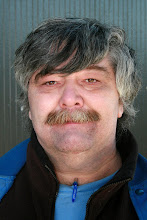
Waldman headed up the fish team. Net in hand, he addressed his group.

“This isn’t Mars,” he said. “But there are always surprises if you look hard.”

Waldman penned “Heartbeats in the Muck,” a book about the degradation of New York Harbor and its recent comeback. Having served with the Hudson River Foundation for 20 years, he is hardly a stranger to tracking wildlife. He explained how BioBlitz is unique.

“Typically you chip away,” Waldman said. “This is an intense snapshot."

Scientific Method

Waldman, joined by a National Parks Service Superintendent Dave Taft, lead his team to the first pond and distributed waders. Holding onto opposite sides of a green net, the scientists waded into the shallow pool. Waldman immediately started to sink.

“The lagoon used to be sturdy enough,” Taft acknowledged. “You could get some footing.”

The men agreed that changing circulation patterns had caused the pond’s softest settlement to build up. With 21 hours remaining, they decided to relocate to another site.

Upon arriving at the next pond, Waldman and Taft ventured in with their net. Drawing it back toward the shoreline, they discovered an abundance of tiny fish. The group crowded around and complaints from the college students that it smelled bad quickly subsided as hundreds mummichogs and silversides wiggled for air.

“It’s one thing to look in a textbook,” Taft said. “It’s another thing to get there and see it for yourself.”

The leaders asked if anyone wanted to drag the net and with no one volunteering they began the process again.

Baruch College freshman Anastasia Vasilchuk stood at the water’s rim with her hands on her hips. Her ecology professor had recommended she sign up.

“The air itself is healthy and fresh compared to the city,” Vasilchuk said. “All you see there is pigeons.”

She watched the scientists intently as they made their way toward her with a net full of fish. Although she had never conducted a similar study, she knew her goal for the afternoon.

“To find more than 10 [species],” she stated, adding, “It’s nice to know they all exist in this area,” she said.

But Waldman’s findings were not encouraging.

“More of the same,” he said looking down at the pile of fish. “What it lacks in diversity it makes up for in quantity.”

By the time the group was finished assessing the evidence, many had died on the sand.

“It’s the way of life,” Vasilchuk said before picking up her backpack and following the group to the East Pond.

The group, unused to the scientific method, seemed to be losing energy and focus. Three students left for the A train before the group had even arrived at its next destination. But as Waldman and Taft drew back their net for the third time, they revealed two more species: white perch and grass shrimp. The team’s bucket was quickly filling with diverse specimen.

Waldman, who grew up in the Bronx, described his childhood as a “Huck Finn environment within city limits.” He said that people mistakenly assume that crystal clear mountain springs boast the most wildlife.

“These mucky places are where you have the real life,” he said.

A New Discovery


After dinner Waldman ventured to the Bay’s marine waters and gathered more silversides. Then, alone in his tent, he took out his microscope and noticed something unusual.

He realized that the silversides from the bay differed considerably from those found in the pond water. It was midnight and the rest of his team was asleep, totally unaware of his discovery.

The next day, at the end of the 24 hours, Waldman’s group had found 14 species of fish. The announcement of these new “tidewater silversides,” however, was his group’s most significant contribution to the expedition.

“This is the heart of New York City,” Waldman said from his Queens College office Monday morning. “It has been walked on, netted and birded. You don’t expect dramatic surprises, but you also don’t know everything you think you know.”