Showing posts with label wildlife. Show all posts

Tuesday, December 28, 2010

Helping the Wild Birds of New York City - WNYC Radio - Video


New York City is a stopover on an ancient migratory path for birds called the Atlantic flyway. During the spring and fall migration, birds are often injured flying into plate glass windows, or become disoriented and exhausted by the bright lights at night. But unlike L.A., Chicago and Philadelphia, New York doesn't have a wildlife rehabilitation center. Instead, injured wildlife is cared for by an underground network of wildlife rehabilitators like Rita McMahon.

Sunday, July 4, 2010

Soundtrack of Mating Calls Helps Put Flock of Endangered Waldrapp Ibis at Bronx Zoo in the Mood by Barry Paddock - NY Daily News

Read original...

Six endangered Waldrapp Ibis chicks like the one above (l.) were born at the Bronx Zoo several weeks ago. The birds mated after a soundtrack of mating calls was piped into their enclosure. Watts for News


A low-libido colony of endangered birds in the Bronx got their groove back - thanks to love songs piped into its home.

The flock of 21 Waldrapp ibis living at the Wildlife Conservation Society's Bronx Zoo had produced no chicks for seven years.

After zookeepers piped in a sexy soundtrack of mating calls recorded halfway around the world, they turned frisky and have hatched six offspring from three sets of parents.

It's a coup because the birds are extremely endangered - there are just 400 left in the wild - and rarely reproduce in captivity.

"The whole species is at risk," said Mark Hofling, a zoo ornithologist who oversees the species survival plan for ibis in North America.

"They had pretty much stopped courtship behavior," Hofling said of the Bronx birds. "They were just going through the motions."

Two years ago, Dr. Alan Clark of Fordham University recorded the flock's own mating calls, hoping to create aural Viagra by playing them on an endless loop.

There was too much outdoor ambient noise on the tape, so Clark tried again last year at the Philadelphia Zoo's indoor display.

The recordings, played back in the Bronx last spring, did seem to get them in the mood, but they still produced no chicks.

So this spring, Clark upped the ante and visited a semiwild flock in Austria, returning with the perfect recordings of the birds' three distinct mating calls: a chirrup, a whoop whoop and a shrum shrum.

When they found the right sounds, they were played mornings and afternoons from an iPod hooked to speakers on the ibis' wire mesh enclosure near JungleWorld.

And the birds got busy.

They built nests, preened and necked. Several couples laid eggs, and the six chicks hatched in May. The birds grew to adult size, about 2 pounds, in six weeks.

Now zoo officials are trying the same technique on Caribbean and Chilean flamingos, also experiencing a dry spell.

"If it works with this one species, there's the possibility we can apply it to a wide range," said Dr. Nancy Clum, chief ornithologist at the zoo.

It took some experimenting to isolate the right flamingo calls.

"It can sound like a lot of noise," Clum said of the recordings. "You don't want to be playing a vocalization to them that's actually an alarm call."

Meanwhile, the zoo is installing a professional sound system for the ibis for next spring's mating season.

The adult fowl have pink featherless heads splotched with black spots. They can live into their 30s.

"They have beautiful glossy plumage," Hofling said. "People come and say, 'Oh, that's an ugly bird.' I tend to disagree. They're unique."

The mating success doesn't mean the ibis are on the road to repopulation.

"The reasons that made them endangered - human encroachment, pesticide use - are still with us," Hofling said.


No Lions and Tigers, but Plenty of Bears as Population of Coyotes, Deer and Raccoons Boom by Barry Paddock - NY Daily News

Read original...

Wild coyote Hal ran amok in Central Park in 2006 before getting caught.

The urban jungle's getting wilder every day.

Booming populations of coyotes, deer, bears and raccoons are causing chaos in close suburbs and encroaching more and more on the five boroughs.

A coyote led cops on a three-day chase through Tribeca in March. Three black bears were spotted just a few miles from the George Washington Bridge in May. And Thursday, two deer tore around the parking lot of a Target in the Bronx.

Experts say numerous factors are leading to the city's growing wild kingdom, from more greenways and bike paths to over-development in the burbs.

"You see them in city limits more than you have in the past," said Dr. Pat Thomas, head animal curator at the Wildlife Conservation Society's Bronx Zoo. "Animals can become desensitized to our presence and more emboldened."

After only three coyote sightings in Manhattan over the last decade, the cunning canines have been popping up all over Manhattan. One roamed Harlem in January, three were spotted at Columbia University in February and another was seen crossing a frozen lake in Central Park.

"We're going to see them continue to infiltrate New York City," said Kevin Clarke, a wildlife biologist with New York's Department of Environmental Conservation.

In Rye, just 12 miles from the Bronx, police are hunting for coyotes that attacked a 3-year-old girl Tuesday and a 6-year-old girl four days earlier.

And on Friday, a cop in Yonkers fired at a coyote but the animal escaped.

"This is new to a lot of the experts," said Rye Mayor Doug French. "There's no explanation at this point."

Parents aren't letting their children outside, said Kelly Hodulik, whose daughter, Emily, 6, suffered minor injuries after being bitten on her shoulder and thigh by a pair of coyotes. "Everybody's being really cautious," Hodulik, 42, said. "It's really scary."

Coyotes also are striking out into the city, following power line corridors, parkways and greenways - perfect paths for critters.

"One thing I've learned in the past 10 years," said Dr. Stanley Gehrt, a coyote expert at Ohio State University, "is to never bet against coyotes."

Biologists believe deer in New Jersey have been swimming across the Hudson River to Staten Island since 2000, replenishing the dwindling native population.

Frank Masseria, 53, videotaped the migration of two deer swimming from Perth Amboy, N.J., to Tottenville in May.

"You always wonder how they got here," Masseria said. "I understand they are good swimmers, but to actually see it, I was pretty shocked."

The city is increasingly going to the birds. New York has the highest density of peregrine falcons in the world, said Glenn Phillips, executive director of New York City Audubon. And while Pale Male and Lola used to be about the only red-tailed hawks, now there are more than 30 in the city, he said.

While bears have yet to be spotted in Manhattan, they have gotten close. West Milford, N.J., postponed fireworks after a bear charged a hiker, injuring his dog.

A bear could make the swim across the Hudson River, biologists say, but would likely be discouraged by the urban landscape on either side of the river.

"You're seeing them in places you didn't see them before," said Larry Ragonese of the New Jersey Department of Environmental Protection. "They're moving toward New York."

Thursday, July 1, 2010

Displaced Black Landowners Fight to Reclaim Georgia Land by Shaila Dewan- NYTimes.com

Read original...


HARRIS NECK NATIONAL WILDLIFE REFUGE, Ga. — When the managers from the federal Fish and Wildlife Service talk about this 2,800-acre preserve of moss-draped cypress, palmetto and marsh, they speak of endangered wood stork rookeries and disappearing marsh habitat, dike maintenance and interpretive kiosks.

But when the members of the Harris Neck Land Trust talk about it, they speak of injustice, racism and a place they used to call home.

In 1942, Harris Neck, a thriving community of black landowners who hunted, farmed and gathered oysters, was taken by the federal government to build an airstrip. Now, the elders — who remember barefoot childhoods spent climbing trees and waking to watch the Canada geese depart in formation — want to know why they cannot have it back.

The Harris Neck Land Trust, formed by the former residents, their descendants and a handful of white families who owned land but did not live on Harris Neck, is asking Congress to return the land. The Fish and Wildlife Service maintains that the land is a crucial part of the national refuge system.

On its face, the quest of the former residents pits the goal of environmental conservation against that of righting a historical injustice. But it is also a conflict about two ways of life — one that tries to protect natural resources from human encroachment, the other demonstrating that humans can live in harmony with nature.

To the former residents, the suggestion that they cannot coexist with the wildlife on Harris Neck is absurd. “Wildlife was a part of us all of our lives,” said Kenneth R. Dunham Sr., 80, who was a child when the federal government gave Harris Neck families two weeks to leave before their houses were bulldozed and burned. “In my back door, I could hear the wild geese coming. We left food in the field so they would have something to eat.”

Harris Neck was deeded by a plantation owner to a former slave in 1865. Black families who settled there built houses and boats and started crab and oyster factories. But the community, many descendants suspect, was too independent for the comfort of McIntosh County’s whites.

During World War II, when federal officials were looking for a site for an Air Force base, the county’s white political leaders led them past thousands of uninhabited acres to Harris Neck. The government condemned the land and ordered the families to clear out with the promise, some residents recall, that they could come back after the war. Blacks received an average of $26.90 per acre for the land, while whites received $37.31, according to a 1985 federal report. In 1962, the wildlife refuge was established.

Trust members do not imagine that they can recreate their old way of life, but their plan for the land is meant to be similarly low impact. It includes solar energy, cutting-edge sewer treatment and organic farming. Most of the acreage would remain wild and open to the public.

But a little more than a tenth of the land would be developed — each of about 70 families would get four acres, with design requirements and a strict covenant that the land, now worth $100,000 or more an acre, could not be sold. There would be an eco-lodge and a convention center, which the county now lacks.

Transferring federally protected land is, of course, no easy matter. Representative Jack Kingston, a Republican who represents the area, has been generally supportive of the trust’s efforts but has tried to caution its members on the political difficulties. “Environmental advocates can be formidable adversaries,” he wrote in a May 25 letter to the trust.

Environmental groups, for the most part, have yet to voice opposition. Deborah Sheppard, executive director of the Altamaha Riverkeeper in nearby Darien, was hesitant to address the issue, saying that her organization had not taken a position. “This is not the traditional question that’s posed to environmental groups, and to the extent that people aren’t being responsive, it’s probably that they don’t know how to weigh in,” she said.

As a local resident, though, Ms. Sheppard said she was familiar with the history of Harris Neck and sympathetic to the former residents, displaced from land whose status as a wildlife refuge has helped drive the construction of million-dollar retreats nearby.

“People continue to suggest that people from Atlanta with money can live here in an ecologically sound way — why can’t people with experience hunting and fishing and living off the land live in an ecologically sound way?” she said. “Those people are rightly suggesting that they have a historic capacity to interact well with their natural resources. And the rest of us haven’t.”

Complicating matters is that the former residents are themselves, in a way, endangered. They are Gullah/Geechee, descendants of West African slaves who became some of the nation’s earliest black landowners. Their distinctive culture, preserved for years by isolation on the coastal barrier islands, has been threatened by development to such a degree that in 2006, Congress designated a Gullah/Geechee Cultural Heritage Corridor stretching from North Carolina to Jacksonville, Fla.

But without access to the land that sustained the Gullah way of life, there are few options for preserving it. Some official ideas were detailed in a letter from Cynthia Dohner, the regional director of Fish and Wildlife, who proposed, in lieu of returning the land, an “annual homecoming day” at Harris Neck and the chance to collaborate on an “interpretive kiosk.”

Evelyn Greer, 82, recalls the forced move out of Harris Neck in vivid detail: residents lugging furniture by hand or mule cart, leaving jars of preserved food and livestock behind. On the morning their house was to be demolished at 6 a.m., she and her mother woke early to retrieve a treasured phonograph and its two records. On the path, her mother froze.

“I heard the fullness in her voice,” Ms. Greer recalled. “She said, ‘We in plenty of time, but we’re too late.’ ” The house was in flames.

The family moved into a barn owned by the white man her mother worked for.

Now, Ms. Greer and other trust members meet monthly to pray, sing and mull their next move. There will be a meeting with a congressman who is friends with President Obama, and another with a Georgia Department of Natural Resources employee. Two longshoremen were in the room at a recent meeting — maybe the A.F.L.-C.I.O. could do something. “The Return of Our Land,” read an agenda. Then, pointedly, “Community Meeting No. 49.”

Mr. Dunham rose to deliver encouragement. “We’re going to move on, and we’re going to come on in spite all,” he said to amens and mm-hmms. “Won’t that be a happy time, when we all get to heaven? I’m talking about Harris Neck, now.”

Saturday, December 29, 2007

Searching for Green in Gotham - NYS Dept. of Environmental Conservation

Read original....


New York City is my laboratory. When spring peepers begin chorusing in March, I am transformed from sleepy bookworm into mad scientist, keen to identify every plant and animal I find in my travels through Gotham. On starry summer nights, I creep through Central Park, in search of owls that flit from tree to tree in the shadow of skyscrapers. In autumn, I spend hours with my neck craned to the skyline, watching hawks heading south in migration. During winter, I keep warm in science libraries, thumbing through vivid accounts of wild New York written by early naturalists in whose footsteps I now follow. I am on a mission to determine what plants and animals inhabited my city in the past, and which ones live here still. Why have some species disappeared, while others flourished? Is there any rhyme or reason to these local extinctions? By answering such questions, it might be possible to develop strategies to protect our remaining biodiversity.

I know, I know. To some, New York City is regarded as the land of rats, roaches and other nasty things. Worse, many scientists don't take urban ecology studies seriously. I am often teased by those who do "serious" research in the rainforests of faraway Shangri-las. Compared to them, I feel like an outsider to real science. However, important biological information that has relevance to "wild" places can be discovered in urban areas if you know where to look. Cities like New York afford wonderful opportunities to study changes in biodiversity through time. There is often a history of investigation for particular urban locations made by naturalists dating back as far as the early 19th century, recorded in scientific papers, museum specimens and field notes. This historical record can then be compared to what still exists today in order to understand how and why changes have occurred.

Does the study of New York City's urban ecology have any relevance to other places? Absolutely. Today, most people in North America, South America, Europe and Australia live in cities. By 2025, almost two-thirds of the world's people will live in urban areas. Understanding the effects of rapid development will help conservation biologists decide what kinds of species and habitats to monitor in the coming years as urban sprawl affects natural areas throughout the world. Rather than a strange place to study nature, New York City might be the perfect laboratory to study a habitat that people, plants and wildlife share together. Understanding changes in diversity in New York City through time can shed light on the future of biodiversity everywhere.

Here in Gotham, my favorite species are wildflowers and other plants that grow in our parks. No special skills are needed to find them, and they won't run or fly away when you do. Plants define natural areas in the five boroughs: from the meadows and woodlands of the Bronx to the ponds and forests of Staten Island, to the sandy ocean beaches and salt marshes of Brooklyn and Queens-and even to the baseball fields of Manhattan's Central Park. Native plants (those found here before Europeans arrived) tell us about what New York City was like in the past and our connection to other places near and far. For example, a native tree such as the sweetgum (Liquidambar styraciflua) commonly grows in moist woodlands in all five boroughs and ranges south to Guatemala. Another native species found here, skunk cabbage (Symplocarpus foetidus), is also native to eastern China. American chestnut (Castanea dentata) trees still exist in New York City and so do native orchids. We have at least one globally endangered plant, Torrey's mountain mint (Pycnanthemum torrei), found in fewer than 20 other locations in North America.

New York City also has many non-native plants such as dandelions, hawkweeds and bittersweet. To the casual observer, these invasive plants make natural areas in New York City look vibrant. But looks can be deceiving. These non-native plants tell a tale of disturbance and development, extinction and invasion.

Non-native plants such as purple loosestrife, Asiatic dayflower, garlic mustard and porcelainberry can outcompete native plants creating a landscape of sameness that can adversely affect birds and insects.

Some of these non-native European species are so aggressive they can sprout through the asphalt in parking lots. Alien plants such as porcelainberry (Ampelopsis brevipedunculata), mugwort (Artemisia vulgaris) and Asiatic dayflower (Commelina communis) have run rampant in meadows throughout the city, making it virtually impossible for native species to keep a toe-hold. We have little idea how others such as purple loosestrife (Lythrum salicaria) affect the diversity of our native insects and birds. Overall, in the last 50 years many of our natural areas have become dominated by a handful of nonnative generalist species, creating a landscape of sameness.

As a result, we are losing the diversity that is characteristic of New York City. In order to help combat this invasion and preserve native plant species, we urban scientists needed some weapons of our own: an inventory of what plants once lived here but are now gone (extirpated), and a comprehensive list of what remains (extant). In the past two decades, my colleagues and I have compiled a list of more than 2,100 New York City plant species, 1,369 (65%) native plants and 739 (35%) non-native. New York City is home to about 60% of the native species ever recorded in New York State-an area 150 times larger. Pockets of native plants still thrive in New York City because some of the finest natural areas were set aside as parkland beginning in the mid 19th century, including Central Park in Manhattan and Prospect Park in Brooklyn. Most of the Bronx parks were established in 1888 as part of New York City's first environmental movement, whose motto was "More Parks Now!" By the late 19th century, clubs and organizations with strong interests in plants and wildlife had been established. These included the Torrey Botanical Club (1867), the American Museum of Natural History (1869), the Linnaean Society of New York (1878), the Staten Island Institute of Arts and Sciences (1881), the New York Botanical Garden (1891) and the Wildlife Conservation Society (1895). Today, we have a good idea of what plants and animals were previously found in each borough because of the collections, notes and writings made by members of these organizations.

Since the first comprehensive studies began, native herbaceous plants such as wildflowers, sedges and grasses have been most abundant. Approximately 30% of our botanical diversity comes from just three families of plants whose members generally prefer much sunshine. These include asters and goldenrod species (Asteraceae), grasses (Poaceae), and sedges (Cyperaceae). The abundance of species in these and similar sunloving plant families indicates that from the 19th to mid 20th century, most of New York City's natural areas were composed of open fields and meadows. Closed canopy forests were rare. Since the Second World War, we have lost nearly half of our native herbaceous species. By comparison, only about a fifth of woody shrubs and trees have become extinct in New York City. Certain groups of our native plants have been particularly prone to extinction. Gone are the majority of our native ferns, violets, sedges, grasses, and pondweeds. We have lost 24 of the 30 species of native orchids ever found here. All 21 of the native orchids once found on Manhattan Island have been eliminated. Nine entire plant families (all composed of herbaceous species) have been extirpated from New York City. Sadly, here in the Big Apple, native herbaceous plants, especially wildflowers, appear to have a dim future for a variety of reasons.

Pockets of native plants still thrive in New York City because of its magnificent parks. Half of all the plants ever catalogued in New York State, are found in the city.

In our parks in the last 75 years, development for landfills, highway expansion, baseball fields, buildings and water treatment facilities has caused a net loss of open space for living things. Native herbaceous plants are forced to exist on ever smaller parcels of land. Many sun-loving native plant species are being shaded out as the forest around them has matured. In the few remaining meadows and fields, our native species are losing the war of competition with aggressive non-native plants.

Increased use of city parks has had a negative effect too, especially on erodible slopes and sensitive wetlands. Perhaps the most important lesson to be learned from New York City is that the designation of an area as a park is not sufficient to ensure the preservation of its native plants, or to prevent the invasion of nonnative species. This is most evident in Pelham Bay Park in the Bronx, the second largest park in New York City. Since 1947, at least 145 native plant species have been extirpated, while 136 non-native species became established during this same time frame. Every habitat in that park has a greater percentage of non-native species than just a half-century ago.

In each New York City borough, a wave of extinction threatens our native flora. Not surprisingly, Manhattan and Brooklyn, the two boroughs that developed the fastest in the 19th century, have been affected most. They have the least amount of parkland and have lost approximately 70% of their native species. Even Queens, where most parks were established from the 1920s through the 1960s, lost roughly 62% of its native flora. An alarming trend is clearly evident: in every borough except Staten Island, more native species have been eliminated than still exist. If other boroughs are any indication, the same trend is going to happen to native plant species diversity on Staten Island in the coming years.

Being a true-blue scientist with ear pressed to the ground, I am always listening for solid ideas to help save New York City's remaining plant diversity and prevent further degradation of our natural areas.

Perhaps collecting seeds of native plants for propagation and translocation, or removing acres of non-native plants that carpet our parks could stop the loss of native species. Such endeavors are part of the solution, but we can't forget to preserve one of our most important habitats: the classroom. Growing there now are young New Yorkers in whose eyes I can read two fundamental questions: Why should we care if our native species go extinct? Why is preserving our diversity important?

These are good questions, and ones that people throughout the world are trying to answer. In the last decade, urban naturalists from as far as Italy and Russia have documented the remaining plant species of their cities, found rare native plants and published scientific papers about changes in local biodiversity. Closer to home, the "Chicago Wilderness" movement has sparked public support and fueled a wave of enthusiasm to save or restore pockets of native plants and animals in the urban environment. In more than one California city, people are working to transform abandoned landfills into meadows, wetlands and forests. Perhaps a new perspective is needed, too: besides restoring parks at street level, green space can be created for native species atop buildings, especially in industrial areas. In New York City, just such an idea is taking root. Almost 600 acres of warehouse roofs are being planted with hardy, drought-resistant grasses and wildflowers for climate control. These and similar solutions, especially if they involve young people, are music to my ears.

Right now in New York City, a renewed environmental movement is afoot to preserve our remaining wild plants and places. Naturalist foot soldiers are combing our parks, continuing to note species new to the city. Graduate students from city universities are conducting ecological studies of urban oases. Reporters from the Village Voice and even the New York Times are reminding everyone that good things can still be found in our town. However, the future of New York City's remaining biodiversity depends on more than the efforts of naturalists, scientists and concerned citizens. We need to ignite the imagination of all New Yorkers, from school kids to taxi drivers to the Mayor.

Who cares about the 2,100 plant species that compose New York's parks, yards and city streets? Why is biodiversity important? I don't know, but I can hear the flowers thinking.

Urban ecologist Dr. Robert DeCandido was born and raised in the Bronx. He has studied bird migration, night hunting peregrine falcons, Gotham's nesting owls and American kestrels, and flora of the Big Apple.

Photo: Robert DeCandido

Tuesday, October 9, 2007

Save Ridgewood Reservoir: Ridgewood Reservoir video

Save Ridgewood Reservoir: Ridgewood Reservoir video


I believe the Ridgewood Reservoir should be maintained as a nature area in perpetuity...I urge you to watch the video and lend your support...it's a good cause for our kids, their kids and future generations...

Thursday, October 4, 2007

11 new species discovered in remote Vietnam - Independent Online Edition > Nature

11 new species discovered in remote Vietnam - Independent Online Edition > Nature

By Emily Beament

Published: 26 September 2007

Two types of butterfly and a red-spotted snake are among 11 new species discovered in tropical forests in Vietnam, it was revealed yesterday.

The species, which include five orchids and three other plants, are exclusive to the remote forests in the Annamites Mountains of Thua Thien Hue, commonly known as Vietnam's "green corridor".

Another 10 kinds of plant, including four orchids, are still being examined and are also thought to be new species.

The discoveries have come in the same province where several mammal species were discovered in the 1990s, and could represent the "tip of the iceberg" said Chris Dickinson, WWF's chief technical adviser in the area.

"You only discover so many new species in very special places and the 'green corridor' is one of them," he added.

The new snake is called the white-lipped keelback and has a yellow-white stripe along its head with red dots covering its body. It lives by streams and catches frogs and other small animals.

Three of the new species of orchid have no leaves and live on decaying matter, like fungi, while the other new plants include an aspidistra with almost black flowers, and a yellow-flowered species of arum with funnel shaped leaves.

One of the new butterflies, which is among eight to have been discovered in the province since 1996, is a skipper which has quick, darting flight habits. All the new species were discovered in the past two years.

But the WWF warned that endangered species in the area, which is one of the last remaining lowland wet evergreen forests in the south-east Asian country, are under threat from illegal logging, hunting, extraction of natural resources and development.

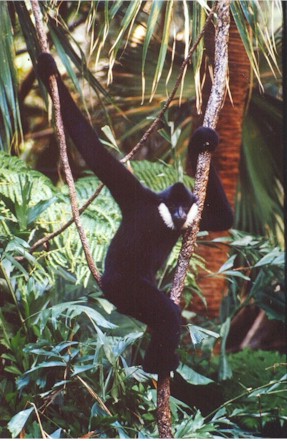
The "green corridor" is home to many threatened plants and animals, including one of the world's most endangered primates, the white-cheeked crested gibbon, the WWF says.

It is also considered to be the best place to conserve the Saola – a unique type of wild cow which was discovered by scientists only in 1992.

Hoang Ngoc Khanh, director of Thua Thien Hue provincial forest protection department, said: "The area is extremely important for conservation and the province wants to protect the forests and their environmental services, as well as contribute to sustainable development."

Independent Online Edition - Fertilisers Blamed as Researchers Solve Mystery of Deformed Frogs...

(click on pic to enlarge)

Read original..

American researchers claim to have answered the riddle of the deformed frogs that have been appearing in increasing numbers around the world.

Run-off from farmland drenched in fertilisers is behind the explosion in amphibians missing legs, or having extra legs and other deformities, according to the scientists.

Nitrogen and phosphorous from fertilisers are leaching into rivers, causing significant changes to the aquatic ecosystem. This prompts algae growth and increases numbers in the snail population, animals which play host to parasitic flatworms called trematodes. These parasites infect birds, snails and amphibian larvae, causing severe limb deformities and an increase in mortality.

"This is the first study to show that nutrient enrichment drives the abundance of these parasites, increasing levels of amphibian infections and subsequent malformations," said Pieter Johnson of Colorado University, who led the study.
These malformations include the growth of extra limbs, partly formed or missing limbs, skin webbing and bone defects. When examined, amphibians with these defects were often found also to suffer from life-threatening eye abnormalities and tumours.

Reports of these abnormal amphibians have risen sharply since the mid-1990s, when some Minnesota schoolchildren found a pond where more than half of the frogs had missing or extra legs. This has generated increasing concern from scientists and ecologists, who have since established that parasite infection is a major cause of these deformities.

Trematode parasites that affect amphibians have a series of host species. They can grow in snails and then become infectious when released. The parasites then infect tadpoles, forming cysts on new limbs. When the frogs are eaten by predators, they excrete the parasites back into the ecosystem.

With many of the causes of amphibian decline still poorly understood, this research, which appears in the latest edition of the Proceedings of the National Academy of Sciences of the USA, may be a major breakthrough. "Our results have broad ecological significance," said Mr Johnson.

Rapidly declining amphibian populations have been noted globally since the 1980s, and are now regarded as one of the most critical threats to global biodiversity.

Tuesday, September 25, 2007

Jamaica Bay Bio-Blitz on September 7th & 8th...


I attended this event at Jamaica Bay Wildlife Center from about 2 pm on September 7th until roughly 2am on September 8th, 2007...

I tried my best to help at the Registration Desk with some other volunteers from the NY Biology Teachers Association...it got really hairy there in the beginning of the day...


It was well attended, when I left that evening (early morning) there were over 100 participants...

Some 665 species were identified in the 24 hour period, a few of the highlights found was an adult Katy-did, a Praying Mantis, some big grasshoppers and two tree frogs...

I'd like to thank Prof. Gillian Stewart and Prof. John Waldman from CUNY Queens College and Jill Tripp and Nancy Khan from the National Parks Service, Jamaica Bay Institute and Suzi from National Geographic...for organizing this important community event...

I think it's important to recognize the hard legislative work being done on both the City level by City Councilman James Gennaro (Chairman - Environmental Committee) and in Washington, DC from Representative Anthony Weiner (NY 9th)...I'm proud of his 100% rating by the League of Conservation Voters on their
2006 National Environmental Scorecard...He deserves our thanks...

Look up your delegation's scores Send a letter to your Members of Congress -- let them know you're watching!

I feel this will provide a comprehensive base-line of species which currently exist in Jamaica Bay...

It was a pleasure to help out these fine folks who are doing a great job towards for protection of the environment of Jamaica Bay...

The more information we possess of this unique ecological environment in the City of New York, the better we will be able to protect it for future generations of New Yorkers and Americans...

NYBTA Activities: NYBTA @ Jamaica Bay BioBlitz

NYBTA Activities: NYBTA @ Jamaica Bay BioBlitz


NYBTA
at
Jamaica Bay BioBlitz
September 7-8, 2007


Times Ledger - BioBlitz of Jamaica Bay wetlands teaches lessons

Times Ledger - BioBlitz of Jamaica Bay wetlands teaches lessons

Ready, set, blitz! Science and nature lovers gathered at Jamaica Bay last weekend to take part in a scavenger hunt that explored the ecosystem's biodiversity.

The BioBlitz competition was the first ever event at the blighted bay where science experts led teams of volunteers on a 24-hour trek into the marshes, woods and trails in search of its exotic fauna and flora. The blitz has been held at dozens of other national parks, wilderness areas and marshlands across the country attracting hundreds from all over the world.

In Jamaica bay teams had a lot of organisms to find in a large amount of space including From red foxes, horseshoe crabs, and even non-indigenous species like Western jackrabbits.

"It's a bit overwhelming for your average person to learn about different plants that live here, so this will give them a chance to do it in an organized way," said Dr. David Franz, a biology professor from Brooklyn College who led the invertebrates team.

The event, which was created by the National Parks Service and Queens College, was held to increase awareness of the bay for the people who never take notice of the body of water despite its proximity to the city and escalating warnings about its vanishing marshlands.

"Anything we can do to draw attention to the plight of this natural resource...is a great step forward," said Councilman James Gennaro (D-Fresh Meadows), chairman of the Council's Committee on Environmental Protection, at Friday's opening ceremonies.

A report issued last month by the National Park Service and Jamaica Protection Plan Advisory Committee found that the bay has lost 70 percent of its marshlands in the last 50 years and could lose them completely in five years if nothing is done to stop their disappearance.

More than 100 volunteers took part in the scavenger hunt, and many stayed for the full marathon at the bay's national wild refuge's camp area. At the end of the event teams put their findings into a massive database that will be logged and studied by scientists, according to Gillian Stewart, a Queens College assistant science professor who co-ordinated the event.

"It's particularly good for students to interact with scientists and learn the in's and out's of identification," she said.

Participants came from all parts of the borough and some even arrived from out of state to take part in the adventure.

"It was interesting to see what types of birds there were. It's great that you have this large undeveloped area near a large city," said Doug Wood of Pennsylvania, who came to look for the bay's birds.

Gennaro praised the event's coordinators and participants for bringing the bay into the limelight at a time when it faces enormous environmental hurdles.

"This is a success by the virtue that we have young scientists and people who want to immerse themselves in the natural beauty and splendor of Jamaica Bay," he said.

On a somber note, Franz issued a bleak outlook for the future of the bay in view of the eroding marshlands.

"If the condition continues to deteriorate, then there won't be food for the fish, and that can totally disrupt the food chain here," Franz said.

Reach reporter Ivan Pereira by e-mail at ipereira@timesledger.com or by phone at 718-229-0300, Ext. 146.

NPS Digest - Volunteers Gather 665 Species Around Gateway’s Jamaica Bay (NPS Digest)

Volunteers Gather 665 Species Around Gateway’s Jamaica Bay (NPS Digest)

At midday Friday, September 7, an eager crowd of scientists, amateur naturalists, students and volunteers gathered at Gateway National Recreation Area’s Jamaica Bay Wildlife Refuge for the start of the first ever Jamaica Bay BioBlitz. Organized as a partnership between the National Park Service and Queens College (CUNY), the program was designed to collect and analyze as many species as possible over a 24 hour period. Field teams had specifically been instructed to explore less studied areas, such as Fort Tilden and Floyd Bennett Field, in order to expand the already extensive list of species known to exist in the park.

As survey teams returned from the field they congregated in the Refuge’s conference room which had been transformed into a temporary research laboratory. There scientists and volunteers huddled over microscopes and scoured field guides as they worked to identify the more obscure specimens.

Throughout the event ranger-led programs provided opportunities to learn about the natural history of species found in the Jamaica Bay area. At the Refuge base camp displays put together by the Brooklyn Children’s Museum, the New York Aquarium, and the Queens Botanical Garden provided interactive activities with live animals and biofacts. A lunchtime workshop on nature sketching by a scientific book illustrator was a special treat for those wanting to create their own field notebook.

This first ever BioBlitz for Jamaica Bay was envisioned by the Jamaica Bay Institute of Gateway National Recreation Area and co-organized in partnership with research faculty in the sciences at Queens College. One of these researchers, Dr. John Waldman, discovered that the numerically dominant fish in the east and west ponds at the Refuge, which had long been considered to be the Atlantic silverside, Menidia menidia - the same as the dominant species in Jamaica Bay's marine waters – was M. beryllia, a very similar but different tidewater species.

By the end of the 24 hour effort 273 volunteers had enthusiastically stepped into hip waders, wielded an insect or fish net, raised binoculars, or looked through a hand lens as part of the intensive effort to gather information about the extent of the park’s biological diversity. At the closing ceremonies a tired, but still very excited crowd cheered when the final tally of 665 species was announced.


Name: Nancy Khan
Phone Number: 718-338-3338 x 223
Email: nancy_khan@nps.gov

Queens Chronicle -BioBlitz Participants Storm Jamaica Bay by Lucy Torres...

Queens Chronicle - ‘BioBlitz’ Participants Storm Jamaica Bay

Many Queens residents drive through Broad Channel on their way to Rockaway’s beaches without appreciating the ecological diversity in Jamaica Bay.

At last week’s first annual BioBlitz, a 24-hour ecological festival based at the Jamaica Bay Wildlife Refuge, located on Broad Channel, diversity was both catalogued and celebrated.


More than 260 people, ranging in age from 2 to 81, worked over the 24-hour period to document the different species near the refuge, as well as in Fort Tilden, located in Rockaway, and in Floyd Bennett Field, in Brooklyn. Over half of the participants were volunteers. While many left early on Saturday morning, some worked straight through.

Beyond listing the different species in the area, participants sought to give scientists the opportunity to study their findings.

“Our main goal is to get researchers out in the park doing basic science, doing research and then getting that translated,” said Nancy Khan, a refuge staff member.

Khan added that the BioBlitz allowed scientists and average citizens to better understand the environment around them in a festive atmosphere.

Participants were greeted with T-shirts, water bottles and an assortment of healthy snacks.

Councilman James Gennaro (D-Fresh Meadows), chairman of the Environmental Protection Committee, helped kick the event off late Friday afternoon.

“It’s critical that we preservemarshland,” he said. “It plays a critical role in protecting the mainland of Queens and Brooklyn, from tidal action to wave action, and also the wetlands, which are incubators for marine life and a lot of terrestrial life as well.”

Coordinated by Queens College Professors Gillian Stewart and John Waldman, the BioBlitz was sponsored in part by the CUNY Institute for Sustainable Cities, Jamaica Bay Institute and the Gateway National Recreation Area.

Among the many excursions BioBlitz offered was Friday evening’s sunset walk, where spectators watched the sun stretch across Jamaica Bay at dusk; Saturday morning’s butterfly search and Saturday’s nature sketching class.

Many college students who were interested in learning more about the bay’s delicate ecological balance volunteered.

“I just want to get involved, even if it’s around the area,” said a graduate student from Brooklyn. Both the student and her friend volunteered to study jellyfish, which involved extracting samples and later identifying species collected.

Queens College biology graduate student Jonelle Orridge came out to study plants, but also to do her part to increase awareness about ecology.

“If (we) reach out to the high schools and make principals aware (of ecological events) students could have a better grasp of what is going on around them.”

Orridge, who is involved in community outreach, believes the best way to learn about the environment is to offer programs at parks and promote events in publications.

By the end of the event, researchers found 665 species, including 166 species of terrestrial plants, 34 insects and 27 species of marine invertebrates.

Congressman Anthony Weiner (D-Forest Hills) helped close the event by saying: “BioBlitz, species by species, item by item, is making us aware just how diverse it (Jamaica Bay) is. We have to do everything to protect it.”

Daily News - This scavenger hunt's truly a wild affair

This scavenger hunt's truly a wild affair

Volunteers raced against the clock to collect, identify and count as many living things as they could find in 24 hours at the Jamaica Bay Wildlife Refuge recently.

The 250 nature enthusiasts — ages 2 to 81 — hiked the 9,000-acre grounds armed with butterfly nets and binoculars as part of the park's first BioBlitz, organized by Queens College and the Jamaica Bay Institute.

The tally: 665 species, including birds, mammals, insects and fish.

But the BioBlitz was about more than just numbers.

"It's one thing to be able to read about science in a magazine or a textbook, but it's another thing to be able to go out and see how scientists conduct their work in the field," said John Waldman, 52, a Queens College biology professor and a BioBlitz organizer.

During the marathon event Sept. 7-8, scientists and volunteers collected specimens and took them back to a makeshift lab in the visitors center. Scientists worked together at the center, peering through microscopes and cross-referencing textbooks, to categorize the findings.

"Probably one the most inspirational moments was at about midnight," Waldman said. "There was a little boy here who was helping us count, and he didn't want to go home. His father was rubbing his eyes and wanted to get out of here. But they didn't leave until 2 o'clock. And they [came back the next day]. He couldn't get enough of it."

That boy was John-Kaarli Rentof, 12, of Manhattan, who declared he wants to be a herpetologist — someone who studies amphibians and reptiles. The boy's favorite finds were a red-spotted newt and two tree frogs.

"One of the frogs was a big guy, and he was gray, and the other was a small one and it was green. I put them in a bag to bring them back and I gave them a shower in the water fountain," he said.

Inspiring the next generation of naturalists was a key goal of the event.

Earlier this summer, the Jamaica Bay Watershed Advisory Committee released a report contending the refuge's salt marsh islands — which serve as a natural sewage-battling filtration system — were vanishing much faster than previously thought. They could be gone in as little as five years, the report said.

At the event's closing ceremony, Rep. Anthony Weiner (D-Queens, Brooklyn) called on New Yorkers to help protect the park.

"Would it be so bad to lose one mollusk? Would it be so bad to lose one bird? The answer is we have no idea what the impact would be if we lost one species or all of the others," Weiner said.

Queens Tribune - Jamaica Bay Surprises:Need To Document Dwindling Species Spurred By Estuary’s Rapid Degradation

Queens Tribune: Jamaica Bay Surprises:Need To Document Dwindling Species Spurred By Estuary’s Rapid Degradation:

The Jamaica Bay Watershed Protection Plan Advisory Committee, established by law in 2005, released a study last month showing that the Jamaica Bay wetlands are disappearing much more rapidly than was previously thought. After comparing 2003 maps to 2005 maps, the Advisory Committee projected that the wetlands would be gone by 2012.

The causes behind the rapid loss of the wetlands are varied and include high toxin levels, rampant seaweed growth and grazing geese. However, concern is mounting over the role of nitrogen dumping.

Councilman Jim Gennaro (D-Fresh Meadows), chairman of the Committee on Environmental Protection, held a hearing Sept. 6 in order to discuss the nitrogen factor.

Every day, four of the City’s wastewater treatment plants dumps into the bay 250 million gallons of treated wastewater, which contains 30 to 40 thousand tons of nitrogen.

The Advisory Committee has declared that nitrogen levels must be reduced by 55 percent by 2015, a recommendation modeled after the Long Island Sound.

According to City Council spokesman Anthony Hogrebe, the Department of Environmental Protection has committed to reducing nitrogen levels and must present a detailed plan by Oct. 1 of this year.


Bring On The BioBlitz

“How many people have actually been to this bay,” Gennaro asked a circle of scientists, students and volunteers who had gathered last Friday afternoon to take part in BioBlitz, a 24-hour expedition to tally the flora and fauna in the area. As Gennaro had suspected, the vast majority of participants — all wearing baby blue BioBlitz T-shirts — were first timers.

Jamaica Bay is the largest urban wildlife refuge in the country, and the only accessible by train. The visitor center is immaculate, the white pebbled paths hardly disassembled by foot traffic; it is yet another Queens’ attraction regularly described as an undiscovered gem.


Queens College professors Dr. Gillian Stewart and Dr. John Waldman organized BioBlitz to generate species lists and maps for park management. Their goal was to showcase the biodiversity that currently thrives in Jamaica Bay in order to highlight the need to protect the area wetlands.

“This is the generation that is either going to save or lose Jamaica Bay,” Gennaro said at a press conference last Friday before everyone divided into teams to survey the 9,155-acre refuge, protected since 1972 as a part of the Gateway National Recreation Area.


Waldman headed up the fish team. Net in hand, he addressed his group.

“This isn’t Mars,” he said. “But there are always surprises if you look hard.”

Waldman penned “Heartbeats in the Muck,” a book about the degradation of New York Harbor and its recent comeback. Having served with the Hudson River Foundation for 20 years, he is hardly a stranger to tracking wildlife. He explained how BioBlitz is unique.

“Typically you chip away,” Waldman said. “This is an intense snapshot."

Scientific Method

Waldman, joined by a National Parks Service Superintendent Dave Taft, lead his team to the first pond and distributed waders. Holding onto opposite sides of a green net, the scientists waded into the shallow pool. Waldman immediately started to sink.

“The lagoon used to be sturdy enough,” Taft acknowledged. “You could get some footing.”

The men agreed that changing circulation patterns had caused the pond’s softest settlement to build up. With 21 hours remaining, they decided to relocate to another site.

Upon arriving at the next pond, Waldman and Taft ventured in with their net. Drawing it back toward the shoreline, they discovered an abundance of tiny fish. The group crowded around and complaints from the college students that it smelled bad quickly subsided as hundreds mummichogs and silversides wiggled for air.

“It’s one thing to look in a textbook,” Taft said. “It’s another thing to get there and see it for yourself.”

The leaders asked if anyone wanted to drag the net and with no one volunteering they began the process again.

Baruch College freshman Anastasia Vasilchuk stood at the water’s rim with her hands on her hips. Her ecology professor had recommended she sign up.

“The air itself is healthy and fresh compared to the city,” Vasilchuk said. “All you see there is pigeons.”

She watched the scientists intently as they made their way toward her with a net full of fish. Although she had never conducted a similar study, she knew her goal for the afternoon.

“To find more than 10 [species],” she stated, adding, “It’s nice to know they all exist in this area,” she said.

But Waldman’s findings were not encouraging.

“More of the same,” he said looking down at the pile of fish. “What it lacks in diversity it makes up for in quantity.”

By the time the group was finished assessing the evidence, many had died on the sand.

“It’s the way of life,” Vasilchuk said before picking up her backpack and following the group to the East Pond.

The group, unused to the scientific method, seemed to be losing energy and focus. Three students left for the A train before the group had even arrived at its next destination. But as Waldman and Taft drew back their net for the third time, they revealed two more species: white perch and grass shrimp. The team’s bucket was quickly filling with diverse specimen.

Waldman, who grew up in the Bronx, described his childhood as a “Huck Finn environment within city limits.” He said that people mistakenly assume that crystal clear mountain springs boast the most wildlife.

“These mucky places are where you have the real life,” he said.


A New Discovery


After dinner Waldman ventured to the Bay’s marine waters and gathered more silversides. Then, alone in his tent, he took out his microscope and noticed something unusual.

He realized that the silversides from the bay differed considerably from those found in the pond water. It was midnight and the rest of his team was asleep, totally unaware of his discovery.

The next day, at the end of the 24 hours, Waldman’s group had found 14 species of fish. The announcement of these new “tidewater silversides,” however, was his group’s most significant contribution to the expedition.

“This is the heart of New York City,” Waldman said from his Queens College office Monday morning. “It has been walked on, netted and birded. You don’t expect dramatic surprises, but you also don’t know everything you think you know.”

Knight News - BioBlitz Set to Tally Jamaica Bay's Flora and Fauna...


BioBlitz Set to Tally Jamaica Bay's Flora and Fauna - News:

Queens College researchers will stage the first BioBlitz Friday and will descend to the wildest reaches of New York City to conduct a round-the-clock tally of flora and fauna for the Jamaica Bay area.

This event, co-sponsored by Queens College, the Jamaica Bay Institute, the CUNY Institute for Sustainable Cities, the Gateway National Recreation Area of National Park Service and the North Atlantic Coast Cooperative Ecosystems Studies Unit, is set to last 24 hours and researchers will be equipped with nets and insect repellents, in addition to their notebooks.

Professor John Waldman from the biology department and professor Gillian Stewart from the earth and environmental sciences department organized this event, which targets thousands of acres within the Gateway National Recreation Area, between the borders of New York and New Jersey.

Although Jamaica Bay may be an urban location, it is rich in wildlife, consisting of red foxes, horseshoe crabs and invasive species such as Western jackrabbits. Jamaica Bay simultaneously serves as a major flyover area for hundreds of migrating visitors such as hawks, ospreys and monarch butterflies.

According to professor Waldman, in an effort to document Jamaica Bay's biodiversity, the researchers are going with a team of different specialists in plants and animals to survey a plot of land. It may be a "quick and dirty look" of what is already there; however, it will enable the scientists to account for a future baseline.

Planners of the event hope that this event will raise awareness of biodiversity. New York City Councilmember James Gennaro, who has played an important role in preserving New York City's water supply, is set to speak at the event. In addition to Gennaro, Barry Sullivan, the superintendent of the Gateway National Recreation Area, and Kim Tripp, the director of the Jamaica Bay Institute will address the participants.

The schedule of activities on Friday evening and Saturday morning will include guided field walks, workshops on sketching plants and animals in the wild and even a junior BioBlitz for children. Professional naturalists will be staking out various parts of the park in four-hour shifts.

Upon returning to the wildlife center, they will file their regular reports. Their findings, which will include a final species count, will be revealed at the closing ceremonies where Congressman Anthony Weiner will serve as a guest speaker. Weiner has made Gateway one of his top priorities and has secured $66 million for the park since his election in 1998.

There are a limited number of positions available for volunteers, who are expected to bring their own water and snacks, and no bedding will be provided. Luckily, camping will be permitted at Floyd Bennett Field.

"If you can attend the event, you should," said senior Alexandrea Bowman. "This event is especially important as the ecosystem of Jamaica Bay has been seriously disrupted. A lot of the marsh has been lost in the past 100 years. Surveys like this one are needed for remediation."

Newsday.com - DIARY: Jamaica Bay's Teeming Wildlife by Merle English...

DIARY: Jamaica Bay's teeming wildlife -- Newsday.com: "

There were bats, and owls, horseshoe crabs and ribbon snakes. And even a few lesser-known species: Teddy Bear caterpillars, and sphinx moths.

In all, 665 species were collected in the first 24-hour survey of wildlife in and around Jamaica Bay.

The creatures were finds of scientists, naturalists and members of the general public participating in what is being billed as BioBlitz, sponsored by the Earth and Environmental Sciences Department at Queens College in Flushing and the Jamaica Bay Institute at Gateway National Recreation Area.

For two days, 250 people from the City University of New York, private and public high schools, the state Department of Environmental Conservation, the National Audubon Society, the American Littoral Society, other organizations and neighborhood residents tallied terrestrial and aquatic species in the federal park.

"This is all about getting people excited about nature," Gillian Stewart, assistant earth and environmental sciences professor at Queens College, said. "It's a combination of people doing this all their life and people who've never done this."

John Kaarli, 12, of Manhattan, was among many young volunteers. He repeatedly dipped a small net into a fish tank until he brought up a live killifish. Shrimp and seaweed were also in the tank.

"I love nature," John, an aspiring herpetologist, said. "I have hated all my life people polluting the planet, things dying in the rain forest, spider monkeys losing their habitat. A tree that took maybe 500 years to grow is cut down in five minutes, just wiped off the planet."

He arrived for the BioBlitz at 6 p.m. Friday with his father, Peter, a retired math and science teacher. They stayed until 2 a.m. Saturday and were back later that day.

One purpose of the BioBlitz was to "highlight the natural resources and get people to understand the rich biodiversity of Jamaica Bay," said Kim Tripp, director of the Jamaica Bay Institute.

Two hundred BioBlitzes have been held internationally since Sam Droege, a biologist with the U.S. Geological Survey, conducted one in Washington, D.C., 10 years ago. "It's awareness. It's education," said Suzi Zetkus, a volunteer at the Museum of Natural History who organizes such events.

John Waldman, a Queens College biology professor, said BioBlitz is "a concept that's growing. It brings a lot of scientists together to get information it would take years to get. People see how scientists work in the field, and they're being exposed to high-level science also. We've opened a lot of eyes," he said.

Rep. Anthony Weiner (D-Forest Hills) told the scientists and volunteers, "People are having a dramatic impact on this park. We as neighbors have an obligation to protect it. We have no idea of the impact of losing a single species on the others."

For Maria Acevedo of Flushing, it was all about knowledge. "It's always good to know what you have in the area," she said.

Epoch Times - College Plans 'BioBlitz' for NYC's Jamaica Bay by By Evan Mantyk

Epoch Times | College Plans 'BioBlitz' for NYC's Jamaica Bay

NEW YORK—Just south of John F. Kennedy Airport, and with Manhattan's skyscrapers still visible in the distance, Jamaica Bay is a 9,000-acre wildlife refuge that remains a unique portion of the Big Apple. It's probably the only place in New York City where you will get a chance to see a red fox, a horseshoe crab and a jackrabbit in their natural habitat.

Equipped with nets, notebooks, and insect repellent, Queens College researchers will descend on the refuge on Sept. 7, and they won't emerge for 24 hours. They're not filming an episode of "Survivor," they're staging the first BioBlitz—a round-the-clock tally of flower and animal species present in the bay. The event, open to the public, is meant to be fun and raise awareness about the great value of this natural treasure.

Event co-organizer, Professor Gillian Stewart said Jamaica Bay "is comprised of incredibly diverse landscapes. There are wetlands, ponds, forests, estuaries, marshes, rivers, uplands, meadows, etc. This rich ecosystem is home to a huge number of marine, estuarine, and terrestrial species as well as thousands of coastal migratory organisms."

While Jamaica Bay has been protected by the federal government since 1972, being in such close proximity to JFK airport and the commercial and industrial development of New York City has taken its toll. For example, about 49 of the 65 square kilometers of wetlands have been filled in or are disappearing, and sewage treatment plants have impacted the water quality.

"The BioBlitz is not aimed to stop development or destruction, but instead to make the public aware of the amazing biodiversity in their 'backyard.' We hope people will realize how close and accessible this amazing resource is," said Stewart.

The schedule of free activities on Friday Sept. 7 and the following Saturday morning will include guided field walks, a workshop on sketching plants and animals in the wild and a junior BioBlitz for children. Meanwhile, professional naturalists will be staking out parts of the park in four-hour shifts, returning to the wildlife center to file regular reports.

"We're going to take a team of scientists with different specialties in plants and animals, and survey the hell out of a plot of land," said Queens College Professor John Waldman. "It's a quick and dirty look at what's there, giving us a baseline for the future."

The final species count, and other interesting findings, will be announced at closing ceremonies on Sept. 8 at 3 p.m., when Congressman Anthony Weiner will speak.

Whether for the BioBlitz or just to getaway from the city, Jamaica Bay is amazingly accessible via the A Train.

"Anyone can go and visit Jamaica Bay at the Wildlife Refuge, Fort Tilden, and Floyd Bennett Field, and other sites," said Stewart. "This is the only unit of the National Park Service accessible by subway."

Monday, September 24, 2007

NEWTOWN CREEK ALLIANCE - Newtown Creek Nature Walk - Saturday, September 29, 2007 - 11am - 4pm...

NEWTOWN CREEK ALLIANCE:

"Saturday, SEPTEMBER 29, 2007 Opening Celebration and Festivities for “Newtown Creek Nature Walk” 11:00 AM – 4:00 PM NEWTOWN CREEK WASTEWATER TREATMENT PLANT PAIDGE AVENUE & PROVOST STREET BROOKLYN, NY 11222 Shuttle buses are available from the intersection of Greenpoint and Manhattan Avenues (Greenpoint Ave G Stop) from 11am to 3 pm. Children activities and light refreshments will be served Christine Holowacz, Community Liaison, 718 349-0150, 917 670-9044"

Wednesday, September 5, 2007

Queens Shark Sleeps with the Fishes - Daily News and other media...

Queens shark sleeps with the fishes:

The wayward shark that beached itself in the Rockaways - causing a stretch of the Queens shoreline to be closed to swimmers Saturday - died yesterday, city park officials said.

"It is now safe to go back into the water and we invite beachgoers to enjoy a picture-perfect Labor Day weekend at the Rockaway Beach," Parks Commissioner Adrian Benepe said after the shark washed ashore at 6 a.m.

A group of sunbathers first spotted the shark Saturday morning when it splashed out of the surf near Beach 113th St.

Rather than flee, the beachgoers pushed the shark back into the ocean. For several hours, the 5-foot thresher shark could be seen swimming just off shore.

The sightings led park officials and lifeguards to close more than 10 busy blocks of beach - from 107th to 121st - at the start of the long, Labor Day weekend.

Benepe said city lifeguards acted "appropriately" Saturday when they closed the beach to swimmers. The parks commissioner referred to the shark as "one of the most respected creatures of the deep" yesterday before announcing all the city’s beaches were open for the holiday weekend.

Hans Walters, a shark researcher and supervisor at the New York Aquarium, said he was impressed by the way New Yorkers responded to the shark sighting.

"Sharks get a lot of bad press," he said. "But the public that was at the beach said, 'Hey, we gotta help this animal,' rather than, 'Hey, it's a shark. Let's kill it.'

"It's just sad the shark didn't live."

NY Post - SOCK IN THE JAWS | By Ikimulisa Livingston and Eric Lenkowitz...

New York Times - Shark Lands Again, Dead This Time...

Newsday.com - Rockaway Beach reopens after dead shark washes ashore...