Showing posts with label civil rights. Show all posts

Tuesday, April 26, 2011

Bloomberg Pressing For Fingerprints On Social Security Cards by: Erin Billups - NY1.com

Watch original...

h/t to Javier Castano at QueensLatino.com for alerting me to this situation by King Mike...


Mayor Michael Bloomberg says putting fingerprints on social security cards would help control the nation's borders, and give employers a way to check whether potential hires are legal citizens.
"The companies could just run it through a computer," Bloomberg said Friday morning on his weekly radio show. “And if you're an undocumented illegal, they just don't give you the job. And you're not going to come here if you cant get a job."
The mayor's remarks come on the heels of his trip to Washington on Tuesday, where he took part in a discussion on immigration policy with President Obama and other politicians.
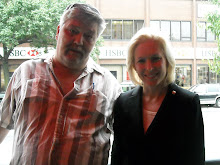
Photo from QueensLatino.com
Advocates for immigrants rights say they're surprised Bloomberg is making this proposal.
"This is a plan that's ill advised and should not be pursued and is incompatible with some of the values that the mayor claims to be important to him," said Donna Lieberman of the New York Civil Liberties Union.
Things like preventing the marginalization of the immigrant community.
"When we add a layer of documentation in order for people to do basic activities there are people that are vulnerable ... for whom this just means they are pushed to the outskirts," Lieberman said.
One company of Bloomberg makes a device for checking fingerprints. If your proposal is approved, will increase his fortune, at the expense of undocumented migrants. Go Bloomberg ... Yes, we can!
Critics of Bloomberg's proposal say putting fingerprints on social security cards would not only be a burden for immigrants, but an imposition on all Americans.
"Once you open the door to such government intrusion what you're doing is you're allowing the Government to collect all sorts of information and we have questions about what this will mean for the future," said Jacki Eposito of the New York Immigration Coalition.
The idea of putting fingerprints on social security cards has been floated by other elected officials, including Sen. Charles Schumer.

Wednesday, April 13, 2011

Queens Residents File Suit Challenging Biased Denials of Social Security Disability Benefits


Class Action Suit Seeks To Disqualify Biased Social Security Administration Administrative Law Judges, de Blasio files Amicus Brief in Support

Eight disabled Queens residents filed a class action lawsuit today charging systematic bias against low-income disabled individuals seeking Social Security Disability benefits in Queens. The suit against the U.S. Social Security Administration seeks the disqualification of five Administrative Law Judges (ALJs) at the Queens Office of Disability Assistance & Review (ODAR) because of their persistent denial of claims based on glaring and intentional legal and procedural errors, thereby depriving thousands of eligible claimants of benefits they need to survive.

The Queens ODAR has the third highest benefits-denial rate in the country and the highest benefits-denial rate in the New York region, based on data covering decisions from 2005 to 2008. Almost all of the ALJs named in the suit rank high on the national list of top claims deniers. On appeal, the Queens ODAR suffers one of the highest remand rates in the country.

The lawsuit brought by the Urban Justice Center’s Mental Health Project and the law firm of Gibson, Dunn & Crutcher, details a history of persistent and intentional denials by the ALJs of disability claims, and provides compelling evidence of their anti-claimant bias. These errors have persisted despite repeated warnings and reversals by the federal court in Brooklyn. In prior rulings, that court has used various phrases to describe the problem with ALJs from Queens ODAR, including:

  • Proceedings that were “a far cry” from the required standards;
  • Conduct that “raises the possibility that the ALJ was not seeking to neutrally develop the record, but rather to find support for the conclusions he had already formed”
  • Analysis that was “deficient” and “incoherent”
  • Delay that was “particularly egregious”
  • Rationale that was “plucked from thin air”
  • Analysis that “trivializes plaintiff’s impairments”
  • Overall conduct that demonstrates “serious negligence and could possibly even suggest bias”

While these findings came in individual cases over three years, this is the first lawsuit to weave those findings together, and with other evidence of bias, as a basis to seek the disqualification of most of the members (5 of 8) of a local Social Security hearing office.

Eve Stotland, Director of the Mental Health Project, Urban Justice Center, said “We hope this lawsuit will bring an end to the well-known and flagrant bias our clients face every day. These ALJs have used any and every rationale to deny claims for many years. We look forward to the day when bias against disabled claimants is no longer tolerated.”

“Many of these individuals are living in dire poverty while these ALJs repeatedly to refuse to apply the law,” says Emilia Sicilia, Senior Attorney at the Urban Justice Center. “Attempts to appeal these cases are almost always futile because even when errors are found on appeal, the cases are typically remanded back to the same ALJ and always to the same hearing office.”

"Any time the rights and needs of the vulnerable are disregarded, we must stand up for them,” said Public Advocate Bill de Blasio, whose office has filed an amicus brief in the case. “For years, administrative law judges have been wrongly denying disabled New Yorkers the social security benefits they deserve. My office will file our first amicus brief to help restore benefits to these victims and reform the way these judges do business,”

The five ALJs at the center of the lawsuit are Hearing Office Chief Administrative Law Judge David Nisnewitz, and ALJs Michael D. “Manuel” Cofresi, Seymour Fier, Marilyn P. Hoppenfeld, and Hazel C. Strauss. All have presided over thousands of cases, making the potential class of affected persons enormous.

Jim Walden, a partner at Gibson, Dunn & Crutcher, said, “Federal law does not permit this kind of bias in any form or fashion. Although this lawsuit is ground-breaking in the relief it seeks, it is firmly grounded in established precedent and statutory and Constitutional imperatives.”

Ian F. Feldman and Emilia Sicilia are counsel for the Mental Health Project, Urban Justice Center.

Oliver Olanoff, Tyler Amass, Sharon Grysman, Daniel Harris, Adam Jantzi, William Moriarty, Karin Reiss, and Abraham Shaw of Gibson, Dunn & Crutcher LLP are also working on the litigation on behalf of Class Plaintiffs.

The case is Padro, et al, v. Astrue, and has been filed in the U.S. District Court for the Eastern District of New York.

Wednesday, September 22, 2010

Book Banning Alive and Well in the U.S. | American Libraries Magazine

Read original...


Nation confronts censorship head-on during Banned Books Week, Sept. 25 – Oct. 2
What do books from the Twilight series, “To Kill a Mockingbird” and “Catcher in the Rye” have in common? All have faced removal from library bookshelves in the United States within the past year.
From coast to coast, libraries and bookstores will battle censorship and celebrate the freedom to read during Banned Books Week, Sept. 25 – Oct. 2, 2010. Thousands of participants will read from banned or challenged books and will discuss the impact censorship has on civil liberties.
Each year, the American Library Association’s (ALA) Office for Intellectual Freedom (OIF) receives hundreds of reports on book challenges, which are formal written requests to remove a book from a library or classroom because of an objection to the book’s content. There were 460 recorded attempts to remove materials from libraries in 2009 and more than 11,000 attempts recorded sinceOIF began compiling information on book challenges in 1990.
Not every book is right for each reader, but we should have the right to think for ourselves and allow others to do the same,” said ALA President Roberta Stevens. “The founders of this nation protected freedom of expression based on their conviction that a diversity of views and ideas is necessary for a vital, functioning democracy. Danger does not arise from viewpoints other than our own; the danger lies in allowing others to decide for us and our communities which reading materials are appropriate. How can we live in a free society and develop our own opinions if our right to choose reading materials for ourselves and our families is taken away? We must remain diligent and protect our freedom to read.”
In many cases, it is only through public concern and citizen involvement that books are saved from confiscation or from being kept under lock and key. For example in Stockton, Mo., concerned citizens spoke out during school board meetings and persuaded the school board to reconsider its ban of Sherman Alexie’s National Book Award –winning novel, “The Absolutely True Diary of a Part-Time Indian.” While the work of these citizens is not done, their ongoing campaign to encourage the Stockton school board to reverse its decision demonstrates how public support for the right to read freely can help prevent the suppression of literature and ideas.
This year will mark the 29th annual celebration of Banned Books Week. This year’s observance will kick off in Chicago on Sept. 25, as best-selling banned authors participate in a “Read Out!” event. Participating authors include the most frequently challenged author of 2009, Lauren Myracle (the ttyl, ttfn, l8r, g8r series); Chris Crutcher (“Athletic Shorts”) and many others.
Many bookstores and libraries celebrating Banned Books Week will showcase selections from the ALA OIF’s “Top Ten Most Frequently Challenged Books of 2009.” The list is released each spring and serves as a comprehensive snapshot of book removal attempts in the U.S. The “Top Ten Most Frequently Challenged Books of 2009” reflects a range of themes and consists of the following titles:
  • ttyl, ttfn, l8r, g8r (series), by Lauren Myracle
    Reasons: Drugs, Nudity, Offensive Language, Sexually Explicit, Unsuited to Age Group
  • And Tango Makes Three, by Peter Parnell and Justin Richardson
    Reasons: Homosexuality
  • The Perks of Being A Wallflower, by Stephen Chbosky
    Reasons: Anti-Family, Drugs, Homosexuality, Offensive Language, Religious Viewpoint, Sexually Explicit, Suicide, Unsuited to Age Group,
  • To Kill A Mockingbird, by Harper Lee
    Reasons: Offensive Language, Racism, Unsuited to Age Group
  • Twilight (series) by Stephenie Meyer
    Reasons: Religious Viewpoint, Sexually Explicit, Unsuited to Age Group
  • Catcher in the Rye,” by J.D. Salinger
    Reasons: Offensive Language, Sexually Explicit, Unsuited to Age Group
  • My Sister’s Keeper, by Jodi Picoult
    Reasons: Drugs, Homosexuality, Offensive Language, Religious Viewpoint, Sexism, Sexually Explicit, Suicide, Unsuited to Age Group, Violence
  • The Earth, My Butt, and Other Big, Round Things,” by Carolyn Mackler
    Reasons: Offensive Language, Sexually Explicit, Unsuited to Age Group
  • The Color Purple, Alice Walker
    Reasons: Offensive Language, Sexually Explicit, Unsuited to Age Group
  • The Chocolate War, by Robert Cormier
    Reasons: Nudity, Offensive Language, Sexually Explicit, Unsuited to Age Group
For more information on Banned Books Week, book challenges and censorship, please visit the Office of Intellectual Freedom’s Banned Books Web site at www.ala.org/bbooks, or www.bannedbooksweek.org.

Banned Books Week is sponsored by the American Booksellers Association, the American Booksellers Foundation for Free Expression, the ALA, the Association of American Publishers, the American Society of Journalists and Authors, the National Association of College Stores and is endorsed by the Library of Congress Center for the Book.

Sunday, September 19, 2010

New York Rejects Plan on Firefighters’ Test Bias by Elizabeth A. Harris - NYTimes.com

Bloomberg would rather spend millions and risk public safety than obey court order to hire more minority firefighters


Read original...

The City of New York said Friday that it would not hire a new class of firefighters using proposals laid out by a federal judge, who had ruled that the test used to screen Fire Department applicants discriminated against African-Americans and Hispanics.

In a letter to the judge, Nicholas G. Garaufis of the Federal District Court in Brooklyn, Michael A. Cardoza, the city’s corporation counsel, said all of the judge’s five hiring methods involved race-based quotas that were “both illegal and unwise public policy.”

The city’s decision is the latest move in a long-running legal battle over how to diversify a firefighting force that remains overwhelmingly white.
Judge Garaufis ruled in August that the exam for firefighters used by the department discriminated against blacks and Hispanics, and he issued a temporary order prohibiting the city from hiring firefighters.

But in hearings before Judge Garaufis, the city said that if it was not able to hire a new class of firefighters, it would incur millions of dollars in overtime costs per month. The city wanted to hire about 300 firefighters.

In response, Judge Garaufis offered the city five methods it could use to hire a new class, which would, he wrote, “adequately balance the court’s duty to eradicate illegal discrimination with the need to safeguard New York’s citizens and firefighters.”

Some of his proposals were meant to ensure that the class of firefighters that was hired would have the same percentage of blacks and Hispanics as the applicant pool that took the test. Other proposals would diversify the pool of those eligible to be hired by replacing the lowest-scoring white candidates with minority candidates who had lower scores.

I’m a little bit surprised and confused by the city’s response,” said Darius Charney, a lawyer with the Center for Constitutional Rights, which is representing the Vulcan Society, an organization of black firefighters. The group is suing the city, claiming discrimination.

They’ve been saying all along they wanted to hire a new class as soon as possible,” Mr. Charney said. “They were presented with a way to do that that complied with civil rights laws, and they chose not to. They’re contradicting themselves.”


The city, however, saw it differently.

All of the options were quota based, and the city does not believe that that’s good public policy,” said Georgia Pestana, one of the city lawyers involved in the case.

Ms. Pestana said the city’s need for new firefighters was “just as urgent as it was last month when we held the hearings.” But, she added, “we decided it was important to stick to our principles; we’ll figure out a way to deal with the economic hardship this is going to cause.”

Thursday, July 1, 2010

Guest Column by Senator Kirsten Gillibrand: Beyond Pride - Pam's House Blend

Read original...


On Sunday, I was proud to march in Manhattan's Pride parade all the way from 38th St. & 5th Ave. to Christopher St. in the West Village, near where the Stonewall riots took place 41 years ago this week.
It was on June 28, 1969 that a group of lesbian, gay, bisexual and transgender New Yorkers stood up, fought back, and openly challenged a police raid on the Stonewall Inn, a gay bar on Sheridan Square. Gay New Yorkers, for the first time, took to the streets and publicly identified themselves and the modern gay rights movement was born. The Stonewall Uprising was an act of unheralded bravery that kicked off a battle for LGBT equality, a fight that we are still waging to this day.

As you know, the LGBT community remains subject to the injustice of institutionalized prejudice every day. The time is long overdue to grant LGBT Americans the equal rights and equal protection they deserve. It's unconscionable that in 2010 America, LGBT men and women are barred from openly serving in our armed forces, can be fired from their jobs or denied housing simply because of who they are, and are denied marital status and benefits. This must change.
So, as Pride month comes to a close and we look toward the ongoing battle for equality, I'd like to outline my legislative agenda to eradicate this institutionalized prejudice towards LGBT Americans. It is an agenda that I pledge I will continue to fight for all year round even as we look back, remember and celebrate the events that kicked off what I consider to be the civil rights march of our generation.

1. Repeal “Don’t Ask, Don’t Tell.”
Since 1993, over 13,000 brave men and women have been discharged from the United States Armed Services solely because of who they are and who they love. We have lost over 800 soldiers in mission critical posts, including 10% of our foreign language experts, especially in Arabic and Farsi, who are invaluable in the global fight against terrorism. This policy is detrimental to unit cohesion and morale, as well as antithetical to the moral foundation upon which our Army and nation have been founded. One year ago, I asked the Senate Armed Services Committee to hold the first hearings on the subject since 1993. During this vital hearing, Admiral Mullen, the Chairman of the Joint Chiefs of Staff, testified that, “For me personally, it comes down to integrity – theirs as individuals and ours as an institution.” This testimony ensured the historic votes in which the Senate Armed Services Committee and the House of Representatives voted to repeal DADT. I call on my Senate colleagues to ensure that ‘Don’t Ask, Don’t Tell’ repeal language remains in the 2011 Defense Authorization bill. It is time for Congress to fully repeal this destructive policy to strengthen America - both militarily and morally.

2. Pass a fully sexual and gender identity inclusive Employee Non-Discrimination Act (ENDA).
It is against the law to terminate an employee on the basis of race, religion or gender. However, LGBT Americans can still be fired from their jobs with no recourse or legal redress. No statute addressing sexual orientation and gender identity exists at the federal level, and working LGBT Americans are at risk every day, especially in tough economic times, of losing their jobs. We must do better: all Americans should be viewed the same in the eyes of the law and deserve equal protection in the workplace.

3. Ensure that Immigration Reform includes the Uniting American Families Act (UAFA).
When Congress takes up comprehensive immigration reform, I will push for language supporting this key measure in the final bill. I support a system where LGBT couples can sponsor their partners and place them on a path to citizenship. Too many families are kept apart every year due to this injustice.

4. Repeal the Defense of Marriage Act (DOMA).
The right to enter into a federal civil marriage contract with the person who you love should be a basic right, not a privilege, and should be recognized in all 50 states and accorded all of the over 1,000 federal rights and privileges granted to non-same sex married couples. According to the Defense of Marriage Act, the federal system classifies marriage as only existing between a man and a woman. DOMA should be repealed outright. Marriage equality should be the law of the land.

5. Amend the 1964 Civil Rights Act to include full federal protections for LGBT Americans.
We should amend the 1964 Civil Rights Act to grant full equality to LGBT Americans. This watershed bill is among the most important strides our nation has made in the last century, providing equal protection under law to all Americans, regardless of race, gender and religion. Sexual orientation and gender identity should be included in this landmark legislation. It is a matter of justice, fairness, equal opportunity and equal protection.

I'm sorry I'm not able to stay and answer questions in the comments right now but look forward to reading them all. Thanks for all your hard work and activism on behalf of equality.

P.S. You can see more pictures from Pride on my Facebook page. And please join our Out For Kirsten Facebook page as well.

Saturday, June 19, 2010

Rep. Towns' Statement in Observance of Juneteenth...

Rep. Towns' Statement in Observance of Juneteenth

U.S. Rep. Edolphus “Ed” Towns (NY-10) issued the following statement today in observance of Juneteenth:

“Today, we commemorate the historic event on June 19, 1865 when General Gordon Granger and his soldiers arrived in Galveston, Texas to announce the end of slavery. Though President Abraham Lincoln’s Emancipation Proclamation went into effect two years prior, freedom did not come to all slaves until this date, which has since become known as Juneteenth.

“The last slaves throughout the country became free at last, and over 140 years later, we continue to celebrate this defining moment in our nation’s history. As we rejoice in the promises of freedom and independence, we also take this opportunity to honor and appreciate the achievements by generations of African Americans throughout American history. Juneteenth also serves as a time to reflect on the historic progress our nation has made to protect the freedom and promote equality for all Americans. In observance of Juneteenth, let us reaffirm our commitment to the advancement of freedom and fairness for all.”

Wednesday, June 2, 2010

City Officials, Civil Rights Leaders, and Grassroots Organizations Rally Against Nonpartisan Elections...

Click here to view these pictures larger


A growing coalition of city officials, civil rights leaders, civic groups and grassroots organizations rallied today near City Hall against a controversial proposal to make New York City elections nonpartisan, a move soundly rejected by New York City voters in 2003.

The groups say nonpartisan elections have been shown to suppress voter turnout, deny voters critical information about candidates, privilege well-known and wealthy candidates and make it harder for minority candidates to compete in elections. The rally is being held on the same day that the Charter Revision Commission is holding a hearing on voter participation issues, including nonpartisan elections.

Public Advocate Bill de Blasio said: “Nonpartisan elections undermine our democracy. They create a political system that is dominated by wealth, suppresses voter turnout and makes it harder for minority candidates to compete. Our broad coalition will fight to stop nonpartisan elections and preserve the diversity and integrity of our City’s democracy.”

Voters want to know where candidates stand,” said New York City Council Speaker Christine C. Quinn. “Party affiliations are important because they clearly tell voters where candidates stand on many social and fiscal issues that matter to our city’s electorate.”

Former Comptroller Bill Thompson said: “New Yorkers voted overwhelmingly in 2003 that knowing a candidates party is important to them and helped them identify the candidates’ core values and beliefs. Knowing your elected officials beliefs matter and the Charter Commission should listen to the voters of New York City and reject nonpartisan elections.”

So-called minorities have been a majority in New York City for decades, but we've still had only one Mayor of-color, and the first majority minority City Council was elected just 6 months ago,” said Hazel Dukes President of the NAACP New York State Conference. “We've made tremendous racial progress in this city, but non-partisan elections threatens to undo those gains. The Charter Commission should listen to the voters of New York City and reject this bad idea.”

Adopting nonpartisan elections would be rolling the dice with the city's democracy," said Manhattan Borough President Scott Stringer. “This proposal risks reversing decades of gains by minorities in city government at a moment when New York is more diverse than ever before.”

Simply put, political parties give voters an idea of the beliefs of candidates,” said Brooklyn Borough President Marty Markowitz. “To increase voter turnout, we should be looking for ways to make it easier for voters to know where candidates stand, not more difficult. I’m a proud Democrat, and when I say that, I know it means something to people. The reality is, doing away with party affiliation gives unfair advantage to those who can buy the most name-recognition. The party system—be it two parties, three, or even more—is the best way for the electorate to form like-minded communities and to figure out which candidates share their civic goals.”

The question of nonpartisan elections was already placed before the voters of this City in 2003, and it was soundly rejected by a two-to-one margin. The Charter Revision Commission should not waste its time rehashing old business, especially unpopular ideas that have the potential to disenfranchise African-American and Latino voters. The voters have already sent a crystal clear message that they do not want nonpartisan elections, and asking them again would only waste time and resources that could be put to better use,” said Bronx Borough President Ruben Diaz Jr.

Susan Lerner, Executive Director, Director of Common Cause said, “Study after study reveals that nonpartisan elections actually decrease voter turnout and disadvantage minority and working class voters. If we truly want to increase civic participation, the Commission should look into changing the time of the municipal election to the fall when federal elections are held and instituting a Vote by Mail system. The Commission should be looking to put more information on the ballot, rather than less.”

Dan Cantor, Working Families Party Executive Director said: “Voters know nonpartisan elections weakens our democracy and gives another leg up to wealthy candidates who can outspend the competition. That’s why they’ve resoundingly rejected the idea, and why the Charter Commission should too.”

Nonpartisan elections will further disengage low-wage communities of color from the political process,” said Hector Figueroa, 32BJ Secretary-Treasurer. “We should be focusing on strategies to reach out to these communities, not to turn them away.”

Friday, February 12, 2010

Parents, Students and Civil Rights Advocates Protest the Mass Closings of Public Schools by Leonie Haimson - The Huffington Post

Read original...

In communities all over the country, resistance is building to the mass closings of neighborhood schools.

Instead of strengthening our neighborhood schools, that have for generations accepted and served a variety of students, and providing resources and reforms like smaller classes that have been proven to work, officials are pursuing a scorched earth policy -- as during the Vietnam war, when the military claimed they were forced to destroy villages in order to save them.

Here in New York City, rallies and protests have attracted thousands, culminating in a tumultuous eight hour meeting of the Panel for Educational Policy, at which parents, students and teachers pointed out how the Department of Education and Chancellor Joel Klein had unfairly targeted their schools, putting forward misleading statistics and incomplete or false data.

They also revealed how the DOE was itself responsible for overcrowding these schools with our neediest children -- many of them poor, immigrant, and needing special education services -- after having closed other large schools nearby. The small "boutique" schools and charter schools that took their place failed to enroll them. The schools now slated for closure also saw huge rises in the number of homeless students over the last few years.

Given all these challenges, many of these schools have done an admirable job. Particularly moving was the testimony of many students, some of them recent graduates, who eloquently pleaded with the administration, saying that after they had been rejected or discarded elsewhere, teachers and administrators at these schools had literally saved their lives.

Here is one story, told by a recent graduate of Paul Robeson High school in Brooklyn, now proposed to be closed:

Stephanie Adams, 22, described being born with fetal alcohol syndrome, getting turned away from school after school in a couple of states, and eventually enrolling at Robeson in the 10th grade. She started out in ninth-grade special education classes but was transferred to general education classes the following year and later graduated 11th in her class, despite being homeless for two years while in high school...."you're not just giving up on institutions, you're giving up on the kids, you're giving up on the teachers....Without Robeson to light the way I don't know where I'd be."

Over the course of eight hours, only a single individual out of nearly three hundred spoke up in favor of the proposed closings, and yet the panel, composed of a supermajority of mayoral appointees, rubberstamped these decisions with not a word of explanation offered to justify their decisions. Only the independent members appointed by the borough presidents of Manhattan, Bronx, Brooklyn and Queens voted in opposition.

In Chicago, battles have been similarly intense and heartbreaking, with community members and parents fiercely defending the survival of their neighborhood schools, now fated for extinction, while officials assured them that they knew better what was best for their children.

As one commentator put it, "While local and national education leaders talk about increasing school choice, parents ... feel the choice they've made is being taken away" -- the choice to send their children to a neighborhood school.

And it's not just parents, students and teachers who oppose these policies; so do researchers. Studies have shown that in Chicago, students sent to schools in other neighborhoods after their schools had closed did no better academically, and in some cases, their displacement appears to have led to the worsening of gang violence, ending in shootings and deaths.

Before the 2006 school year, an average of 10-15 Chicago public school students were fatally shot each year. With massive numbers of school closings, this number soared to 24 deaths in 2006-07, and 34 deaths in 2008-9.

Here in New York City, discharge rates have skyrocketed as schools are phased out -- with up to half of the students in the last two classes at closing schools either forced to transfer to GED programs or just disappearing from the system's records.

Researchers have found that an increase in student mobility is correlated with worse outcomes in academic achievement, nutrition and health, and that nationwide, students who change schools even once are twice as likely to drop out.

Unfortunately, Arne Duncan, head of the US Department of Education, is forcing more districts to adopt these destructive policies, by making this a condition of their eligibility for federal stimulus funds. The federal government has ordained that states have to choose from a small number of "intervention models" -- none of which have been proven to work: either close schools, turn them over to charter school management, or fire half of the staff in the process of "reconstituting" them.

Attempts at actual improvement can be only used in about half of targeted schools -- and unfortunately the specified methods, like teacher performance pay, have never been shown to work.

After studying the these sort of policies for five years, the Center on Education Policy concluded that the federal government "must refrain form forcing schools to implement unproven strategies...Only with more specific knowledge can leaders create policies that help schools improve."

Meanwhile, in New York City alone, literally tens of thousands of students are going to be left without a neighborhood school they have a right to attend -- breaking the ties between their communities and their public schools -- while charter schools are installed in their place.

The expansion of the charter school sector proposed by the Obama administration is particularly risky. According to two recent studies, one from UCLA's Civil Rights Project and another from researchers at the University of Colorado and Eastern Michigan University, show that the proliferation of charter schools nationwide has led to more segregation nationwide.

Yet another analysis reveals how charters in NYC serve far fewer poorer, immigrant and special needs students than reside in the communities in which they sit, leading to a "separate but unequal" school system.

Some day these misconceived policies will be recognized as the educational equivalent of practices pursued by civic authorities the 1950s and 1960s to remake entire neighborhoods in the name of "urban renewal" and "slum clearance."

Those top-down policies led to loss of vibrant neighborhoods characterized by small businesses, a mix of low-rise housing in a complex eco-system, bull-dozed into barren complexes of cement, and caused misery for millions of residents dispersed elsewhere.

Just like the current educational establishment, which has withdrawn their support from neighborhood schools to make their eventual privatization easier to achieve, financial institutions in earlier decades disinvested in these inner-city neighborhoods and "redlined" them so that no loans would be available to improve their conditions- all in the interests of flattening them to the ground.

Indeed, the current policies constitute educational redlining, prescribing top-down solutions, with those in charge ignoring the experience and priorities of community members, in the heedless and arrogant fashion of those who have never themselves sent their own children to urban public schools, and know little and care less about what makes schools work.

Yet communities are fighting back. Here in New York City, the NAACP, along with the teacher's union and local elected officials have filed suit in state court in an attempt to block the city from closing these schools.

Let's hope that the courts deliver justice, before it's too late.

Tuesday, May 5, 2009

Happy 90th Birthday to Pete Seeger (May 3rd, 1919) - Where Have All the Flowers Gone?


From Wikipedia: Peter "Pete" Seeger (born May 3, 1919) is an American folk singer, and a key figure in the mid-20th century American folk music revival. A fixture on nationwide radio in the 1940s, he also had a string of hit records during the early 50s as a member of The Weavers, most notably the 1950 recording of Leadbelly's "Goodnight, Irene" that topped the charts for 13 weeks in 1950.[1] In the 1960s, he re-emerged on the public scene as a pioneer of protest music in support of international disarmament and civil rights and, more recently, as a tireless activist for environmental causes.

As a song writer, he is best known as the author or co-author of "Where Have All the Flowers Gone?", "If I Had a Hammer (The Hammer Song)" (composed with Lee Hays of The Weavers), and "Turn, Turn, Turn!", which have been recorded by many artists both in and outside the folk revival movement and are still sung throughout the world. "Flowers" was a hit recording for The Kingston Trio (1962), Marlene Dietrich, who recorded it in English, German and French (1962), and Johnny Rivers (1965). "If I Had a Hammer" was a hit for Peter, Paul & Mary (1962) and Trini Lopez (1963), while The Byrds popularized "Turn, Turn, Turn!" in the mid-1960s, as did Judy Collins in 1964. Seeger was one of the folksingers most responsible for popularizing the spiritual "We Shall Overcome" (also recorded by Joan Baez and many other singer-activists) that became the acknowledged anthem of the 1960s American Civil Rights Movement, soon after folk singer and activist Guy Carawan introduced it at the founding meeting of the Student Nonviolent Coordinating Committee (SNCC) in 1960.

Wednesday, December 3, 2008

Odetta, Voice of Civil Rights Movement, Dies at 77 Odetta by Tim Weiner - Obituary (Obit) - NYTimes.com

Read original and watch video...


Odetta, the singer whose deep voice wove together the strongest songs of American folk music and the civil rights movement, died on Tuesday at Lenox Hill Hospital in Manhattan. She was 77.

The cause was heart disease, said her manager, Doug Yeager. He added that she had been hoping to sing at Barack Obama’s inauguration.

Odetta sang at coffeehouses and at Carnegie Hall, made highly influential recordings of blues and ballads, and became one of the most widely known folk-music artists of the 1950s and ’60s. She was a formative influence on dozens of artists, including Bob Dylan, Joan Baez and Janis Joplin.

Her voice was an accompaniment to the black-and-white images of the freedom marchers who walked the roads of Alabama and Mississippi and the boulevards of Washington in the quest to end racial discrimination.

Rosa Parks, the woman who started the boycott of segregated buses in Montgomery, Ala., was once asked which songs meant the most to her. She replied, “All of the songs Odetta sings.”


Odetta at Radio City Music Hall in New York for a "Salute to the Blues" Benefit concert in 2003Odetta, Voice of Civil Rights Era, Dies at 77.

Odetta sang at the march on Washington, a pivotal event in the civil rights movement, in August 1963. Her song that day was “O Freedom,” dating to slavery days: “O freedom, O freedom, O freedom over me, And before I’d be a slave, I’d be buried in my grave, And go home to my Lord and be free.”

Odetta Holmes was born in Birmingham, Ala., on Dec. 31, 1930, in the depths of the Depression. The music of that time and place — particularly prison songs and work songs recorded in the fields of the Deep South — shaped her life.

“They were liberation songs,” she said in a videotaped interview with The New York Times in 2007 for its online feature “The Last Word.” “You’re walking down life’s road, society’s foot is on your throat, every which way you turn you can’t get from under that foot. And you reach a fork in the road and you can either lie down and die, or insist upon your life.”

Her father, Reuben Holmes, died when she was young, and in 1937 she and her mother, Flora Sanders, moved to Los Angeles. Three years later, Odetta discovered that she could sing.

“A teacher told my mother that I had a voice, that maybe I should study,” she recalled. “But I myself didn’t have anything to measure it by.”

She found her own voice by listening to blues, jazz and folk music from the African-American and Anglo-American traditions. She earned a music degree from Los Angeles City College. Her training in classical music and musical theater was “a nice exercise, but it had nothing to do with my life,” she said.

“The folk songs were — the anger,” she emphasized.

In a 2005 National Public Radio interview, she said: “School taught me how to count and taught me how to put a sentence together. But as far as the human spirit goes, I learned through folk music.”

In 1950, Odetta began singing professionally in a West Coast production of the musical “Finian’s Rainbow,” but she found a stronger calling in the bohemian coffeehouses of San Francisco. “We would finish our play, we’d go to the joint, and people would sit around playing guitars and singing songs and it felt like home,” she said.

She began singing in nightclubs, cutting a striking figure with her guitar and her close-cropped hair.

Her voice plunged deep and soared high, and her songs blended the personal and the political, the theatrical and the spiritual. Her first solo album, “Odetta Sings Ballads and Blues,” resonated with an audience hearing old songs made new.

Bob Dylan, referring to that recording, said in a 1978 interview, “The first thing that turned me on to folk singing was Odetta.” He said he heard something “vital and personal,” and added, “I learned all the songs on that record.” It was her first, and the songs were “Mule Skinner,” “Jack of Diamonds,” “Water Boy,” “ ’Buked and Scorned.”

Her blues and spirituals led directly to her work for the civil rights movement. They were two rivers running together, she said in her interview with The Times. The words and music captured “the fury and frustration that I had growing up.”

Her fame hit a peak in 1963, when she marched with the Rev. Dr. Martin Luther King Jr. and performed for President John F. Kennedy. But after King was assassinated in 1968, the wind went out of the sails of the civil rights movement and the songs of protest and resistance that had been the movement’s soundtrack. Odetta’s fame flagged for years thereafter.

In 1999 President Bill Clinton awarded Odetta the National Endowment for the Arts Medal of the Arts and Humanities.

Odetta was married three times: to Don Gordon, to Gary Shead, and, in 1977, to the blues musician Iverson Minter, known professionally as Louisiana Red. The first two marriages ended in divorce; Mr. Minter moved to Germany in 1983 to pursue his performing career.

She was singing and performing well into the 21st century, and her influence stayed strong.

In April 2007, half a century after Bob Dylan first heard her, she was on stage at a Carnegie Hall tribute to Bruce Springsteen. She turned one of his songs, “57 Channels,” into a chanted poem, and Mr. Springsteen came out from the wings to call it “the greatest version” of the song he had ever heard.

Reviewing a December 2006 performance, James Reed of The Boston Globe wrote: “Odetta’s voice is still a force of nature — something commented upon endlessly as folks exited the auditorium — and her phrasing and sensibility for a song have grown more complex and shaded.”

The critic called her “a majestic figure in American music, a direct gateway to bygone generations that feel so foreign today.”