The exhibition features a stunning news photograph taken just a split-second after the mayor was struck and a long-forgotten plaque that I rediscovered several years ago. I had been reading up on the shooting when I came across a reference to a large bronze tablet designed by the artist Charles R. Lamb that had been given to the sisters of St. Mary’s Hospital by Gaynor’s supporters as a token of gratitude for the nuns’ kindness and skill. Since there was nothing in NYC that marked the assassination attempt -- it took place across the Hudson, after all -- I thought I'd go looking for plaque. Monday, August 9, 2010
The Day the Mayor of New York City Was Shot by Michael Miscione - Manhattan Borough Historian
The exhibition features a stunning news photograph taken just a split-second after the mayor was struck and a long-forgotten plaque that I rediscovered several years ago. I had been reading up on the shooting when I came across a reference to a large bronze tablet designed by the artist Charles R. Lamb that had been given to the sisters of St. Mary’s Hospital by Gaynor’s supporters as a token of gratitude for the nuns’ kindness and skill. Since there was nothing in NYC that marked the assassination attempt -- it took place across the Hudson, after all -- I thought I'd go looking for plaque. Monday, August 11, 2008
'Achievement Gap' in City Schools Is Scrutinized by Elizabeth Green - The New York Sun
Scores of both black and Hispanic students on some state and national tests have gone up since Mayor Bloomberg took over the Department of Education in 2002, and by some measures the "proficiency gap" between black and Hispanic students and white and Asian ones has begun to close.
But by one other measure — not the test scores of black and Hispanic students alone or the percentage of them that met the bar called "proficiency," but a more subtle and relative measure known as the "achievement gap" — progress has been more elusive.
RELATED: Aaron Pallas's Achievement Gap Analysis | Department of Education Achievement Gap Analysis.
Three researchers studied that measure at the request of The New York Sun by analyzing detailed data the city Department of Education previously had not released. They found that the actual gap between different racial groups' test scores has not budged by most measures, and in some cases it has widened.
In the most encouraging case — the difference between black and white students' scores on an eighth-grade English test -- the gap has narrowed slightly. Yet it remains wide. In 2008, 74% of black eighth-graders in the city scored below the average white eighth-grader on the state English test, compared to 79% in 2002.
How much this achievement gap matters depends upon whom you talk to.
In an interview at Tweed Courthouse, the schools chancellor, Joel Klein, said the achievement gap is "an issue," but he said it should not obscure the significant gains black and Hispanic students have made under his watch.
Though in some cases the achievement gap is steady because no students have made gains on standardized tests, in other cases it is staying constant because scores have risen for all students — white, black, Hispanic, and Asian.
"If the way to close the achievement gap is to pull whites down, that's not a strategy that any intelligent person or any responsible school district would ever follow," Mr. Klein said.
Others say the relative differences between races the achievement gap exposes are important.
"In the real world, no one looks at proficiency scores to determine the likelihood of someone getting ahead," one of the researchers that analyzed the data for the Sun, Aaron Pallas, a professor of education and sociology at Columbia University's Teachers College, said. "What really matters is how people do in relation to one another. And so if you have groups remaining the same distance apart, then the group ahead is still going to remain ahead when you look at selection into colleges and the labor market."
Messrs. Bloomberg and Klein have previously said that New York City's achievement gap is narrowing.
"Over the past six years, we've done everything possible to narrow the achievement gap — and we have," Mr. Bloomberg said in testimony to Congress this summer. "In some cases, we've reduced it by half."
Their statements draw on two measures of progress. The first is actual improvements made by black and Hispanic students on standardized tests.
At some grade levels, more black and Hispanic students are passing both federal and state tests than ever before.
The percentage of black fourth-graders scoring above the "basic" level on a federal math test soared to 72% in 2007 from 58% in 2003.
In other grade levels -- notably the eighth grade -- there has been little if any change in the number of black and Hispanic students attaining proficiency on both state and federal tests, and in some cases the number of black and Hispanic students passing tests has declined.
The second measure is the percentage of students in different racial groups that meet the bar known as "proficiency." The gap between the percentage of, say, black students and white students who pass that bar is what Messrs. Bloomberg and Klein have been referring to as the achievement gap.
That measure has indeed been sliced in half in some cases. For instance, in 2002 the black-white gap on a state fourth-grade math test was 35 percentage points, with 76% of white students scoring "proficient" compared to 41% of black fourth-graders. By 2008, the gap had narrowed to 18 points: 91% of white students now score proficient compared to 73% of black students.
The proficiency gap is closing even as the achievement gap stays essentially the same because each gap represents a different kind of improvement. Proficiency rates detect movements across the proficiency bar, rising when students who had been below it learn enough knowledge and skills to reach the standard, but registering no change if students who were already meeting the standard surge even further above it. The achievement gap, on the other hand, is sensitive to changes both above and below the proficiency bar.
Black and Hispanic students are more likely to start out with scores below the "proficient" mark. That means that the proficiency gap can close even though all groups of students might be rising by equal amounts.
One of the three researchers who analyzed the achievement gap data for the Sun, Howard Everson, said that he puts more stock in proficiency scores, which are also the measure the federal government's No Child Left Behind law uses to judge schools and school districts.
Mr. Everson, a psychometrician at Fordham University, is the lead testing adviser to the New York State Education Department and an adviser to the federal government on its testing regime.
He said the proficiency figures are important because they contain not only information about test scores but also a professional judgment on whether a student has adequate skills and knowledge. Expert math and English teachers set "proficiency" bars, and Mr. Everson said he takes their judgments seriously.
On those grounds he said, "I think overall it looks to be pretty good news."
The third researcher who analyzed the data for the Sun, Robert Tobias, a New York University professor who was the city's testing director for 13 years, said he puts more stock in the achievement gap than in the proficiency gap because it reflects changes in students across the spectrum -- not just those who moved above or below the proficiency bar.
Mr. Tobias said the achievement gap's changes contradict claims the Bloomberg administration has made of impressive progress, which he said he has read in press releases and newspaper articles. "When one looks at this presentation, the picture is a lot more modest," he said.
The three researchers found that the gap between black and white students' average scores on an English test has closed slightly, as has the gap on that test between Hispanics and whites, and that no gap has closed on a mathematics test. It also found that the gap between Asian students and their black and Hispanic peers has widened slightly since 2002.
In some cases the gap remains wide because black and Hispanic students are making no progress and neither are white and Asian students. In other cases, black and Hispanic students are gaining some ground -- but white and Asian students' scores are improving at roughly the same pace.
The Department of Education also conducted an analysis of the achievement gap, reproducing the same process the outside researchers conducted. Pointing to small changes in figures, the department's analysis concluded that the gap has closed across the board even by this measure. "We are closing the achievement gap," the analysis said.
The researchers challenged that conclusion.
"This is not strong evidence that the gap is closing," Mr. Everson said. "The only thing you can say is that they're relatively flat, that the gap is relatively stable."
The achievement gap can also be examined by looking at New York City students' scores on a federal test, the National Assessment of Educational Progress, which is known as the nation's report card.
An analysis by the National Center for Education Statistics, the research arm of the federal Education Department, concludes that no achievement gaps have narrowed at all in New York City between 2003 and 2007. The only gap that moved in any significant direction is the one between poor students and the rest of the population, which widened slightly, that analysis said.
The National Center for Education Statistics also concludes that upward trends in the reading scores of black and Hispanic fourth-graders lauded by Mr. Klein are not statistically significant.
Mr. Klein criticized the National Center on Education Statistics analysis.
"Those are just confidence levels. Nobody is saying this is a science," Mr. Klein said. He added: "If three points is flat, and four points is statistically significant, then what you're doing is, you're playing something of a game."
Mr. Klein said he stands by his positive stance on New York City's success at closing the achievement gap.
"My view is that our black kids in the fourth grade are outperforming all black kids in America," Mr. Klein said. "Our kids are ripping the leather off the ball of the other kids around the country."
Others drew a more discouraging conclusion.
Mr. Pallas said the results should lead people around the country to question whether they should reproduce the policies being enacted in New York City.
"We need to be aware that what we're doing right now to close the achievement gap may not be working," Mr. Pallas said. "If what we're doing isn't working, we need to be aware of that and perhaps think about doing something else."
Lawrence Feinberg, the assistant director for reporting and analysis at the National Assessment Governing Board, the group that oversees the federal test, wrote in a memo last year that Mr. Klein's conclusions about progress by black students are "incomplete." The conclusions "may be questioned by his critics" because they depend on trends in test scores and do not take into account whether increases are statistically significant, the memo said.
The interim executive director of NAGB, Mary Crovo, to whom the memo was addressed, said in a telephone call to the Sun that the memo was an internal staff memo that was not meant to reflect the official position of the governing board. Asked whether she supported the memo's argument, she said, "I think the data in the memo are accurate, and that's as much as we can say."
A spokesman for the city's education department, David Cantor, called the memo "a politicized gloss" and said the outgoing executive director of NAGB, Charles Smith, had called Mr. Klein to apologize.
Tuesday, July 22, 2008
An Apparent Heir to Weingarten Emerges at N.Y. Teachers Union by Elizabeth Green -- The New York Sun
Having been elected president of the American Federation of Teachers, Randi Weingarten is saying she has no current plans to leave her other job as president of the AFT's New York City local, the United Federation of Teachers. But she is indicating who her preferred New York City successor is: a former high school English teacher known as a fighter and an independent thinker, Michael Mulgrew.
Ms. Weingarten named Mr. Mulgrew the union's new chief operating officer in a memo sent to union officers yesterday evening. The promotion makes him the no. 2 person at the United Federation of Teachers, which calls itself America's largest union local, and puts Mr. Mulgrew in a strong, though not guaranteed, position to become the union's fourth president when Ms. Weingarten decides she is ready to leave.
Ms. Weingarten has been UFT president for 10 years. She was elected president of the American Federation of Teachers on Monday at the union's annual convention in Chicago.
UFT presidents also must be voted in, but both previous presidents were handpicked by their predecessors and groomed for the roles before standing for election. Traditionally, holders of the job have been powerful in shaping both the city's education policy and its broader politics.
Asked how long she will remain president of the New York City union, Ms. Weingarten said her main concern is making sure the UFT remains strong.
Whether Mr. Mulgrew proves he can do that is an open question and his main challenge.
In an interview with The New York Sun earlier this year about who would succeed her, Ms. Weingarten said, "Anybody who thinks that they can just walk into New York City and become the next Randi Weingarten is smoking something."
Several people at the union who were long considered likely successors to Ms. Weingarten have ended up falling out of the running.
Yet now Mr. Mulgrew's star appears to be rising — and the timing of his rise, just as Ms. Weingarten is taking on a national role, could make him the last man standing.
At the same convention where Ms. Weingarten was elected president, Mr. Mulgrew became for the first time a vice president of the national American Federation of Teachers; the same thing happened to Ms. Weingarten when her predecessor, Sandra Feldman, was elected AFT president.
In an interview with The New York Sun, Ms. Weingarten said she is modeling her steps on Ms. Feldman's transition plan.
Mr. Mulgrew is known in the union as a "fighter" who stands out for being bold enough to stand up to Ms. Weingarten when he disagrees with her.
A Staten Island resident, Mr. Mulgrew began his career in construction, where he belonged to the carpenters union. He became a teacher in 1990, starting as a substitute.
By 2005 — after more than a decade teaching English at a career and technical education high school on Coney Island, William Grady — he was being elected vice president of the union.
In recent months Mr. Mulgrew's profile has risen inside and outside of the union. He led the union's efforts to fight threatened school budget cuts, standing in for Ms. Weingarten at press events, traveling to Albany with her, and being introduced to the union's allies and partners.
Among his new contacts is Deputy Mayor Dennis Walcott, who yesterday praised him as a "forceful" advocate, saying the two have a "great relationship."
Following in Ms. Weingarten's footsteps, Mr. Mulgrew seems already to have won the disdain of the union's internal opposition caucus, the Independent Community of Educators, or ICE.
An ICE leader, Jeffrey Kaufman, said Mr. Mulgrew allowed the department to get its way in its overhaul of special education schools. Ms. Weingarten's memo cited Mr. Mulgrew's work in that effort as a reason she promoted him, saying he forced the department to protect teachers' rights.
Others at the UFT praised Mr. Mulgrew. "I think he's extraordinarily talented and the right person," a union vice president, Leo Casey, said.
Mr. Mulgrew declined several requests for comment.
Monday, July 14, 2008
Possible City Charter Overhaul Sparks Anxiety by Grace Rauh - The New York Sun
Mayor Bloomberg's plan to permanently change the structure of local government is prompting anxiety among public officials and community leaders.
There is talk in political circles that a commission to be appointed by the mayor to perform a top-to-bottom review of the city charter would seek to curtail the authority of borough presidents and the public advocate, or do away with their positions altogether. Officials say they also are hearing that the commission may attempt to restructure the charter to remove community boards from the often contentious approval process for development projects.
Mr. Bloomberg has signaled that he would like to leave the city with a more modern, streamlined, and efficient local government, an accomplishment that could be realized through a charter revision commission.
Exactly how he goes about trying to save money, rid the government of redundancies, and update what he considers antiquated regulations is fueling the concern.
"I don't know if it is going to be a political fight or our own mini version of a constitutional convention," the president of Manhattan, Scott Stringer, said.
If the charter revision commission tries to gut the office of borough president, the public advocate, or community boards, Mr. Stringer said he will be ready to go to battle.
"I will spend the next two years fighting to have a diversified government with different opinions," he said.
The charter revision talk is intensifying as Mr. Bloomberg moves deeper into his final term in office and the window to tackle complex questions about the structure and makeup of city government shrinks.
A spokesman for the mayor, Stuart Loeser, declined to comment on the commission and would not say when it might begin and who would be appointed.
The mayor announced in January his intention to appoint a commission, but nearly six months later no appointments have been made and the $354,000 set aside in last year's budget for the commission went unspent. More than $1.4 million has been set aside for a commission to use this year, and another $354,000 is on the books for next year.
Signaling that the new commission would be different from recent ones, the mayor said during his State of the City address that it had been 20 years since the city had taken a comprehensive look at its structure and operations and that it was time to do it again.
There has been speculation that Mr. Bloomberg might try through the charter commission to overturn term limits or extend them to three terms from two. A survey reportedly conducted by the mayor earlier this year found that New Yorkers are opposed to changing term limits.
One of the key obstacles to any proposals to diminish or do away with the offices of borough presidents and the public advocate would likely be members of the City Council, many of whom are campaigning and raising money for those seats in 2009.
But some officials argued that cutting the position of public advocate might not garner the same opposition.
"I don't think the public advocate's position is desperately needed by New Yorkers," Council Member John Liu, a possible candidate for public advocate or comptroller, said.
Mr. Liu added that he does not think the city government is in need of a radical overhaul.
"It is a distraction from the real issues," he said.
Wednesday, July 9, 2008
Parks Dept. Scrambles To Rid Parks of Illegal Activities by Allison Phillips - The New York Sun

Days after a newspaper article exposed the presence of prostitution, chop shops, and homeless encampments in some city parks, the parks department is scrambling to clear the signs of recurring problems.
Yesterday, parks department employees removed two cars from the Fresh Creek Nature Preserve in Brooklyn, where they had been placed on cinder blocks and gutted in an alleged chop shop that was hidden by the overgrowth. Its existence was first reported by the New York Post.
The New York Sun found the department's employees had erected several 3-foot-high piles of sand to bar the chop shop's organizers from reclaiming the area and driving in new vehicles. The cars are driven from the Belt Parkway through a roadside clearing and into the park, where they're placed on cinder blocks and their parts are removed and illegally sold.
Left behind were piles of tires, scattered construction waste, broken glass, and acres of shoulder-high invasive plants that hide a variety of activities.
This is a temporary solution to a short-lived problem, the parks commissioner, Adrian Benepe, said of the chop shop. "We regularly go into these places and remove illegal dumping. We do massive operations," he said.
According to the president of the watchdog group New York City Park Advocates, Geoffrey Croft, the parks department has removed the stolen cars once a year for the past three years. "And every time they put up a 3-foot sand pile, as if that were a solution. It would take a couple of guys a few minutes to level that," he said.
At Calvert Vaux Park — formerly Dreier-Offerman Park — in Coney Island, a tent city that was reportedly used by homeless people was leveled Tuesday. Although the waist-high weeds had been flattened, beer bottles and clothing piles remained, as did evidence of the former residents' intent to come back — one person's bicycle was locked to a tree.According to Mr. Benepe, the homeless encampments in Calvert Vaux Park are on private land, not city parkland.
"Anyone can go to the parks department's Web site and see that this is parks department land," Mr. Croft said.
He frequently butts heads with Mr. Benepe, as the two have fundamentally different views of what how parks such as Calvert Vaux and Fresh Creek should be treated.
"We concentrate our maintenance efforts on the parks that people use," Mr. Benepe said, noting that existing resources don't permit every park to be kept in perfect condition.
For Mr. Croft, it is "the city's negligence that prevents the public from enjoying wonderful public places," not the lack of public demand.
Calvert Vaux and Fresh Creek are both former landfills that were bought by the city and never developed. The city has planned a $40 million redevelopment project in Calvert Vaux Park, but construction has yet to begin.
"We always gave priority to developed parkland," a former parks commissioner, Henry Stern, said. "They're basically triage decisions as to what you can fix and what you can't."
"A lot of these areas — you might call them the untended fringes of the emerald empire — simply don't get the attention that Rome does," he said.
Friday, July 4, 2008
US Representative Weiner: Wars In Iraq, Afghanistan Taking Costly Toll On New York City Taxpayers - Various Media Sources - June 23rd - Times Square
Read Press Release...
NEWS: REPORT - CITY WORKERS HAVE MISSED 700,000 DAYS OF WORK IN IRAQ, AFGHANISTAN
New York City – City police officers, fire fighters, and municipal workers deployed in Iraq and Afghanistan have missed nearly 700,000 days of work since 2001, according to a new report released today by Representative Anthony Weiner (D – Brooklyn & Queens), co-chair of the Bipartisan Congressional Caucus on the Middle Class. The report, based on City payroll data and salary estimates for municipal workers, found that City taxpayers have paid more than $65 million in salaries for workers deployed overseas. The monetary costs and productivity losses – which come on top of 51 City residents who have tragically died for their country – result from 2,028 City employees who have taken military leave since September 11th, including 1,191 from the NYPD and 251 from the FDNY.
The loss of first responders poses a particular hardship to New York City’s ongoing effort to keep 8 million residents and 4 million daily mass transit riders safe. Rep. Weiner announced a new comprehensive revenue sharing bill, which will provide $40 billion in Federal aid to economically-challenged cities, including localities incurring costs when first responders are called to active duty.Rep. Weiner said, “Dozens of New York families have lost loved ones in the wars in Iraq and Afghanistan. But all New Yorkers have paid in economic price for this foreign policy folly.”
KEY HIGHLIGHTS OF THE REPORT- Since September 11th, City employees have missed a total of 691,493 days of work while on military leave.
- Of the 691,493 missed work days, the NYPD has lost 405,927 days and the FDNY has lost 70,819 days due to military leave.- In 2007, the NYPD had a total of 362 members deployed and the FDNY had a total of 76 members deployed. These first responders missed a total of 60,893 work days at an estimated cost of $3.3 million to the City.
- In total, the City has paid $123.3 million to City employees on military leave, including $79.4 million paid to NYPD employees and $13.2 million to FDNY.- After salary reimbursements, the City has spent $65.6 million since September 11, 2001 to fill salary gaps between City pay and military pay, with $40.9 million specifically funding first responders.
- Of the $92.6 million paid to first responders, an estimated $43 million has been refunded to the City, leaving the City to pick up a $49.6 million tab.- Currently, there are a total of 488 City employees on leave, including 281 NYPD employees and 59 FDNY employees.
Typically, when City employees are called up for active duty, they forfeit their regular paychecks, and take their new paychecks from the military. Under most circumstances, this amounts to taking a pay cut.To honor the service of New York’s City employees, the City has set up a program to make up the difference in their salaries – so that the families of men and women deployed overseas are not put under additional financial hardship.
For example, if Mr. Smith makes $55,000 annually as an NYPD officer and his military salary is $45,000, serving in the military would normally mean taking a $10,000 pay cut. Instead, the City continues to pay Officer Smith $55,000 annually, the military pays him $45,000 and he must refund to the City the lesser of the two – in this case the military pay. In the end, Officer Smith gets paid $55,000 – his City salary – to serve in the military.Under Weiner’s comprehensive revenue sharing proposal, the Federal government would provide cities and states with $40 billion in aid, part of which would reimburse the City for the $10,000 it expends to fill the gap between Officer Smith’s City pay and his lower military pay.
NY1-Weiner: Wars In Iraq, Afghanistan Taking Costly Toll On New York City Taxpayers
Watch video report...
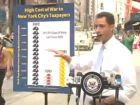
The ongoing wars in Iraq and Afghanistan are taking a financial toll on city taxpayers, according to a study released Monday by Representative Anthony Weiner.The study finds the city is owed more than $65 million in salary reimbursements for its workers deployed overseas.
According to the report, more than 2,000 city employees have taken military leave since September 11, 2001.
That number includes nearly 1,200 NYPD officers and 251 City firefighters.
The city has paid more than $123 million to fill the salary gaps between those first responders' civilian pay and military pay, which can be much less than what officers and firefighters typically earn.
"While it is important that we honor the patriotism of those that go to serve overseas, we should realize that for every police officer that is off the streets of New York City patrolling the streets of Fallujah or Baghdad, New York City taxpayers are footing the bill," said Weiner.
Weiner has introduced a new bill in the House that would provide $40 billion in federal aid to reimburse cities that incur costs when first responders are called to active duty.
NY Sun - Weiner: Reimburse Cities for Employees Deployed to War By Anna Phillips
A newly released study by Rep. Anthony Weiner, a likely candidate for mayor in 2009, is calling on the federal government to reimburse New York City for the millions of dollars it has spent paying city employees who are serving in Iraq.
The report, "Taking a Toll: The Cost of War on New York City," states that police officers, firefighters, and other civil servants who are paid less by the military than by the city continue to receive their larger city salaries and are supposed to send their smaller, military-issued checks to City Hall. But they often don't, and have cost the city $65.6 million since September 11, 2001 — "a historic loss of revenue," according to Mr. Weiner.He has proposed that city employees be required to send the city these refunds and that the federal government give a total of $40 billion to certain cities and states that have suffered financially because their police and firefighters have been sent to Iraq.
The deployment of civil servants overseas has especially affected the city's police department, according to the study. Of the department's 38,000 employees, 281 are currently deployed overseas.
"Last month, the NYPD chose to end its policy of guarding the entrances to subway tunnels under the East River. Why? Because the cost of paying officers overtime was too high — in large part because so many members of New York's finest are on duty in Iraq," the study says.
A police department spokesman, Assistant Chief Michael Collins, said no such decision had been made and that officers are currently guarding the tunnels. "The present coverage hasn't changed in two years and that has nothing to do with anyone serving overseas," he said.
The report compiled by Mr. Weiner's office states that in the last seven years, New York has lost nearly 700,000 workdays as a result of city employees being deployed overseas.
"While it is important that we honor the patriotism of those who go to serve overseas, we should realize that for every police officer that is off the streets here in New York City patrolling the streets of Fallujah or Baghdad, taxpayers are footing the bill," Mr. Weiner said at a news conference yesterday.
Commissioner Raymond Kelly "has not seen the report, but he would not be against reimbursements for the officers now serving in the Armed Forces," Mr. Collins said.
Metro - Weiner Eyes Federal Cash for Soldiers by S. Spencer ScottCity municipal employees have missed nearly 700,000 days of work on military deployment in Iraq and Afghanistan, a report released yesterday said.
Since Sept. 11, 2001, 1,191 police officers and 251
firefighters have been called from their posts to serve in National Guard and Reserve units overseas. The report, released by the office of Congressman Anthony D. Weiner (D – Brooklyn & Queens), noted that 488 city workers are currently on military leave, including 288 employees from the NYPD and 59 from the FDNY.
In addition to the loss of what Weiner called, “boots on the ground,” the report highlighted the $65 million that overseas deployment of municipal workers has cost New York City taxpayers.
The hefty price tag is tied to a program where the city makes up the difference between a worker’s city salary and typically lower military pay.
Weiner has introduced a revenue sharing bill to provide $40 billion in federal aid to municipalities incurring costs when first responders are called to active duty.
NY Post - Reservistss' Duty Costs City $65M by Rebecca Rosenberg
Representative Weiner Presenting His Case to the Media in Times Square
More than 2,000 city workers have been called up to serve in Iraq or Afghanistan since 9/11, costing the city $65 million, Rep. Anthony Weiner said yesterday.
When municipal workers who are military reservists are called up for active duty, the city makes up the difference in salary.
Since 2001, city workers on military leave missed a total of 700,000 days of work, said Weiner (D-Brooklyn/Queens).
"For every police officer taken off the streets of New York to serve in Fallujah, New York taxpayers are footing the bill," he said.
He proposed a $40 billion federal revenue-sharing bill that would include aid for US cities that lose manpower due to military leaves.
Some city 1,191 cops and 251 firefighters are among the 2,082 municipal workers have been called up since 2001, Weiner said.
Currently there are 488 city workers on military leave.
"It's time that the military reimburse New York for its sacrifice," Weiner said.
Gothamist - Weiner Wants Reimbursement for War Costs By Jen Chung
Congressman Anthony Weiner sounded the call for cities to be reimbursed for employees fighting in the Iraq War. Like he did last year, Weiner cites the fact that civil servants, like cops and firefighters, still get paid by the city when their military salaries are less. And since many don't send their military salaries to the city, Weiner says NYC has lost "$65.6 million since September 11, 2001," per the Sun. Weiner said, "While it is important that we honor the patriotism of those who go to serve overseas, we should realize that for every police officer that is off the streets here in New York City patrolling the streets of Fallujah or Baghdad, taxpayers are footing the bill." More info here at Weiner's website.
Tuesday, July 1, 2008
High Test Scores, and Criticism, Follow a South Bronx Principal by Elizabeth Green -- The New York Sun
A South Bronx elementary school that adopted the motto "The Best School in the Universe" on the strength of soaring tests scores is being investigated for allegations that teachers helped students cheat on state tests.
Several students who attended P.S. 48 said last week that teachers would examine their answers during official test administration periods and point out mistakes and how to correct them."They would give you the answers on the state tests," a graduate of P.S. 48, who is now in seventh grade, said. "You'd say, 'I need help,' and then they'd tell you what the answer was."
The Department of Education is also investigating cheating allegations at a nearby school, M.S. 201, which this year was taken over by P.S. 48's former principal, John Hughes.
Mr. Hughes moved to the middle school after running P.S. 48, to great acclaim. He told the Web site InsideSchools.org that he oversaw a 30-point jump on a math test in 2004, and that year Chancellor Joel Klein spoke at the school's graduation — reportedly while wearing a "Best School in the Universe" T-shirt.
The test scores subsequently oscillated, but the general upward trend won Mr. Hughes favorable profiles in the New York Times and on PBS, and he has developed a good rapport with a teacher-recruitment nonprofit, Teach For America.
In his first year at M.S. 201, scores have also shot up; the percentage of students passing math tests this year jumped by 17 points, and the percentage passing reading increased by nine points. (Citywide, scores rose by nine points in math and seven points in reading.)
Yet Mr. Hughes has butted heads with many of the teachers at M.S. 201, many of whom have not been invited to return next year when the school is restructured.
Some of those teachers said in interviews that they fear Mr. Hughes is importing a culture of cheating to their school.
In a recent letter to the Department of Education, a group of teachers reported that Mr. Hughes asked several teachers to help students during the state tests.
One teacher, Sandra Ameny, who came to M.S. 201 through Teach For America, said Mr. Hughes asked her to help her students on the math test, but that she refused.
"He asked me to guide my students to the right answers during the test, and I said that's helping them; I'm not supposed to do that. And he said, 'Well, just guide them towards the right answer,'" Ms. Ameny said.
She added: "He basically said during the exam that I should go over close to them, and for example if they mark 'D' and 'D' is not the right answer, tell them, you know, 'That's not the right answer, try something else,' and just keep guiding them until they get the right answer."
Ms. Ameny said that when she refused to follow his instructions, Mr. Hughes retaliated against her, making her working conditions miserable.
She said Teach For America has released her from its regular two-year commitment.
Reached via telephone last week, Mr. Hughes said he had no comment.
The executive director of Teach For America's New York City branch, Jemina Bernard, would not comment on Ms. Ameny's situation, but she said the group is maintaining its relationship with Mr. Hughes.
"Principal Hughes is a strong partner. We continue to work with him. We have several corps members at the school, and we look forward to working with him and our over 300 schools throughout the city to place our incoming corps," Ms. Bernard said.
Across the country, as standardized tests have become more important to schools — determining everything from whether schools close to teachers' pay — cases of cheating have become increasingly apparent. In Texas, a newspaper analysis by the Dallas Morning News last year found that more than 50,000 student test scores showed evidence of cheating.
In New York, the investigations of the South Bronx schools are among at least a handful of their kind. The Department of Education is also investigating a charter school inside its headquarters building after an allegation that an administrator violated rules by taking home state tests and possibly tampering with them.
The allegations do not always hold up on inspection; last year, a city investigator cleared the names of Brooklyn administrators who had been accused of cheating, saying the charges were brought unfairly by a teacher who had received an unsatisfactory rating.
A spokesman for the city teachers union, Ron Davis, said the union has observed other cases similar to those in the South Bronx, with teachers saying their principals are pressuring them to cheat.
"We've seen too many examples of principals pressuring teachers to help students cheat," the union president, Randi Weingarten, said in a statement. "We must allow zero tolerance for this kind of behavior by principals, and we must insist upon immunity for educators who come forward to report it."
Several staff members at M.S. 201 said they have long suspected cheating went on at P.S. 48. The school feeds its graduates into M.S. 201, and they said students from that school often come unprepared — despite having high test scores.
State tests in New York are graded on a scale of 1 to 4, with 4 being the highest score. Teachers said that while many children would leave P.S. 48 having scored at a level 3 or 4, they would arrive with skills well below grade level.
"These kids didn't know how to write, they didn't know how to add," a math teacher at M.S. 201 who is leaving the school, Elizabeth Cano, said. "How could they be getting level 4?"
Ms. Cano said the discrepancy would be clearest when the teachers gave pre-tests in the first week of school. "They used to all get a level 1," she said.
A sixth-grader at M.S. 201. said that a teacher once looked over his shoulder and said, "Ooh, is that right? Is that the right answer?" encouraging him to erase and try again.
Meanwhile, 11 of 12 P.S. 48 graduates interviewed last week said they were coached during the state tests.
They said that teachers would look over their shoulders and instruct them to try again and again until they got answers right.
"They'd be like, 'Is that the right answer?' — until they make sure it's right," a sixth-grader said.
"When I was at 48, I never went to class, and I still passed the test," a seventh-grader said. "If you go to graduation, you pass."
Higher test scores could pay off for M.S. 201's teachers this year. The school is one of about 200 participating in a trial project to give teachers bonuses if their students perform well on state tests.
The bonuses average $3,000 a teacher.
Friday, June 20, 2008
Protesters Target School Budget Cuts - The New York Sun
With negotiations over Mayor Bloomberg's proposed school budget cuts locked in a stalemate, more than 1,000 public school students, parents, teachers, and principals marched around City Hall Park yesterday to urge Mr. Bloomberg to refrain from cutting their budgets.
One of the largest contingents was a group of students at the prestigious Townsend Harris High School in Queens, which is slated to receive one of the largest cuts in the city.
The Townsend Harris students wore matching green T-shirts and created their own chant: "Not the Budgets — Cut the Crap."
The Bloomberg administration is saying that the larger budget cuts at schools such as Townsend Harris could be drastically reduced if Albany lawmakers loosened restrictions on a pot of state money intended for poor-performing and struggling schools. But Governor Paterson and the Assembly speaker, Sheldon Silver, are showing resistance to that idea, and the City Council speaker, Christine Quinn, is saying schools should be completely insulated from cuts.
The Townsend Harris students said they are most concerned about after-school programs.
A sophomore on the swim team, Jenny Zhang, said she is worried about the team's three-year run as city champions. "We're creating a dynasty here, and they're cutting our budgets," Miss Zhang said.
"What's bubbling up is all of the anger because the cuts are starting to hit schools," the teachers union president, Randi Weingarten, said.
"Somebody just said to me, 'Why don't we have a strike in September if the budgets aren't restored?'" she added. She did not say whether she would consider the idea.
Ms. Weingarten, along with the leader of the principals union, Ernest Logan, has been working with officials at the City Council and the education department to resolve the issue, but talks are at a stalemate.
School officials said the city is keeping its promise to public schools. By 2011, they said, city spending on public schools will have increased by $6.3 billion since 2002.
Saturday, June 14, 2008
'Soviet-Style' Tactics Said To Be Used To Help Yanks by Peter Kiefer - The New York Sun
All three projects have already received hundreds of millions of dollars in tax-exempt bond financing, but the city and state are seeking more, which has angered a number of watchdog groups and state legislators.
"These decisions are being made in secret in these Soviet-style meetings and it is outrageous," the chairman of the Assembly's Committee on Corporations, Authorities and Commissions, Richard Brodsky, said. On Wednesday, it was disclosed that the Yankees had approached the city about seeking an additional $350 million in tax-exempt financing.
"The city is working in Washington to seek relief on the IRS regulations," the president of the New York City Economic Development Corp., Seth Pinsky, said in an interview yesterday.
Since the 1986 Tax Reform Act was enacted during the Reagan administration, private development companies have faced tight restrictions when attempting to get access to tax-exempt bonds for sports facilities.
In 2006, with the support of the Bloomberg administration, the Yankees and the Mets were able to circumvent the federal regulation by employing a complex accounting technique that allows the bond debt to be paid by the city and state with money received from the private developer, known as payments in lieu of taxes.
Now the IRS is considering closing the loophole for future projects, a move city officials say would hinder development. They say that more private development projects should be able to get the benefits of tax-exempt bonding.
"They have taken away a tool that would be useful for a number of New York City development projects. Ideally we would like the ability to use this financing tool more broadly," Mr. Pinsky said.
The bonds, exempt from city, state, and federal taxes, are said to have an interest rate of about 25% below taxable bonds. According to the city's Independent Budget Office, the construction of the new Yankee stadium has already received $920 million in tax-exempt bond financing, resulting in savings of $190 million in tax payments for the Yankees.
Taxpayers are ultimately forced to pick up part of that tab. According to the Independent Budget Office, the city's treasury lost $10 million in taxes, the state $18 million, and the federal government $200 million.
City officials see the bonds as a relatively inexpensive way to subsidize development, specifically because the federal government picks up a greater share of the tab.
"What is advantageous is that the vast majority is paid for by federal taxes as a result the city loses a small amount of money," Mr. Pinsky said. "We are leveraging a small amount of city and state funds to get a substantial amount of federal assistance."
Bettina Damiani, a project director at a government watchdog group, Good Jobs New York, questions why the city would seek a break from Washington on sports stadium projects when there are so many other pressing infrastructure problems in the city that need additional financing.
"Doesn't the mayor have better things to do than be asking Washington for money to help the Yankees?" she said.
The writer of the book "Field of Schemes," Neil deMause, says the accounting trick used for the Yankees and Mets stadiums counters the intent of the 1986 Tax Reform Act. "At a certain point, this is a huge way for the cities to raid the federal treasury, and let everybody borrow tax exempt money," he said.
Mr. Pinsky said all the funds had been cleared by the IRS. He also said that the developer Forest City Ratner Co. had expressed interest to the city about seeking additional tax-exempt funding, but that the request was being handled by the state.
"We are not making an end-run around anyone," Mr. Pinsky said. "The IRS issued a letter saying what we are doing was perfectly legal."
A spokeswoman for the Yankees, Alice McGillion, said it was always the intent to be seeking additional tax-exempt funding, but she said the exact sum that would be sought had not been determined.
While in Washington yesterday, Mayor Bloomberg was asked about the possibility of additional subsidies for Yankee Stadium.
"With the current regulations, we couldn't give out any more interest-subsidized bonds. So it's an interesting thing. We'll talk to them certainly, as we'd talk to anyone building anything large in the city. But I think it's premature. We would like to see them do it without any more assistance, and whether they can do that or not, I don't know," he said.
Photo courtesy of MLB Snagging Baseball Blog...
Friday, May 30, 2008
Proposed Queens Police Station Is Criticized as 'Land Grab' by Benjamin Sarlin - The New York Sun
A proposed police station in Queens is facing opposition from a parks activist who says the plan would appropriate parkland illegally and requires the approval of the state Legislature to be built.
The founder of NYC Parks Advocates, Geoffrey Croft, is calling the 110th Police Precinct, which Police Commissioner Raymond Kelly proposed be built in Flushing Meadows-Corona Park, a "land grab."
"It's not like they're putting in a designated precinct for the park like in Central Park. There are no guarantees that those cops would be patrolling the park," Mr. Croft said in an interview.
Mr. Kelly, who testified at a police budget hearing at City Hall yesterday, said the new building is needed to replace the current structure on 43rd Avenue. The Parks Department is reviewing the proposed precinct location, he said.
Council Member Peter Vallone Jr., who represents parts of Queens and is chairman of the City Council's Public Safety Committee, said the plan for a new precinct in the park is "welcome news."
"The crime rate there is higher than any park outside Central Park, so it makes sense," Mr. Vallone said. Last summer, 43 crimes were recorded in Flushing Meadows-Corona Park, second only to Central Park's 90, according to a report by the police department.
While generally supportive of the precinct, Mr. Vallone described Mr. Croft's objections as "legitimate issues" that need to be addressed before the precinct's location is chosen. "It's a tricky task because you don't want to take away parkland," he said.
Mr. Croft is currently a plaintiff in a lawsuit against the city to prevent the construction of a proposed restaurant in Union Square Park.
Wednesday, May 21, 2008
Delayed Education Budget Heightens Cuts Speculation - by Elizabeth Green - The New York Sun
Public school principals expected that they would receive their budgets for the next school year a week ago, but the Department of Education has not delivered any news, and it is not expected to do so until next week — a silence that is leaving open the possibility that the Bloomberg administration could cut a deal with critics demanding more funding for education.
Mayor Bloomberg's proposed budget cut projected increases to schools along with every other agency.
Schools Chancellor Joel Klein predicted that would mean more than $300 million in program cuts, and principals said they have been preparing to cut their budgets by about 5%, or thousands of dollars.
Principals have been told that they will not receive final budgets for another week, a union official who is a Brooklyn principal, Brian de Vale, said.
The delay could be a result of the complexity of divvying up funding, given restrictions from the state on where a certain pot, known as Contracts for Excellence funds, should go.
But it is also raising hopes that the Bloomberg administration may move to insulate schools from the rough economy.
Mounting pressure from the City Council could make such a compromise necessary. Forty-six members of the council have signed a resolution opposing cuts to the classroom proposed by Council Member Bill de Blasio of Brooklyn.
Yesterday the speaker of the City Council, Christine Quinn, called cuts to the classroom "totally unacceptable." Ms. Quinn also offered a blueprint for a compromise, suggesting that the administration find money to restore classroom cuts by shaving from expensive contracts.
A spokesman for the mayor, Stuart Loeser, said of Ms. Quinn's speech, "These proposals are things we'll negotiate with the council through the budget process."
The president of the Partnership for New York City, Kathryn Wylde, a regular ally of the Bloomberg administration who represents the business community, said the administration should consider Ms. Quinn's advice. "I've never seen a government agency that didn't lose money in the procurement process that they could recapture," Ms. Wylde said.
Ms. Quinn joins a group of critics that have been holding regular rallies, airing television and radio ads, and handing out fliers to protest budget cuts.
The president of the teachers union, Randi Weingarten, yesterday applauded Ms. Quinn's step toward joining the group. "The council is really stepping up," she said.
Pressure also has come from Albany, where lawmakers including Assembly Speaker Sheldon Silver say the city is defaulting on a promise to increase funding that Albany kept.
School officials point out that since 2002 the city has actually increased its school spending by more than the state; the city's increase was $4.6 billion, or 79%, compared to the state's increase of $3.1 billion or 55%.
In her speech, Ms. Quinn pointed out that $3 billion of the Department of Education's more than $7 billion budget goes to contracts.
More than $1 billion of the pot goes to transportation contracts, which are receiving extra scrutiny after a federal indictment charged four Department of Education employees with accepting bribes from bus companies.
School officials said 43% of contracts are impossible to cut, such as payments to private schools for special education services the public system cannot provide.
Tax increases on the wealthy, such as a so-called millionaire's tax proposed by Democratic Assembly members, could be another way to increase revenue for schools.
Ms. Quinn said yesterday that given gloomy economic forecasts for the 2010 budget, she "would not take off the table" a proposal by Democratic Assembly members to raise income taxes on those making $1 million a year.
The speaker also has supported a planned property tax cut and $400 tax rebate for this budget season. But she said yesterday she would not rule out eliminating those tax breaks in 2010.
Tuesday, March 18, 2008
Education Panel Extends Ban On School Social Promotion by Elizabeth Green - The New York Sun
Middle-school students will have to pass two tests and four core subjects next year before they can move on to high school, under a new policy approved last night despite objections from two borough presidents and a crowd of rowdy parents who said they spoke on behalf of 5,000 city residents.
Mayor Bloomberg proposed the policy in his State of the City address in January as a way to extend his ban on so-called social promotion, but the Panel for Education Policy had to approve it before it could become official.
The group, which has not vetoed a mayoral plan since it was created to replace the Board of Education in 2002, voted 11–1 to pass the policy last night.
The Manhattan president's representative, Patrick Sullivan, voted against the plan. The representative of President Adolfo Carrion of the Bronx originally proposed delaying the vote, saying the panel had not had enough time to review the decision. He then appeared to oppose the plan, but quickly changed his vote to a yes, citing a misunderstanding. The other 10 members, eight people appointed by Mr. Bloomberg and two appointed by the presidents of Staten Island and Brooklyn, voted for the plan. (The president of Queens currently has no appointee on the panel.)
The schools chancellor, Joel Klein, applauded the decision. He cited data on previously installed retention policies for third-, fifth-, and seventh-graders, which he said show retention helps students improve.
Mr. Sullivan called that data "statistical malpractice," asking: "If these programs were so effective, why do we have 18,000 children in eighth grade you are proposing to hold back?" He referred to the number of eighth-graders the city estimates would have been affected by the retention policy had it been in place last year.
About 85 community members who had filed into the Department of Education headquarters at Tweed Courthouse to protest the policy booed and chanted against the vote, creating such a disruption that Mr. Klein decided to adjourn the meeting prematurely.
The group, organized by the Coalition for Educational Justice, presented Mr. Klein with 5,000 ballots in support of its position, which is that retaining eighth-graders who do not pass standardized tests does nothing to help them succeed, and indeed could move them to drop out of school. Speaking to reporters later, Mr. Klein said he believes the new policy has "widespread support throughout the city." "There's always going to be a small group of people who don't like the policy and feel the need to express it," he said
Thursday, March 6, 2008
Fine Is Levied for Nepotism by Queens Principal by Sarah Garland - The New York Sun
A man accused of using corporal punishment and intimidating a teacher while serving as principal of a Queens middle school has admitted new charges of nepotism and bucking the city's competitive bidding process, according to documents released by the city yesterday.
The city's Conflict of Interest Board found that Anthony Aldorasi, who headed I.S. 141, helped his sister get a job with a tutoring company that provides services to the Department of Education. He also awarded a contract for electrical repairs at the school to one of his tenants in a private building that he owns, without going through the city contracting process, according to the documents. Mr. Aldorasi admitted the latest charges and agreed to pay fines totaling $4,500, according to the papers.
He was fined $6,000 earlier in the school year in a separate investigation into charges that he used corporal punishment against his students and intimidated a teacher, a spokeswoman for the Department of Education, Marge Feinberg, said.
In that case, the Department of Education sought his termination. As a tenured principal who has served as an educator in District 30 for 26 years and as a principal at I.S. 141 since 2001, he was able to appeal the charges and keep his job and his $136,000 salary.
The arbitration decision also required that Mr. Aldorasi be offered a principal assignment in District 30. Ms. Feinberg said the education department decided yesterday to reassign Mr. Aldorasi to the Queens Integrated Service Center temporarily, where he will perform administrative duties.
She said that, under the agreement Mr. Aldorasi signed with the Conflict of Interest Board, the latest charges could not be held against him. Mr. Aldorasi could not be reached for comment.
Tuesday, March 4, 2008
Mayor Defends Donation To Senate Republicans - The New York Sun
Mayor Bloomberg is defending a donation he made to state Senate Republicans and implying that he would give money to anyone who supports the city's agenda in Albany.
"I've said repeatedly, I will help those who help us," Mr. Bloomberg said yesterday in Florida, speaking to reporters attending a conference of the organization he founded, Mayors Against Illegal Guns. "They have stood up for the city a number of times — when we needed to have a voice in Albany and we didn't have that voice from the Assembly or from the governor, whether it was the last governor or this governor. Now sometimes the Assembly and this governor and the last governor are with us and we want more of that. And I'd like to encourage that," he said.
Mr. Bloomberg, who left the Republican Party in June, took issue with the idea that his donation of $500,000 to Senate Republicans, first reported in the New York Times, would hurt his agenda in Albany, particularly congestion pricing. "You are saying that those decisions are made based on politics rather than what's best for the city," he said.
Monday, February 18, 2008
Why I Resigned - February 15, 2008 - The New York Sun
Read original...
Photo - nyla.org
A story on Wednesday in the The New York Sun reported that I resigned from the editorial board of Education Next. I resigned because Education Next published a deeply flawed account of Mayor Bloomberg's school reforms. I resigned with regret because I admire Education Next. I have found it to be the most consistently interesting and lively publication about American education currently available.
That is all the more reason why I was surprised to read Peter Meyer's article, "New York City's Education Battles," which is a thinly veiled puff piece for reforms that have been both costly and ineffectual. As a member of the editorial board of Education Next and as someone who has written extensively about education in New York City, I was stunned that I did not see the article until after it was published.
The article treats school reform in New York City as a matter of conflicting opinions, of "he-said, she-said," rather than as a matter of verifiable fact, even when facts are available.
For example, Mr. Meyer says that the New York Times reported "no significant progress in reading and math" between 2003 and 2007 for city students on the federal test called the National Assessment of Educational Progress and "little narrowing of the achievement gap." Mr. Meyer then quotes a hedge fund manager and blogger, Whitney Tilson, who said that the Times' story was "lousy" and that city students actually made gains in three of the four measures.
But the NAEP scores are not a matter of opinion; the facts can be easily checked — google NAEP TUDA 2007 and look at pages 50-51. Anyone who does check will learn quickly that New York City students made no statistically significant gains between 2003 and 2007 in fourth-grade reading, eighth-grade reading, or eighth-grade math. There were no significant gains for black students, white students, Hispanic students, Asian students, or lower-income students. New York City was the only city (of eleven tested) where eighth-grade reading scores declined for black, Hispanic, and lower-income students, and the achievement gap grew. Only in fourth-grade math did city students make statistically significant gains. If facts matter, Mr. Tilson's opinion is wrong.
Despite these dismal outcomes, writes Mr. Meyer, Mayor Bloomberg and Chancellor Klein "defended the results." Mr. Klein said they showed "good progress." But at the same time, Mr. Meyer says, the mayor and chancellor were "sobered." Why would they be sobered if they thought the results showed "good progress?" Certainly they were not chastened enough to throw out the failed reading program that they had mandated citywide in 2003 nor did they open an inquiry to find out why eighth-grade students made no significant gains in math.
The two graphs accompanying the article were even more misleading than the text. One shows state and city test scores in math and reading between 2001 and 2007. The text on this graph says, "Both Mayor Bloomberg and his critics seek to prove their points by comparing city and state trends in student test-score performance. Each side picks certain tests and certain points in time to make their claims and counterclaims."
But it is not simply a matter of opinion about when the Bloomberg school reforms began. The state Legislature passed the mayoral control law in June 2002. The mayor and chancellor spent the fall of 2002 considering reform proposals. In January 2003, they announced what they planned to do the following September.
At the very time that they made their announcement, New York City students in fourth and eighth grades were taking state tests. When the scores were released in May (for reading) and October (for math), there was a large jump in the city's fourth-grade scores, with double-digit gains in some of the poorest neighborhoods.
Others were jubilant about the good news, but newspaper reports said Chancellor Klein's reaction was "muted." He knew that these were not his gains since his new programs would not be implemented until September 2003. The graph in the article, however, leaves it up to the reader to decide whether Messrs. Bloomberg and Klein should get credit for the test score increases in the two years from 2001 to 2003, before their programs started.
Another graph shows a closing of the achievement gap between black students in New York City and black students in New York State. This is an irrelevant factoid. The term "achievement gap" invariably refers to score differences between black/Hispanic students on one hand, and white/Asian students on the other. Thus, this graph celebrates the closing of a gap that is of no significance, while ignoring the achievement gap that is of greatest concern.
I admire Mayor Bloomberg but I do not admire what he has done to the public schools. I hope that the state Legislature, when it reconsiders public school governance next year, abolishes the bumbling, tyrannical Department of Education and restores an independent Board of Education, appointed by the mayor.
The school system needs checks and balances. It needs a regular, independent audit of graduation rates and test scores. It needs a leadership in which education decisions are made by educators. Such changes won't solve all of our schools' problems, but they will end the pointless turmoil of the past five years, provide honest information about academic progress, and reestablish the role of the public in public education.
Ms. Ravitch, a research professor of education at New York University, is a senior fellow at the Brookings Institution and the Hoover Institution. She also is the author of "The Great School Wars," a history of New York City's public schools.
Wednesday, September 26, 2007
7Online.com: Announcement made on 'No child Left Behind' Act
Watch video report with Art McFarland...
Announcement made on 'No child Left Behind' Act
By Phil Lipof
(New York-WABC, Sep. 26, 2007) - From the U.N. to school. President Bush is touting new national test scores today. He says the results prove his signature education law, the "No Child Left Behind" act, is working and deserves renewal by Congress.
Education reporter Art Mcfarland is live in Midtown with that story.
The Brode prize, handed out last week makes it no coincidence that the president used a New York City appearance to talk about changes that he'd like to see changes in the law called "No Child Left Behind".
As he did so, he gave a lot of credit to New York for academic achievement.
The president was joined by Mayor Bloomberg, Schools Chancellor Joel Klein, First Lady Laura Bush and Secretary of Education Margaret Spellings. Also, students from the high achieving P.S. 76 in the Bronx were also in attendance.
Mr. Bush made a strong call for Congress to reauthorize no child left behind and he also recommended strengthening the law with measures that include:
As he made those proposal, the president said other urban school districts have something to learn from New York.
"The city tackled a challenges of underperforming schools, in such a way that has become a model for urban schools. This achievement is a hopeful sign for other school districts in across America. If New York City can do it, you can do it," said Bush.
Later on today on Eyewitness News at 5:00 p.m. we will have reaction to the president's visit from the mayor and the chancellor, as well as the kids from P.S. 76. in the Bronx.
(Copyright 2007 WABC-TV)
Bush, Klein Meet On School Peformance - Videos - WNBC
- Bush, Klein Meet On School Peformance
- Education Policy
- A day after addressing the U.N. General Assembly, President Bush meets with Schools Chancellor Joel Klein.
Bush Singles Out City for Praise on Education Gains by Sarah Garland...
President Bush met with Mayor Bloomberg and Chancellor Joel Klein in New York this morning to congratulate them on progress in the city's schools.
It was the second time in six months that Mr. Bush, who is in town to address the U.N. General Assembly, called on Messrs. Bloomberg and Klein to praise them for their efforts to reorganize the city's education system.
He praised Mr. Bloomberg for "moving aside bureaucracy."
"The city tackled the challenges of underperforming schools in such a way that it's become a model for urban schools. This achievement is a hopeful sign for other school districts across America," Mr. Bush said during a news conference at the Waldorf Astoria Hotel. "New York City can do it, you can do it," he said.
Earlier, the president met with the principal and a group of fourth and fifth graders from P.S. 76 in the Bronx.
The president's visit comes a week after the city's school district won a prestigious national education award, the Broad Prize, and a day after state scores on national reading and English tests were released. New York State showed some declines and some improvements, including a narrowing of the gap in performance between minority and white students.
The city's recent progress in closing that gap was part of the reason it was awarded the Broad Prize. Mr. Bush suggested that other school districts "e-mail" the New York City Department of Education to find out how it was done.
The last time Mr. Bush met with the mayor and the chancellor, in April, he spoke at a charter school in Harlem.
The president today reiterated his call for the passage of the No Child Left Behind Act as Congress considers reauthorizing the law this year. He voiced support for several major changes to the law, including more flexibility for school districts and incentive payments for teachers who raise achievement in low-performing schools.
[where: 52 chambers street, new york ny 10007]
Wednesday, May 2, 2007
NY Sun: Bloomberg Unveils Queens Development Plans...by Karen Matthews...
NEW YORK (AP) - Mayor Bloomberg announced a plan Tuesday to turn 60 acres of junkyards and auto-parts shops next to the construction site of the New York Mets' new stadium into a new neighborhood of homes, shops, offices and entertainment.
"We believe that out of these ashes can rise New York City's next great neighborhood, a dynamic center of life, energy and economic activity and a model for sustainability and environmental stewardship," Mr. Bloomberg said. "After a century of blight and neglect, the future of this area is very bright indeed."
The master plan for the area known as Willets Point, or the Iron Triangle, would create a new neighborhood also including a school, a 700-room hotel and a 400,000-square-foot convention center.
Over the next decade the plan would replace 225 auto shops and 25 industrial and manufacturing businesses with 5,500 housing units, 1.7 million square feet of retail and entertainment and 500,000 square feet of office space.
Mr. Bloomberg's announcement at the nearby Queens Museum of Art is one step in a long process of redeveloping the site, due east of where the Mets' new Citifield is scheduled to open in 2009.
The area is now an eyesore that Mr. Bloomberg called "one of the bleakest parts of this borough." The entire site is polluted from years of petroleum spills and will have to be cleaned up before it can be redeveloped. Garbage and broken-down chassis are piled high, and there are no sewers. Many of the auto shops are low-rent chop shops in cinderblock sheds.
Saturday, April 7, 2007
Dick Cheney for President..?
Just when I thought I had heard everything, the NY Sun today endorsed Vice President Cheney for the 2008 Republican nomination:

Cheney's Chance, NY Sun Editorial, April 4, 2007
“For all the talk about potential candidates who haven't entered the 2008 presidential race — from Mayor Bloomberg to Vice President Gore to Senator Thompson and Speaker Gingrich — the one that who would bring the most to the race is Vice President Cheney”
“Mr. Cheney has virtues as a candidate in his own right. He has foreign policy experience by virtue of having served as defense secretary, and he has economic policy experience, having served as a leading tax-cutter while a member of the House of Representatives. His wife, Lynne, would be an asset to the ticket in her own right, a point made by Kathryn Jean Lopez in a post on the topic at National Review Online back in February. By our rights, Lynne Cheney would make one of the greatest First Ladies in history. Mr. Cheney, in any event, is more than
four years younger than Mr. McCain, and, if elected, would be 67 years old at his inauguration, younger than Reagan was when he took office. His health, while a topic of frequent speculation, hasn't interfered with his service as vice president.”
For a laugh, read the whole editorial here...
Salon.com's Tim Grieve has a different perspective on Cheney running...
Memo to the New York Sun: April Fools' Day was Sunday.
In an editorial dated Wednesday, the Sun said that the not-yet-declared candidate who would "bring the most" to the 2008 presidential race is ... Dick Cheney.
No, really.
Can Cheney's poll numbers really be this low..?
Hat's off to Crooksandliars for the find...